Pathways to TEFL Success in Cambodia


Cambodia provides a compelling environment for aspiring English teachers: a fast-developing economy with increasing requirements for language skills in education, tourism, and business, and a population that is eager to learn. Englisch im Ausland unterrichten is an exciting dream, but with that come practical questions: which certificate do I need to pursue, where can I train effectively, and what are my career options in Cambodia? The right TEFL/TESOL preparation provides a bridge from intention to employment that helps you with structured coursework, supervised teaching practice, and a credible credential that employers recognise across private language schools, international programmes, and online platforms. In a country where English is increasingly seen as a passport to opportunity, quality certification helps you stand out and start with confidence.
This article focuses on reliable, standards-aligned pathways to TEFL success in Cambodia. It explores course types and accreditation, practical training both in-country and online, and typical career trajectories within Cambodian education markets. You will find guidance on how to match courses to your goals, assess accreditation and practicum opportunities, and navigate the local context – cultural, linguistic, and regulatory. The advice places a strong emphasis on alignment with international standards and von Ofqual anerkannt ist awards, as far as possible, so your certificate will carry weight not only in Cambodia but in many other markets as well. Whether you’d like to teach at Phnom Penh’s language schools, work with international schools in Siem Reap, or teach online to Cambodian and global learners, this guide will assist you to set yourself up for success and start your TEFL/TESOL journey on a solid foundation.
Cambodia has a diverse English-teaching market. In urban centres, private language schools, international curricula, and corporate training create demand for teachers who bring both solid grammar knowledge and engaging classroom practice. In rural and provincial communities, teachers who can offer practical communication skills, adaptability, and a willingness to collaborate with local educators are often most highly valued by schools. The country’s education system is undergoing a period of reform and growth with support from UNESCO, World Bank programmes, and national policymakers to improve learning outcomes. Such a changing context further confirms the significance of selecting a reputable TEFL/TESOL programme that provides meaningful practicum, robust assessment, and transferable classroom skills. Training should equip you to teach a wide variety of learners – young and adult students alike – in a range of educational settings.
Pathways to TEFL Success in Cambodia: Courses & Careers
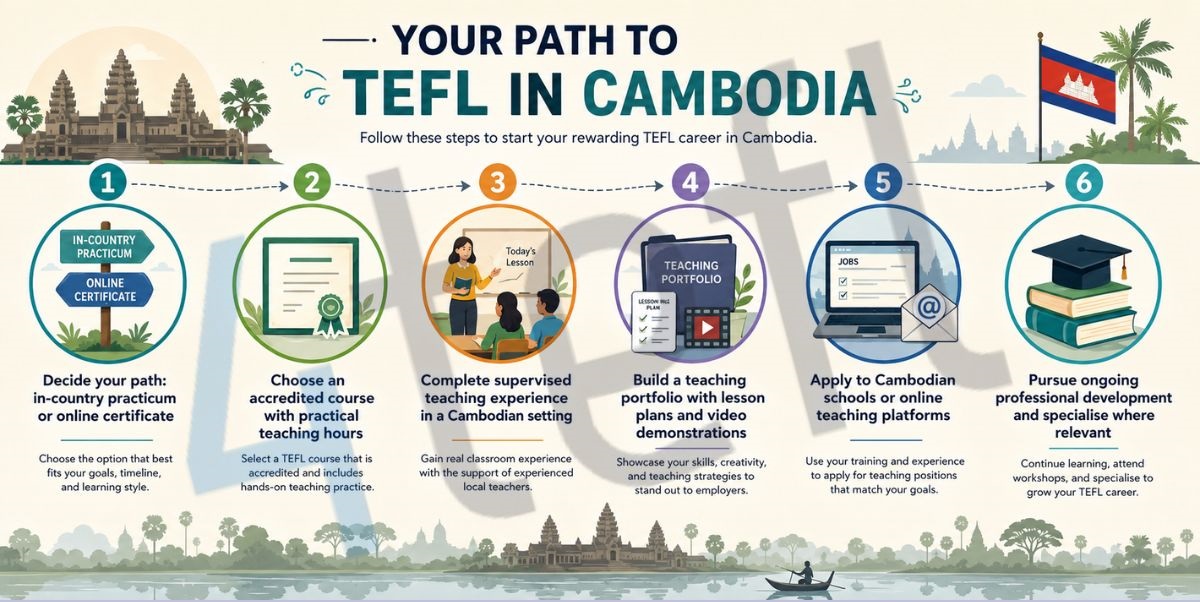
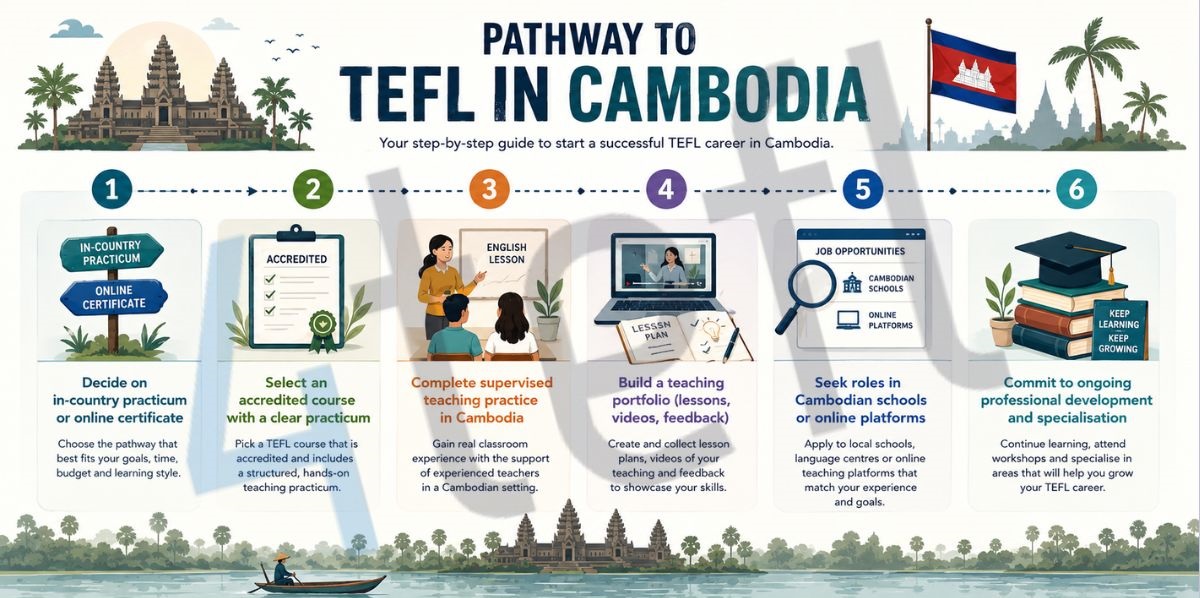
Cambodia’s English classrooms can be accessed via a variety of pathways, all of which offer a different combination of flexibility, cost and experience on the job. Most candidates to these entry-level positions are offered an opportunity to work for a certification, which provides practical teaching in practice, and for positions at the senior level in international schools or teacher leadership, one needs more advanced credentials of CELTA or other well-regarded TEFL/TESOL qualifications, alongside relevant experience. These certificates are primarily in either online, blended or face-to-face formats that will be offered depending on the student for a range between a few weeks up through several months. Where your choice aligns both should be based on your timetable, your budget, and what institutions you want to be a part of – like private language schools, international schools, universities, or online education platforms. In every instance, a course containing a practicum in the authentic environment of a Cambodian classroom offers the most robust preparation for the unique context of the myriad teaching environments found in this country.
Realistic teacher preparation is grounded in practical training. A well-designed programme will integrate theory with classroom practice with supervision, the opportunity to observe experienced teachers, deliver lessons, receive feedback, and work at developing classroom management, assessment and differentiation skills. In-country practicum is most beneficial to those wanting to establish a longer-term presence in Cambodia, as it is an introduction to cultural differences, language interference patterns and the logistics of day in, day out at school, as well as the difficulties in terms of communicating with parents and using available resources. Online or combined programmes broaden access to students beyond urban centres and lower costs, but the most promising alternatives generally involve a supervised practicum in Cambodia or a formal partner programme. A focus on practice helps you to show that a teacher can demonstrate a portfolio of effective practice and a history of how students are progressing – both of which are prized by hiring schools. A strong TEFL/TESOL education plan must, by design and intent, be ‘future-proof’. If certification is sufficient, consider other qualifications you might want to pursue for specialisation (e.g. Young Learners, Wirtschaftsenglisch, Exam Preparation) or further qualifications (Diploma in TESOL or equivalent qualifications to CELTA) to get into a higher-rank role. Seek these programmes that offer jobs and support services, career advice, mock interviews, job placement and career counselling, on-site skills training sessions, along with continued access to teaching resources and networks. An appropriate course selected to this type of course will also give you insight into the Cambodian education environment, assist you to see the Cambodian educational environment and know what types of employers are looking for and what you can work for and how to handle employment expectations, and offer practical assistance to you to keep up with all the real-world realities of your career progress, but will also help you in the local job market and with real-world factors such as moving to a new country and work eligibility.
Accreditation and Standards: TEFL/TESOL in Cambodia
Cambodia’s education system revolves around MOEYS, which marks the limits of public schooling and curriculum. Although rules governing national standards are mandated by MOEYS, most of the teachers from private language schools and international programmes are accepted because of their TEFL/TESOL qualifications, not as national teaching licences. Your certificate needs to be accredited and recognised for employability, especially in international schools and top private centres. When picking a course, check if the awarding body is generally well recognised by employers and if the given course entails a supervised teaching practicum. An international-grade certificate with a leading awarding organisation can go a long way in securing a job, in Cambodia as well as with global teaching institutes too. Apart from certifying facilities, make certain you look for those courses that correspond to CEFR values, have clear standards of practice, assessment and feedback. Your CEFR-related syllabi allow, when applicable to courses, you to facilitate lesson planning that best meets a range of learners’ needs and to monitor progression in a way that is transparent and uniform. Cambridge English exams and other internationally acknowledged bodies (for equivalent assessment in the foreign TEFL/TESOL market) are widely recognised and are commonly accepted by some schools in Cambodia and offer professional certification opportunities. Select, when possible, a course which includes evidence-based teaching notes for practicum supervision, mentoring and evidence-based teaching portfolios. UNESCO highlights high-quality teacher training as a cornerstone of educational improvement, further reinforcing the importance of credible TEFL/TESOL programmes in the profession in line with standards. Quality assurance in TEFL/TESOL should be made by what kind of details a provider has in place: who teaches the course, how the teaching is organised, how feedback is received, and what career paths employers will take once certified. An authoritative course will publish a full course with feedback written by either a mentor or supervisor, and outline a route for ongoing professional development. Check a few employers or a few recruitment sites in Cambodian education to see that your qualification meets international standards. Not all providers will be Ofqual-licensed, but many provide certificate accreditation that is internationally acknowledged by international schools and private language academies. The wider move for global standards regarding English teaching, with backing from either UNESCO or international researchers, makes well-planned accredited TEFL/TESOL programmes in Cambodia appear of value.
Practical Training and Online Teaching in Cambodia
In-country practicum remains a central tenet of the most credible TEFL/TESOL programmes. Practicum elements in these examples commonly consist of observed practice in real classrooms with reflection meetings with a supervisory mentor. And you will also come across language learners of all ages, taking the opportunity to plan, implement and evaluate lessons with guidance. In many Cambodian partner schools, practicum placements are scheduled according to local needs and range from grammar teaching sessions to communicative activities to promote talking and listening. Practicum hands-on learning gives you real-world experience which has nothing but good for you; it’s a testimony to your teaching and it offers tangible evidence of being ready to teach by yourself (which would be an asset to you should you apply for work within private schools, international programmes or NGOs). In Cambodia and internationally, e-teaching, and more especially in the US, has grown very fast; this has also expanded access to English in the country and beyond. Online teachers, for some, can fall into a blended model, teaching in person in Cambodia while teaching remotely for international or local students. Online classes give you the flexibility to plan asynchronous programmes, to operate live sessions across time zones and to manage groups of students at differing levels. The adaptability of online instruction is a draw for travellers, career-changers and those developing a professional profile. Nonetheless, proper Online-Unterricht demands powerful technological foundations, effective management of online classrooms, and course content that requires learners to remain engaged in the digital environment. In practice, many practitioners mix or match them back and forth – face-to-face in-class teaching in Cambodia while tutoring in e-tutors on weekends and at night – which provides for a strong and robust career line. In contemporary English teaching practice, both technology use and pedagogical strategies are at the forefront of the teaching of English in Cambodia. Courses include course work on digital and interactive whiteboard tools, and blended learning to support traditional teaching. You’ll learn to adjust activities for the mixed-ability groups, to make effective use of visual aids and to generate clearly structured lesson sequences. However, there will be greater focus on digital instructional practices and asynchronous tasks when working online, and support for collaboration and feedback. Employability can be enhanced if you are able to demonstrate your adaptability to various classroom scenarios, how well you are able to manage your time and expectations, and the extent to which you display a portfolio that captures your classroom and digital teaching.
Certification and Career Paths with TEFL/TESOL in Cambodia
The number of career options for graduate TEFL/TESOL students within Cambodia is large, comprising private language schools, international schools, universities, and non-governmental organisations. A TEFL/TESOL certificate is the minimum requirement for entry-level positions; international schools and other well-regarded private schools are generally searching for teachers to hold CELTA certification or equivalent, along with established classroom experience. That’s when you have those hours, and the evidence you’ll prove you have made an impact – lesson plans, student progress and reflective practice – to move to roles more responsible in your career (lead teacher, curriculum developer, staff trainer). A route that has specialties (such as Young Learners, Wirtschaftsenglisch, or Exam Preparation) will distinguish you in a crowded space as well as opportunities in urban and regional settings. A deliberate formula for career development in Cambodia combines certification, experience and continuous professional development to create success. Once you have had your first experience of work, write your professional success up with a teaching portfolio consisting of example lesson plans, video demonstrations and supervisor response. This portfolio can be used to progress on your career path and can be used for shifts to head of department for an organisation, teacher trainer or resource developer within your school or educational projects. Aside from official jobs, many teachers move into Online-Unterricht, tutor platforms and freelancing with content written in English for English instruction. The Cambodian market is in need of adaptable, culturally responsive, professional teachers who are looking to do better every day, whether in a classroom or digital space.
Local Context, Culture and Legal Considerations for TEFL in Cambodia
Knowing the local context is an important basis for being a successful teacher in Cambodia. Urban places such as Phnom Penh, Siem Reap, and Sihanoukville offer more opportunities and higher salaries, while rural areas provide unique experiences with different resource levels and community expectations. Relationships are everything in a Cambodian school system – building the confidence of pupils, parents and workmates often takes patience, respect, and a willingness to engage in local customs. Networking with other expatriate teachers and local educators enables you to acclimate quickly and learn about job openings, professional development opportunities, and even culturally responsive teaching practices. Working in Cambodia should be a professional occupation because law plays a big role in a career in teaching. Usually, foreign teachers need to have a work permit and an employer’s sponsorship; visa arrangements are commonly handled through the employing institution. Verify visa and work-permit restrictions prior to accepting a position and ensure the contract clearly states responsibilities for sponsorship, permit renewal, and all associated costs. Because rules are not the same in every district and type of school, potential teachers should look at the contemporary information being shared by government-backed information websites, established education agencies, or official embassy advisories. And beyond mere compliance, social sensitivity – such as learning a few basic Khmer greetings and showing respect for local rituals and school norms – is another step that facilitates smooth integration and positive relationships in classrooms.
Selecting the Right TEFL/TESOL Course in Cambodia
The choice between the appropriate TEFL and TESOL course in Cambodia depends on your purpose, the credibility of the awarding body, and practical outcomes provided by the programme. Determine your goals early: do you prefer teaching in-country, or is Online-Unterricht your immediate aim? If you want to be available and to work at international schools or private schools in Cambodia, then at best some kind of CELTA or other widely recognised qualification with an actual practicum is advisable. For more general teaching experience within a private one, there is good evidence that a 120-hour certificate (along with a considerable practicum component) might work. When choosing providers, pay regard to courses with clear syllabi for transparency, practicum hours, clear practicum windows, and transparent job placement or career support if appropriate. The most suitable course to choose will give you the edge in an increasingly competitive and expanding market. A practical checklist is perfect for comparisons without being bogged down or overwhelmed by each option. Ensure that the programme will involve a supervised practicum in a real classroom setting, ideally in Cambodia or by a Cambodian partner school. Confirm that the certificate has been issued by an internationally recognised awarding body; verify that the course is aligned with CEFR requirements. Be sure you are not without mentors who will support your teaching progress and provide feedback, as well as post-certification guidance such as interview coaching, portfolio development, and access to ongoing professional resources. A table below offers a list of popular types of courses and their characteristics to assist you in making your way around the options. A genuinely compatible course you choose will save you time as you are on track to finding the job you are looking for, and will give you a really high chance of being successful in the job.
Table: TEFL Course Types and Features
| Kurstyp | Typische Dauer | Praktikum | Certification/Accreditation | Ideal für |
| 120-hour online certificate | 4–6 Wochen | Optional | International bodies | Anfänger |
| 120-hour blended | 6–8 Wochen | 6–12 Stunden | CEFR-konformem | Relocating |
| CELTA-equivalent | 4 Wochen | 20–40 Stunden | Cambridge CELTA | Senior roles |
| Specialist certificates | 1–3 weeks | Some | Employer-recognised | Niche contexts |
| Diplom in TESOL | 3–6 Monate | Extended | Higher-level | Leadership |
Autoritative Quellen und Faktenprüfungen (Referenzen)
- UNESCO: Teacher Professional Development and Management – Global insights on quality assurance in teacher training.
- MoEYS: Ministry of Education, Youth and Sport (Cambodia) – Primary portal for national education policies and regulatory frameworks.
- Cambridge Assessment English: Teaching Qualifications – Standards for CELTA and internationally recognised benchmarks.
- Council of Europe: CEFR – The global standard for evaluating language proficiency and teaching goals.
Do I need a TEFL/TESOL certificate to teach in Cambodia?
While some informal teaching opportunities exist, formal TEFL/TESOL certification is typically expected by reputable private language schools and international programmes. A recognised certificate with practicum improves job prospects and contract terms, and it provides you with a verifiable record of teaching competence.
Are online TEFL certificates accepted in Cambodia?
Online certificates can be accepted, particularly if they include a supervised practicum in a partner school or university setting. Employers increasingly value evidence of in-class practice, lesson planning, and assessment skills, which are more robust when paired with practicum.
Was ist der Unterschied zwischen TEFL und TESOL?
TEFL (Teaching English as a Foreign Language) focuses on teaching English to non-native speakers in foreign-language contexts. TESOL (Teaching English to Speakers of Other Languages) is a broader term that covers both TEFL contexts and English-language teaching in English-speaking environments. In practice, many providers use TEFL/TESOL interchangeably, but the key factor is accreditation, practicum, and alignment with international standards.
Wie lange dauert die Zertifizierung?
Durations vary by programme. Short online certificates can be completed in 4–6 weeks, blended courses may take 6–8 weeks, and more intensive programmes (including CELTA-equivalents) can span 4 weeks or more with a substantial practicum. Consider your schedule, budget, and relocation plans when choosing.
What are typical job options in Cambodia?
Common paths include private language schools, international schools, universities or colleges, language centres catering to tourism and business sectors, and online teaching platforms. Some teachers also work with NGOs or education-focused organisations on programme delivery or teacher training. The Cambodian market often rewards practical experience, reliability, and the ability to adapt to local learning contexts.
What visa or work permit do I need?
Most foreign teachers require a work permit and employer sponsorship. Visa processes vary by employer and location; expect your school to assist with the necessary paperwork. Always verify current regulations before accepting an offer and obtain a written contract detailing sponsorship and permit renewal responsibilities.
Is Cambodia safe for teachers?
Cambodia is generally safe for expatriates in major urban centres and tourist areas, with standard travel precautions advised. Like any destination, safety varies by district and activity. Joining reputable schools and familiarising yourself with local customs, transport patterns, and emergency contacts will support a smooth and secure experience.
Are there opportunities in rural areas?
Yes. Rural and provincial schools often welcome qualified teachers who can bring new language experiences and materials into communities that may have fewer resources. Living and teaching in rural settings can be highly rewarding but may require flexibility and a willingness to adapt to different school schedules, facilities, and languages.