Teaching English in Jamaica: A TEFL/TESOL Roadmap


Jamaica occupies a crossroads of culture, language, and opportunity. For aspiring English teachers, that translates into a unique blend of a tropical backdrop, welcoming communities, and a tourism-driven economy that guarantees a demand for English instruction in all kinds of settings.
But figuring out certification, local standards, visa implications, and career trajectories in Jamaica can seem complicated. Prospective teachers frequently question which qualifications will best equip them to teach in Jamaican classrooms, how to secure accreditation, and where to find credible local support. This article provides a clear, research-backed guide to teaching English in Jamaica for TEFL and TESOL certification. With references to reputable sources and practical insights, it guides you on how to select well-qualified courses to study, the Jamaican certification requirements to achieve, and real career options that align with Ofqual and international standards.

Why Jamaica is a Prime Destination for TEFL Careers
English is the official language of instruction and everyday communication in Jamaica, contributing to a high demand for English language instruction for learners of all ages. The country’s focus on literacy, paired with the presence of proficient English speakers in urban and tourist centres, provides a large market for TEFL and TESOL graduates wishing to teach grammar, pronunciation, and communicative skills in settings as diverse as private language schools and universities (UNESCO reports Jamaica’s thriving literacy culture and usage of English in education and daily life).
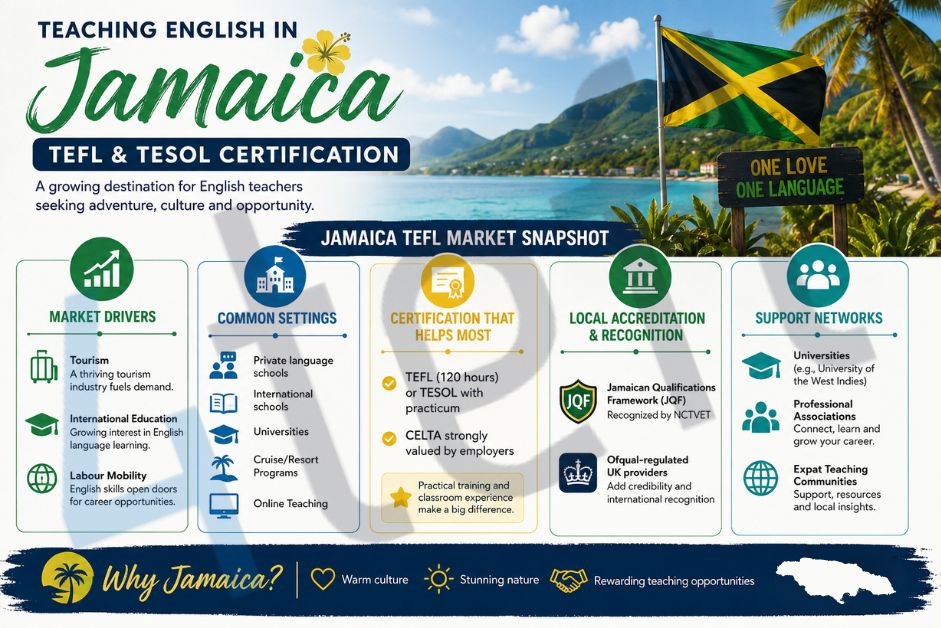
Jamaica’s economy is driven by tourism, international business, and higher education, which creates a demand for English-language professionals to serve locals pursuing higher education, accrediting professionals, and visitors who want to use functional English in their travel and hospitality. This cocktail throws open pathways in quite a few different types of classroom situations, among which are resort-based language programmes, literacy programmes on cruise ships, and educational projects with local communities.
Outside the classroom, there is ample academic and non-academic support for Jamaica’s English-language ecosystem through well-established institutions in Jamaica, as well as an expanding expatriate teaching body and a legislative framework that favours internationally recognised qualifications. A friendly culture and systematic professional development paths in line with global standards of English teaching, coupled with a local culture of teaching, are part of what sets Jamaica apart and make the country a place where TEFL/TESOL practitioners can thrive, while earning qualifications or higher-level credentials further along.
Guiding You Through Jamaica Certification Standards
In Jamaica, a national qualifications framework exists, operating as part of a larger JQF, and is administered by the National Council on Technical and Vocational Education and Training (NCTVET) and tied to the Ministry of Education.
TEFL/TESOL education and training credentials must ensure that they meet local standards and are also comparable to international standards.
It makes sense to verify whether or not a course aligns with the JQF, and whether it carries recognition that Jamaica’s employers and government agencies will accept.
Internationally recognised credentials, e.g. CELTA and TESOL certificates, are considered highly prestigious in Jamaica when they include a supervised practicum and structured teaching practice.
A normal entry-level path is a 120-hour TEFL or TESOL certificate; more well-rounded programmes (which include observed teaching and micro-teaching, the latter being a focus) are coveted by private schools and universities.
For those who wish to pursue more senior roles, postgraduate-level TESOL diplomas or DELTA-level qualifications show a greater mastery of linguistics, assessment, and curriculum design.
Certain UK-based providers have qualifications regulated by Ofqual, the UK regulatory authority.
Ofqual-regulated programmes have also the benefit of additional credibility in the hands of Jamaican employers who acknowledge UK-level quality assurance.
For example, when making a course application, the only way that may ensure legitimacy is by searching for Ofqual’s clear statement of accreditation, by referring to cross-border recognition via NCTVET/JQF links, or by obtaining a copy of the awarding body’s recognition letters.
This due diligence ensures the acceptance of the certificate among Jamaica’s schools and institutions.
| Zertifizierungstyp | Typische Dauer | Focus / Settings | Jamaica Acceptance | Hinweise |
| TEFL-Zertifikat (120 Stunden) | 3–6 weeks online/blended | General English, classroom techniques | Widely accepted for private schools and language centres | Look for practicum opportunities if possible |
| TESOL-Zertifikat (120–150 Stunden) | 1–4 months online or in person | Language structure, pedagogy, lesson planning | Broad acceptance in urban centres | Consider courses with teaching practice |
| CELTA | 4 weeks (plus practicum) | Intensive practice teaching, real classrooms | Highly valued by schools and universities | The practicum is a selling point in Jamaica |
| Diploma in TESOL (120–200 hours + practicum) | 3–6 Monate | Advanced pedagogy, assessment, curriculum design | Respected for senior roles and programme leadership | May lead to leadership roles with experience |
| DELTA (Diploma in TESOL) | Postgraduate level | Specialised areas: course design, assessment, leadership | Competitive edge for higher‑level positions | Not routinely required for entry, but highly advantageous |
Essentially, Jamaica’s TEFL/TESOL market is open to graduates with internationally recognised certificates and practical teaching experience. When reviewing certification standards, cross-check the awarding body with trusted Jamaican sources, and seek out providers who include classroom practice, local context training, and ongoing mentor support.
Essential TEFL/TESOL Prerequisites for Jamaican Roles
A university degree in any discipline will therefore serve as a base-level qualification for most Jamaican employers, together with a reputable TEFL/TESOL certificate.
Candidates are usually invited to pursue a Bachelor’s degree in Education, English, Linguistics, or a related field for university or international school jobs, while private language schools hire non-education graduates who can show that they have strong teaching skills and high English proficiency.
A comprehensive TEFL/TESOL certificate with a practicum and observed teaching would surely be very desirable.
Certification programmes embedded in the classroom provide you with a portfolio of lesson plans, classroom management, and a proven ability to respond to the needs of learners – a valuable skill within Jamaica’s diverse student population.
Certifying English proficiency with a high level of proficiency is a prerequisite for non-native practitioners; many employers require test evidence of English-language competence.
That can be Cambridge Advanced, IELTS, or TOEFL.
It’s also important for those working with children in Jamaica to have background checks and safeguarding experience from their home country (private schools, youth programmes, university outreach).
You are expected to send a clean copy of a good conduct certificate or equivalent clearance, especially if your position involves working with minors or if travel between campuses or guest programmes is required for business.
Some employers might also request references, criminal history checks, and require you to bring health checks to their offices, so you will want to make these documents available before applying.
Cultural and job-level preparedness, as well as formal qualifications, are crucial.
Jamaica’s classrooms can be fast-paced and student-centred.
It stresses an affinity for expression and working with language.
Showing that you are ready to work and learn within the confines of the local culture, that you have a flexible educational style among Jamaican staff, and that you are able to work with these staff will help.
Continued professional development – such as Jamaica’s curriculum standards and regional English language assessment practices – helps improve your chances of being seen.
Finding Accredited Jamaica Courses and Local Support
Look for Jamaica-based TEFL/TESOL-Kurse by selecting those programmes that have received accreditation from reputable bodies and that clearly map to national standards (for example, JQF/NCTVET) and international standards.
Seek out course providers already experienced with graduate placements in Jamaica, request student outcomes data, practicum experience and supervision systems.
Many of the universities in Jamaica, such as the University of the West Indies (UWI), also offer continuing education or teaching certificates that fit with local and international needs.
If you would rather take a UK or international route, look at Ofqual-regulated providers that offer certificates that have been recognised in Jamaica.
Cross-verifying the legitimacy of the award is critical: obtain official confirmation of accreditation from the awarding body and check with local Jamaican employers or reputable networks to verify acceptance.
You’ll also want to confirm whether the course features a supervised teaching practicum in a Jamaican classroom or works alongside local language schools to maximise practical instruction.
Local support networks greatly help with the transition.
Networking within Jamaica – through universities, teacher associations, expat communities and professional groups – you can tap into mentoring, job boards and curriculum updates.
Many well-established institutions in Jamaica offer teacher training or create opportunities for foreign-trained teachers to practise teacher education in classrooms before launching into longer-term positions.
Informational interviews or brief internships, and building relationships with Jamaican schools and language centres, can also help to facilitate the path to full-time positions.
Career Prospects, Roles, and Salary in Jamaica
In Jamaica the range of TEFL/TESOL roles spans private language schools, international schools, universities, cruise-ship literacy programmes and private tutoring networks.
In many cases, private language schools are the easiest entry points for newcomers who can provide strong credentials and a strong teaching résumé to enter.
International schools and universities create a more well-defined career pipeline but generally demand higher qualifications as well as prior experience, work permits and strong clearances around child safeguarding.
The wages and benefits differ by sector, geographical location and employer.
Local private language schools will often provide housing allowances, meals or help you to arrange accommodation, meaning that relative pay may be competitive in such an environment.
International schools and universities offer higher wages and better packages, as well as professional development plans such as ESP or teacher training programmes for local staff.
In all situations, a well-thought-out career development plan – for example, through professional progression into teacher training, curriculum design or leadership roles – will support your progression into potential longer-term professional development in your career, to optimise long-term income and professional satisfaction.
When it comes to working in new areas, ask yourself what changes are going to help you get further along your career path.
Such qualifications may open the door to senior teaching roles, programme co-ordination, higher-level teaching posts, or specialist language teaching and language development work with a CELTA or TESOL Diploma.
For example, with experience you might move into curriculum design, staff mentoring or teacher training functions at Jamaican institutions or international schools that are willing to embrace the concept of ‘cross-cultural’ education.
Opportunities are also presented through online courses or hybrid models whereby you can grow your base outside Jamaica – yet still take part in local teaching life.
Legal and Logistical Considerations for Teaching in Jamaica
Work permits and visas: Most non-Jamaican teachers require a work permit to work legally in Jamaica.
Employers typically sponsor the permit, which is processed through Jamaica’s Labour and Social Security framework.
The process can take several weeks, so it’s wise to begin early and ensure your prospective employer is prepared to manage the paperwork.
Always verify the latest guidance with Jamaica’s Ministry of Labour and Social Security or your employer’s compliance team.
Residency and contract considerations: Many teaching roles in Jamaica are contract-based, with durations ranging from six months to two years, depending on the institution and the project.
Shorter contracts can be common in language schools or seasonal programmes tied to tourism peaks.
If you hope for longer-term residence or eventual permanent teaching opportunities, discuss potential pathways with your employer and consider supplemental study or certification that might position you for a longer-term role.
Cultural adaptation and classroom norms: Jamaican classrooms value warmth, interpersonal rapport, and participatory learning.
You’ll find a generally friendly and collaborative working environment, with an emphasis on oral communication and practical language use.
Building rapport with students and Jamaican staff, being punctual, adhering to local dress codes, and respecting school norms will serve you well.
It’s also prudent to familiarise yourself with Jamaica’s safeguarding expectations, attendance policies, and student welfare procedures so you can respond appropriately in all situations.
Fazit
For prospective teachers, Jamaica offers a compelling combination of English-language opportunity, professional development pathways, and supportive local networks.
By selecting accredited TEFL/TESOL-Kurse that align with Jamaican standards and international benchmarks, you can build a robust teaching profile that opens doors in private language schools, international institutions, and online platforms.
The path includes a mix of foundation qualifications (TEFL/TESOL with practicum), strategic certifications (CELTA or Diploma routes for advanced opportunities), and practical experience within Jamaica’s classrooms.
With careful planning – rooted in credible coursework, proper work-permit processes, and active engagement with local communities – you can craft a rewarding teaching career that spans Jamaica and beyond.
Autoritative Quellen und Faktenprüfungen (Referenzen)
- Ministry of Education and Youth (Jamaica): Official portal for educational standards and teaching requirements in Jamaica.
- Ofqual (Das Amt für Qualifikationen und Prüfungsregulierung): Regulatory information for verifying the legitimacy of internationally recognised teaching qualifications.
What is the easiest TEFL/TESOL path to start teaching in Jamaica?
An entry‑level 120‑hour TEFL or TESOL certificate with a supervised teaching practicum offers a practical, widely accepted route. For faster employability, choose a provider with practicum hours in real classrooms or partnerships with Jamaican schools.
Do I need a degree to teach English in Jamaica?
A bachelor’s degree is commonly required for higher‑level teaching roles (especially in international schools or universities). Some private language schools hire non‑degree holders with solid certificates and teaching experience, but a degree increases job options and eligibility for work permits.
Are Ofqual‑regulated qualifications recognised in Jamaica?
Yes, many Jamaican employers recognise Ofqual‑regulated programmes, particularly when the awarding body provides official accreditation and aligns with Jamaican qualification standards. Confirm the course’s recognition with potential employers before enrolling.
Was ist mit Visa und Arbeitsgenehmigungen?
If you’re not a Jamaican citizen, you’ll typically need a work permit to teach in Jamaica. Your employer usually sponsors the permit, and processing times vary. Start the paperwork early and stay in contact with the employer’s compliance team and Jamaica’s Labour and Social Security authorities.
Which institutions offer local Jamaican support for TEFL/TESOL teachers?
The University of the West Indies (UWI) and other Jamaican universities frequently offer continuing education and teacher training programmes. Local language centres, private schools, and professional networks also provide mentorship, job boards, and collaboration opportunities.
Is Jamaica a good place to gain classroom experience before moving on?
Absolutely. Jamaica’s mix of private language schools, international schools, and universities provides multiple entry points for gaining classroom practice, cross‑cultural teaching experience, and professional networking, which can help you progress to higher‑level roles or further study.
Can I teach online from Jamaica?
Yes. Many TEFL/TESOL graduates combine on‑the‑ground Jamaican teaching with online tutoring or remote teaching roles. Online work can supplement local teaching experience and help you build a broader client base or school partnerships.
How should I choose a TEFL/TESOL course for Jamaica?
Prioritise programmes with a solid practicum component, clear alignment to national standards (JQF/NCTVET), and opportunities to learn about Jamaica’s classroom context. If you plan to work with UK or international employers, consider an Ofqual‑regulated credential for extra credibility.