Summer TEFL Certification: Your Fast-Track to Teaching Abroad

Thinking about enseigner l'anglais à l'étranger this summer but not sure where to begin? A 10. TEFL certification is widely recognised as a gateway to summer-teaching opportunities across continents – from camps on the Med to language institutes in East Asia and Eastern Europe.
The rush of the season means many les employeurs prioritise practical training, classroom-ready skills, and verifiable credentials over long, unfocused study.
The guide will empower would-be teachers to understand how a certificate can unlock short-term gigs, reduce travel stress, and meet international 16. Pour de nombreux postes, en particulier dans les écoles de langues privées et certaines écoles internationales, les éléments suivants sont considérés favorablement :.
The focus is to provide real training and skills to make a summer job you enjoy and that you can trust, as you sit next to others who are committed to getting ready and keeping students safe.
The time between holidays is both exhilarating and stressful for those wanting the combination of vacations and work experience over the summer.
Certification serves as a portable passport: it goes with you from a bustling city in Europe to a seaside town in Asia, and it is aligned with well-known standards, including those by Ofqual in the UK and international best practice as recognised by UNESCO and other educational organisations.
This is for marché TEFL/TESOL learners who want practical advice, information they can trust, and the path from enrolment to classroom doors opening in time for the summer rush.
It also focuses on protection, teaching for ethical purposes, and career support, which goes beyond the certificates themselves.

Why a TEFL Certification Shines for Summer Teaching
A 10. TEFL certificate is a portable credential telling employers you’ve completed a programme specifically aimed at language pedagogy, classroom practice, and student safety.
For a temporary summer position, employers typically prefer candidates with verified preparation and a proven ability to perform a task over those without formal credentials.
While teaching through camps, private language schools, and international programmes, it becomes all the more useful when they prefer standardised lesson planning and assessment.
(UNESCO and similar global education literature highlight the need to teach English as a priority in most national systems, further highlighting the demand for competent lecturers.)
Certification also shows that you are invested in 18. développement professionnel. practice and lifelong learning.
Accredited TEFL programmes, particularly those aligned with high-profile national standards, provide formal training, observed teaching practice, as well as experienced tutors to teach students.
For summer work, this means smoother onboarding with students, faster development of relationships with learners, and higher classroom results in more compact teaching blocks.
An “ideally designed” certificate might consist of or have stage and micro-teaching aspects that simulate real-life classes leading to a teacher who is not in a classroom so that you will feel confident in stepping into a physical classroom and becoming trained.
Last but certainly not least, your application is supported by the 10. TEFL certifications, in other languages and regions.
Whether the summer your plan takes you to language camps in Spain, l'enseignement en ligne centres, or classrooms in Southeast Asia, employers are increasingly seeking proof of practical experience and a solid grasp of fundamental teaching methods.
Relating your certificate to overseas standards is a way to make your qualifications recognised by schools and colleges outside your home country.
That international reliability is all the more useful when you’re about to relocate from one locality to other countries in a single season but come back for another for teaching at some future date.
In actuality, this implies that your certificat TEFL isn’t a letter at all, it means you’re armed with a small, portable set of tools that tells us you are ready – not only professional, but student-friendly.
If your mission is to teach this summer, a successful check of the credibility of the certificate at the outset of your planning can have enormous bearing on turning the first smile on your face into a cringe in the course of onboarding.
It also establishes a base for continued professional development, and will keep you in your long-standing 10. TEFL job.
Mapping Your Path: Training Options for a Quick Start
When you’re beginning teaching this summer, you need to choose the correct training path.
Common pathways that lead to classroom readiness within a limited time frame are specified below.
Each path involves trade-offs between duration, format, cost, and tangible outcomes so that you can choose what fits your schedule and budget.
The path you choose should be best suited to your target region and the kind of summer programme you’ve envisaged.
- 4-week intensive Certificat TEFL (120–130 hours). This option is designed to ensure immediate progression to classroom readiness. It usually combines theory, lesson planning, micro-teaching, and observation hours. Pros: the fastest path to certification. Cons: a demanding daily workload and a steep learning curve if you’re completely new to teaching. Ideal for candidates who can afford full-time study over a short period.
- TEFL en ligne avec stage (150–180 hours). This more flexible route combines online learning with a supervised teaching practicum at a local venue or through a partner school. Pros: great for students balancing work or travel, good practicum opportunities, and study alongside existing commitments. Cons: requires self-discipline, and you will need regular access to teaching opportunities to complete the practicum hours. Most providers offer a certificate that is internationally recognised and aligned with common standards.
- Blended certificate with micro-teaching and peer feedback (100–120 hours online, 20–40 hours practicum). A more manageable online component accompanied by substantial classroom practice, generally appealing to people with some teaching experience. Pros: manageable time commitment. Cons: less theoretical depth if you are new to language teaching. Best for students who prefer more focused practice within a shorter time frame.
- Affilié à une université or institute certificate (varies). A more formal route that may also involve academic credit and structured assessments. Pros: recognised across some regions. Cons: potentially more expensive and time-consuming. If you’re pursuing a specific country programme that values university-affiliated credentials, this may suit you well.
Training options table at a glance
| Training Path | Durée typique | Format | Core Focus | Avantages | Inconvénients |
| Intensive 4-week Certificat TEFL | 4 semaines | En personne ou mixte | Theory + micro-teaching + practicum | Fastest route; strong on practicum integration | Intensive schedule; may be exhausting for newcomers |
| Online TEFL with Practicum | 6 à 12 semaines (flexible) | Online + practicum | Flexible study; practicum in host country or partner school | Balance with travel or work; broad access | Requires reliable internet and self-discipline |
| Blended Certificate (online + practicum) | 6 à 8 semaines | Online + practicum | Focused method training; targeted classroom practice | Flexible yet practical; often lower cost | Limited depth if online-only portions are light |
| University- or Institute‑Affiliated Certificate | 8 à 12 semaines | Various (online/in-person) | Academic grounding; formal assessments | Potentially higher recognition in some regions | Higher cost; longer time to complete |
To help you picture how these options can prepare you for a summer posting, imagine this: an intensive 4-week course gets you into a stage module quickly, allowing you to begin live teaching sooner.
The hybrid online option allows you to build theoretical knowledge whilst simultaneously developing your practicum to a high standard.
As shown in the table above, timelines, formats, and practical outcomes are presented together, allowing you to choose a path that aligns with your intended teaching start date.
Practical tip: A minimum number of heures d'enseignement observées or a practicum requirement is often stipulated for summer postings.
If you are targeting a specific region (e.g. Europe or East Asia), check whether the practicum hours in your chosen TEFL programme meet those job requirements.
Established providers will clearly specify practicum content, international standards, and safeguarding guidelines in their programme descriptions.
Standard note: The TEFL providers we work with usually comply with national or global standards and organisations, such as Ofqual in the UK and organisations supporting the teaching and learning of English worldwide.
This alignment helps give your certificate credibility across a wide variety of employers and destinations.
As you evaluate providers, look for clear statements regarding accreditation, teaching practice hours, and assessment methods.
A takeaway for a quick start: If you’re looking to teach this summer, an intensive 4-week certificate with a practicum can be the quickest route to qualifying for many summer postings.
If you need greater flexibility, a hybrid online approach with a strong practicum can deliver similar results while requiring less intensive upfront study.
Gaining Real Classroom Skills Before You Depart
The essence of preparing for 10. TEFL is creating genuine competence in the classroom.
You need concepts to explain, but in the heat of the moment, in summer, you are demonstrating learning, managing student groups from different cultures, and working with learners from multiple cultures.
These focus areas help you approach a summer classroom with practical confidence and a clear plan for student success.
- Teaching practice and micro-enseignement,. Most reputable TEFL classes feature a capstone or practicum in which you teach short pieces of information to classmates or actual learners. Your learning is honed as you practise planning a lesson, presenting content clearly, and pacing your lessons according to audience engagement. Being directly supervised by tutors and classmates will give you first-hand feedback and knowledge, which are essential when it comes to dealing with unfamiliar classroom situations in a summertime classroom setting.
- Lesson preparation and adjustment. The summer months are usually brief and fast-paced, so time management makes an important difference. Create a flexible template for warm-ups, core activities, differentiation for learners, and exit strategies. Being able to change up activities in real time (for example, in response to a loud environment, mixed language levels, or the late arrival of materials) is what makes you stand out.
- Evaluating, feedback and protection. Knowing how to monitor progress and give effective feedback is vital, as this is common during camps and summer schools with young learners or other large groups. Teaching assessment (tests, quizzes, or performance tasks) and safeguarding provides guidance on how to create an environment that is safe, legal, and ethically sound in many areas.
- Sensitivity to another culture and learner-centred practice. Many summer postings are filled by diverse learners. There is a need for a learner-centred approach that values student voices, ensures cultural norms are respected, and works to implement inclusive teaching strategies. The ideal training prioritises cultural adaptability, sensitivity to diverse learning styles, and ways to be inclusive in fast-paced classes.
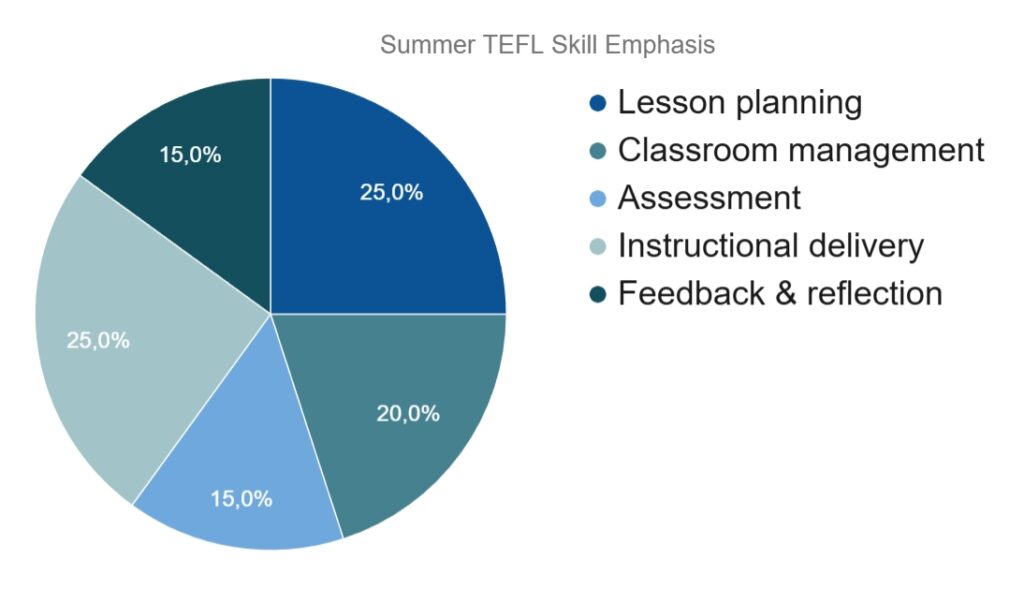
The visual gives a sense of where most training emphasis tends to lie when preparing for summer teaching. Planification des leçons and instructional delivery generally take a larger share because fast-paced summer classrooms demand clear structure and engaging delivery.
Classroom management and feedback/reflective practice are also essential, especially when you’re working in busy camps or language schools with varying learner needs.
The practical tip: simulate authentic classroom contexts during your practicum. Organise micro-enseignement, sessions where you rotate roles (teacher, assistant, observer) and deliberately vary group size, language level, or activity type.
Recording short, consented teaching segments and then reviewing them with a mentor can dramatically accelerate skill development in a short time frame.
A note on safety and ethics: safeguarding training is a standard component of quality TEFL programmes.
In summer settings, where groups may include younger learners, clear safeguarding policies and reporting procedures are crucial.
Ensure your course includes a robust module on child protection, data privacy, and professional conduct.
Jobs, Visas and Support After TEFL Certification
You are now ready to train and transfer your 10. TEFL certificate to a placement.
Summer postings may be arranged with language schools or camps, or through programme providers placing teachers in partner programmes.
Jobs, visas, and continued support are country-, employer-, and programme-specific, with particular requirements.
The important points are knowing what to expect in terms of timelines, responsibilities that you’ll be expected to fulfil, and how your training provider or employer will help you get there.
- Job search and placement. Many TEFL providers offer job-matching services, interview preparation, and post-course support. Some placements are booked by the provider in advance of your departure, especially for high-demand destinations. Others ask that you apply directly to host organisations or to a central summer programme featuring a distinct application window. Read the contract carefully for all routes and confirm everything included, such as airport pick-up, housing assistance, weekly tasks, and orientation.
- Visa and work permits. There are very different visa rules for teaching abroad. In some regions, some programmes provide visa sponsorship or support; in others, you have to obtain your own visa. As policies change, always consult official government guidance for the destination country (for example, UK government guidance on work visas or country-specific embassies). Your TEFL provider helps you with the necessary guidance and documentation for destinations they support. However, final eligibility rests with the host country’s regulations.
- Support and safeguarding during placement should be consistent. A decent TEFL provider or employer typically provides ongoing support during your placement, including local orientation, ongoing teaching supervision, and a point of contact if you encounter problems. Search for programmes that offer clear safeguarding policies, health and safety protocols, emergency procedures, and a local liaison to assist with practical issues (e.g. accommodation, travel, or cultural adjustment).
The summer posting can serve as a springboard for longer opportunities – a return to the same programme in subsequent years or to other destinations where graduates have been successfully placed.
Make sure your schedule includes ways to collect letters of reference, teaching materials, and reflections on your practice that will help with future applications.
Practical tip: organise your post-certification calendar with deadlines and milestones.
Have target destinations, visa windows, housing options, and flight arrangements.
Build in buffer time for delays, particularly around visa processing or contractual negotiations.
Keep a neatly organised folder so that if an employer requests certificates, practicum feedback, or reference letters, you can respond quickly.
Choosing the Right TEFL Provider for Summer Programmes
Les certificats TEFL are not equal, especially for a seamless summer teaching experience.
Your ideal provider can provide relevant and credible training whilst offering strong practicum and job support services that fit your destination and lifestyle.
Keep these in mind as you make your comparisons:
- Accreditation and conformance to established standards. Find programmes that openly outline how their coursework meets existing standards (such as Ofqual in the UK or similar national/regional frameworks). Organisations that share transparent accreditation information tend to deliver more reliable results in terms of transferability and employer trust.
- Quality of placements, teaching practice, and the practicum. The stage portion is where theory meets application. A good programme offers the possibility of a supervised teaching environment, constructive feedback cycles, and a clear plan for putting practicum hours into practice to build classroom credibility. Request sample lesson plans or a summary of practicum tasks where possible.
- JOB PLACEMENT AND REGIONAL REACH. If your heart is in a specific region (Europe, East Asia, or the Middle East, for example), ask about the provider’s placement network and previous placement success. Inquire about the institutions they partner with (summer camps, language schools, universities, and international schools) and whether they provide a referral or placement service.
- Cost, schedule, and course timetable. Compare total costs, including any registration fees, materials, practicum surcharges, housing, or orientation fees. Review the course timetable, too: Is the course available at a time that matches your summer plans? Does the format fit your work commitments if you’re travelling or working part-time?
- Protection, safeguarding, and students. A key feature of reputable providers is protection training and safeguarding policies. They should also have pre-departure briefings, country-specific safety advice, and a local support network when you arrive.
- Data: Success stories and testimonials from students. Ask des anciens élèves to what extent they think the programme prepared them for summer postings. If possible, search for evidence of outcomes based on student success in terms of, for example, job placement rates, placement duration, or region-specific success stories.
Practical tip: Ask for a sample practicum timetable and a student handbook in advance, and request a sample practicum timeline before you commit.
If possible, take the opportunity to interview alumni.
A transparent provider listens, welcomes questions, and gives transparent answers, including about deadlines, expectations, and support.
Maximising Your Summer Experience: Budget, Safety and Cultural Prep
Summer teaching abroad isn’t just about getting a certificate and a job placement; it is a dream come true in finding time and space to plan for real, safe, and financial success.
These are things that will support you in feeling better heading into the summer season:
- Animated with a budget for a summer posting. Costs of living can also vary by locality, but include rent (most commonly shared), local transport, meals, and occasional travel. Construct a budget with an eye on upfront expenses (visa fees, insurance, deposits) and ongoing obligations. Some programmes provide bundled housing or stipends, but you will want to verify what’s included in the package. A good budget gives you more time to focus on teaching and is less stressful.
- Insurance, health and safety. Your travel and health 13. assurance santé should be sufficient to meet medical needs, emergency evacuation, and travel disruptions. If you are teaching in itinerant programmes or camps, you may encounter crowded conditions or remote places where there’s little access to health care. Your instructor should advise you to keep safety and safeguarding in mind, but you should also carry copies of your documents and plan ahead for any health concerns.
- Basic skills in cultural preparation and the language. A pre-departure micro-module on la préparation culturelle, local customs, classroom habits, and simple language expressions will have its rewards. Even a basic command of the local language makes it easier for you to communicate with your learners and hosts, minimise misunderstandings, and show cultural respect to your hosts. Do write down two or three useful phrases you can use in your classrooms and learn local greetings.
- Packing and travel logistics. Develop a simple packing list that balances a professional look (and uniform requirements) with the rigours of hot weather and the realities of summer teaching (heat, crowded camp days, etc.). Remember the importance of teaching materials, a small first-aid kit, adapters, and a durable carry-on. Hold important documents – passport, visa documents, and copies of contracts, for example – securely and within easy reach.
- Looking back after placement and career progression. After your summer experience, reflect on what you learned and how your teaching practice changed. Obtain feedback from supervisors and students, refresh your lesson portfolios, if able, and collect letters of reference. This momentum will allow you to pursue longer-term la progression de carrière, whether for another post or further certification, which can add to your CV in the future.
Practical tip: Make a basic playbook for your summer assignment.
Include your standardised lesson starters and classroom management techniques, as well as ideas for differentiation and a small library of ready-to-go activities.
The ability to access all these resources in one place helps you hit the ground running during the first week and maintain consistency across sessions.
Conclusion
Having a summer teaching adventure with que la certification TEFL really makes for a great summer experience, both as career development and personal growth, provided that you have credible training, practical classroom practice, and strong post-certification support.
By choosing an appropriate training path that fits your schedule, ensuring you have genuine teaching experience prior to your flight, and understanding the job and visa landscape, you are best positioned to contribute effectively to classrooms overseas whilst immersing yourself in new cultures and experiences.
This blend – in-depth training, hands-on practice, and continued support – helps you differentiate yourself from other applicants and prepares you for a successful launch into the TEFL world.
Sources autoritaires et vérifications des faits (Références)
- British Council – TeachingEnglish: The British Council provides comprehensive resources for English language teachers, including information on professional development, teaching methodologies, and global standards.
- Cambridge English – Qualifications d'enseignement: Cambridge offers globally recognised teaching qualifications and provides insight into the rigorous standards required for effective language pedagogy.
- UNESCO – International Task Force on Teachers for Education 2030: UNESCO’s task force sets the global agenda for teacher standards, safeguarding, and the professionalisation of teaching across diverse educational systems.
- Ofqual (UK Government Regulator): Ofqual regulates qualifications, examinations, and assessments in England. Understanding their framework helps in verifying the credibility of various que la certification TEFL providers.
Do I need a TEFL certification to teach English abroad this summer?
While requirements vary by country and employer, many summer postings prefer or require a TEFL/TESOL certificate. A recognised certificate provides credibility, practical teaching skills, and a verifiable record of training. Some employers may accept significant teaching experience in lieu of a certificate, but a TEFL is the most reliable path for most first-time summer teachers.
Can I teach online from abroad during the summer?
Yes. Many TEFL programmes prepare you for l'enseignement en ligne as well as in-person roles. You’ll need a stable internet connection and a suitable workspace. Some destinations allow l'enseignement en ligne while you travel, subject to local regulatory rules and platform policies.
Which TEFL certificate is best for summer postings?
The best certificate is the one that aligns with the regions you’re targeting and includes a practicum component. Look for courses with observed teaching practice, clear assessments, and credible accreditation. If you know you’ll teach in a specific country, verify whether that country’s employers recognise a particular provider or standard.
Combien de temps dure un cours TEFL ?
It depends on the path. An intensive 4-week certificate is possible, but many learners complete a blended online course in 6–12 weeks. The key is to choose a schedule that aligns with your travel plans and visa windows, without compromising the quality of training.
What kind of visa should I expect for a summer teaching role?
Visa requirements depend on the destination. Some countries offer short-term work visas or visa exemptions for seasonal teaching roles, while others require sponsorship or a work permit. Always check official government guidance for the destination country and coordinate with your employer or programme provider for any visa documentation they can assist with.
What support should I expect after certification?
Reputable providers offer ongoing support: job placement assistance, interview preparation, and access to a network of partner schools or camps. Some organisations provide pre-departure briefings, country-specific guidance, and on-site support in the destination country.
Is safeguarding training required for summer teaching?
Yes in many programmes. Safeguarding and child-protection training is commonly embedded in credible cours TEFL and employer policies. It’s essential to understand how to keep learners safe, manage risk in group settings, and respond to concerns appropriately.