Teaching English in Iceland: Certification, Training, and Careers


Teaching English in Iceland is an adventure, full of opportunities and challenges. There is steady demand for skilled English teachers thanks to the country’s heavy investment in education, its burgeoning tourism industry and its English-speaking community. But new immigrants will also have to figure out certification, training channels and the realities of working in a country with a different regulatory and visa system. This article is a clear, fact-checked breakdown of the Icelandic 10. TEFL field, offering practical steps and advice on how to choose Ofqual-aligned certificates, understand career paths and analyse pay potential. Whether you’re going to be teaching at Iceland’s schools, language centres or even online with Icelandic language learners, the correct TEFL credentials can make the difference and enable you to develop a legitimate, successful career.
In Iceland, the teaching of English is represented by a combination of private language schools, municipal language units and, once in a while, public schools or universities. They increasingly look for TEFL qualifications that they know and associate with high standards, especially those from Ofqual in the UK. The requirement for work visas and residence permits for non-EEA teachers also complicates the job search. With careful thinking – choosing a strong Ofqual-aligned certificate, obtaining the appropriate visa and focusing on the sectors that are most likely to recruit English teachers – you can build a clear career path. The following provides information on certification pathways, training available in Iceland, the regulatory context for Ofqual-aligned certificat TEFLs and realistic salary expectations, to help you plan your path.

Understanding Iceland TEFL Certification and Career Pathways
Ce qui que la certification TEFL means in Iceland. Employers in countries such as Iceland want not just foreign English speakers, but also general working professionals to be able to organise their teaching as well as students’ English language programmes, and the 10. TEFL certificate is the standard credential they would consider necessary in such cases. Many language schools and private training centres in Iceland look to certificat TEFLs as a means of assessing whether teachers can teach effectively, plan lessons well and manage classrooms successfully. The well-established 120-hour cours TEFL with practical teaching components is common practice in many parts of Europe, as well as other countries, and many Icelandic employers explicitly request or prefer certification that meets international standards. Though some public-sector English teaching positions may require teachers to have experience within the Icelandic education system or to work alongside certified teachers, certificat TEFLs still represent the quickest way into much of the private sector.
Pathways into Icelandic language education. Career pathways are usually based on securing a recognised TEFL certificate and applying for a job primarily at private language schools, adult education centres or municipal language initiatives. At the same time, a diplôme de licence is typically favoured or required for senior roles or for positions in institutions with accredited language programmes. Applicants from outside the EEA should prepare for visa and work permit processes in advance. EU/EEA nationals have greater freedom of movement within Iceland, though. Participating in job fairs organised by universities and engaging with local TEFL communities in Iceland is another way to identify suitable job opportunities. Your TEFL credential, your relevant degree and, above all, your understanding of the work permit system form a credible proposition for Icelandic employers.
Why alignment with Ofqual is important. Ofqual-aligned TEFL certificates are attractive to Icelandic employers looking for consistency in course design, assessment and quality assurance. An régulés par Ofqual certification demonstrates compliance with established standards across curriculum design, teaching practice and quality assurance. By helping employers compare qualified candidates from different nationalities and reducing uncertainty regarding training quality, this alignment aids employers in comparing credentials. Selecting an Ofqual-supported qualification could help job seekers during recruitment, especially where private language schools and international schools emphasise comparable teaching qualifications and teacher competency. It also provides a clear route to professional development, as most courses accredited by Ofqual offer a clear outline of progression, micro-credentials and recognised transferability.
TEFL Training in Iceland: Qualifications and Jobs
In-country options and the wider training market. In Iceland, prospective teachers can take TEFL/TESOL de 120 heureswork, which is available through local providers and international online courses. Locally available options may include short certificate courses or introductory programmes offered by local language schools or partner institutions. These programmes can also be quite useful to newcomers wanting real-world practice and experience in Icelandic classrooms. However, the widest recognition is usually achieved through des cours en ligne with international accreditation, particularly those that are also Ofqual-aligned. This can ensure that, if you work with Icelandic learners in a broad range of settings, combining an online Ofqual-aligned certificate with local language proficiency is an effective solution.
Job-ready qualifications. A solid job-ready profile may consist of a TEFL certificate (minimum 120 hours) and proven teaching practice supported by a reflective teaching portfolio. Some courses provide observed teaching practice with feedback, micro-teaching and peer observations, which make your CV stand out to Icelandic employers. Furthermore, a bachelor’s degree in any field is worth considering, whereas a degree in education or languages may be useful in schools and universities. If you plan on working in adult education (or teaching or leading courses such as Cambridge English or IELTS preparation), specialised adult learning modules or certificates may provide additional career opportunities. Finally, for sustainable career development, it is wise to participate in ongoing professional development and relevant TEFL professional organisations or networks.
So how do you get training? Start by considering what is best for your career in Iceland: do you want to teach at a private language school, in a municipal centre or online with Icelandic learners? Select a TEFL certificate of 120 hours or more, including practical teaching. Make sure the certificate is accepted by potential Icelandic employers and is aligned with Ofqual or equivalent international standards where possible. Plan a date for your course so you can obtain the required certification and start applying for positions, leaving enough time to arrange any visa documents you may need. Finally, create a basic portfolio with sample lesson plans, classroom management strategies and a reflective teaching diary. This portefeuille will be useful in demonstrating that you are prepared to teach different groups in Iceland and adapt to the local educational environment.
Ofqual-Aligned TEFL Certification for Iceland Jobs
Icelandic recruiters understand the value of Ofqual alignment. Ofqual is the authority that regulates qualifications in England, Wales and Northern Ireland. It checks the alignment of course design, assessment and quality control standards. An Ofqual-compliant TEFL certificate means that the awarding body adheres to strict standards of teaching and learning, including course materials that are meaningful in the real-world classroom and a robust assessment system. Icelandic employers – especially those with international programmes or connections to UK-based pathways – recognise Ofqual-aligned qualifications as credible evidence of teaching competence. This alignment allows recruiters to benchmark applicants from different backgrounds fairly and can help to speed up the recruitment process.
How to check if a certificate fits within Ofqual criteria. Once you have chosen a TEFL certificate, verify that it is Ofqual-aligned by checking the programme’s awarding body and its official Ofqual registration. Pay particular attention to the provider’s website and the certificate documentation. It may also be helpful to obtain formal confirmation or a digital certificate from the awarding body verifying its status. When reaching out to Icelandic employers, you can refer to the qualification’s Ofqual status and, where possible, include a link to its registration information or provide a scanned copy. This proactive approach demonstrates professionalism and can support discussions about salary and job responsibilities.
The practical importance for career advancement. If candidates plan to relocate between countries or move into different teaching contexts, an Ofqual-aligned qualification may be advantageous. It can support eligibility for advanced teaching positions (such as lead teacher or curriculum designer roles) and help candidates progress to further qualifications, for example a Diplôme de Master in TESOL or Education. In Iceland, where private language schools often operate independently, a respected qualification can help you stand out among applicants. It should also be noted that many Icelandic employers prefer candidates with teaching experience; however, an Ofqual-aligned certificate combined with supervised teaching practice and a strong teaching portfolio can help strengthen your application.
Practical Teaching Roles and Salary Outlook in Iceland
Common roles for English teachers in Iceland. There are many jobs for English teachers in Iceland. Private language schools and language centres frequently employ native English-speaking instructors to teach group classes, participate in conversation clubs and prepare students for examinations. Municipal language units and some bilingual schools also hire English educators to support language development and immersion programmes. Teachers or tutors may be employed in universities and colleges to assist with English language support programmes, such as those for international students or professional development courses. For newcomers, private language schools are the most common starting point, where structured classes and stimulating communicative learning opportunities are still needed, especially in places like Reykjavík and other urban centres.
Salary prospects and determinants of pay. Salaries for English teachers in Iceland differ depending on the sector, location, level of responsibility, experience and role. Generally, English teachers in private language settings have pay packages consisting of monthly salaries based on teaching load, class size and the school’s status in the market. Public and municipal schools, where foreign teachers are permitted under clear rules and policies, may offer more structured pay scales and clearer progression, though these positions can require local professional credentials or certification. University-level teaching and specialised adult education positions will generally compensate teachers better than introductory private classes, although these roles may require more experience or advanced qualifications. As tax and social contributions in Iceland tend to be high, take-home pay depends on tax brackets and deductions; a formal package should always cover gross salary, hours and benefits.
A practical table of typical roles and approximate salary ranges.
| Secteur | Rôle typique | Estimated monthly gross (ISK) | Notes |
| Écoles de langues privées | Classroom English teacher | 550,000 – 800,000 | Based on 20–25 hours teaching/week |
| Municipal language units | English instructor | 650,000 – 900,000 | May require higher language competencies |
| Universités / collèges | English language lecturer/tutor | 800,000 – 1,200,000 | Higher pay with advanced qualifications |
| Online/Private tutoring | Remote or hybrid teacher | 500,000 – 1,000,000+ | Flexible hours; varies with student load |
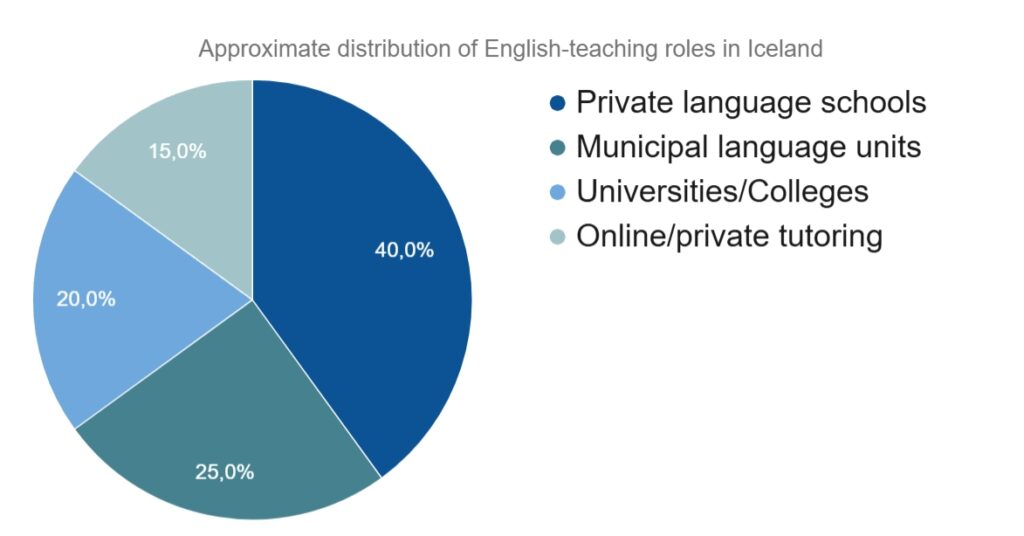
Data considerations. These figures reflect typical patterns observed in Icelandic language education and hiring practices. For accuracy, rely on official wage data and direct employer offers. The Icelandic government’s wage statistics and labour market information provide the best sources for current ranges and trends.
Careers and long-term prospects. English teachers in Iceland can move up into curriculum development, educational management or programme development beyond the classroom. Or they may end up being employed as principals in private language schools or participating in consultancy projects to develop English language programmes in industries like tourism, hospitality or technology. If there is always room for career advancement (e.g. in advanced TEFL certificates, leadership courses or a Master’s degree in TESOL or Education), then opportunities for promotion can be enhanced. In Iceland, much like in other markets, learning to adapt to the local learning and teaching culture, integrating the basics of Icelandic and demonstrating the ability to deliver results with different types of learners will enable long and satisfying careers.
Cultural adaptation. It’s in the Icelandic language and culture that success is often built through cultural adaptation. Although English is widely understood in Iceland, some teaching positions require effective instruction using Icelandic or, at the very least, an awareness of local norms regarding classrooms and student-teacher relationships. By networking with teachers in the area, getting involved with community-based professional learning organisations and gaining hands-on experience of the Icelandic education landscape, you can adapt your teaching according to the situation. Also consider getting ready for visa and work permit requirements. There won’t be much friction in the transition if you have a plan for legal eligibility, financial planning and housing.
Realistic approach to following the Icelandic TEFL career.
- Get an 13. Mais TEFL certificate with substantial teaching practice.
- Make a portfolio with sample lesson plans, assessment tasks and reflective statements.
- Look up visa and work permit requirements for non-EEA applicants before applying for employment or alongside your application.
- Apply to private language schools, language centres and municipal language units in Reykjavík and other metropolitan areas, and consider online platforms targeting Icelandic learners to supplement your income.
- Consider additional exams or adult courses to widen your market.
- Make provision for initial settlement costs in terms of housing, healthcare registration and opening a bank account. With each step, you get closer to a sustainable, meaningful teaching career in Iceland.
Conclusion
Teaching English in Iceland offers a distinctive blend of cultural richness, educational emphasis and a welcoming environment for international educators. With a solid Ofqual-aligned TEFL certificate, careful planning around visas and a proactive approach to professional development, you can build a meaningful career that benefits both you and Iceland’s learners. By combining practical teaching experience with a strong portfolio and a clear understanding of the job market, you’ll be well positioned to move from initial roles in private language schools to more advanced positions over time. The investment in high-quality certification, a targeted job search and ongoing professional growth pays dividends in the form of rewarding teaching experiences, career diversification and long-term professional stability in Iceland’s dynamic education landscape.
Sources autoritaires et vérifications des faits (Références)
- Statistics Iceland (Hagstofa Íslands): Official source for Icelandic wage statistics and labor market trends.
- Directorate of Immigration (Útlendingastofnun): Regulatory body for work permit requirements for non-EEA citizens.
- Ofqual (Bureau des qualifications et de la réglementation des examens): Government site for verifying accredited qualifications and awarding bodies.
- Ministry of Higher Education, Science and Innovation: Information on the national education system and standards.
Is a TEFL certificate enough to teach in Iceland, or do I need a local teaching licence?
A TEFL certificate is widely valued for private-language schools and l'enseignement en ligne. Public schools and some municipal programmes may require local licensing or additional qualifications. If you plan to work in regulated settings, check with each employer about licensing expectations and pathways to licensure in Iceland. Always confirm visa and work-permit requirements based on your nationality.
Do I need to be a native English speaker to teach in Iceland?
Native-speaker status is often preferred by private language schools, but many employers also prioritize teaching ability, cultural awareness, and the quality of your TEFL training. Non-native speakers who demonstrate strong language competence, effective classroom management, and a robust teaching portfolio can secure roles, particularly in online or private-language settings.
What is the typical visa process for non-EEA teachers?
Non-EEA teachers usually need a work permit and residence permit to live and work in Iceland. The Directorate of Immigration (Útlendingastofnun) provides guidance on work-permit categories, application steps, and required documents. An employer in Iceland can sponsor your work permit, though the process varies by job type and applicant circumstances.
How long does TEFL training take, and what should I look for in a programme?
A common minimum is a 120-hour TEFL certificate with a practical teaching component. Look for accredited programmes, ideally with Ofqual alignment or comparable standards, teaching practicum, and evidence of assessed teaching practice. Check for a clear statement on validation, exam integrity, and career support, such as job placement assistance or portfolio development.
Are online TEFL certificates accepted in Iceland?
Many Icelandic employers accept online TEFL certificates, particularly those with strong practical components and reputable accreditation, including Ofqual-aligned providers. It is wise to verify the certificate’s recognition with prospective employers and to emphasise teaching practice evidence in your portfolio.
What is the salary range for English teachers in Iceland?
Salaries vary by sector and location. Typical ranges for private language schools might be mid-range (entry to mid-level) in the private sector, with universities and larger institutions offering higher compensation for experienced teachers or those with specialist qualifications. Always obtain a written salary offer that details gross pay, hours, and any benefits, and check current wage data from Statistics Iceland for up-to-date context.
How can I improve my chances of getting hired in Iceland?
Prioritise an Ofqual-aligned certificate with strong teaching practice, assemble a compelling teaching portfolio, demonstrate flexibility and cultural adaptability, and network with local language schools and universities. If possible, secure a visa sponsorship or a clear pathway for work-permit eligibility before applying. Tailor your CV to the Icelandic market by highlighting classroom innovations and results with specific learner groups.