Lavori di insegnamento dell'inglese in Francia: Certificazione TEFL e percorsi

France presents a compelling destination for aspiring English teachers: cities, rich culture and a long-standing demand for fluent English speakers in schools, universities and private language centres. Here’s what you should know: yet breaking into the market can be difficult if you are uncertain where to start, which certification to follow and how to meet visa requirements.
This guide is designed to cut through the noise by offering clear, fact-checked certificazione TEFL pathways, practical career choices and realistic steps to secure English teaching roles in France, helping you save time and effort if you are targeting classroom positions.
Il panorama dell'insegnamento dell'inglese in Francia
The landscape of English teaching in France blends traditional classroom roles with more modern, flexible ways to work. Some public schools welcome native English speakers through government-supported programmes although much of the demand lies in private language schools, international schools and online programmes.
This is remarkably useful: visa rules, employer expectations and accreditation standards vary by sector so candidates should treat certification as a strategic asset rather than a checkbox. With the right TEFL or TESOL qualification you can approach the market with confidence.
Certificazione TEFL: Percorsi verso ruoli di insegnamento del francese
Accreditamento e Standard
Want to improve your position? The truth is that a Certificato TEFL sits at the centre of most English teaching journeys in France. You will find that courses vary in length, depth and focus although the most reputable qualifications are aligned with international standards and offer practical teaching experience alongside theoretical knowledge.
This is a game-changer: a growing number of courses are linked to recognised regulatory frameworks including the 26. livelli CEFR. (Common European Framework of Reference for Languages) administered by the Council of Europe and some UK-regulated awards overseen by Ofqual. This means employers across sectors can recognise your training.
In addition a solid certification can help you meet the expectations of both French schools and visa authorities who assess professional credentials.
CELTA vs. Corsi TEFL/TESOL più ampi
It is worth noting that the pathways vary although a common distinction exists between CELTA-type programmes and broader TEFL or TESOL che offrono sia praticità che qualità.
CELTA (Certificate in English Language Teaching to Adults) is highly regarded for its practical teaching component and integrated practicum. Other TEFL or TESOL certificates may offer longer online sections or modular formats.
For teaching in French schools emphasising a qualification with a practicum and a clear link to classroom practice can be advantageous particularly when applying to government-supported programmes or reputable private schools. A certificate alone will not guarantee work because employers look for teaching practicum evidence, cultural adaptability and commitment to ongoing professional development. The CEFR alignment of your course strengthens credibility.
Valutazione delle opzioni di certificazione
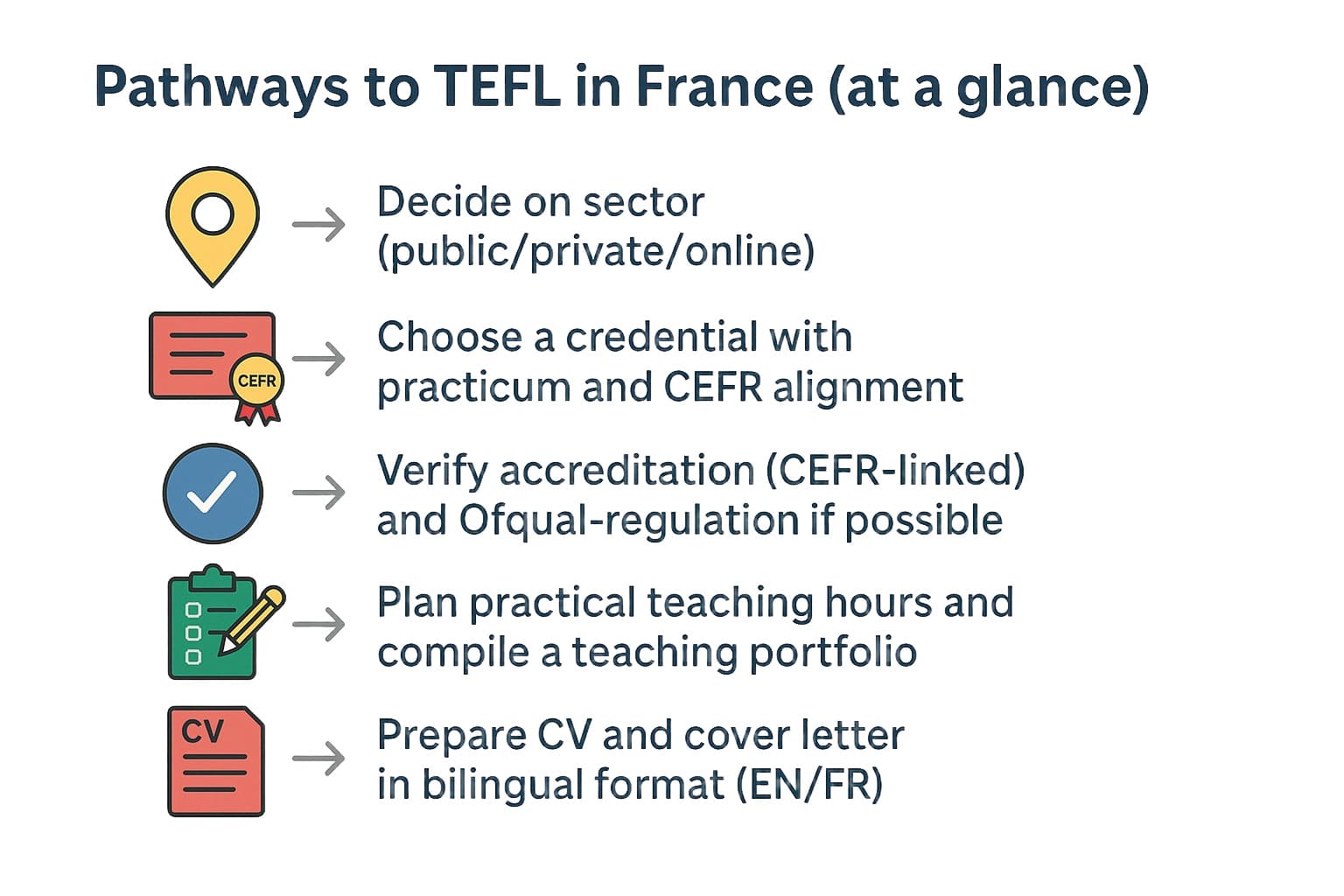
Need to improve your situation? When evaluating certification options candidates should check accreditation, practicum quality and transferability.
You will find that le qualifiche regolate da Ofqual provide a recognised level framework many UK-based courses use to align with CEFR levels and international job markets. This is worth considering: your eventual French employer will assess your suitability for a teaching role so a certificate aligned to widely understood standards reduces ambiguity and supports clear comparison with other candidates. Always check the course’s accreditation status and practicum structure. The combination of a credible certificate, teaching practice and CEFR-aligned content will be your strongest evidence of readiness when applying to French schools.
Dove iniziare: Corsi TEFL per lavori in Francia
A differenza di altre opzioni, iniziare il tuo percorso TEFL con un corso ben scelto stabilisce il tono per la tua ricerca di lavoro in Francia. Ecco cosa dovresti sapere: la chiave è scegliere un programma che offra accreditamento credibile, pratica didattica significativa e un percorso verso competenze didattiche allineate al CEFR.
Se miri a ruoli nelle scuole pubbliche o in programmi sostenuti dal governo, dai priorità ai corsi con componenti di praticantato riconosciuti e prove di pratica in aula in ambienti di insegnamento reali, assicurando che la tua transizione sia più fluida. Per le scuole di lingue private, queste aspettative possono essere più flessibili, anche se i datori di lavoro apprezzano ancora i candidati che dimostrano una pianificazione delle lezioni metodica e strategie focalizzate sugli studenti.
Formati e Vantaggi del Corso
I formati online o in presenza offrono ciascuno vantaggi. I corsi in presenza forniscono pratica immediata in aula sotto supervisione, feedback diretto e un portfolio didattico pratico. I corsi online offrono flessibilità, spesso costi iniziali più bassi e contenuti modulari che puoi completare da qualsiasi luogo, rendendo la tua preparazione più facile.
Qualunque sia il modo che scegli, l'accreditamento del corso è importante: dai priorità ai corsi riconosciuti da quadri CEFR e, dove possibile, a quelli che offrono un chiaro percorso verso i livelli di insegnamento CEFR come prova della tua capacità di progettare attività attorno agli obiettivi di ascolto, parlato, lettura e scrittura. Se stai puntando a posizioni a Parigi o in altre grandi città, considera programmi che evidenziano strategie di insegnamento interculturale e gestione della classe bilingue, che le scuole francesi valutano molto.
Certificati Supplementari
Inoltre, i candidati TEFL o TESOL possono rafforzare il loro profilo ottenendo certificati supplementari o micro-credential. Alcuni corsi basati nel Regno Unito si collegano a quadri regolati da Ofqual, che possono aiutare a dimostrare i tuoi risultati di apprendimento e le tue abilità di valutazione. Un corso ben strutturato includerà un praticantato didattico, note di osservazione e un toolkit per la pianificazione delle lezioni allineato con fasi CEFR permettendoti di risparmiare tempo e sforzi mentre ti prepari per la tua ricerca di lavoro.
Percorsi TEFL comuni e cosa offrono
| Percorso | Durata tipica | Caratteristiche chiave | Migliore per |
| CELTA o simile allo stile CELTA | 4 settimane (intense) o 5-8 settimane part-time | Praticantato immersivo, insegnamento supervisionato, applicazione immediata in aula | Scuole di lingue private tradizionali, scuole internazionali; forte focus in aula |
| TEFL/TESOL generale (non-CELTA) | 8-12 settimane mix online/offline | Teoria ampia, qualche praticantato, programmazione flessibile | People needing flexibility or on a budget; entry to l'insegnamento online |
| Ofqual-regulated TEFL/TESOL | 6-12 weeks (structured) | UK-regulated framework, clear assessment criteria, CEFR alignment | Employers seeking formal UK-regulated qualifications; credibility across EU markets |
| Specialist TEFL (online micro-credentials) | 4-8 weeks per module | Targeted skills (lesson-planning, classroom management, l'insegnamento online) | Niche roles, online schools, continuous professional development |
Suggerimenti pratici per ottenere ruoli TEFL nelle scuole francesi
The key is that securing a TEFL role in France requires preparation beyond earning a certificate offering both convenience and quality. Start with a bilingual CV and a cover letter that highlights your CEFR-aligned lesson planning skills, your ability to manage mixed-ability groups and any cross-cultural teaching experience.
If you have a practicum include a selection of lesson plans, learner progress samples and a reflective journal to demonstrate your ability to respond to feedback. Some recruiters value a Europass-style CV although adapting your CV to French hiring expectations increases clarity and impact. The European Commission’s Europass platform is a credible starting point although you may adjust the layout to align with French job market norms.
Networking and formal channels can greatly accelerate your application process offering both convenience and quality. Follow official routes where possible such as job boards run by education authorities or language associations and contact schools in cities where demand is strongest such as Paris, Lyon, Marseille, Lille, Toulouse and Nice. Research the specific requirements of each institution because government-supported Assistant d’anglais programmes have distinct application cycles and eligibility criteria saving you time and effort. Prepare documentation in advance such as identity proofs, academic transcripts and legally accepted translations which will speed up visa and hiring procedures when opportunities arise.
The awe-inspiring part is that readiness means preparing for interviews and lesson presentations, combining functionality with aesthetic appeal. Plus, be ready to discuss your approach to differentiated instruction, how you plan lessons for mixed-level groups and how you assess learner progression. This is outstandingly useful: be ready to deliver a short micro-lesson during an interview, perhaps demonstrating a speaking activity or a pronunciation task for a CEFR level. French schools value clarity. What makes this different is practising presenting in clear, concise English and if possible preparing a few bilingual handouts or slides to show your ability to bridge language gaps in a classroom.
You’ll witness that beyond initial hiring ongoing professional development matters, combining functionality with artistic appeal. Here’s the prospect: consider pursuing additional micro-certificates in online teaching, classroom management or CEFR-aligned assessment strategies. Not to mention, this ongoing development signals to employers you are committed to improving learner outcomes and adapting to changing classroom dynamics, which means saving you time and effort. Finally be practical.
Fonti Autorevoli e Verifiche dei Fatti
This section provides authoritative resources related to English teaching credentials, the CEFR framework, and official teaching assistant programs in France.
- Council of Europe – Common European Framework of Reference for Languages (CEFR): Official page for the standard framework used across Europe to describe language ability, which is critical for Corso TEFL alignment and employer assessment.
- Teaching Assistant Program in France (TAPIF) / France Éducation International: The official government-backed program that places native English speakers in French public schools, which is a key pathway mentioned in the article.
- UK Office of Qualifications and Examinations Regulation (Ofqual) Database: A resource to verify the legitimacy and regulated status of UK-based TEFL qualifications, useful for checking if a course is “Ofqual-regulated.”
- European Commission Europass: The official platform offering templates and guidance for creating CVs and cover letters widely recognized across European countries, including France.
Do I need TEFL/TESOL to teach English in France?
Sebbene non sia sempre legalmente richiesto, la maggior parte dei datori di lavoro rispettabili in Francia preferisce candidati con un certificato TEFL/TESOL riconosciuto, specialmente con un componente pratico e allineamento CEFR. Un certificato ben scelto migliora la tua occupabilità nelle scuole di lingue private, nei programmi internazionali e nei ruoli online.
Are CELTA or TEFL certificates recognised in France?
Sì, i certificati TEFL/TESOL allineati a CELTA e CEFR sono ampiamente riconosciuti in Francia, in particolare quando includono un componente pratico di insegnamento e risultati compatibili con il CEFR. L'allineamento ufficiale al CEFR rafforza l'accettazione da parte dei datori di lavoro.
Can I apply for a visa if I’m not an EU citizen?
Sì, i cittadini non UE possono lavorare in Francia, ma di solito richiedono un visto di lavoro valido o un permesso di soggiorno sponsorizzato da un datore di lavoro. Il portale France-Visas e le linee guida dell'ambasciata/consolato francese delineano i passaggi e i documenti richiesti per il lavoro qualificato o temporaneo.
How much can I earn teaching English in France?
La retribuzione varia a seconda del settore e della posizione.
Do I need to speak French to teach English in France?
Basic French is helpful for classroom management, administrative tasks, and daily life, but many English teaching roles, especially in private language schools and online contexts, accept native English speakers with limited French. However, improving your French will broaden your job prospects and integration into the school community.
Quanto tempo ci vuole per ottenere la certificazione TEFL?
La durata dipende dal programma. I corsi online possono essere completati in poche settimane, mentre i formati part-time o misti possono durare 6-12 settimane. I programmi CELTA o equivalenti CELTA più intensivi si svolgono in 4 settimane. Controlla i programmi dei corsi per le ore di tirocinio e le tempistiche di valutazione.
What are the best cities in France for TEFL jobs?
Parigi, Lione, Marsiglia, Lille, Tolosa e Nizza offrono tutti mercati robusti per insegnanti di inglese grazie alle popolazioni studentesche e all'attività turistica.
Are online TEFL courses accepted by French employers?
Corso TEFL onlines possono essere accettati, in particolare se includono un forte componente pratico e allineamento CEFR.
How can I ensure my TEFL certificate aligns with CEFR?
Look for courses that explicitly map their learning outcomes to CEFR levels (A1 - C2) and provide a clear framework for assessing progress against CEFR descriptors. The Council of Europe’s CEFR guidance and cross-border accreditation processes underpin these alignments.