Zrozumienie TEFL, TESOL, TESL, CELTA i DELTA

Wprowadzenie: Demistyfikacja akronimów
Many wish to teach English abroad or online as a dream job. But the vernacular can be confusing: 10. TEFL, TESOL, TESL, CELTA, and DELTA are used interchangeably, although they all refer to different things. For an aspiring language teacher, that clear idea about such qualifications matters not only for gaining entry to the profession but for salary levels, job location, and advancing in a career. This guide demystifies the four major domains of preparedness and explains how they are integrated.
You’ll learn what each certificate or qualification covers, what it says to employers about your skills and training background, as well as the type of study required, including how long you need to study for (and how the course is delivered) and what it will cost. With this knowledge, you can chart a course that’s tailored to your geography, career goals, and time at hand. We will also take a look at reliability and standards. In the UK, recognized bodies and regulation impact on how qualifications are valued in schools and through online courses. Global demand varies, but the best-known qualifications – including courses such as CELTA and DELTA by Cambridge English – are regularly found on shortlists of employers for roles around the world. This article is based on reporting that features expert sources. Alison Phipps is a Professor of Linguistics and Languages at the University of Glasgow, where she researches in the areas of intercultural theory and foreign language education.
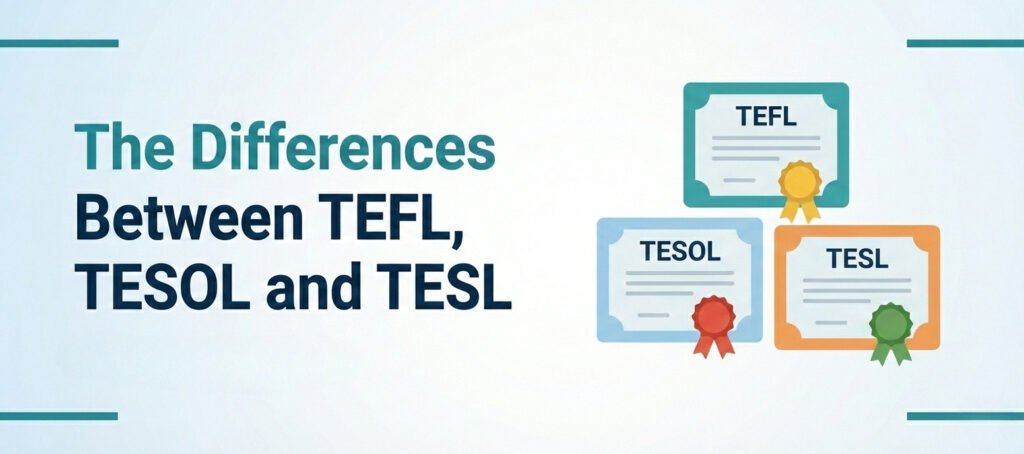
TEFL, TESOL, and TESL: Umbrella Terms
These umbrella terms refer to the field of study of teaching English.
- 10. TEFL (Nauczania Angielskiego jako Języka Obcego): which is usually used to refer to courses and qualifications on how to teach the English language in countries where it’s not their first language.
- TESOL (Nauczania angielskiego dla osób mówiących w innych językach): is also widely used in North America and elsewhere to describe similar work that incorporates both classroom instruction and teacher preparation.
- TESL (Teaching English as a Second Language): is the term used in regions such as California and Canada, where second language learners are in an English-speaking environment.
All three describe the act of teaching English, which might have slightly different geographical contexts or audiences, so some employers may prefer that you have a particular credential.
CELTA and DELTA: Specific Qualifications
In this context, CELTA/DELTA are names of particular qualifications rather than names of things in general. Both qualifications are awarded by Cambridge English.
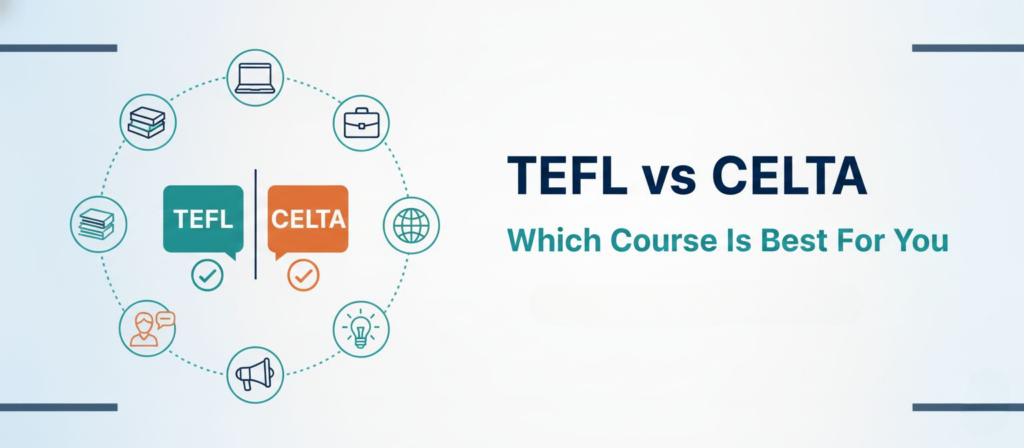
- CELTA is a practical, hands-on teaching qualification that includes teaching practice and written assignments. It is intended for novice teachers.
- DELTA is intended for the experienced teacher looking to build on their existing skills, including those who have been teaching for some time and have a range of experience that includes preparation for a range of exams.
Dlaczego różnice mają znaczenie dla awansu zawodowego
Distinctions do matter when you chart your course:
- Fast Entry: If you’re looking for a fast entry into numerous language schools or into teaching abroad as a beginner, there’s no quicker path than with a practical certificate like CELTA or even simply a reputable Rynek TEFL/TESOL cert.
- Leadership and Academic Career: If you would like to move into leadership, teacher training, or academic positions in higher education, employers may have a preference for a DELTA or an equivalent master’s-level qualification.
It’s also crucial to know that some destinations want a degree and a teaching qualification, while for others, the quality of your practicum and reflective work is more important.
What Each Certificate Teaches, and Why It Matters
Most TEFL/TESOL/TESL courses will provide instruction on language systems, lesson planning, classroom management, and learner needs analysis. They enable you to prepare excellent lessons, adapt them to different levels, and assess learner improvement.
CELTA Focus
CELTA focuses on practical teaching skills. The majority of the practice seminars focusing on hands-on practice, including:
- A competent amount of observed teaching with learners.
- Real-based reflection and written analyses of lesson forecasting.
- It is intended to produce assured novice teachers who can start teaching almost immediately after their CELTA.
DELTA Depth
DELTA digs deeper and typically consists of three modules:
- Moduł 1: Dotyczy świadomości językowej i świadomości struktur językowych, z wystarczającą znajomością słownictwa i gramatyki, aby podejmować decyzje w klasie.
- Moduł 2: Koncentruje się na metodach szkoleniowych i praktycznych procedurach, obejmujących organizację klasy oraz umiejętności nauczania skoncentrowane na uczniu i mentoring.
- Moduł 3: Skupia się na profesjonalnym wykonaniu i odkryciu, często z koniecznością ukończenia projektu badawczego i wykazania zdolności do prowadzenia, doradzania lub rozwijania programu nauczania i oceny jako specjaliści w swojej dziedzinie.
DELTA jest szeroko uznawane za główną kwalifikację do awansu i przywództwa w nauczaniu języka angielskiego.
Employer Value
Twoja kwalifikacja informuje przyszłego pracodawcę o twoim poziomie i przyszłości:
- A CELTA oznacza, że już wiesz, jak uczyć, co jest atrakcyjnym punktem startowym dla szkół na całym świecie.
- A DELTA pokazuje chęć do ciągłego rozwoju zawodowego oraz zdolność do podejmowania większej odpowiedzialności, takiej jak koordynacja programów, szkolenie nauczycieli lub zarządzanie akademickie.
Which Path to Take: TEFL, TESOL, CELTA, or DELTA?
Dla całkowitych nowicjuszy, którzy chcą wyjechać do obcego kraju i szybko uczyć, praktyczny Rynek TEFL/TESOL certyfikat lub CELTA może być najszybszą drogą do pracy.
Rekomendacje dla początkujących i doświadczonych nauczycieli
| Cel | Zalecana Kwalifikacja | Wymagania Doświadczeniowe | Cechy Studiów |
| Szybki Wstęp dla Nowicjuszy | Praktyczne TEFL/TESOL lub CELTA | Nie wymagane lub minimalne | Intensywny kurs (4-tygodniowy w pełnym wymiarze godzin lub 12–16 tygodni w niepełnym wymiarze godzin/online) połączony z obserwowaną praktyką nauczycielską. |
| Rozwój kariery i przywództwo | DELTA | Minimalne jeden rok doświadczenia w nauczaniu w pełnym wymiarze godzin i kwalifikacji do nauczania języków | Zaprojektowane do nauki podczas pracy dla nauczycieli praktykujących, aby kontynuować zatrudnienie, zdobywając nowe umiejętności. |
Geography and Standards
- Popyt na rynku: Niektóre kraje lub systemy cenią CELTA lub DELTA ze względu na ich uznawany międzynarodowy status i udowodnioną zdolność nauczania. Firmy ESL online mogą akceptować różne Rynek TEFL/TESOL certyfikaty, ale najbardziej konkurencyjne oferty pracy często preferują CELTA lub DELTA wykwalifikowanych nauczycieli.
- Standardy: Kwalifikacje Cambridge English (CELTA, DELTA) są ustandaryzowane, uznawane na całym świecie i wysoko cenione w prywatnych szkołach językowych oraz w sektorze szkolnictwa wyższego.
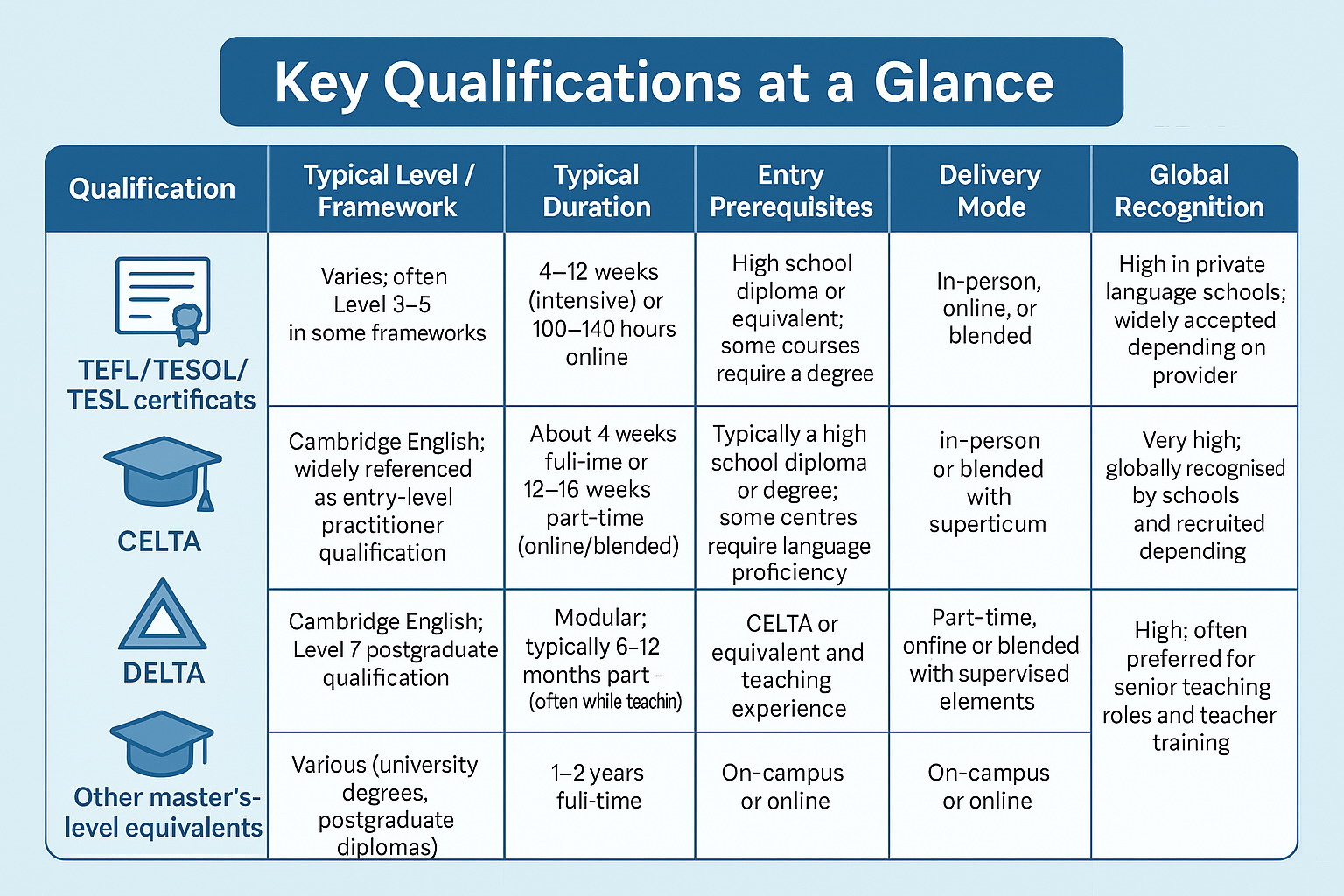
Practical Decision Tips
Zacznij od zdefiniowania swojego celu: Czy chcesz uczyć od razu, czy interesuje cię długoterminowy rozwój zawodowy?
- Jeśli twoim celem jest get into the classroom quickly at a popular 10. TEFL destination, then CELTA makes good sense.
- If you plan to lead school-wide initiatives, train other teachers, or undertake more advanced applied research, preparing for DELTA (or its master’s-level equivalent) can be a stronger indication of readiness to employers and universities.
Also, weigh delivery method (in person/online/blended), the cost per credit hour, and the help a center offers with visa procedures, housing, and further professional development.
Course Coverage, Credential Options, and Career Opportunities
A good TEFL/TESOL/TESL certificate or diploma program includes language awareness, teaching skills, lesson planning, evaluation, and testing skills as well as management techniques for the classroom and tools of reflective practice.
Detailed CELTA Components
The emphasis in CELTA is on practical, hands-on teaching with plenty of support. Typically, this will include:
- Observed teaching practice with real learners (usually 6-8 hours of observed practice per candidate).
- Lesson planning, tasks on language analysis, and a written assignment.
- Assessment is based on teaching performance, lesson planning, and a portfolio of writing.
Detailed DELTA Components
The three components of DELTA go from learning to practice, and then on to professional leadership:
- Moduł 1: Focuses on the learning of language and the development of an understanding of English language/linguistics.
- Moduł 2: Focuses on teaching, learning, and assessment with a focus on creativity and innovation in pedagogy and the evaluation of teaching.
- Moduł 3: Focuses on in-class research or projects that provide solutions to real-world teaching problems and lead to improved curriculum assessment and support structures.
Together, DELTA prepares teachers for more senior positions, teacher training courses, and policy-making roles in language teaching institutions.
Certification Standards and Recognition
Kwalifikacje Cambridge English 3. (np., CELTA, DELTA) are standardized tests administered by Cambridge Assessment English. At an international level, many governments and institutions acknowledge CELTA and DELTA as a basic or range requirement for teaching English worldwide.
Career Paths
- Lower-level TEFL/TESOL/CELTA teachers might find work in private language schools, university international campuses, or through nauczanie online.
- DELTA provides opportunities for teacher training, curriculum design, program development, and research in education.
No matter which approach one takes, creating a bank of reflective practice, samples of teaching materials, and proof of learner progress is evidence the teacher has created something meaningful to positively impact employers or potential funders.
What is the difference between TEFL, TESOL, and TESL?
TEFL refers to Teaching English as a Foreign Language and is often used for roles in non-English-speaking countries. TESOL stands for Teaching English to Speakers of Other Languages and is common in North America and other regions. TESL stands for Teaching English as a Second Language and is typically used for teaching in English-speaking countries to learners who are learning English as a second language. In practice, many institutions treat these terms as interchangeable, but understanding regional usage helps when tailoring applications.
Is CELTA necessary to teach English abroad?
CELTA is not always strictly required, but it is one of the most widely recognised entry-point qualifications for teaching English internationally. It provides structured practicum experience and a clear demonstration of teaching ability, which many employers value highly. Some destinations accept a high-quality TEFL/TESOL certificate with substantial practicum, but CELTA remains a strong standard for global mobility.
Can I teach online with a TEFL certificate?
Yes. A growing number of online platforms accept well regarded TEFL/TESOL certificates. The key is to choose a provider with credible practicum components, robust assessment, and positive learner outcomes. For online roles that involve longer-term engagement or higher responsibility (e.g., teacher training, class facilitation), an endorsement like DELTA or an advanced certificate can boost credibility.
Jak długo trwa DELTA i kto może się zapisać?
DELTA typically takes 6–12 months on a part-time basis, though some centres offer longer schedules. Candidates usually have at least one year of teaching experience and a CELTA or an equivalent qualification. The modular format allows teachers to fit study around work commitments while progressing toward a Level 7 qualification recognised for advanced roles.
Are CELTA and DELTA recognised around the world?
Yes. Cambridge English qualifications are internationally recognised by schools, universities, and online platforms. While local regulatory frameworks vary, CELTA and DELTA consistently appear on hiring lists and visa guidelines as reputable indicators of professional capability. It’s wise to check specific country or school requirements before committing to a course.
Do I need a degree to start with CELTA or DELTA?
For CELTA, a college-level certificate or degree is not always required, though some centres prefer applicants with a degree. DELTA typically requires a degree plus teaching experience (or equivalent professional credentials). Always verify the entry requirements with the chosen Cambridge-approved centre, as requirements can vary by location and programme track.
What should I consider when choosing a provider?
Look for Cambridge-approved CELTA or DELTA centres, a clear practicum framework, quality mentor feedback, and robust post-course employment support. Check the centre’s student support, housing and visa assistance if you plan to study abroad. Cross-check the course’s alignment with Ofqual or other national standards where relevant, and review independent learner feedback.