Teaching English in Hong Kong: TEFL/TESOL Careers and Pathways


Hong Kong is one of Asia’s most vibrant centres for students learning English as a foreign language.
The city has wide-ranging prospects for prospective teachers – from private language centres and international schools, to universities and online platforms that cater to learners globally.
But negotiating certification, visas, and salary expectations can feel daunting. This article was written with the purpose of breaking down the qualification-to-classroom gap and providing practical guidance on how to launch and maintain a rewarding TEFL/TESOL career in Hong Kong.
It highlights the principles of quality that meet Ofqual and international benchmarks, but is situated within the context of Hong Kong jobs. In Hong Kong, a firm plan is as important as a good 证书.
Private language employers are more interested in teaching practice, communication ability, and standard qualifications than they are in narrow specialist qualifications. Conversely, roles in the public sector might demand local registration and particular teaching qualifications. Where both these private-sector avenues and public-sector requirements intersect dictates the decisions that future teachers may make: the kind of TEFL/TESOL 课程 they may choose, for instance, and the manner in which they are going to proceed in practising the field. This article covers certification pathways, certification standards, visa basics, salary expectations, and practical tips for registering for courses that integrate with Hong Kong 学校 dynamics.

Hong Kong TEFL Careers: Certification, Training & Pathways
The certificate for teaching English in Hong Kong can help close the gap between a love of language and a sustainable 职业.
For some, a TEFL/TESOL certificate provides a strong foundation in lesson planning, classroom management, language analysis, and assessment. Although entry-level positions at private language centres may require a 120-hour certificate, it is often the more comprehensive qualifications – such as 3. CELTA or a Cambridge/TESOL equivalent – that will differentiate you from the pack.
Moreover, certain learners are more likely to seek Ofqual-regulated qualifications (e.g. Level 5 TESOL diplomas) because they are closely aligned with international standards and can lend academic confidence to roles overseas or with multinational organisations. In Hong Kong, employers look for good-quality hands-on teaching and internationally recognised qualifications – so the ideal combination of certificate and 实习 is usually the best recipe.
Your learning pathway needs to match your career aspirations and the specific sector you want to be involved in. As for private language centres in Central Hong Kong or Kowloon, a good TEFL/TESOL package with significant teaching opportunities is an absolute necessity.
Those who aim to enter international schools or university language centres will generally require either a bachelor’s degree or an accredited teaching qualification (e.g. PGDE or related), with TEFL/TESOL certificates supporting ESL-specialised roles. Some providers offer blended programmes in which online theory is combined with in-person practicum in partner centres, so you can gain real classroom experience as you train. The most successful pathways also focus on continual CPD (continuing professional development) and micro-teaching experiences so that you gain the confidence needed to teach in various classrooms and respond to a wide range of classes and curricula.
And at last, experience matters as much as formal credentials. Seek out courses with an authentic 实习 element – providing supervised teaching with real students and feedback.
In Hong Kong, a robust practicum can create a strong competitive advantage in the TEFL industry: an enthusiastic teacher can design a stimulating lesson plan, instantly address a student’s learning needs, and reflect on feedback. “If you decide to do either an online certificate or a ‘real-life’ practicum, make sure that it is tied to established teaching criteria and provides a clear path to classroom readiness.” A quality certification programme will be the cornerstone of your career in Hong Kong TEFL.
Standards and Qualifications for TEFL in Hong Kong
The modern Hong Kong model is one of private-sector flexibility and public-sector expectations. To a certain extent, for private-sector language centres, demonstrated teaching skill, a relevant certificate, and a degree, where applicable, are considered the criteria for training, and qualifications are usually not part of the local language teachers’ curriculum.
The Education Bureau (EDB) establishes the framework for teachers in local schools, and non-local teachers who wish to work in local schools or the public or subsidised sector are usually required to have a valid work visa and comply with employer requirements, in addition to holding TEFL credentials.
On the other hand, privately run language schools often consider reputable TEFL/TESOL credentials (especially those with significant practicum and 与CEFR对齐的 lesson design) as part of the hiring mix. These distinctions are important when you’re preparing your CV: a certificate alone may work for some private jobs, but government-affiliated schools are going to require more formal credentials.
The minimum qualification for most teaching positions in Hong Kong is generally a recognised 学位, with a degree being a competitive advantage.
A bachelor’s degree with a regulated teaching qualification – for example, a PGDE (Postgraduate Diploma in Education) or a similar teaching credential – is often the key for those considering public-school or university-related roles.
TEFL/TESOL certificates are particularly good for building an applicant’s profile, ensuring that there is good practicum experience, exposure to classroom management principles, and 评估 literacy.
International schools also value credentials from global organisations; hence 3. CELTA, TESOL with practicum, and Ofqual-regulated Level 5 diplomas may prove good additions to a CV for jobs in an English language department or exchange programme.
Select a course with high-quality assurance for Hong Kong. The choice of provider should also depend upon its qualifications, whether they are widely recognised by reputable awarding bodies or adhere closely to international standards for language instruction. Ofqual, the UK regulator, approves some TEFL/TESOL qualifications and diplomas, and although not every Hong Kong employer necessarily requires Ofqual-regulated credentials, most see such qualifications as proof that a systematic and disciplined approach to teaching has been taken.
Seek courses with clear outcomes, a clear assessment framework, and specified minimum teaching practicum hours. For the future, consider obtaining 认证 from UK, US, or Australian accrediting bodies, or establishing relationships that may also prove valuable (particularly if portability for future teaching in other countries is in your plans), which may make it easier to move into other teaching markets. Distinguishing between different types of accreditation can help ensure that the certificate remains a credible qualification in Hong Kong as well as in the wider international market.
Work Permits, Salary Expectations and Roles in Hong Kong
As non-local teachers wishing to work in Hong Kong, you need to obtain an Employment Visa before starting a job.
The Employment Visa is administered by the Hong Kong Immigration Department, where the employer is required to sponsor the applicant by showing that the job offer is genuine and that the applicant meets the necessary qualifications. Schools and language centres, in practice, seek candidates for genuine positions with relevant skills and a clear plan for integrating into the Hong Kong workplace. The 签证 process may take several weeks – depending on the applicant’s background and the employer’s ability to process the documentation. It’s essential to secure a formal job offer before you apply, as this is a core component of the application. For many, this means customising your CV to highlight practical teaching experience and a record of student engagement to increase the chances of visa sponsorship. Workers’ pay expectations vary considerably in Hong Kong’s TEFL sector based on the sector, the number of hours worked, and the level of responsibility. Private language centres often pay monthly salary in line with local market norms, with opportunities for overtime and private tutoring.
International schools and university language centres also offer higher salaries than private language centres, although expectations regarding credentials, experience, and teaching load are also higher. In addition to the base salary, there are often health insurance options, holiday entitlements, and professional development opportunities. Hong Kong’s high cost of living (particularly in central districts) should be taken into account when evaluating an offer. When negotiating, look not only at the salary, but also at working hours, class size, planning time, 商务英语 or exam preparation duties, and opportunities for career progression within the organisation.
What you do as a TEFL/TESOL teacher in Hong Kong depends on where you are employed. Private language centres cover a vast array of areas, from adults’ conversation classes to examination preparation (雅思, TOEFL, Cambridge).
In international schools and universities, you could serve as an English language lecturer or 课程 support staff member, supporting language development across departments or delivering intervention programmes.
Online and hybrid roles have expanded opportunities even further, with teaching available across different time zones for a global student body. No matter the setting, excellent classroom practice, clear lesson objectives, and evidence of student success are essential parts of every teacher’s toolkit. Continuing professional development in 教学法 for second-language learners, assessment literacy, and inclusive teaching techniques will also contribute to sustained employment in Hong Kong’s highly competitive TEFL environment.
Roles in the field differ across sectors, but the common focus remains student learning and professional 发展.
At private language centres, educators often plan short courses to suit each student’s needs – such as test preparation, 商务英语, or conversational English – and frequently work flexible or part-time schedules. In university or college-based settings, work may be more extensive and formalised, including longer programmes, assessment, curriculum development, and teacher education opportunities.
在线教学 roles, which are increasingly popular in Hong Kong, can involve teaching students from around the world, synchronously or asynchronously, to accommodate a global student body, requiring strong online classroom management and learner motivation. In all of these positions, professional lesson planning, feedback, and 反思 practice remain at the heart of success in Hong Kong’s TEFL scene and are fundamental to teachers at every level.
Enrolling in TEFL Courses: Practical Training for Hong Kong
Selecting the appropriate TEFL/TESOL course for Hong Kong should begin with understanding your objectives.
This is particularly true if your intention is to find yourself working quickly in a private language centre, where a short, well-organised certificate, complemented by a good amount of practicum, might be best suited. If you are looking for jobs within international schools or universities, you may prefer a course that combines theory with an extended practicum and a clear path to recognised teaching credentials.
When considering which providers to look at, consider the status of the awarding body, the depth of the teaching practicum, the balance between theory and practice, and whether or not the course prepares you for real-world classroom challenges. It’s also a good idea to ensure the programme meets Ofqual 监管的 standards or follows a curriculum recognised by international accrediting bodies.
There is so much value to be gained from a solid course that it can prepare you with 实践 skills to plan engaging lessons, differentiate for different learners, and carry out assessment in classroom contexts relevant to Hong Kong’s classrooms.
该 实习 is the foundation of trustworthy TEFL training.
An effective practicum provides the opportunity to plan and teach classes under supervision, receive feedback on your performance, and reflect on your teaching based on authentic feedback. For many Hong Kong employers, classroom proficiency is valued more highly than a teaching certificate on its own. Find programmes that offer opportunities to teach students of different ages and language abilities, participate in 微型教学, engage in reflective journal writing, or develop teaching portfolios.
The most relevant courses will also focus on classroom management, ensuring that you know how to manage both small and large groups, improve transitions, correct errors effectively, and support learning in a positive environment. When you complete your practicum, prepare a 作品集 or teaching log that includes lesson plans, objectives, teaching methods, and evidence of student learning.
The last thing you should do after certification is plan your next move. Develop a strong 简历 that highlights relevant knowledge, qualifications, practicum experience, and specialist training (such as exam preparation or 商务英语).
Write a short, concise cover letter tailored for Hong Kong employers and practise mock interviews focusing on differentiation, assessment, and classroom scenarios.
Research potential employers, including private language centres, international schools, and universities, to target your applications effectively. If you are interested in further opportunities, you could also join professional TEFL/TESOL associations, connect with CPD opportunities such as workshops, and build relationships with peers both in your school and across your region. Combined with a recognised certificate, a strong practicum, and a proactive job-search plan, these steps can significantly improve your chances of securing an appealing TEFL/TESOL position in Hong Kong.
The Hong Kong TEFL Job Market: Public vs Private Sectors
In Hong Kong, TEFL employment is based on a strong private language-centre sector, with opportunities in academia, international schools, and 在线教学.
The vast majority of entry-level TEFL教师 continue to find employment in private language centres, offering a relatively rapid route into classroom practice where flexible scheduling and immediate teaching opportunities are common. These centres serve a wide audience, ranging from young adults preparing for international qualifications to professionals seeking 商务英语.
The reality is that the private sector tends to place much greater emphasis on practical teaching, meeting the needs of individual learners, and tailoring lessons accordingly than on formal teaching credentials, as might be required in the public sector. For teachers who can demonstrate strong communication skills and classroom management, securing a job usually requires a high-quality TEFL/TESOL certificate with a solid practicum.
For TEFL/TESOL professionals, 大学 and international schools present a different pathway.
In Hong Kong, university language centres and international schools may provide structured long-term contracts, higher salary bands, and opportunities to contribute to curriculum development. Nevertheless, such roles usually demand higher qualifications, such as a Master’s degree in TESOL, a PGDE or similar teaching qualification, and relevant teaching experience.
Competition is generally stronger in these environments, and the visa process can be more complex. Ensuring 赞助 and regulatory compliance is critical for non-local candidates, who often have additional requirements to meet. However, the prestige and stability of these positions may be highly attractive for teachers looking to build a long-term career within Hong Kong’s education sector.
Teachers can also expand their opportunities within Hong Kong’s TEFL market through 在线教学 beyond the local market.
Remote teaching offers flexibility in scheduling and the opportunity to work with students throughout the Asia-Pacific region, Europe, and the Americas. Online roles may supplement traditional centre-based employment or provide an alternative for those living in Hong Kong while teaching globally.
CPD is, across all sectors, a key factor in long-term career success.
Many employers value teachers who actively engage in continuing professional development, expand their teaching toolkit, and keep up to date with current language-teaching methodologies. The Hong Kong job market rewards flexibility, a learner-centred approach, and a proven commitment to continuous improvement – all of which can be demonstrated through a strong teaching portfolio, clear performance indicators, and a commitment to student success.
To navigate the market effectively, prospective teachers should identify the sector that best aligns with their 包含实习或观察教学的 and career goals.
By combining targeted training with strategic job-hunting, you can build a TEFL/TESOL career in Hong Kong that combines professional growth with meaningful teaching experiences.
Enrolling in TEFL Courses: Practical Training for Hong Kong
The practical aspect of TEFL/TESOL training starts with choosing a course that is suited to your 职业发展 aspirations in Hong Kong.
If you have your mind largely set on working in private language centres, for example, a certificate with a sound practicum, a structured approach to lesson planning, classroom management, and assessment will provide you with a strong foundation. For those targeting more formal posts at international schools or university-affiliated centres, you might choose a programme that includes a longer practicum period, experience teaching a range of learners, and a route to accredited teaching qualifications. Also consider the balance between online and face-to-face delivery, the reputation of the awarding body, and the degree of support the provider offers to help you find work in Hong Kong. It is also wise to verify that the certificate or diploma is recognised by employers in your target sectors and that the course also provides opportunities for future credit transfer to a higher qualification.
A sound TEFL/TESOL course will involve a full-length teaching practicum, micro-teaching, and an opportunity to shadow experienced teachers.
Your practical training should prepare you to plan and teach lessons for various levels and age groups, include different types of activities – speaking, listening, reading, writing, and more – and help you organise and manage classroom dynamics effectively. Teachers should be trained in assessment for learning, personalised feedback strategies, and inclusive teaching practices that address a range of learning needs. Alongside hands-on training, comprehensive courses provide an easily accessible range of teaching resources, rubrics for evaluating student progress, and a roadmap for further professional development after certification. When you graduate, you should have a portfolio designed to present to prospective employers, including lesson plans, micro-teaching sessions, and reflections on your teaching practice.
The steps to enrolment are straightforward but should be carefully prepared. Start by gathering 文件 confirming that you have completed the required coursework, demonstrating language proficiency (if applicable), and verifying your identity for visa or work permit purposes.
Then compare course syllabuses to determine whether they reflect Hong Kong’s classroom environment, such as how the programme addresses classroom management in both small and large groups, differentiates learners across levels, and supports 2. 讲者的语言支持和课后活动。与当前教师和外籍人士社区的家庭建立联系,可以获得有关安全、通勤时间和儿童保育选择的实用见解。-speaking learners. Finally, structure your job-search timetable around your course, as many employers appreciate candidates who already have teaching portfolios prepared and a good understanding of the local education landscape. With careful course selection and hands-on training, you will set yourself up well to enter the TEFL/TESOL job market in Hong Kong.
Pathways, Qualifications, and Salary Ranges (Illustrative)
| Sector / Pathway | 典型角色 | 跟踪 | Estimated Monthly Salary Range (HKD) | 备注 |
| 私立语言中心 | ESL teacher; conversation classes; exam prep | TEFL/TESOL 120h; 3. CELTA or equivalent preferred; practicum valued | 20,000–30,000 | Part-time options common; hours vary; growth with experience |
| International schools / universities | English language lecturer; curriculum support | Degree + PGDE or teaching credential; TEFL as supplement | 25,000–50,000+ | Highly competitive; visa sponsorship often required; higher expectations |
| Public schools / government-linked roles | ESL support teacher; intervention programs | Local teaching credential; TEFL as additional credential | 28,000–60,000 | Non-locals face tighter competition and visa considerations |
| 在线/混合教学 | Online English teacher; language coaching | TEFL/TESOL + subject-matter expertise | 60–350 HKD/hour | Flexible; geographic and time-zone considerations; safety for online platforms |
| 私人辅导 | 1:1 or small-group lessons | TEFL/TESOL + subject knowledge | 150–500 HKD/hour | High variability; leads to flexible schedules and potential repeat clients |
Note: The salary ranges above are illustrative and reflect general market conditions observed in private-language centres and international schools in Hong Kong. actual pay can vary based on hours, age group, qualifications, and employer policies. For public-sector roles, salaries are aligned with civil service scales and may differ from private-sector pay.
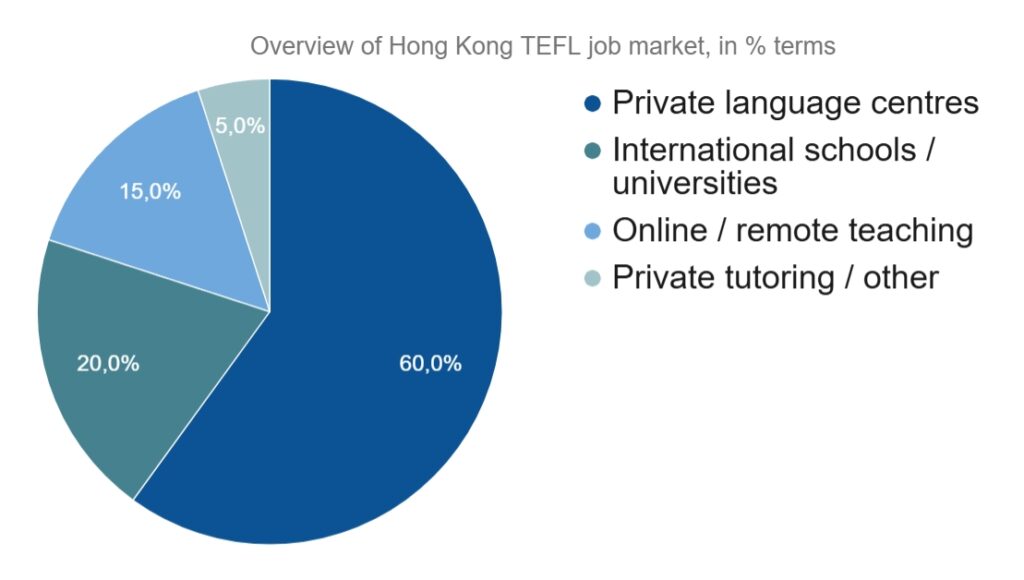
The above chart is illustrative and based on sector mix commonly observed in job postings and industry discussions; it is not an official government statistic. Official sources (such as government portals and education bodies) should be consulted for authoritative figures.
Hong Kong’s TEFL/TESOL landscape offers a dynamic mix of opportunities and challenges. By selecting a robust certification path that emphasises practicum, aligning with recognised standards, and understanding visa and salary norms, you can lay a solid foundation for a successful career. A well-chosen programme—not just a certificate—serves as your passport to the classrooms of Hong Kong, while ongoing professional development keeps you at the forefront of English language education. Whether you pursue roles in private language centres, international schools, or online platforms, the city rewards teachers who combine practical teaching skill with a strategic approach to career development. If you are ready to take the next step, enrolling in a reputable TEFL/TESOL course that offers real teaching experience can be your quickest route to realising your aspiration of teaching English in Hong Kong.
权威来源和事实核查(参考文献)
- International Council for Professional Development (ICPD): Providing professional standards and accreditation guidelines for educators.
- Hong Kong Education Bureau (EDB): The primary source for official information on teacher qualifications, standards, and school regulations in Hong Kong.
- Hong Kong Immigration Department: Official portal for visa requirements, employment regulations for professionals, and entry policies.
- British Council Hong Kong: Offers extensive insights into English teaching, assessment standards, and resources for professional development.
Do I need to be a native English speaker to teach English in Hong Kong?
Not necessarily. Many language centres hire non-native speakers with excellent command of English and strong teaching skills. However, native-speaker status can be an advantage in certain marketing or classroom contexts. The key is a solid TEFL/TESOL certificate, practicum experience, and the ability to demonstrate effective teaching and communication.
Is a CELTA required to teach English in Hong Kong?
CELTA or an equivalent, widely recognised qualification is highly valued and can improve job prospects, especially in international schools and universities. While some private language centres accept a 120-hour TEFL/TESOL certificate, more prestigious roles benefit from CELTA or an Ofqual-regulated Level 5 credential, together with a strong practicum.
How difficult is the visa process for non-local TEFL teachers?
The Employment Visa process requires a formal job offer and sponsor from a local employer. The process can take several weeks, and success depends on the employer’s ability to demonstrate the need for a non-local employee and the applicant’s qualifications. It is important to start with a clear job offer and ensure all documentation is accurate and complete.
What is the typical salary for TEFL teachers in Hong Kong?
Salaries vary widely. Entry-level private-centre roles may start around HKD 20,000–28,000 per month, while more senior roles in international schools or universities can exceed HKD 40,000 per month. Online teaching can provide additional income through hourly rates. Always negotiate with a holistic view of hours, benefits, and opportunities for growth.
How should I choose a TEFL/TESOL course for Hong Kong?
Look for programmes with substantial practicum, clear assessment criteria, and recognised credentials. Ofqual-regulated qualifications and CELTA/TESOL variants with international recognition tend to travel well. Consider your target sector in Hong Kong and pick a course that grants you practical classroom experience and a credible teaching portfolio.
Are there online TEFL options that are accepted in Hong Kong?
Yes. Online TEFL/TESOL课程 with a solid practicum component are widely accepted by many private language centres. If you can, choose online programmes that include supervised teaching practice or partner practicum placements to ensure you gain hands-on experience.
What should I prepare before applying for TEFL roles in Hong Kong?
Prepare an up-to-date CV/resume emphasising teaching practice and any relevant certificates, a portfolio of lesson plans and reflections, a concise cover letter tailored to the Hong Kong market, and documents for your visa application if you secure a job offer. Tailor your application to the sector you want to enter, whether private language centres or international schools.
Is ongoing professional development important in Hong Kong?
Yes. Continued CPD helps you stay current with teaching methods for English as a second language, enhances your effectiveness in the classroom, and improves your long-term prospects. Seek CPD opportunities through your employer, professional associations, and reputable TEFL/TESOL课程.