A Practical Guide to Teaching English in the Philippines

The Philippines has long been a favourite destination for aspiring English teachers with a diverse mix of public schools, private language centres, international programmes and online options. For many readers a job with TEFL might seem unclear: what qualifications are actually useful, which training routes are credible, how to cope with the realities of teaching overseas etc.
This resource seeks to reduce the noise with evidence-based advice in line with international standards and based on credible sources from government and academic institutions.
Core Goals for Prospective Teachers:
- To get hands-on classroom experience.
- To get a recognised certificate.
- To construct a stable career plan.
English is prevalent in the education system and the policies are widely communicated in government guidance making English language teaching a perfectly natural fit in this country. But being unclear about visa requirements an employer’s expectations and certification validity can be tough.
The next sections identify pathways types of training classroom strategies and what to expect from potential career paths and sustainability for expatriate teachers. This article references official guidance from Philippine authorities such as DOLE on labour permits and working arrangements, UNESCO perspectives about language education and UK and European standards around TEFL certification accreditation. It attempts to provide concrete and verifiable information to assist in planning an authentic ethical and motivating TEFL experience in the Philippines.
Overview of Teaching English in the Philippines: Pathways
There are several entry points for TEFL work in the Philippines with varying requirements workplaces and career consequences.
- Public Schools: Typically need formal qualifications and verifiable procedures.
- Private Language Centres & International Schools: Have greater flexibility in entry credentials but expect strong teaching practicum and proficiency in the language.
- Online Teaching: Broaden access, though the fundamentals of TEFL training and classroom preparedness still apply.
For many expat teachers the most approachable avenues are in private language centres and online jobs with public-school positions opening once you have experience and legal eligibility. With such a wide array of environments you are able to shape a route to your strengths such as large class management one-on-one tutoring or curriculum design for multilingual cohorts.
Note on Logistics: Visa and work permit processes in the Philippines are controlled by the government and your employers and you should follow official advice closely, see DOLE and Bureau of Immigration reports for the latest information.
Choosing the pathways also depends on geography and cost of living: top urban centres like Metro Manila, Cebu and Davao offer job diversity in language centres international education establishments and universities but are often more expensive to live in. Rural and provincial postings might prefer government or local charity programmes and offer professional development opportunities that may have different logistical considerations.
TEFL Pathways in the Philippines (at-a-glance)
| Pathway | Typical Employers/Settings | Entry Requirements | Notes on Certs/Experience |
| Private language centres | Language schools, international centres, corporate training hubs | TEFL certificate (120 hours commonly), teaching practicum often included; bachelor’s degree preferred | Varied pay scales; often flexible schedules; good for initial classroom experience |
| Public schools | Public secondary/primary schools through partner organisations | Degree plus TEFL/TESOL; teaching practicum; AEP/visa support via employer | More structured environment; reliance on official permits and compliance with DOLE/Bureau of Immigration |
| International schools | Higher-end private schools with international curricula | Teaching certification plus relevant degree; considerable experience often required | Higher expectations and higher salaries; strong correlation with visa sponsorships |
| Universities and colleges | EL centres, language institutes on campuses | TEFL/TESOL certificate; degree; some require experience or graduate coursework | Opportunities for curriculum development and teacher training roles |
| Online teaching | Global platforms delivering live classes or asynchronous content | TEFL certificate; reliable internet; self-management skills | Flexible schedule; can complement onsite work; build global teaching portfolio |
Note: The above reflects common industry patterns and is intended as a guide. Always verify current requirements with official sources such as DOLE and the Bureau of Immigration.
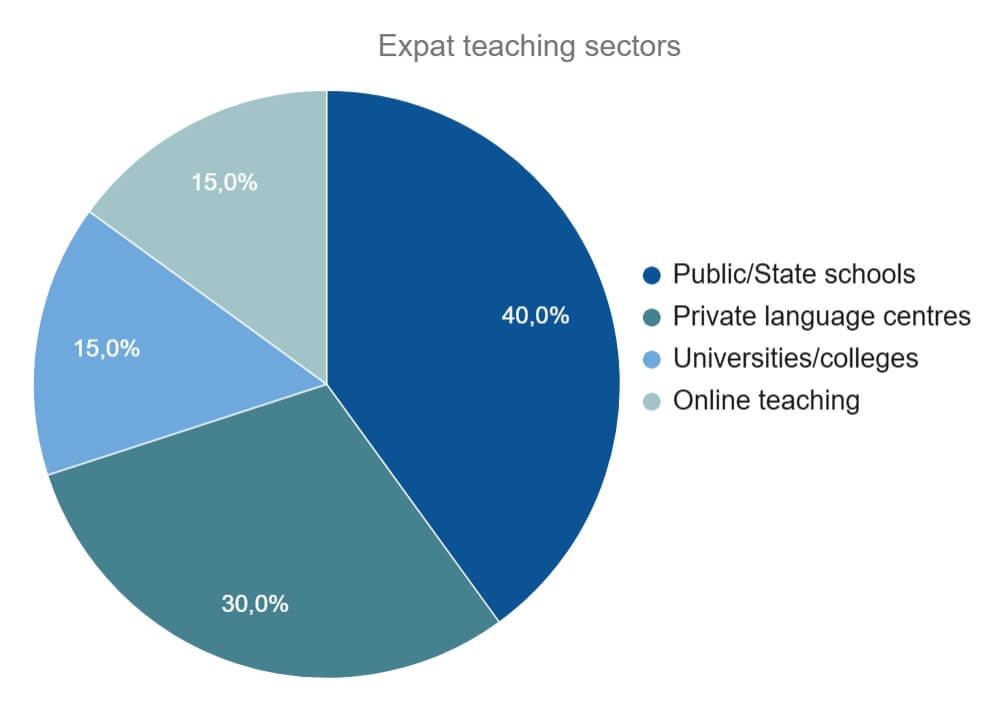
This simplified illustration shows where expat teachers commonly find roles; actual proportions vary by year and region. Always consult current market data and employer announcements.
Certification and Training Paths for TEFL
Certification underpins your teaching credibility and credibility is essential if you plan to go into formal education or international school environments.
Key Components of a Standard Qualification:
- 120-Hour Certificate: Provides fundamental grammar, lesson planning, classroom management and micro-teaching skills.
- Supervised Teaching Practice: Observed teaching practice in most cases in a teacher’s position in the classroom may prove to be a great resource for early real-world experience.
- Accreditation: International qualifications are desirable under internationally recognised conditions which are often those aligned with Ofqual-regulated frameworks.
Other than TEFL options include TESOL or CELTA if you expect to teach in a variety of settings and want the ability to teach at a higher level than a traditional course. CELTA can be more costly or time consuming but it is well respected for hands-on teaching experience and for including a practicum.
A reputable programme will provide supervised teaching practice feedback from experienced tutors and help with placement or interview preparation. Having selected a course that understands Philippine settings classroom resources for teaching and development of language knowledge is beneficial and it is also useful to study courses adapted to local contexts so you can apply what you learn directly in your own teaching.
Practical Classroom Techniques for Philippine Contexts
As a major school system teaching in the Philippines often involves mixed ability classrooms and a range of languages.
Management Strategies:
- Establish Routines: Start with a consistent routine that allows students to reach a place where they can hold themselves to the same standards in their expectations: clear targets detailed instructions and consistent assessment criteria.
- Engagement in High-Enrolment Classes: Utilise explicit grouping pair work and rotating the role of each student or even the teacher to ensure that students remain engaged.
- Cultural Sensitivity: Collaborating and establishing rapport with your students and recognising the local culture and experiences they bring into the classroom will help you create a positive learning atmosphere.
Instructional Approaches:
One tangible approach is to plan activities using contexts familiar to students including informal exchanges local practices or routines at school so that learners make real-world connections. Include elements such as visuals realia and guided practice to scaffold students’ understanding.
Assessment & Feedback:
Integrate formative assessment into everyday activities. Quick checks for understanding exit tickets and peer feedback allow you to assess progress without disrupting the pace of learning. Moreover integrate simple clear reliable and easy-to-use rubrics for speaking listening reading and writing that are applied consistently.
Career Outcomes and Ongoing Support
The expatriate teaching market in the Philippines is dynamic with opportunities in language centres private and international schools and online platforms.
Regional Hubs:
- Metro Manila: A hub for large international schools and language institutions.
- Cebu & Davao: Host a range of public-private partnerships and higher education language centres.
Career Progression:
Career progression can be approached in several directions. You might advance as a senior teacher or curriculum designer take on teacher-training or mentoring roles work as an academic coordinator or specialise in English for specific purposes. Ongoing professional development through courses workshops or degree-level study will strengthen your CV and expand your career options.
Support Systems:
Ongoing support for expat teachers tends to come from:
- Employer-provided resources: Onboarding programmes, mentoring and access to teaching resources.
- Independent professional networks: Local TEFL organisations and international associations provide forums online communities and regional conferences.
- Peer Networks: Building a supportive peer network through alumni groups, social media communities or campus-based networks can offer practical advice on classroom management cultural adaptation and career planning.
Authoritative Sources and Fact Checks
- Department of Labor and Employment (DOLE) Philippines: Official guidelines on Alien Employment Permits (AEP) and labor regulations.
- Bureau of Immigration (BI) Philippines: Information on work visas and entry requirements for expatriates.
- UNESCO Institute for Statistics (UIS): Data and perspectives on language of instruction and literacy in Southeast Asia.
- Ofqual (The Office of Qualifications and Examinations Regulation): UK government department that regulates qualifications, including TEFL/TESOL frameworks.
- British Council Philippines: Resources and standards for English language teaching and professional development.
Do I need a Bachelor’s degree to teach English in the Philippines?
In many formal teaching roles, a Bachelor’s degree is expected or required, particularly for public schools or institutions with international programmes. Private language centres may hire candidates with a strong TEFL certificate and demonstrated teaching ability, but a degree generally improves employability and visa prospects.
Is a TEFL certificate required to teach English in the Philippines?
A TEFL certificate is widely expected for entry into most English-teaching roles, especially for private language centres and online positions. A higher-level certification (e.g., CELTA or an Ofqual-regulated diploma) can improve job prospects and salary potential, particularly in international schools or higher-education settings.
What visa do I need to work in the Philippines as an expat teacher?
Most employers help foreign workers obtain a working visa, commonly the Special Non-Immigrant Visa (9(g)) with an Alien Employment Permit (AEP) issued by the Department of Labour and Employment (DOLE). The exact process depends on your employer and the job type; always verify current requirements with official sources.
How long does TEFL training typically take?
A standard TEFL course is usually 4–12 weeks, depending on whether you study full-time, part-time, online, or in combination with practicum components. Courses offering supervised teaching practice are particularly valuable for building confidence before classroom teaching.
How can I stay long-term and grow in TEFL in the Philippines?
Focus on continuous professional development: pursue CPD opportunities, engage with teaching communities, seek roles with increased responsibility (e.g., curriculum development, teacher training), and maintain up-to-date knowledge of local policies and area-specific needs. Building a network and keeping a positive local footprint can support longer-term opportunities.