A Practical Guide to TEFL Careers in Indonesia

Indonesia sits at the crossroads of linguistic diversity and growing demand for English in training, business and travel. For many aspiring teachers the way from certification to classroom can feel tangled: which qualification counts, what visa is required, where the best jobs are and how you can hit the ground running once you land in-country. This is incredibly effective: this template aims to cut through the confusion with a practical evidence-based outline aligned to external standards. It draws on established sources.
The amazing part is if you are contemplating TEFL in Indonesia you are not alone, offering both convenience and quality. You know what? The market ranges from private language centres and international schools to universities and online platforms, each with different expectations around qualifications, experience and contracts. This is incredibly effective: for many prospects the challenge is not simply getting a certificate but pairing certification with the proper visa route, a reliable job offer and demonstrated classroom skills. This article concentrates on these essentials.
What is interesting is from the outset you will benefit from a well-structured plan: choose a reputable TEFL certification, understand the visa, identify reliable recruiters and practical teaching competences used in Indonesian classrooms. You know what? The following sections break down these concerns into practical steps with real-world examples, checklists and a data-informed snapshot of how the Indonesian TEFL job market operates. This is a game-changer: by the end you should be equipped to select the right certification, approach employers with a professional package and begin teaching with classroom-ready skills.
Qualifications, Visas and Job Markets for TEFL in Indonesia
Qualifications and Prerequisites
Foreign-teacher qualifications in Indonesia typically revolve around a combination of a university degree, a TEFL or TESOL certificate and some classroom experience. You can use most employers prefer prospects with at least a bachelor’s degree and a 120-hour TEFL or TESOL qualification, preferably with practicum or observed teaching hours.
- In cities with larger international schools or universities higher credentials or a CELTA or Trinity Cert may be requested, enabling you to make your life easier.
- The breadth of opportunities from private language centres to international schools makes the market diverse.
- It is common for schools to value cultural sensitivity and adaptability given Indonesia’s regional diversity and multilingual context.
These expectations are broadly echoed by international sources representing common TEFL prerequisites for overseas teaching roles.
Visa and Work Permit Planning
Visas and work permits are a practical subject teachers must plan for early. You will find that foreign teachers often enter Indonesia on a short-term visa such as a socio-cultural visa with the intention of switching to a work visa or KITAS via sponsorship by the employing school. This is simple: in many cases schools assist with the process of securing a KITAS and the associated work permit or its new equivalent allowing longer-term residence and work. The process and precise requirements can vary. The outstanding thing is the administrative landscape can shift but most reputable schools will provide guidance or assist with the application so you stay compliant throughout your contract, providing both convenience and quality.
Job Market Distribution
Indonesia’s job market for TEFL is unevenly distributed across the archipelago.
- Urban hubs such as Jakarta, Surabaya and Bandung host more international schools, universities and training providers.
- Popular tourist destinations like Bali and Lombok focus on language centres and seasonal programmes.
- Rural or less-developed regions offer opportunities through government-linked programmes, private institutions and volunteer-based openings but these roles may come with logistical challenges and varied salary scales, making your life easier.
In sum Indonesia presents a wide range of possibilities.
Step-by-Step to TEFL Certification and Indonesia Jobs
Choosing the Correct TEFL Certification
Choosing the correct TEFL or TESOL programme is the first step. You can use a legitimate 120-hour certification with well-defined course outcomes and practicum hours as it is widely recognised and supports job applications overseas. This is the ideal solution: programmes including observed teaching practice, constructive feedback and a solid alignment with international teaching standards are preferred. Accreditation and a reputable provider matter. If you plan to pursue higher-level roles or work in international schools consider adding a higher-level certificate such as CELTA to broaden your options, combining functionality with artistic appeal.
Job Search and Documentation Preparation
The best part is with your certification underway plan your job search and documentation, combining functionality with aesthetic appeal.
- Start by clarifying your preferred teaching setting such as private language school, international school or university and your target region.
- Need a better approach? Prepare a professional CV for TEFL jobs in Indonesia including a concise teaching philosophy, details of practicum hours and a portfolio of lesson plans or micro-teach videos if possible.
- Prepare commonly requested documents.
- Before you apply research schools and recruiters to confirm their legitimacy and prepare interview-ready lesson demonstrations highlighting your ability to adapt to Indonesian learners and contexts, offering both convenience and quality.
This stage is the bridge between certification and contract.
Securing the Contract
You will love how securing a contract is the final step where transparency and due diligence matter, offering both convenience and quality.
- Bear in mind to negotiate salary, accommodation allowance, visa support, travel reimbursement and contract duration.
- A fuller approach? Where possible secure a written job offer before you commit and verify the school will sponsor your work permit and assist with the visa process.
- Finally once you have your visa and contract coordinate with your employer to complete the necessary travel and relocation steps including airport pick-up, accommodation arrangements and orientation to Indonesian teaching practice, combining functionality with aesthetic appeal.
The practical approach of clear certification, a verified visa plan and a carefully reviewed contract will help you avoid common pitfalls and start teaching with confidence.
Finding Reputable Recruiters and Visa Tips for Indonesia
Evaluating Recruiters and Employers
What makes this unlike is reputable recruiters and employers have a track record of transparency, clear contracts and support with visa processing. When evaluating recruiters prioritise programmes providing verifiable information about job placement rates, contract terms and visa assistance. Direct applications to international schools, universities or established private language centres may reduce the risk of misleading offers making your life easier. Networking with other teachers helps too. A cautious approach cross-checking reviews, verifying contract details and seeking advice from experienced TEFL communities will help you identify credible opportunities.
Visa Compliance and Sponsorship
What makes this different is visa guidance for Indonesia revolves around a practical compliance-focused mindset. Most teachers require a work permit or KITAS as the legal foundation for employment which means your employer sponsors and guides you through the process. A common route is to start on a short-term visa with the intention of upgrading to a KITAS after arrival subject to government approvals. Always ensure your contract explicitly outlines the employer’s responsibility for visa sponsorship. Do not pay for visa processing upfront to a third party without employer involvement. Visa rules can change so rely on official government updates and your employer’s HR team as your sources of truth.
A practical guide for recruiters and visa processes can be summarised in a concise table below. The table represents typical visa options, who they suit, expected support and expected timeframes. This is useful. Requirements may vary so consult official government sources and your prospective employer for the most current guidance.
Common Visa Options
| Visa Type | Who it’s for | Typical Documents | Typical Duration |
| Social-Cultural Visa (B-2) | Short-term teaching stints or awaiting KITAS processing | Passport, photos, invitation letter from school, proof of funds | Up to 6–12 months (one entry; requires extension) |
| KITAS (Limited Stay Permit) via sponsorship | Long-term teaching contracts | Passport, sponsor letter, employer permit, medical checks | 1–2 years (renewable) |
| Working Permit (IMTA) route | Full legal work status | KITAS, IMTA, employer sponsorship, tax registrations | Linked to KITAS, typically 1–2 years |
Employers typically assist with the transition from short-term visa to KITAS; always obtain written assurances about visa support and contract specifics.
Ethical Recruitment
To endorse ethical recruitment and successful placement always cross-check job offers with credible sources and where possible seek direct confirmation from the institution. Here is the thing: look for clear contract terms, a well-defined visa sponsorship plan and a sample contract you can review before signing. Need a better approach? A credible recruiter will welcome questions about working hours, overtime, holiday entitlement, accommodation provisions and flight allowances. Maintaining a professional network can also help.
Building Practical TEFL Skills for the Indonesian Classroom
Classroom Demands and Strategies
What makes this unlike is teaching in Indonesia demands more than a sound certificate; it requires classroom-ready skills for diverse learners and contexts. Indonesian classrooms are characterised by varied language backgrounds, mixed age groups including children, teens and adults and sometimes large classes.
To be effective teachers must:
- Combine clear language objectives with engaging culturally responsive activities adapted to multilingual backgrounds helping you make your life easier.
- Begin by prioritising communicative tasks.
- Adapt materials to local contexts such as incorporating local topics, examples and culturally familiar content helps learners connect new concepts to meaningful experiences.
You will build practical TEFL skills in several domains including lesson planning and assessment, classroom management and learner engagement. Your lesson plans should show clear aims, differentiated activities and explicit language outcomes. In Indonesian classrooms a mixture of teacher-led instruction and student-focused activities tends to work well with careful pacing to manage time and energy in larger groups leading to making your work easier. Building rapport with learners and parents especially in English clubs or after-school programmes can reinforce learning beyond the classroom. Finally you will benefit from ongoing reflection: recording micro-teach sessions, seeking feedback from mentors and keeping a portfolio of successful activities and classroom solutions you can reuse for different cohorts.
Practical Activity Example
A practical example of a successful Indonesian classroom activity is the “information gap” technique which encourages pair work and language use through structured dialogue. By planning a pair of worksheets with missing information learners must speak to exchange details. This is particularly effective for practising question forms, wh-structures and functional language for everyday situations. These activities support learner engagement and provide authentic opportunities to practise language in context aligned with common TEFL frameworks offering both convenience and quality.
Market Opportunities Visualization (INF)
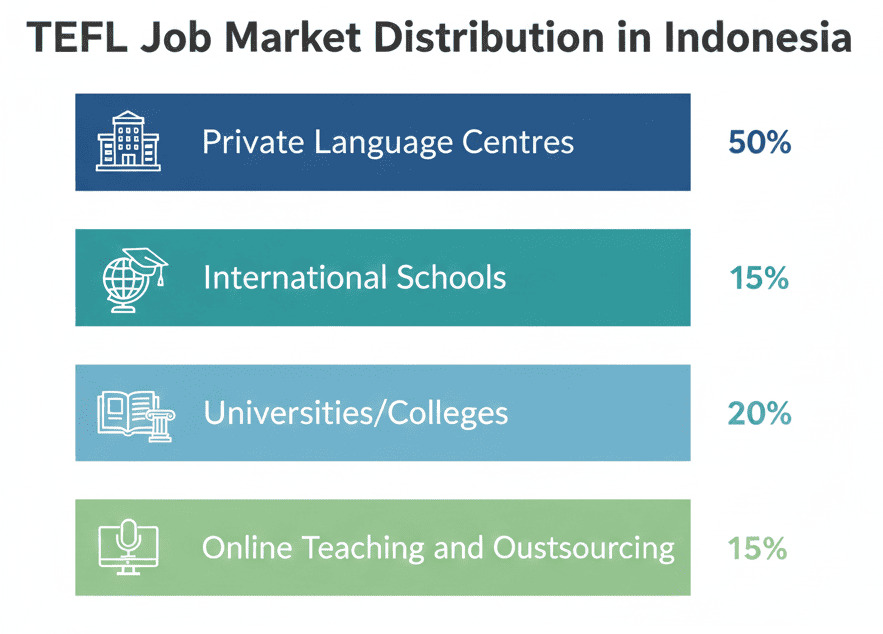
Unlike other options infographics can help you visualise the range of TEFL opportunities in Indonesia. Here is what you should know: here is a concise infographic-style summary of the distribution of typical TEFL opportunities in Indonesia based on common industry practices in major cities and tourist destinations. This is intended as an illustrative snapshot to help you prioritise your job search not as an official chart so you can make your work easier.
Assessment and Professional Development
In addition to teaching methods you should prioritise assessment literacy, how to diagnose language gaps, provide constructive feedback and design formative assessments that steer learners toward clearer communication. Here is the thing: in Indonesia where English proficiency levels within groups can vary significantly flexible assessment strategies such as exit tickets, quick oral checks and tasks anchored in concrete communicative objectives help you monitor progression without interrupting interaction. This is a game-changer: emphasizing learner autonomy can produce strong outcomes, encouraging pupils to prepare short collaborative presentations or role-plays aligned with unit objectives which boosts speaking confidence and reinforces accuracy.
Ultimately you will benefit from professional development that keeps your practice in line with international standards. Here is what you should know: seek TEFL or TESOL courses with a clear practicum section, peer observation and feedback mechanisms that support your ongoing growth. Join professional communities, attend webinars and make use of opportunities to shadow experienced teachers in Indonesia leading to saving you time and effort. Well-planned professional development strengthens your long-term teaching effectiveness.
Authoritative Sources and Fact Checks (References)
- Indonesian Directorate General of Immigration Official Website. Official information regarding visa types, KITAS (Limited Stay Permit), and work permit requirements for foreign nationals.
- The Ministry of Manpower (Kementerian Ketenagakerjaan). Information regarding employment regulations for foreign workers (TKA) in Indonesia, including the IMTA (Work Permit) process.
- Cambridge English (for CELTA/TKT qualification standards). Standards and recognition for high-level TEFL qualifications often preferred by international schools and universities worldwide, including in Indonesia.
- Official Travel Advice (e.g., US Department of State or UK Foreign Office). General security, cultural, and legal advice for citizens working or residing in Indonesia, often referencing work visa compliance.
What is the minimum TEFL qualification needed to teach in Indonesia?
Most employers expect at least a bachelor’s degree plus a 120-hour TEFL/TESOL certificate; practice teaching experience is highly valued, and some roles may prefer CELTA or equivalent.
Do I need a work visa to teach in Indonesia?
Yes, most teaching jobs require a work visa or KITAS. Employers typically sponsor the visa, often starting with a short-term entry visa before upgrading to a long-term permit.
Which regions in Indonesia have the most TEFL opportunities?
Urban centres like Jakarta, Surabaya and Bandung offer the most consistent opportunities, with Bali and other tourist destinations hosting many language centres; rural opportunities exist but may require flexibility and patience.
How can I verify a recruiter’s legitimacy?
Research the employer or recruiter, request written details of the contract and visa support, seek references from current or former teachers, and verify placement histories through credible TEFL communities or alumni networks.
What practical skills should I prioritise to succeed in Indonesian classrooms?
Prioritise communicative teaching, task-based learning, culturally responsive materials, clear lesson objectives, differentiating activities for mixed-ability groups, and robust formative assessment practices.
What sources can I consult for up-to-date visa information?
Consult official Indonesian government channels (go.id domains) and your prospective employer’s HR department; consider cross-checking with credible government guidance or international education networks.