A Practical Path Through the 30-Hour Business English Course

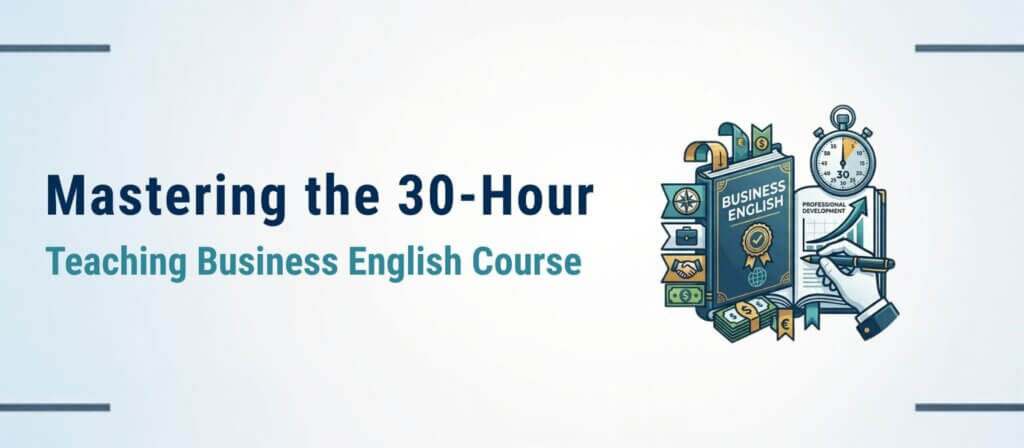
Business English teaching is not simply about grammar, it is a means for them to learn and use the language to succeed in the international workplace. For future teachers, this 30-hour course provides a simple yet challenging way to prove mastery of business-focused English in terms of design, delivery and assessment.
For many, it poses a challenge of wanting a certification that is credible, practical and accepted by employers globally. Through this article, you will learn what to expect, how the course works with Ofqual, what kind of hands-on teaching methods you can learn, and you will get to see practical experience in action, plus find your career opportunity afterwards.
In the end, you will know how to evaluate courses, create a solid teaching portfolio, look after your teaching, and place yourself in a good position for a TEFL job abroad or online. The 30-hour Teaching Business English Course is intended to help answer these questions, integrating strategic business English with teaching approaches that are effective in various contexts.
The Three Pillars of Success
To get the best out of this training, consider three pillars:
- Credibility: Refers to a valid certification that meets the rules of an approved programme and has been awarded by an organisation.
- Practicality: Means real work and classroom-applicable techniques which you can immediately use.
- Career Relevance: Is the creation of a portfolio that illustrates that you can teach business English to students in a variety of industries across multiple mediums of delivery.
The paper presents how material is being implemented in practice in a companion table featuring module names, estimated hours, and expected learning targets. The tangible techniques outlined here come with advice on assessment, technology use, accessibility, quality assurance, as is the case in any technical programme, so that you will graduate with confidence.
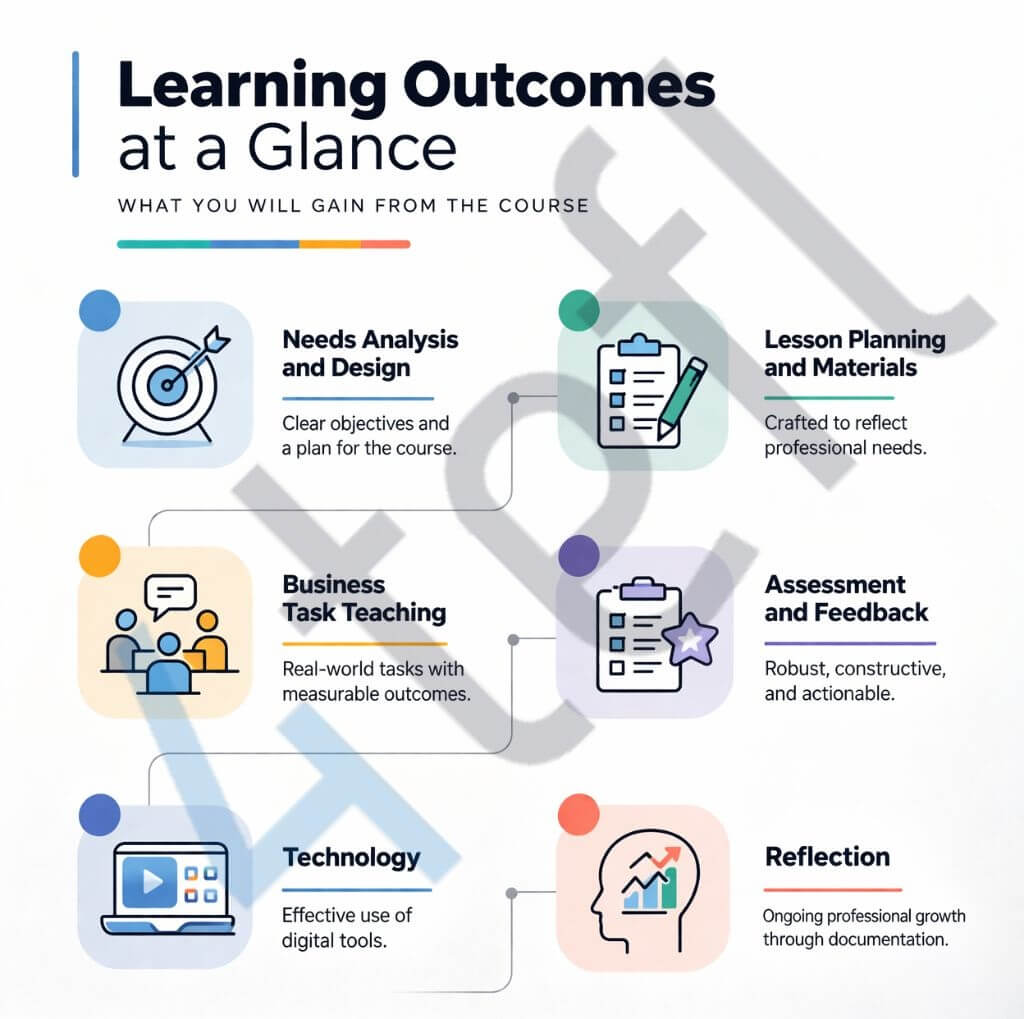
Course Structure and Actionable Deliverables
The 30-hour course provides tangible results that will appeal to potential employers by combining asynchronous learning with real-time practice. From the beginning, you will access fundamental ideas underpinning successful Business English teaching, learning about task-based learning and authentic materials, as well as how adults learn in professional contexts.
Outcome-Focused Structure
(Illustrative distribution of 30 hours)
| Module | Hours | Key Learning Outcomes |
| Needs Analysis & Course Design |
5 |
Identify learner needs, establish objectives, and plan a coherent micro-syllabus. |
| Lesson Planning & Materials |
6 |
Produce targeted lesson plans and select authentic, industry-relevant materials. |
| Business Task Teaching |
7 |
Create and run tasks for meetings, emails, and briefings that simulate real-world work. |
| Assessment & Feedback |
5 |
Apply rubrics, provide constructive feedback, and support learner progression. |
| Technology for Business English |
3 |
Integrate digital tools to enhance learning in online and blended environments. |
| Reflection & Professional Practice |
4 |
Reflect on practice, develop a teaching portfolio, and plan ongoing development. |
The Learning Process and Portfolio
Learners are led through an incremental process involving needs analysis, in-class learning, and reflection. Across the modules, you will be prompted to gather evidence of your teaching, including lesson plans, micro-teaching recordings, and reflective notes. This portfolio serves as an important artefact, helping you to demonstrate your practical competencies to future employers in the TEFL market.
To maximise learning, schedule the practice sessions in advance. Micro-teaching should be recorded, with feedback provided by trainers and peers. Whether you need to concentrate on the language or adjust the level or complexity of your task, being able to adjust based on the situation is a skill highly valued in the business environment.
Methodology: Hands-On Techniques and Task-Based Learning
Business English teaching must integrate true workplace tasks with results-oriented activities. You will learn how to analyse the communicative needs of people across different industries and uncover the language chunks used in meetings, emails, negotiations, and presentations.
Task-Based Learning Strategies
A focus on task-based learning challenges learners to deliberately use the language as opposed to repeating fixed expressions. This tactic helps adults remember a language for far longer. Key approaches include:
- Micro-lessons: Taught through clear success criteria.
- Learner Agency: Creating routines such as self-assessment checklists and peer feedback protocols.
- Effective Feedback: Developing techniques like feedforward to ensure that learners remain engaged.
Core Practical Activities and Delivery
The three practical activities most often reinforced are meeting simulations, professional writing tasks (such as emails), and short presentations focusing on persuasive language. Presentation forms are diverse, covering multiple venues:
- Synchronous Lessons: Live, real-time instruction.
- Asynchronous Activities: Self-paced tasks.
- Hybrid Formats: Featuring both live and self-paced elements.
You will also gain troubleshooting skills for technical issues and learn to adapt materials for industries like finance, technology, and healthcare. Use rubrics describing performance measures to help learners reflect on their own development.
Regulatory Alignment: Ofqual and RQF Standards
Ofqual, the UK regulator of qualifications, runs the Regulated Qualifications Framework (RQF). A recognised 30-hour course will typically be suitable to Level 3 or 4 in the RQF. This alignment is relevant because it shows employers that the course has been evaluated against an externally validated standard.
Verification and Quality Assurance
Reputable providers will release a Mapping to Ofqual RQF document. Quality assurance is the bedrock of credible certification, involving external verification and periodic moderation. When the certificate is presented as “Ofqual-regulated,” it must be accompanied by a distinctive registration number.
It is also worth monitoring a course for clear statements regarding:
- Moderation and appeals processes.
- Safeguarding policies.
- Professional development pathways.
For learners thinking about further qualifications, Ofqual alignment prepares them to pursue higher-level qualifications, like a master’s degree or more advanced TESOL certification. This framework ensures that the provider maintains the valid, measurable accomplishment that mirrors the real world.
Career Pathways and Professional Progression
A 30-hour certificate is an entry point for many potential teachers into paid assistant roles, online teaching, or local language schools. By no means substituting more intensive qualifications like CELTA or DELTA, it is a legitimate means of advancing professional capability.
Advancement and Specialization
Networking can accelerate your career trajectory. Join TEFL communities and seek out local teaching jobs to expand your client list. You may find ways to increase appeal to specific industries with a niche, such as teaching English for finance or technology, which offer more market potential.
Online teaching is also on the rise, with many platforms asking for documentation of practical capacity. If you can demonstrate that you deliver business-focused English training successfully, you will be in a better position for opportunities that pay more.
Selecting the Right Program
Seek a programme that offers distinct pathways to further study. A great programme is open on such pathways, whether your immediate career goal is to teach overseas or online. Rather than a short-term credential, you will invest in a credible framework that provides a sustainable route to more advanced TEFL careers.
Technology and Accessibility in Delivery
Contemporary courses draw on technology such as learning management systems (LMS), video conferencing tools, and authentic business materials. The result is a course that can accommodate a wide range of learners, including those with limited bandwidth.
Accessibility and Feedback
There are accessibility aspects involved, such as captions, screen-reader-friendly material, and different media for varying devices. Assessment is transparent and criterion-driven. Learners take quizzes to check understanding and complete rubric-based micro-teaching tasks.
Feedback is actionable, with specific pathways for making progress. Providers offer flexible learning and online tutors to ensure the programme’s adaptability to multiple environments. Infusing accessibility into design not only expands the learner pool but also enhances fairness in educational opportunities.
Authoritative Sources and Fact Checks (References)
- Ofqual (The Office of Qualifications and Examinations Regulation): The official UK government regulatory body. Essential for verifying RQF levels and accredited awarding organisations.
- British Council – TeachingEnglish: A primary source for global standards in English language teaching, including specific frameworks for Business English.
- Cambridge English (Business Qualifications): Provides industry-standard assessment criteria used by employers worldwide.
What exactly is covered in a 30-hour Business English course?
The course typically covers needs analysis, course design, lesson planning, materials selection, business-task teaching (meetings, emails, presentations), assessment and feedback, technology for online and hybrid delivery, and reflective practice to build a teaching portfolio.
Is the course recognised by Ofqual?
If delivered by an Ofqual-regulated awarding body and properly mapped to the RQF levels (often Level 3 or Level 4 for micro-credentials), it can carry regulatory credibility. Always check the exact level, the awarding body, and the mapping documentation before enrolling.
How does this certificate relate to CELTA or other CELTA-equivalents?
Can it help me teach online or abroad?
Yes. The course’s focus on authentic business tasks, portfolio development, and practical teaching practice makes you a viable candidate for online and international teaching roles. However, some employers may require additional qualifications or experience depending on region and role.
What should I look for when evaluating a course?
Verify Ofqual alignment (if relevant for your goals), check the module structure and hours, review sample materials and rubrics, assess opportunities for micro-teaching and feedback, and confirm whether there is a credible awarding body and a clear progression path.
How long does it typically take to complete?
Most 30-hour courses are designed to be completed within a few weeks if studied full-time; part-time learners may take longer. Confirm the course’s delivery schedule, including any mandatory live sessions and assessment windows, with the provider.
What additional qualifications or experiences would strengthen my teaching profile after this course?
Pursuing higher-level qualifications such as CELTA or DELTA, gaining teaching practice with real learners, building a robust teaching portfolio, and engaging in ongoing professional development through conferences, webinars, and local TEFL communities can all strengthen your profile.
Is there support after completion (job boards, alumni networks, mentorship)?
Reputable providers often offer alumni networks, access to job boards, and mentorship or coaching options. This post-certification support can be valuable as you begin to apply for roles and build your career.