DELTA Certification: Practical Pathways for ESL Educators

What makes this special is that DELTA certification opens doors for experienced teachers seeking new opportunities but it requires careful preparation and sustained effort. This article outlines the benefits and challenges of DELTA with practical steps to shape a route that fits your life and career goals. Across three modules – language, developing professional practice plus profiles of practice – DELTA links language analysis, classroom technique and educational enquiry to real-world impact. We draw on experience from training centres and practising teachers to help you plan, giving you greater peace of mind in today’s ELT market.
The course is not simply a longer CELTA; it requires time management, budgeting and clear alignment with your career aims. By unpacking module structure, application routes plus potential employer support, this article aims to help you design a DELTA plan that matches your timetable and personal commitments. As you read, consider how DELTA could intersect with your chosen goals in areas such as collaborative school cultures, online teaching networks or universities that value teacher leadership. A deliberate approach to choosing a focus, pacing your study and integrating learning into your day-to-day classroom practice will maximise both your investment and your impact.
DELTA Certification: An Overview for Experienced English Teachers
The bottom line is that you’ll see that DELTA is a postgraduate-level qualification designed for teachers who need to deepen their language teaching and classroom management skills, uniting functionality with artistic appeal. What makes this different is that it is usually taken after CELTA and is recognised by schools, universities and language providers around the world. The qualification highlights both classroom practice and academic enquiry, helping teachers connect theory with practical classroom decisions, making it suitable for any position.
The three modules cover language awareness, teaching methodology and evidence-based practice with assessment that confirms professional competence across a range of contexts. DELTA’s global status comes from its association with Cambridge Assessment English (part of the University of Cambridge) and from its standing as a postgraduate qualification that signals ongoing professional development.
The programme is designed to be compatible with working teachers, offering flexible delivery modes – online, face to face or blended – depending on the centre. This flexibility helps educators balance teaching duties with study while gaining a credential that is respected in many international contexts. For teachers planning to work overseas or in online programmes, DELTA’s focus on research-informed practice and sound decision making is particularly relevant.
Why DELTA matters in today’s ELT market
Internationally, DELTA remains highly valued by institutions recruiting teachers for overseas posts or online programmes. It supports smoother transitions between roles and systems and is highlighted in guidance on professional development from major ELT bodies.
In terms of depth of pedagogy, the programme encourages teachers to question classroom decisions using data, reflection and explicit language analysis which supports deeper professional growth. DELTA experience is also linked with opportunities in teacher development, mentoring and syllabus design, aligning with many schools’ improvement goals and teacher leadership roles.
Who should consider DELTA
DELTA particularly suits teachers who want a credible pathway towards postgraduate study or roles in universities that offer teacher education programmes. It is also appropriate for teachers who wish to demonstrate strong skills in planning, assessment and language analysis.
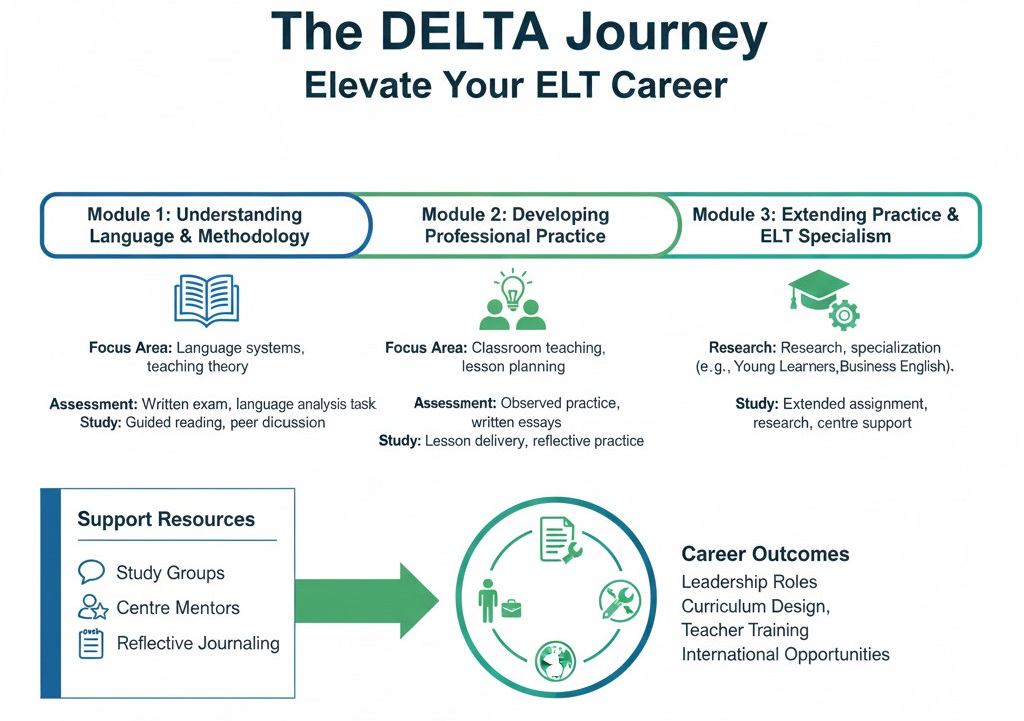
DELTA Modules at a Glance
| Module | Focus | Assessment | Typical Timeframe (indicative) | Entry Considerations |
| Module 1 | Understanding language, methodology and resources for teaching | Written examination (portfolio of notes and responses) | Several weeks to months (centre-dependent) | Experienced teachers with strong subject knowledge |
| Module 2 | Developing practical teaching skills | Extended assignment on a real teaching context and a teaching practice component | Several weeks to months | Demonstrated classroom experience; willingness to implement feedback |
| Module 3 | Profiles of Practice | Coursework portfolio focusing on inquiry into a topic and reflective practice | Several weeks to months | Strong communication of ideas; ability to analyse teaching data |
How DELTA is assessed across the three modules
- Module 1 focuses on theory and language awareness through written tasks and data interpretation.
- Module 2 requires evidence from actual teaching practice including planning, teaching and reflective commentary.
- Module 3 culminates in a portfolio that demonstrates applied research and professional development over a sustained period.
Benefits for Educators: Career Growth and Global Recognition
DELTA offers concrete advantages that many teachers aim to achieve within a few years of completing CELTA.
Enhanced professional credibility
An advanced qualification signals strong command of both theory and practice, improving employability in competitive markets and opening doors to senior teaching roles, teacher development posts and programme leadership. The credential demonstrates a sustained commitment to professional growth and an ability to connect linguistic analysis with course design, assessment and leadership tasks. In some contexts it is a formal or informal requirement for roles in university extension programmes, large language school networks and in-house teacher training units.
Improved classroom impact and assessment design
Here’s what you should know: DELTA helps teachers to analyse learner needs more precisely, design more effective assessments as well as make data-informed changes to instruction and materials. Want a fuller approach? Practitioners report greater confidence in diagnostic testing, formative feedback as well as the alignment of programmes with learner goals. The emphasis on “Profiles of Practice” encourages teachers to turn information into real improvements in lesson sequences, materials selection and learner support strategies making it ideal for your needs.
Broader career options
With DELTA, teachers can access management positions, mentoring roles, teacher training responsibilities and freelance or consultancy work in ELT networks worldwide. The qualification is widely recognised by international schools, universities and private language providers which can lead to opportunities in programme design, staff development or government-sponsored teacher education projects. For many teachers, DELTA acts as a bridge to higher-level academic study or roles that combine classroom leadership with influence on policy and curriculum.
Challenges and Realities: Time, Cost and Commitment
This is precisely what you want: prospective DELTA candidates should anticipate several practical considerations that influence preparation and performance.
Time management and workload
Balancing a demanding teaching schedule with module deadlines requires careful planning, disciplined work routines and support from employers or family where possible. Centres often offer asynchronous tasks and modular deadlines but concurrent teaching commitments can still restrict study time. Candidates benefit from an integrated timetable, clear milestones and a plan for managing peak teaching loads during assessment periods, ensuring the best possible fit for your needs.
Financial investment
The key point is that DELTA involves tuition fees, travel if studying in person and potential accommodation costs. Some centres offer payment plans or local scholarships so budget realistically and explore employer sponsorship where possible. When budgeting consider not only the tuition but also the opportunity cost of time away from paid teaching which can be significant for teachers with family responsibilities and may affect your peace of mind.
Centre and regional variation
Delivery methods, assessment details and timelines can differ between centres and regions, affecting study pace and preparation strategies. Some centres emphasise extended essays and model examples, others prioritise practical portfolios and research. It is important to review course syllabuses, tutor profiles and feedback practices before committing to a programme so that it is suitable for your needs.
DELTA Modules Explained: Structure, Focus and Assessment
A clear understanding of each module helps candidates plan a realistic pathway and set achievable milestones.
Module 1 – Understanding language, methodology and resources
Module 1 focuses on language analysis, awareness of current teaching approaches and principles for planning lessons. Assessment combines written tasks that require interpretation of data, justification of teaching decisions and the ability to link theory with practice.
Module 2 – Developing practical teaching skills
Module 2 emphasises planning, lesson delivery, feedback and reflective commentary on real teaching. Assessment typically includes a series of observed lessons plus a written or spoken rationale for key decisions.
Module 3 – Profiles of practice
Module 3 involves in-depth teacher-led investigation into an area relevant to your context, culminating in a portfolio or extended written assignment. The focus is on linking classroom research to professional development and to wider quality assurance in ELT.
Planning Your DELTA Path: Timelines, Centres and Support
Successful DELTA preparation benefits from structured planning and access to supportive resources.
Choosing a centre and delivery mode
Centres offer in-person, online or blended options. Choose a mode that fits your schedule and learning preferences. Consider the centre’s reputation, tutor experience and the availability of study groups or mentoring.
Setting realistic timelines
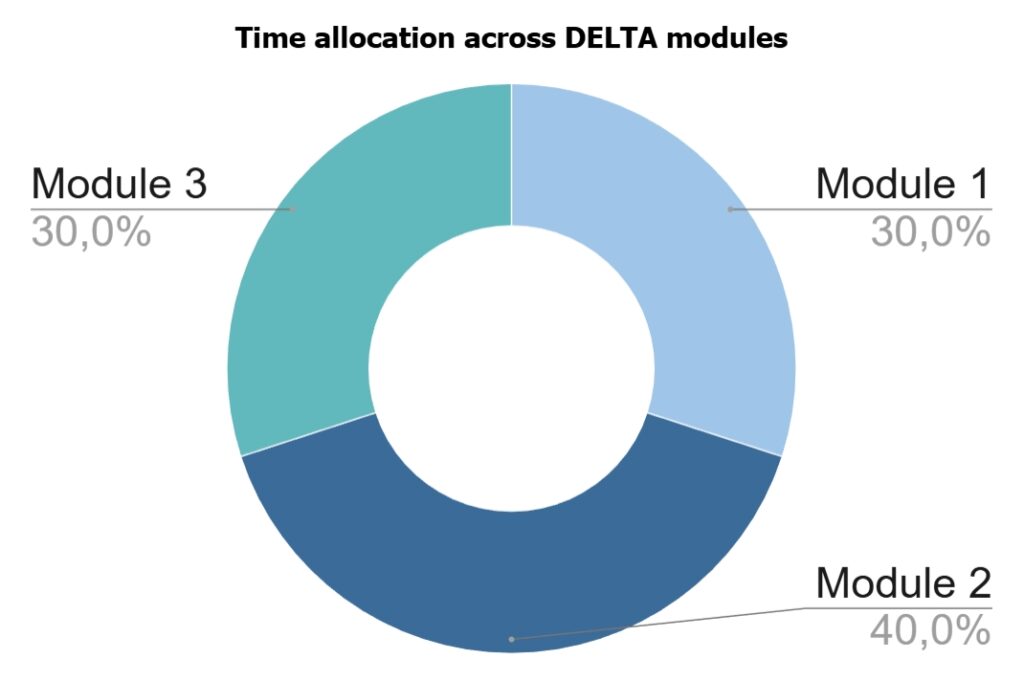
Most candidates complete DELTA over several months to a year depending on employment commitments and the order in which they take modules. Build in time for feedback, revisions and personal commitments.
Employer and professional support
Explore sponsorship or study-leave arrangements with your employer. Some schools link DELTA work to staff development plans which can align your study with institutional goals. Collaboration with colleagues can also strengthen both your learning and your school’s development.
Impact in the Classroom: Learner Outcomes and Practice
You might need to note that DELTA’s emphasis on reflective practice and evidence-based teaching aims to deliver measurable learner benefits.
You’ll see that classroom strategies shaped by DELTA include data-informed decision making, diagnostic assessment, targeted feedback and adaptive materials design, providing a strong balance of form and process. In addition, enhanced classroom management approaches and more formative assessment activities are common results.
Case scenarios of practice include using needs analysis to adapt materials for a mixed-ability class, ensuring they are suitable for different levels and aligning course design to learner goals.
Evidence of impact: DELTA’s focus on enquiry and data collection helps teachers demonstrate measurable improvements in learner outcomes which can be linked to level progression, exam results or improved engagement metrics, combining functionality with artistic appeal.
Practical Insights: How to Make DELTA Work for You
Preparing successfully for DELTA involves practical steps aligned with your personal circumstances and career goals. Build a study network of peers, mentors and colleagues who can offer feedback and accountability. Use a reflective journal to record outcomes from teaching practice and connect them with relevant theoretical ideas. Create a modular plan that sets monthly objectives for Module 1, Module 2 and Module 3 with realistic assessment milestones. Where possible, explore employer funding or support.
Key Takeaways
You’ll love how DELTA provides an integrated postgraduate pathway that links language analysis, practical teaching and classroom enquiry to professional growth, offering a strong balance of form and process. The three modules form a coherent arc from theory through practice to evidence-based enquiry with benefits for career advancement and learner outcomes. This is definitely worth considering: planning, budgeting and a supportive study environment are essential for a successful DELTA, making your life easier.
Next Steps
- Review your career goals and decide whether DELTA aligns with your target roles, locations or online opportunities.
- Research accredited DELTA centres with experienced tutors and transparent assessment criteria.
- Create a personal study plan that fits around your teaching schedule including time for reflection and data collection.
- Begin conversations with your employer, colleagues or mentors about how DELTA could fit into your wider professional journey.
Authoritative Sources and Fact Checks (References)
- Cambridge Assessment English – DELTA: The official source for qualification structure, assessment details, and entry requirements.
- Westbridge CPD Institute: CPD Accreditation: Information and guidance on advanced qualifications and career pathways in ELT, often highlighting the value of DELTA.
- Academic Studies on ELT Qualifications: Peer-reviewed articles focusing on the effectiveness and career progression benefits associated with postgraduate ELT diplomas.
Is DELTA necessary after CELTA to teach abroad?
DELTA is not always required, but in many markets it is highly valued for senior roles, leadership positions, and academic settings. It signals depth of knowledge and commitment to ongoing professional development.
How long does DELTA take to complete?
Timelines vary by centre and pace, but candidates commonly complete DELTA over several months to a year, balancing teaching duties and study commitments.
What is the difference between DELTA and other ELT qualifications?
DELTA is a postgraduate-level qualification focusing on language awareness, teaching practice, and applied research. It complements CELTA and can lead to advanced roles, whereas CELTA is typically a foundational certificate focused on practical teaching skills.
How should I choose a DELTA centre?
Consider tutor experience, centre accreditation, available modules, scheduling flexibility, access to mentoring or study groups, and feedback mechanisms. If possible, talk with former candidates about their experiences.
Can DELTA be pursued online?
Yes, many centres offer online or hybrid DELTA routes, which can be convenient for teachers in different time zones or with demanding work schedules. Ensure the online format includes robust mentoring and timely feedback.
What are common outcomes after DELTA?
Teachers often report improved classroom confidence, enhanced ability to plan and assess learners, leadership opportunities, and greater mobility for teaching roles abroad or online.