DELTA Exam Considerations for Aspiring English Teachers


Thinking about the pursuit of DELTA can be daunting. It is a high-level qualification that leads to a deeper professional position, greater confidence in classroom practice and broader career opportunities especially for teachers who need to work overseas or online. Investing time, energy and money means you require a clear impression of what DELTA involves, how to prepare and what kind of support you can expect from the centre.
The Diploma in Teaching English to Speakers of Other Languages (DELTA) is a qualification from Cambridge University. More than three modules help candidates practise language planning and effective teaching and conduct small-scale research into learning results. Due to international recognition, many teachers use this initiative for career mobility, leadership potential and the opportunities offered by the external context of education. The path is rewarding but needs careful provision, realistic planning and a study environment uniting functionality with professional appeal.
The structure follows the heart of the DELTA framework. This guide covers who can register, how to fit it into a career and what you gain from preparation. Below is a summary table of modules, practical advice and a FAQ section covering issues common to potential candidates. The goal is to give you a clear and evidence-based view of how DELTA is the next step for you and how to move strategically through the process.
What the DELTA covers and the skills tested
DELTA has three different modules, each focusing on an aspect of advanced language teaching:
- Module 1: Focuses on language, methodology and theories about speech and educational needs.
- Module 2: Focuses on the practical development of teaching and materials.
- Module 3: Focuses on the extension of practice through reflective research and professional development.
The assessment formats differ: written tests for Module 1; a combination of teaching practices, portfolios and reflection tasks for Module 2; and a written research-based assignment for Module 3. Together, they test theoretical knowledge and practical application.
| Module | Focus | Typical Assessment Tasks |
| Module 1 | Understanding Language, Methodology, and Knowledge about Language | Written exam with a mix of short answers, data analysis tasks, and applied language knowledge questions |
| Module 2 | The Classroom Teaching | Portfolio tasks including two observed lessons, lesson planning, materials development, and a reflective commentary |
| Module 3 | Extending Practice and Research | A substantial written assignment (e.g., a research project or extended analysis) plus a reflective practice component |
Online preparation centres highlight evidence-based training, reflective practice and professional cooperation. For those studying DELTA, it is useful to connect to established centres and discuss how their provision is in line with Cambridge specifications involving both rigorous evaluation and practical relevance in real classrooms.
Key eligibility, prerequisites and registration steps
Applicants usually need an initial degree and a thorough knowledge of English. A recognised bachelor’s degree and more than two years of EFL/ESOL teaching experience are standard. Non-native English speakers may need proof of proficiency for graduate studies. Since DELTA is offered through accredited training centres rather than directly by Cambridge, the enrolment route is managed by the chosen centre. You should assess your eligibility by checking module sequences, dates and fees.
Registration steps include:
- Taking a DELTA entry test.
- Confirming the modular succession representing your professional objectives.
- Producing documents such as work certificates and proof of teaching experience.
The centre handles most of the administrative work with Cambridge including the supply of courses and the organisation of evaluation dates. It is advisable to start this process early as some centres have waiting lists or specific admission windows.
Financial Considerations
DELTA costs vary by country and centre. Precise figures should come from your chosen centre. Applicants should budget for tuition, module-specific costs and related expenses such as materials or travel for assessed teaching practice. In some cases, scholarships or employer sponsorships are possible. Evaluate registration opportunities by checking tutor access, assessment windows and the level of mentorship provided.
Time commitments, study pathways and scheduling tips
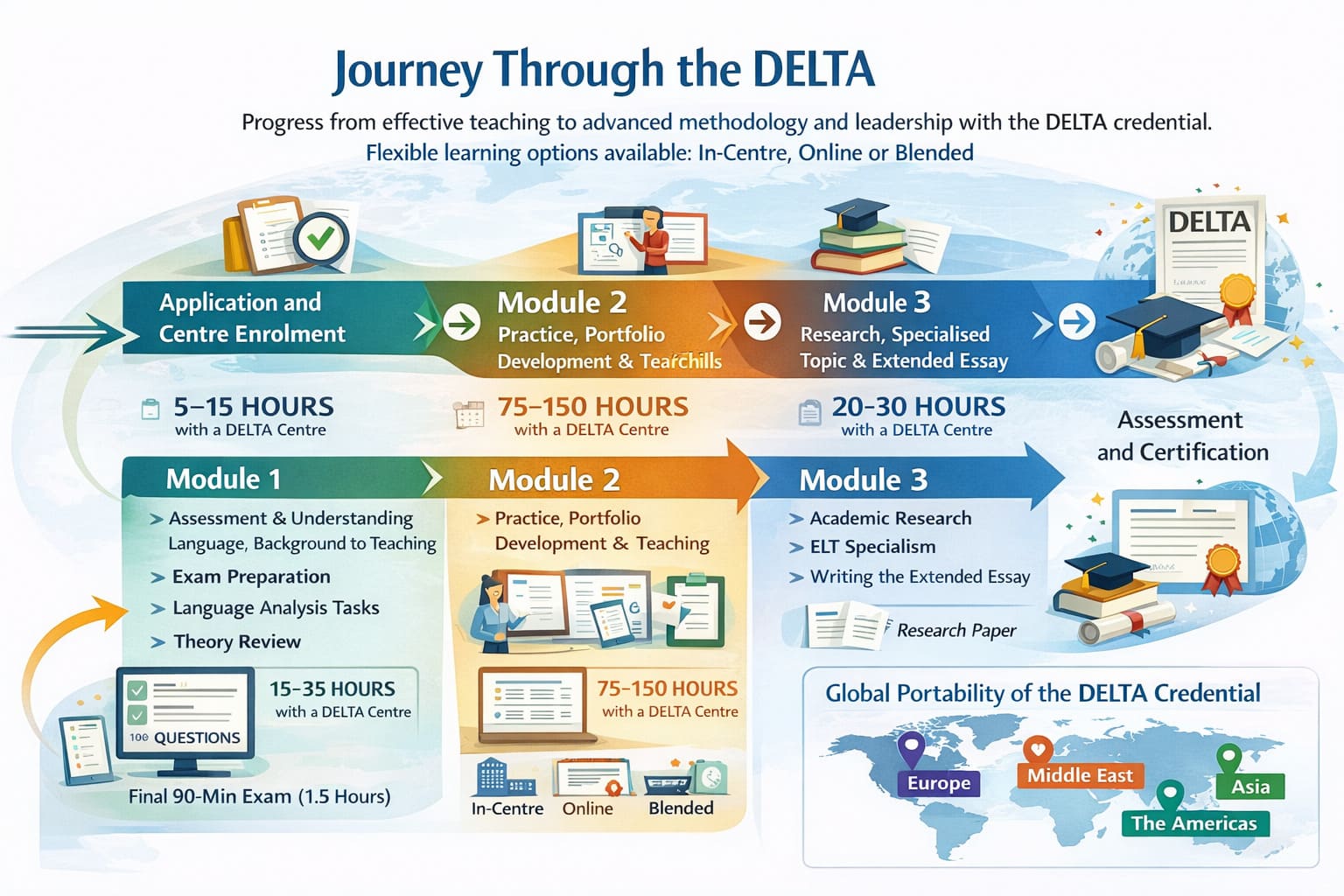
DELTA is modular and designed for working teachers which means most candidates study part-time for several months. A common timeline takes about 9-12 months and some centres offer accelerated or longer programmes depending on cohort size, educational obligations and staff. Since Module 2 requires practical teaching practice your schedule must take into account observation, preparation and materials development in addition to other modules.
Study paths vary to meet different priorities. Some candidates overlap their module preparation using integrated timelines provided by the centre to save time and effort. When planning you must take into account your peak hours, vacations and any opportunities for micro-teaching or peer feedback. A realistic plan includes a weekly study period, classroom practice and regular meetings with a mentor or tutor to monitor progress and adjust plans if necessary.
A 12-month practical model:
- January-February: Module 1 study and practice.
- March-April: Module 1 assessment and Module 2 preparation.
- May-June: Module 2 teaching practice and portfolio tasks.
- July-September: Module 3 research and data collection.
- October-December: Module 3 submission and final review.
Centres offer blended formats uniting online and personal meetings which are useful for those working full-time. Consistency is key: maintain regular study periods and stay organised with your centre deadlines. Create a library of model teaching plans and language analysis notes so you can quickly access resources for different circumstances.
What to expect from DELTA training: outcomes and support
DELTA aims to deepen your professional practice. Graduates report improved language analysis, advanced planning capabilities and research skills that lead to continuous classroom improvement. Training promotes evidence-based decision-making and the ability to influence learning outcomes in different surroundings.
Accredited centres provide support structures. They offer opportunities for cooperation with colleagues of different linguistic and ethnic backgrounds which helps intercultural communication capacities in global educational settings. Centres provide access to professional development resources and online communities where candidates can exchange ideas. The combination of formal judgement, tutoring and peer learning creates a professional ecosystem that goes beyond the certificate.
Regarding career results, DELTA is recognised as a global mark of advanced teaching skills. While it does not guarantee specific work, it provides employers with proof of high-level expertise in terminology analysis and teaching practice. For teachers aiming to work abroad, the qualification may open doors for course coordination, programme management and teacher training tasks.
Conclusion and Next Steps
DELTA is a postgraduate qualification that improves language analysis, teaching practice and research skills. It is modular and designed specifically for working teachers.
Admission requires a bachelor’s degree and practical experience in English teaching with registration managed by an accredited DELTA centre. It is advisable to start the application process early.
Plan your study path with realistic timelines by starting Module 1 with theoretical training, Module 2 with practical teaching practice and Module 3 with a solid research project. Use reflective practice and peer feedback to enhance your development.
The DELTA qualification opens doors to management positions and international educational opportunities. For applicants the next steps are the identification of accredited DELTA centres, confirmation of admission requirements and the establishment of a practical programme that balances workplace obligations and personal well-being.
Authoritative Sources and Fact Checks
- Cambridge English Qualifications: Delta – Diploma in Teaching English to Speakers of Other Languages.
- British Council: Delta (Diploma in Teaching English to Speakers of Other Languages).
- Cambridge Assessment English: Delta Modules – Specification and Assessment.
- English UK: Professional Development for Teachers – DELTA Information.
Is DELTA worth it for someone planning to teach abroad or online?
DELTA is often highly valued by international schools and reputable language centres. It signals advanced knowledge of language analysis, teaching methodology, and research-informed practice. If your goal includes leadership roles, curriculum design, or advanced teaching positions, DELTA can be a strong asset. Consider your current career trajectory, time availability, and financial commitment before deciding.
How much does DELTA typically cost, and are there funding options?
Costs vary by country and centre, reflecting tuition, supervision, and assessment fees. Some employers offer sponsorship or salary-linked study plans. It’s wise to request a detailed breakdown from your chosen centre and explore whether your institution can support part of the cost through staff development funds or sponsorship.
Can I complete DELTA online or in a blended format?
Many centres offer blended or online-supported DELTA routes, especially for Module 1 and Module 3 components. Check with accredited centres about the availability of remote resources, supervision, and assessment arrangements in your region.
Do I need CELTA before tackling DELTA?
A CELTA or equivalent teaching qualification is a common precursor for DELTA, as DELTA builds on practical teaching experience. However, some centres accept substantial EFL teaching experience with appropriate evidence of language knowledge and reflective practice. Always verify the specific entry requirements with your chosen centre.
What is the typical duration of the DELTA programme?
DELTA is usually pursued over 9-12 months when studied part-time. Some candidates opt for accelerated formats or longer programmes depending on their commitments and the centre’s schedule. Your centre will provide a customised timeline aligned with your circumstances.
How should I choose a DELTA centre?
Look for Cambridge Assessment English accreditation, strong tutor profiles, transparent assessment procedures, and clear guidance on module sequencing. Reading candidate reviews, speaking with current or former DELTA learners, and discussing centre-supported mentoring can help you select a centre that matches your learning style and logistics.
What outcomes should I expect after completing DELTA?
Expect enhanced classroom practice, sharper language analysis, more effective materials development, and stronger research capability. You should also gain access to a professional network and increased credibility with employers across international contexts.
Are there recommended timelines for choosing modules or starting the programme?
Start with a clear career goal in mind, then align Module 1 with foundational theory and language knowledge. Plan Module 2 around your teaching schedule to ensure you have adequate time for observed teaching and planning, then reserve a steady block for Module 3’s research project. Your centre will help tailor a practical timetable.