English Teaching Jobs in France: TEFL Certification and Pathways

France presents a compelling destination for aspiring English teachers: cities, rich culture and a long-standing demand for fluent English speakers in schools, universities and private language centres. Here’s what you should know: yet breaking into the market can be difficult if you are uncertain where to start, which certification to follow and how to meet visa requirements.
This guide is designed to cut through the noise by offering clear, fact-checked TEFL certification pathways, practical career choices and realistic steps to secure English teaching roles in France, helping you save time and effort if you are targeting classroom positions.
The Landscape of English Teaching in France
The landscape of English teaching in France blends traditional classroom roles with more modern, flexible ways to work. Some public schools welcome native English speakers through government-supported programmes although much of the demand lies in private language schools, international schools and online programmes.
This is remarkably useful: visa rules, employer expectations and accreditation standards vary by sector so candidates should treat certification as a strategic asset rather than a checkbox. With the right TEFL or TESOL qualification you can approach the market with confidence.
TEFL Certification: Pathways to French Teaching Roles
Accreditation and Standards
Want to improve your position? The truth is that a TEFL certificate sits at the centre of most English teaching journeys in France. You will find that courses vary in length, depth and focus although the most reputable qualifications are aligned with international standards and offer practical teaching experience alongside theoretical knowledge.
This is a game-changer: a growing number of courses are linked to recognised regulatory frameworks including the CEFR (Common European Framework of Reference for Languages) administered by the Council of Europe and some UK-regulated awards overseen by Ofqual. This means employers across sectors can recognise your training.
In addition a solid certification can help you meet the expectations of both French schools and visa authorities who assess professional credentials.
CELTA vs. Broader TEFL/TESOL Courses
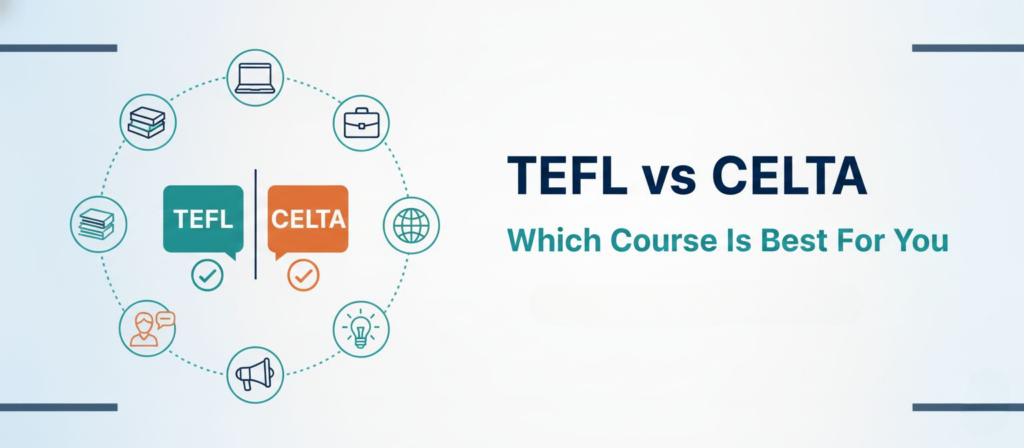
It is worth noting that the pathways vary although a common distinction exists between CELTA-type programmes and broader TEFL or TESOL courses offering both practicality and quality.
CELTA (Certificate in English Language Teaching to Adults) is highly regarded for its practical teaching component and integrated practicum. Other TEFL or TESOL certificates may offer longer online sections or modular formats.
For teaching in French schools emphasising a qualification with a practicum and a clear link to classroom practice can be advantageous particularly when applying to government-supported programmes or reputable private schools. A certificate alone will not guarantee work because employers look for teaching practicum evidence, cultural adaptability and commitment to ongoing professional development. The CEFR alignment of your course strengthens credibility.
Evaluating Certification Options
Need to improve your situation? When evaluating certification options candidates should check accreditation, practicum quality and transferability.
You will find that Ofqual-regulated qualifications provide a recognised level framework many UK-based courses use to align with CEFR levels and international job markets. This is worth considering: your eventual French employer will assess your suitability for a teaching role so a certificate aligned to widely understood standards reduces ambiguity and supports clear comparison with other candidates. Always check the course’s accreditation status and practicum structure. The combination of a credible certificate, teaching practice and CEFR-aligned content will be your strongest evidence of readiness when applying to French schools.
Where to Start: TEFL Courses for France Jobs
Unlike other options, starting your TEFL journey with a well-chosen course sets the tone for your job search in France. Here’s what you should know: the key is choosing a programme that offers credible accreditation, meaningful teaching practice and a pathway to CEFR-aligned teaching competences.
If you are aiming for roles in public schools or government-backed programmes prioritise courses with recognised practicum components and evidence of classroom practice in real teaching environments ensuring your transition is smoother. For private language schools these expectations may be more flexible although employers still value candidates who demonstrate methodical lesson planning and learner-focused strategies.
Course Formats and Benefits
Online or in-person formats each offer benefits. In-person courses provide immediate classroom practice under supervision, direct feedback and a practical teaching portfolio. Online courses offer flexibility, often lower upfront costs and modular content you can complete from anywhere making your preparation easier.
Whichever mode you choose course accreditation matters: prioritise courses recognised by CEFR frameworks and where possible those that offer a clear pathway to CEFR teaching levels as evidence of your ability to design activities around listening, speaking, reading and writing objectives. If you are targeting positions in Paris or other major cities consider programmes that highlight cross-cultural teaching strategies and bilingual classroom management which French schools value highly.
Supplementary Certificates
Additionally TEFL or TESOL candidates may strengthen their profile by earning supplementary certificates or micro-credentials. Some UK-based courses connect to Ofqual-regulated frameworks which can help demonstrate your learning outcomes and assessment skills. A well-structured course will include a teaching practicum, observation notes and a lesson planning toolkit aligned with CEFR stages enabling you to save time and effort while preparing for your job search.
Common TEFL pathways and what they offer
| Pathway | Typical duration | Key features | Best for |
| CELTA or similar CELTA-style | 4 weeks (intense) or 5-8 weeks part-time | Immersive practicum, supervised teaching, immediate classroom application | Traditional private language schools, international schools; strong in-classroom focus |
| General TEFL/TESOL (non-CELTA) | 8-12 weeks online/offline mix | Broad theory, some practicum, flexible scheduling | People needing flexibility or on a budget; entry to online teaching |
| Ofqual-regulated TEFL/TESOL | 6-12 weeks (structured) | UK-regulated framework, clear assessment criteria, CEFR alignment | Employers seeking formal UK-regulated qualifications; credibility across EU markets |
| Specialist TEFL (online micro-credentials) | 4-8 weeks per module | Targeted skills (lesson-planning, classroom management, online teaching) | Niche roles, online schools, continuous professional development |
Practical Tips to Secure TEFL Roles in French Schools
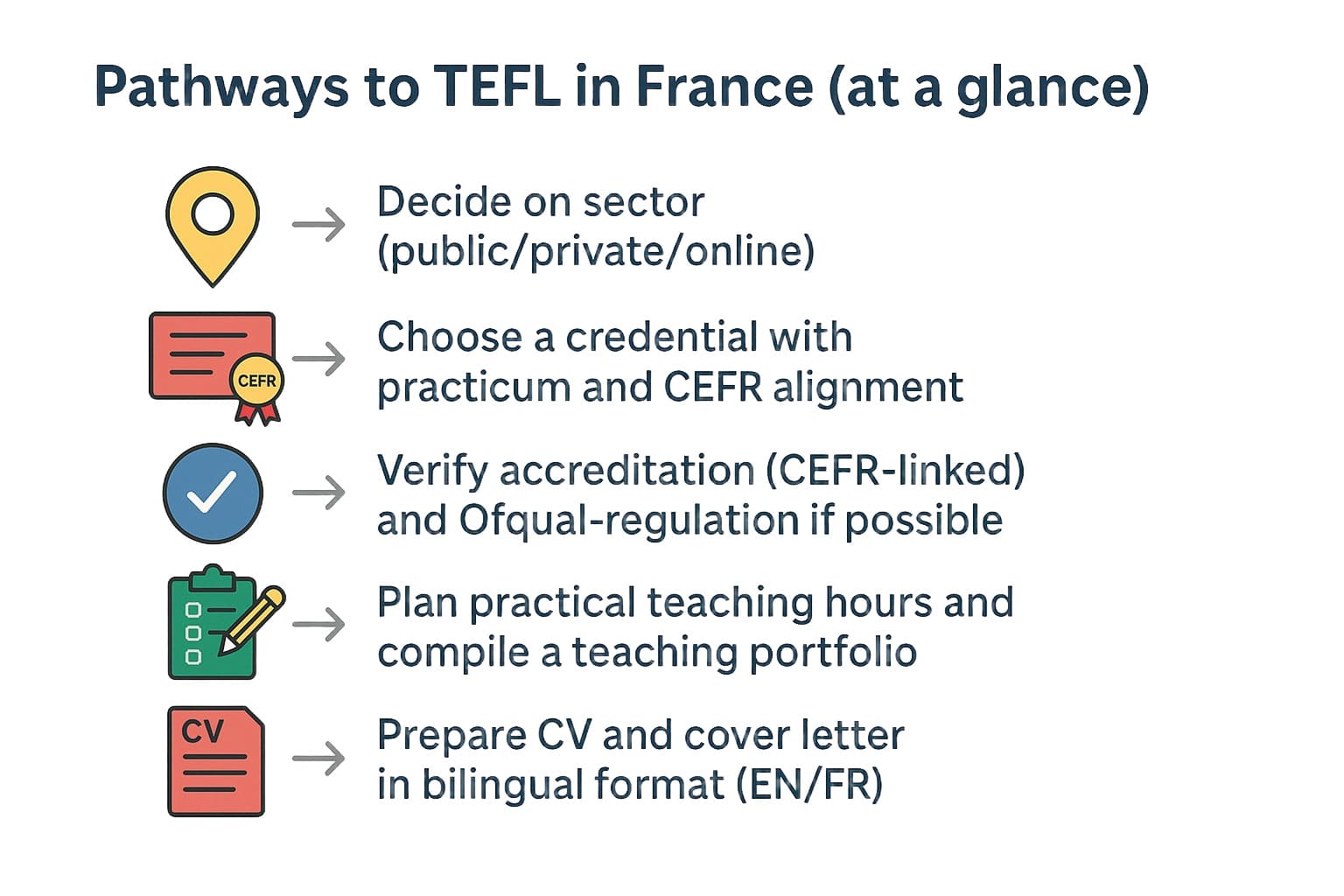
The key is that securing a TEFL role in France requires preparation beyond earning a certificate offering both convenience and quality. Start with a bilingual CV and a cover letter that highlights your CEFR-aligned lesson planning skills, your ability to manage mixed-ability groups and any cross-cultural teaching experience.
If you have a practicum include a selection of lesson plans, learner progress samples and a reflective journal to demonstrate your ability to respond to feedback. Some recruiters value a Europass-style CV although adapting your CV to French hiring expectations increases clarity and impact. The European Commission’s Europass platform is a credible starting point although you may adjust the layout to align with French job market norms.
Networking and formal channels can greatly accelerate your application process offering both convenience and quality. Follow official routes where possible such as job boards run by education authorities or language associations and contact schools in cities where demand is strongest such as Paris, Lyon, Marseille, Lille, Toulouse and Nice. Research the specific requirements of each institution because government-supported Assistant d’anglais programmes have distinct application cycles and eligibility criteria saving you time and effort. Prepare documentation in advance such as identity proofs, academic transcripts and legally accepted translations which will speed up visa and hiring procedures when opportunities arise.
The awe-inspiring part is that readiness means preparing for interviews and lesson presentations, combining functionality with aesthetic appeal. Plus, be ready to discuss your approach to differentiated instruction, how you plan lessons for mixed-level groups and how you assess learner progression. This is outstandingly useful: be ready to deliver a short micro-lesson during an interview, perhaps demonstrating a speaking activity or a pronunciation task for a CEFR level. French schools value clarity. What makes this different is practising presenting in clear, concise English and if possible preparing a few bilingual handouts or slides to show your ability to bridge language gaps in a classroom.
You’ll witness that beyond initial hiring ongoing professional development matters, combining functionality with artistic appeal. Here’s the prospect: consider pursuing additional micro-certificates in online teaching, classroom management or CEFR-aligned assessment strategies. Not to mention, this ongoing development signals to employers you are committed to improving learner outcomes and adapting to changing classroom dynamics, which means saving you time and effort. Finally be practical.
Authoritative Sources and Fact Checks
This section provides authoritative resources related to English teaching credentials, the CEFR framework, and official teaching assistant programs in France.
- Council of Europe – Common European Framework of Reference for Languages (CEFR): Official page for the standard framework used across Europe to describe language ability, which is critical for TEFL course alignment and employer assessment.
- Teaching Assistant Program in France (TAPIF) / France Éducation International: The official government-backed program that places native English speakers in French public schools, which is a key pathway mentioned in the article.
- UK Office of Qualifications and Examinations Regulation (Ofqual) Database: A resource to verify the legitimacy and regulated status of UK-based TEFL qualifications, useful for checking if a course is “Ofqual-regulated.”
- European Commission Europass: The official platform offering templates and guidance for creating CVs and cover letters widely recognized across European countries, including France.
Do I need TEFL/TESOL to teach English in France?
While not always legally required, most reputable employers in France prefer applicants with a recognised TEFL/TESOL certificate, especially with a practicum component and CEFR alignment. A well-chosen certificate improves your employability across private language schools, international programmes, and online roles.
Are CELTA or TEFL certificates recognised in France?
Yes, CELTA and CEFR-aligned TEFL/TESOL certificates are widely recognised in France, particularly when they include a practical teaching component and CEFR-compatible outcomes. Official CEFR alignment strengthens acceptance by employers.
Can I apply for a visa if I’m not an EU citizen?
Yes, non-EU citizens can work in France, but they typically require a valid work visa or residence permit sponsored by an employer. The France-Visas portal and the French embassy/consulate guidance outline the steps and documents required for skilled or temporary work.
How much can I earn teaching English in France?
Compensation varies by sector and location. Private language schools typically pay hourly rates (e.g., approximately €15-€25 per hour, depending on city and experience). Public-sector roles, such as Assistant d’anglais, offer a monthly stipend (roughly €800-€900 gross per month in many cases). Always check the specific contract and local market norms for the city you target.
Do I need to speak French to teach English in France?
Basic French is helpful for classroom management, administrative tasks, and daily life, but many English teaching roles, especially in private language schools and online contexts, accept native English speakers with limited French. However, improving your French will broaden your job prospects and integration into the school community.
How long does it take to obtain TEFL certification?
Duration depends on the programme. Online courses can be completed in a few weeks, while part-time or blended formats may span 6-12 weeks. More intensive CELTA or CELTA-equivalent programmes run over 4 weeks. Check the course syllabi for practicum hours and assessment timelines.
What are the best cities in France for TEFL jobs?
Paris, Lyon, Marseille, Lille, Toulouse and Nice all offer robust markets for English teachers due to student populations and tourist activity. Urban centres tend to provide more private language school opportunities and higher hourly rates, though competition is higher.
Are online TEFL courses accepted by French employers?
Online TEFL courses can be accepted, particularly if they include a strong practicum component and CEFR alignment. For certain employers or government-backed programmes, in-person practicum may be preferable. Always verify the employer’s expectations and accreditation standards.
How can I ensure my TEFL certificate aligns with CEFR?
Look for courses that explicitly map their learning outcomes to CEFR levels (A1 - C2) and provide a clear framework for assessing progress against CEFR descriptors. The Council of Europe’s CEFR guidance and cross-border accreditation processes underpin these alignments.