Global TEFL Salary Outlook for 2026: What English Teachers Earn Abroad

The demand for English as a planetary lingua franca continues to increase and the diversity of opportunities available to teachers who wish to work or teach online overseas is increasing. Salary is a crucial consideration for anyone pursuing a career in TEFL/TESOL. Plus this article gives future teachers a clear and evidence-based vision of what is expected in 2026, regional benchmarks for motivation, certification and virtual earnings. This is super practical, you will discover a carefully compiled context from leading organisations to help you design a rewarding and financially sustainable career.
Key Factors Shaping 2026 Wage Levels:
- Region and sector
- Level and type of qualification
- Balance between on-site hours and contract length
- Hybrid teaching models
Bottom line: exchange rates matter. You will not think this: by combining data-based benchmarks with practical guideposts this guide will help you search for better contracts, negotiate stronger terms and create a sustainable EFL career that meets your personal and professional goals, saving you time and effort.
What earns this different is that the following sections offer an integrated overview of overall TEFL earnings with regional benchmarks, certification effects and applicable strategies. Where appropriate figures are presented as ranges to reflect variability between cities, school types and contractual clauses, enhancing your ability to save time and effort. What makes this unlike others is that the data refers to reputable sources such as UNESCO, the British Council and the OECD, providing a balanced perspective for 2026.
Overview of Global TEFL Salaries in 2026 and Trends
The worldwide market for TEFL in 2026 remains diversified with strong demand in regions experiencing growth in education and labour markets. Despite economic slowdowns English education remains a pillar of private language schools, universities and job training programmes.
Salaries vary widely from location to position depending on the type of contract and employer. A teacher’s net pay often depends on total compensation including:
- Housing provisions
- Visas
- Health care
- Taxation
What is outstanding is that in the context of evolving licensing requirements and digital delivery the market rewards those who can align qualifications with local demand and work effectively in culturally diverse classrooms.
Wage levels across continents are influenced by both market maturity and the cost of living. You’ll notice that in Western Europe and North America, wages tend to be higher gross, but are reduced by higher taxes and living costs. In some parts of Asia and the Middle East, compensation often includes additional benefits, which can increase overall pay, making wages seem modest at first glance. In Latin America and some parts of Africa incomes are lower but the cost of living is proportionally reduced, offering a viable lifestyle for many teachers.
Unlike other options, UNESCO and OECD’s 2026 forecasts highlight continued growth in English learning, while the British Council points out the growing demand in non-traditional markets and wage increases in competitive sectors where employers are vying for qualified teachers.
Unlike earlier cycles the trends for 2026 reflect a shift towards more transparent contracts, clearer expectations around teaching hours and stronger emphasis on professional development. Teachers with practical experience and recognised qualifications see greater job security and improved pay scales as institutions seek educators who can deliver measurable learning outcomes. As with any international role careful contract review remains essential including clear terms on housing, health care, taxation and annual pay progression. Data from international organisations also suggests a growing preference for longer-term contracts combined with performance-related incentives, a development that can significantly affect annual income for experienced teachers.
Salary Benchmarks by Region for English Teachers Abroad
You’ll love how regional recompense patterns in TEFL are better understood by a mix of salaries, welfare and cost-of-living adjustments, offering both convenience and tone. Actually, in mature marketplaces such as Western Europe and the Gulf, remuneration is often followed by wider housing regulations, which means overall packages differ widely though monthly central rates are similar.
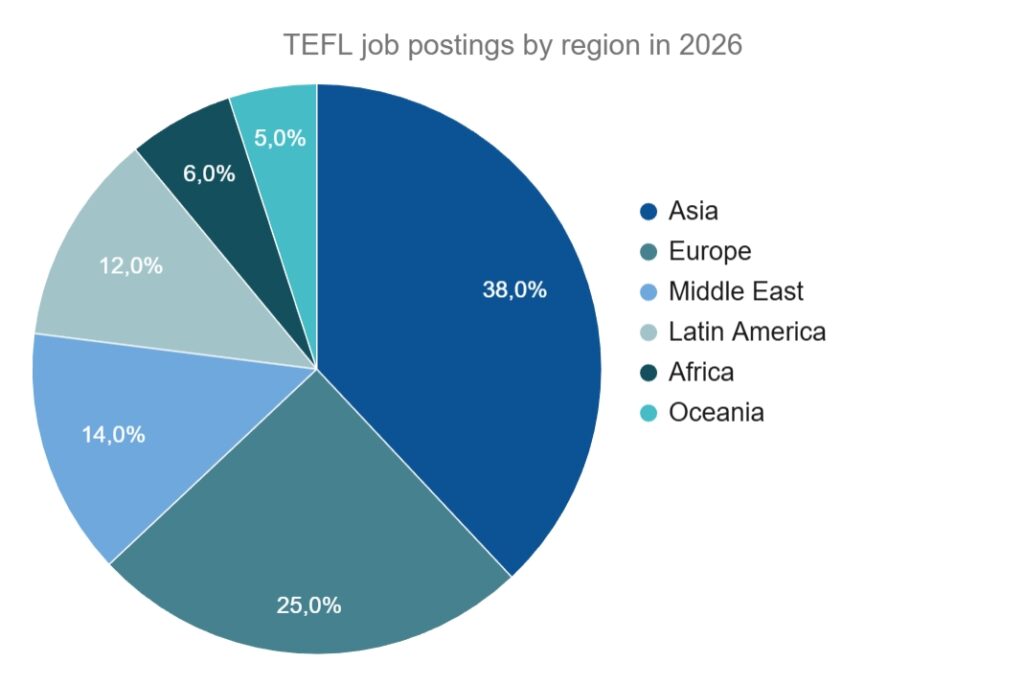
Regional Insights:
- Western Europe: Outside the UK, teachers often report monthly earnings of between USD 2,000 and USD 3,500, with net income varying according to tax and pension schemes.
- Gulf Lands: Often offer tax-free packages.
- Asia: Salaries are spacious: East Asia can offer between USD 1,200 and USD 2,700 gross in large urban centres, while South-East Asia often deviates from USD 700 to USD 1,800 depending on size, sector and type of contract.
- Eastern Europe & Central Asia: Typical monthly gross pay can fall around USD 800 to USD 1,600, with higher bands in some capitals.
- Latin America & Caribbean: Many roles offering USD 800 to USD 1,700 per month.
- Africa: Opportunities in urban centres often delivering USD 500 to USD 1,200 per month gross.
Across all regions the variance underscores the importance of evaluating the full compensation package rather than base salary alone and of considering the potential for additional income through online teaching or tutoring.
Comparative Salary Table 2026
| Region | Typical monthly gross (USD) | Estimated net monthly (USD) | Common benefits and notes |
| Western Europe (excluding UK) | 2,000–3,500 | 1,600–2,900 | Housing allowances common in some roles; private schools may pay more; tax varies by country |
| Gulf & Middle East (GCC) | 2,500–5,000 | 2,100–4,400 | Housing, flights, and health insurance frequently included; tax-free salaries in several states |
| East Asia (e.g., China, Korea, Taiwan) | 1,200–2,700 | 900–2,100 | Strong private schooling networks; housing often part of the package in major cities |
| Southeast Asia (e.g., Thailand, Vietnam, Malaysia) | 700–1,800 | 550–1,450 | Housing often included; cost of living lower; variable hours in some markets |
| Eastern Europe & Central Asia | 800–1,600 | 650–1,300 | Private schools and universities offer higher bands in capitals; pension/benefits vary |
| Latin America & Caribbean | 800–1,700 | 600–1,400 | Housing included in some roles; salaries rise with private institutions and urban centres |
| Africa (urban centres) | 500–1,200 | 400–1,000 | Housing and health benefits add value; market still developing in many regions |
| Oceania (Australia/New Zealand) | 2,000–3,500 | 1,500–3,000 | Higher costs of living; visas and work rights can influence contract length and pay |
The figures above are more indicative than accurate forecasts for each city. You’ll see that the dynamics of the local economy, the school’s reputation and contractual conditions can dramatically alter a package. A role in a private high school or international programme may be more valuable in a metropolis with a comparatively lower base salary once housing, aviation and development budgets are taken into account. Starting roles in smaller cities may offer lower cash payments but lower living costs, which can lead to similar final outcomes if housing and daily expenses are factored in.
Quick line: want a better approach? The key is to measure the entire package, not the monthly base, and align it with your long-term career programme and personal budget.
How Certification Levels Impact Earning Potential Worldwide
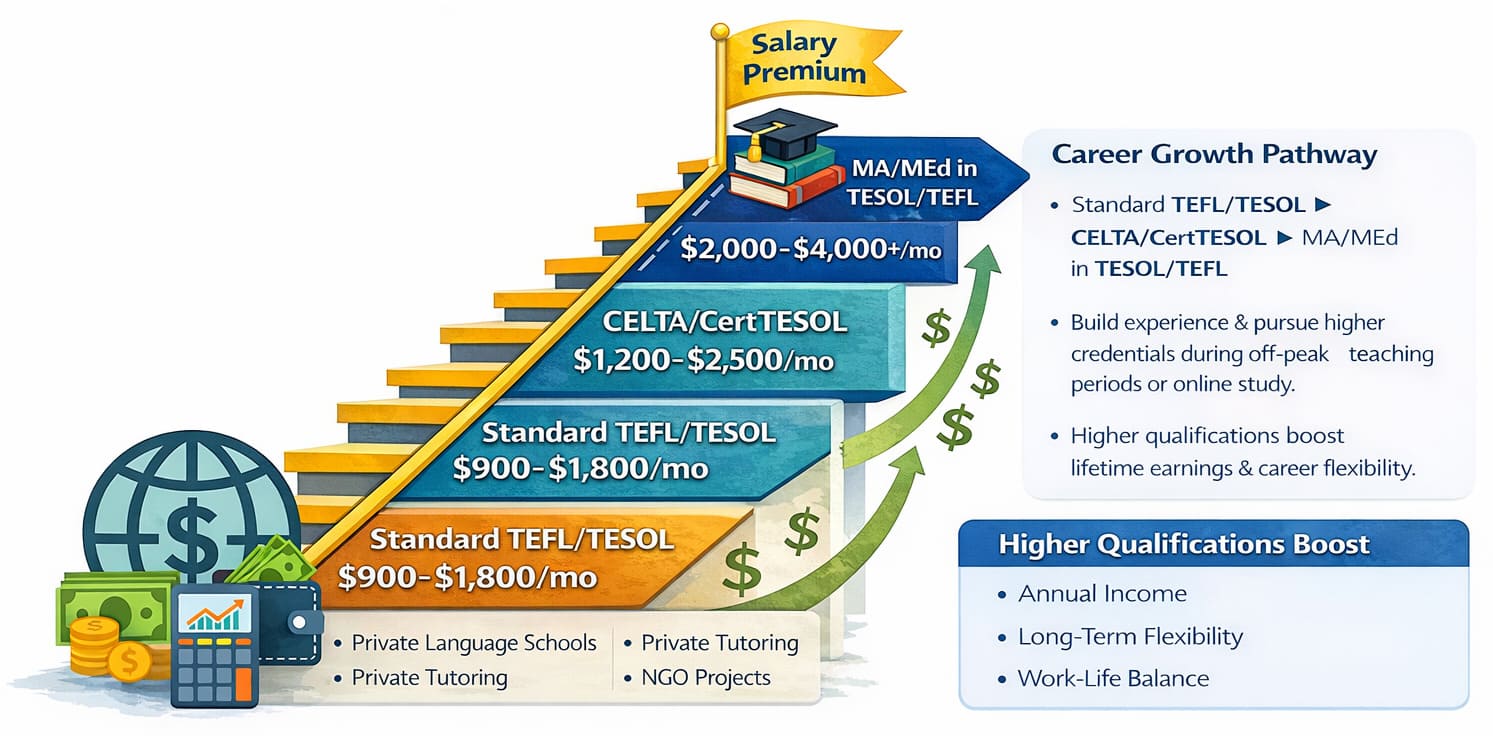
What gets this different is that certification levels have long influenced hiring decisions in TEFL and 2026 is no exception. The truth is that employers are progressively placing emphasis on credentials that demonstrate practical teaching skills, assessment competence and authentic classroom experience.
This is clearly applied: while a 120-hour TEFL certificate may be sufficient for entry roles in some markets, more advanced certificates are often linked to access to higher pay scales, more predictable hours and improved professional development opportunities.
Here’s what you should know: one practical approach to thinking about certification in 2026 is to align the level of qualification with the target role. Looking at challenges? A certificate with observed teaching, assessed practice and feedback cycles, such as CELTA or Cert TESOL, positions candidates for roles with higher hours, larger classes or more intensive curricula, often followed by stronger salary packages and improved housing or allowances. For those in universities or secondary schools a master’s degree in education, TESOL or applied linguistics can further enhance prospects and long-term earning potential, especially in regions with stricter regulatory requirements.
What makes this different is that research by established organisations continues to show qualification quality matters for access to roles and mobility across regions, although pay outcomes still depend on local demand and education policy.
Practical Guidance to Maximise Your TEFL Salary in 2026
Marketing how to improve your situation? What’s interesting is to start by adjusting your qualifications to regional demand. Frankly nothing changes if you require eminent-end learning opportunities: you can focus on DELTA, Cert TESOL with a strong practicum component or a modern university degree, and on target markets where housing is free or heavily subsidised. Need a fuller approach? School search, reputation, contract length and transfer of teaching hours all matter, and you can expand this knowledge as leverage in negotiations. A well-developed cover letter also helps.
Ways to Increase Income:
- Diversification of income streams: Online courses, afternoon or weekend classes.
- Specialised offerings: Exam preparation, business English workshops or test writing.
- Strategic Location: Major cities may offer higher gross, but affordable cities can produce comparable net income when housing and benefits are included.
Ultimately creating a proactive career plan includes consistent reviews of contractual terms and conditions. This is relatively simple: plan annual salary reviews, collect performance data and document teaching outcomes to support future negotiations. Unlike other options you can network, attend training sessions and engage with local teacher communities to stay aligned with market changes.
Here’s the point: if you are using online teaching as an additional income stream, ensure your schedule remains sustainable and your online hours align with peak demand across different time zones. What makes this different is that in 2026 the combination of strong references, targeted regional choices and diversified income streams remains the most reliable path to a sustainable and rewarding TEFL career.
The Role of Experience, Location, and Sector in TEFL Pay
The main benefit is that experience often influences wages by affecting progression, contract duration and the ability to assume additional or senior roles, such as programme planning, teacher mentoring or academic coordination, combining functionality with professional appeal. In many established TEFL markets teachers with three to five years of experience, strong performance results and a proven record of programme development often gain access to higher-level positions with improved overall compensation.
Location also matters: high-cost urban centres with intense competition among qualified teachers may offer higher headline salaries, while rural regions can compensate through stronger benefits or reduced commuting, helping to save time and effort.
The key here is to find the balance between on-site teaching and online work, combining functionality with aesthetic appeal. What is clear is that hybrid roles are becoming more frequent. Want a fuller fit? Employers appreciate adaptability. In some sectors, private opportunities such as English or professional training can offer higher salaries for teachers with expertise in the market, while public or university institutions may provide lower pay but offer more job security and clearer long-term career structures.
Tax, Benefits, and Cost of Living Considerations for TEFL
What causes this difference is that taxes and benefits are central to net income. Here’s what you should know: taxation authorities vary considerably from region to region and some locations provide tax-free or low-tax income regimes for expatriates, which can have significant effects on take-home pay.
- Gulf countries: Historically provided tax benefits on personal income.
- European countries: Apply progressive tax rates that reduce gross wages.
This is clearly important: it is essential to understand not only gross earnings, but also tax brackets, social security contributions and mandatory pension systems. OECD indicators on wages highlight this clearly.
You will find that beyond taxes, the cost of living and living standards remain key considerations in 2026. Housing, transport and health costs vary widely. In many markets accommodation is the single largest expense; contracts that include housing or housing allowances can significantly improve net income, making everyday life easier. You will notice that shipping costs and daily necessities differ considerably from city to city, sometimes making a salary in a large capital less attractive than a lower nominal wage in a smaller city with affordable services.
Teachers should estimate their projected monthly expenses, include occasional travel costs and compare these against the offered package to assess affordability and overall satisfaction with the role, combining functionality with aesthetic appeal.
Practical guidance on taxation and living costs requires a detailed breakdown of allowances and benefits in the contract, consultation with a local tax adviser and comparison of similar roles in neighbouring cities to identify differences in housing and rental costs. This is genuinely useful: it is advisable to calculate potential savings when relocating with dependants and to confirm whether the employer provides health insurance, pension contributions and annual leave that align with your personal plans.
How to Negotiate and Plan a Career Path for Higher Earnings
Negotiations begin with research. The reality is that before discussions you can gather information on typical wages in your target region, city and sector from sources such as UNESCO, the British Council and OECD-based analysis.
Negotiation Strategy:
- Preparation: Prepare a concise summary of your qualifications, classroom outcomes and additional services you offer.
- Value Proposition: Present a clear value proposition.
- Tone: A collaborative tone is often most effective, highlighting the mutual benefits of a well-supported teacher.
Planning for higher earnings often involves phased career progression linked to strategic roles. Early in your career this can be surprisingly simple: create a portfolio that includes student outcomes, teaching programmes and evidence of effective assessment, which can be used as a strong lever in salary discussions. Networking with colleagues, involvement in regional TEFL associations and participation in professional communities can reveal hidden opportunities and insights into contract terms and market standards.
Searching to improve your situation? What stands out is that the combination of informed negotiation and a well-thought-out career plan is a more reliable route to stable employment and progression. A well-negotiated contract may include higher pay, longer terms with scheduled annual reviews, benefits such as housing or travel allowances and structured pathways for income growth, saving time and effort.
Key Takeaways
- Financial Evaluation: For 2026 TEFL salaries vary widely by region. Understanding the full package – base pay, housing, flights, health insurance and allowances – is essential to assessing true earning potential.
- Certification Pathway: Certification levels matter and the right credential pathway can unlock access to higher-paying roles. A staged approach tends to yield more sustainable earnings growth and professional satisfaction.
- Strategic Maximization: Practical steps to maximise earnings include researching regional demand, choosing contracts with housing or allowances, diversifying income through online teaching and developing a professional portfolio.
Thank you for reading this comprehensive guide to TEFL salaries in 2026. The strongest pathways to teaching overseas or online combine solid qualifications, targeted regional demand and well-structured contracts with housing and benefits. Use regional benchmarks to set expectations, align certifications with career goals and negotiate with clear evidence of classroom impact and professional growth.
And the best part? TEFL is competitive and a focused strategy can translate certification and benefits into long-term stability, saving time and effort.
Here’s the thing: in the years ahead you will need to stay alert to visa requirements, regulatory changes and the continued emergence of hybrid teaching models that combine in-person and remote delivery. Monitor the market and stay connected. With the right mix of skills, regional focus and willingness to negotiate you can build a long and rewarding career teaching English abroad in 2026.
What makes this different ultimately is that resilience and cultural curiosity shape successful classrooms and communities. The most effective TEFL journeys balance professional performance with personal growth and allow teachers to contribute meaningfully to learner outcomes, creating a sustainable and measurable career path that reflects individual values and goals. May your teaching be as rewarding as it is impactful.
Authoritative Sources and Fact Checks (References)
- UNESCO Institute for Statistics (UIS): Data on global education trends and teacher requirements.
- British Council: Market reports on the English language teaching (ELT) sector worldwide.
- OECD (Education at a Glance): Statistics on teacher salaries and education funding across member and partner countries.
- International Labour Organization (ILO): Information on international labour standards, contracts, and expatriate working conditions.
How much can English teachers realistically earn abroad in 2026?
In 2026, realistic TEFL salaries vary widely by region and sector. Monthly gross pay typically ranges from about USD 700-1,800 in Southeast Asia, USD 1,200-2,700 in East Asia, USD 2,000-3,500 in Western Europe, and up to USD 5,000 in parts of the Gulf. The key point is that net income depends heavily on benefits such as housing, flights, health insurance, taxes, and local cost of living, not just the headline salary.
Which regions offer the best overall TEFL salary packages in 2026?
The strongest overall packages are often found in the Gulf and parts of Western Europe, especially where housing, flights, and health insurance are included. While base salaries in Asia or Latin America may appear lower, subsidised housing and lower living costs can result in a comfortable net income. The “best” region ultimately depends on how salary, benefits, and expenses balance out for your lifestyle.
Does certification level really affect TEFL salary?
Yes, certification has a clear impact on earning potential. Entry-level TEFL certificates can open doors to many jobs, but qualifications with observed teaching practice, such as CELTA or Cert TESOL, consistently provide access to better-paid roles, more stable hours, and stronger contracts. Advanced qualifications, including master’s degrees, can further increase pay and career mobility, particularly in universities and international schools.
How can teachers increase their TEFL income beyond base salary?
Teachers often increase earnings by diversifying income streams. Common options include online teaching alongside on-site work, private tutoring, exam preparation classes, business English, or short-term workshops. Choosing locations with lower living costs, negotiating housing allowances, and targeting schools that value professional development can also significantly improve take-home pay.
What should teachers focus on when comparing TEFL job offers?
When comparing offers, teachers should look beyond monthly salary and evaluate the full compensation package. This includes housing or allowances, tax obligations, health insurance, flight reimbursement, visa support, teaching hours, and contract length. Factoring in cost of living and potential savings provides a far more accurate picture of real earnings and long-term career sustainability.