How to Teach English in the Netherlands: A Practical TEFL Roadmap


The Netherlands is a very attractive target for TEFL/TESOL alumni as it combines a high standard of living with the requirement for English teaching in schools language institutes and online platforms. However moving as an English teacher overseas may seem complex. Regulations certification requirements and labour market conditions vary from city to city and from employer to employer.
The aim of this pathfinder is to break the confusion and provide clear evidence-based guidance on routes certification routes immigration stages and career tracks in the Dutch EFL sector. It is written to provide clarity.
Here’s what you should know this guide focuses on the pragmatic measures you can now take:
- Preferring a TEFL certification that matches your objectives.
- Aligning your qualifications with the CEFR and employers’ expectations.
- Understanding which visa route fits your position.
- Building a realistic career path in a nation where English is widely used as a working language.
Finally you will find links to relevant sources to help you check the requirements and keep your plans up to date reducing the time and effort needed.
Overview of TEFL Pathways for the Netherlands
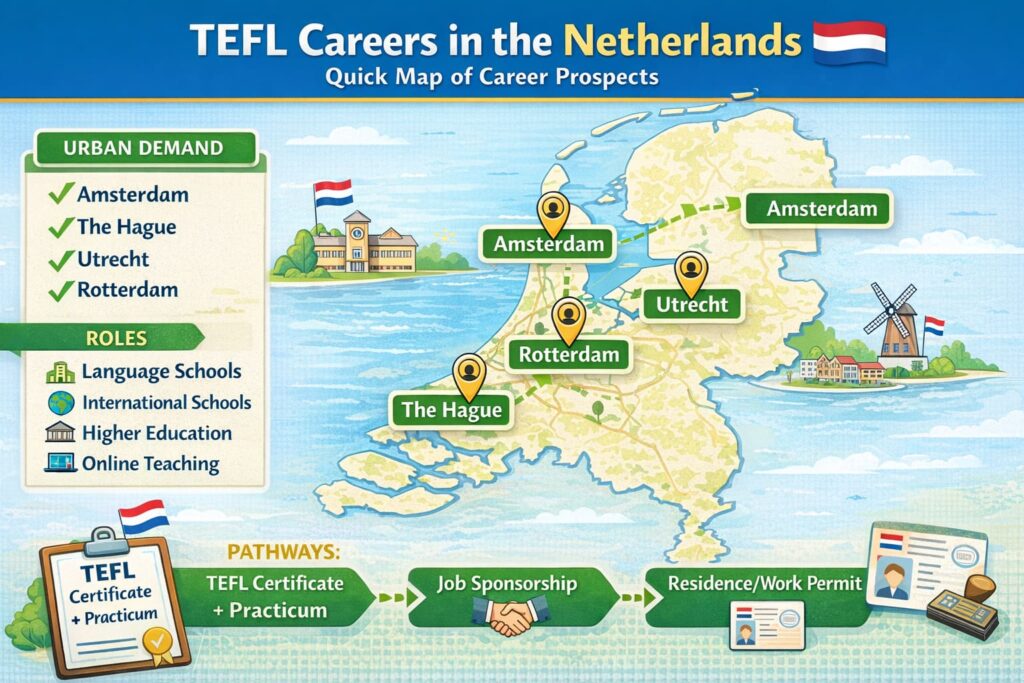
You can take a number of routes in the Netherlands from classroom roles in language schools and international schools to online and hybrid roles which may be temporary or permanent offering both flexibility and stability.
International schools hire English teachers for bilingual or full English-medium sections. Universities and adult training centres offer credit or certification courses which require specific qualifications. Online platforms allow distance learning to students overseas. The variety of settings implies you can adapt your approach to your circumstances subject knowledge and preferred hours helping you save time and effort.
For many aspiring teachers the first step is understanding visa requirements and the framework for legal employment. Third-country nationals require a valid residence permit. Employers most often apply for staff under the Highly Skilled Migrant programme while standard employment requires a valid residence status. EU/EEA and Switzerland nationals have the right to live and work in the Netherlands without a separate work permit subject to registration and standard residence rules. These distinctions can influence your certification decisions and your job search strategy combining functionality with clarity.
Practical progression often looks like this:
- Decide your target sector language school international school higher education or online teaching.
- Obtain a certification that aligns with your career goals and with CEFR standards.
- Secure a sponsor employer who can support your work and residence permit.
- Begin applying for roles while continuing professional development short courses specialisations or classroom management credentials.
While the Netherlands values strong teaching skills many employers also prioritise evidence of practical classroom experience a solid portfolio of lesson plans and demonstrated ability to manage diverse learners.
Certification and Training Routes for Dutch TEFL
TEFL certifications are available in different formats ranging from 120-hour online programmes to blended offerings and in-person courses such as DELTA or CertTESOL. For many Dutch employers a DELTA or CertTESOL is viewed as a strong indicator of training and assessment while a well-structured online certificate with a solid practical component can be used for entry roles especially in language schools. It is significant to choose an internationally recognised programme aligned with the Common European Framework of Reference for Languages CEFR.
The judgement of certification pathways should take accreditation and regulation into account. Some EFL qualifications are more widely recognised than others. Dutch employers are accustomed to a variety of certifications yet a reputable certificate facilitates recruitment procedures and supports discussions on visa sponsorship. Always ensure with potential employers the preferred qualification details and make sure your course provides verifiable assessment procedures a detailed curriculum and a practical component offering both credibility and quality.
A practical approach to certification is to choose a programme that offers a strong combination of theory classroom practice and cultural preparation. For those who are starting or moving from different careers a well-structured qualification of 120 to 150 hours combined with supervised teaching practice of 20 to 50 hours can provide a solid foundation. For teachers working in international schools or universities the pursuit of a DELTA or CertTESOL plus a relevant degree or specialist certificate such as young learners or exam preparation can be advantageous. Courses aligned with the CEFR and opportunities to observe lessons and receive feedback from experienced trainers support professional development.
The Common European Framework of Reference was developed by the Council of Europe and is widely integrated into modern language teaching including in the Netherlands. Alignment of your training with the CEFR improves your approach to teaching and your ability to design lessons at different levels of proficiency.
Work Permits Residency and Teaching Visas in NL
The Netherlands has a work permit system which requires a sponsoring employer for non-EU and non-EEA citizens. The standard route for professionals is the Highly Skilled Migrant authorisation which requires a concrete job offer and a salary that meets the legal threshold. Employers take responsibility for the residence permit application and applicants must provide supporting documents such as an employment contract and proof of qualifications. For the most up to date information consult the IND website.
EU/EEA/Swiss citizens have freedom of residence and employment in the Netherlands without a separate work permit provided they register with the local municipality and meet standard conditions. For non-EU teachers the practical starting point is to obtain an employer who can apply for the required residence permit. Always ensure you check the current rules on the IND website and with your potential employer before planning a move.
Practical planning steps include:
- Securing a job offer from a Dutch employer who is willing to sponsor your permit.
- Confirming the type of permit required often the Highly Skilled Migrant route or another category.
- Ensuring your qualifications are recognised within the Dutch system including Nuffic evaluation and CEFR alignment.
- Preparing all required documentation passport birth certificate criminal record check diploma validation and proof of professional experience.
The IND and official government guidance are the most reliable sources for procedures timelines and fees related to residence and employment in the Netherlands.
Job Prospects Salaries and Career Paths in NL TEFL
Major urban centres such as Amsterdam The Hague Utrecht and Rotterdam show stronger demand for English teachers due to international communities multinational companies and a strong language learning culture. Networking membership in professional associations and participation in local educational communities can help you identify opportunities and understand city-specific labour market dynamics saving time and effort. Earnings vary according to role experience and qualification level.
NL TEFL Contexts and Salary Ranges (gross monthly EUR)
| Context / Role | Approximate gross monthly salary (EUR) | Notes |
| Language schools / private institutes | 2,000–2,800 | Entry to mid-level; part-time or full-time contracts |
| International schools / bilingual programmes | 3,000–5,000 | More senior roles; may require higher qualifications |
| Universities / adult education centres | 2,800–4,200 | Often requires postgraduate qualifications |
| Online teaching / freelance (NL-based) | Variable; hourly 15–40 | Flexibility; self-employment considerations apply |
Note: The salary ranges above are indicative and reflect typical industry patterns reported by employers and industry observers in the Netherlands. For precise figures, consult current NL job advertisements, recruitment agencies, and the CBS (Statistics Netherlands) wage data.
Professional Progression
Professional pathways in NL TEFL often progress from classroom teacher to programme coordinator senior teacher or curriculum designer. Specialisation in exam preparation such as TOEFL/IELTS or Cambridge qualifications business English or English for Specific Purposes can increase earning potential and open doors to larger institutions or corporate training programmes.
Many teachers also take on roles in teacher training professional development mentoring new teachers or management positions in language schools. Ongoing professional development including participation in workshops academic reading and guided research can help you remain competitive and adaptable in a changing educational environment.
Narration recap
If you’re reading this as a prospective teacher, you now have a clear map of how to break into the Dutch TEFL market. Start with a CEFR-aligned certification, pick a pathway that matches your aspirations (language schools, international schools, or higher education), and align your preparations with the visa framework. Build a practical teaching portfolio, connect with NL teaching communities, and keep your documentation—diplomas, transcripts, and police checks—up to date. With careful planning, you can turn the Netherlands into a rewarding, long-term teaching destination that combines professional growth with a high quality of life.
Authoritative Sources and Fact Checks (References)
- Immigration and Naturalisation Service (IND): Official information on residence permits and work visas.
- Nuffic: Dutch organisation for diploma evaluation.
- Statistics Netherlands (CBS): Official source for economic and wage statistics.
- Council of Europe – CEFR: Details on proficiency standards.
- Government of the Netherlands: General guidance on living and working in NL.
Do I need to speak Dutch to teach English in the Netherlands?
Generally no for most English-teaching roles in language schools, international schools, and online teaching. Some positions - especially within local public institutions or schools requiring bilingual instruction - may prefer or require some Dutch language ability. Even basic Dutch can help with daily life and integration; consider short courses to build local context.
What certificate should I choose to teach in NL?
A CELTA or CertTESOL is widely respected by NL employers and can facilitate visa sponsorship discussions. A well-structured 120–150 hour TEFL certificate with a solid practicum can also suffice for many language-school roles. Ensure your chosen certificate includes a supervised practicum and CEFR-aligned teaching materials. For assurance, verify with employers and cross-check CEFR alignment with Council of Europe resources.
How do I obtain a work permit to teach in NL if I am non-EU?
In most cases, a Dutch employer must sponsor your residence permit as a Highly Skilled Migrant or under another employment-based category. You will need to secure a job offer and meet qualification and salary thresholds as specified by IND. The employer typically handles the application; you should prepare documents (passport, diplomas, teaching credentials, police clearance, etc.).
Is an EU/EEA passport required for teaching English in NL?
No. EU/EEA/Swiss citizens have the right to live and work in NL without a separate work permit. Non-EU citizens generally require a work-permit and residence sponsorship, typically through the Highly Skilled Migrant route or other employment categories.
How long does the visa process take?
Timelines vary by category, country of origin, and the completeness of your application. In general, employer sponsorship can streamline processing, but applicants should anticipate several weeks to a few months for residence-permit decisions. Check current IND processing times and guidance for the most accurate estimates.
Are there online or hybrid TEFL pathways that count toward NL eligibility?
Yes, but be mindful of employer expectations. Online or blended certifications can be acceptable for many language schools, particularly if accompanied by a robust practicum, strong references, and a clear demonstration of teaching ability. Confirm with prospective employers and ensure your certificate maps to CEFR levels and recognised accreditation standards.