Pathways to TEFL Success in Poland

English teaching in Poland is a blend of vibrant city life, growing demand for language skills, and rewarding employment opportunities, which can include classroom roles and online teaching. For potential teachers, the path to obtaining certification, recognition, and complying with regulations can become daunting, especially if one is planning to work abroad.
This article unpacks the:
- Certification options.
- Connection between Ofqual-regulated pathways and Poland.
- Visa and work-permit landscape.
- Steps towards becoming a sustainable English teacher in Poland.
We will establish guidance on authoritative, non-commercial grounds, and demonstrate how training can be harmonised with international standards in a way that meets local expectations.
Overview of the TEFL Certification for Teaching in Poland
English language teaching (ELT) in Poland is underpinned by a rich ecosystem: a web of language schools, academies and online sites. In such an environment, a solid TEFL/TESOL certification can:
- Demonstrate professional competence.
- Indicate commitment to best practices in language pedagogy.
- Stand out to employers who value a disciplined training package.
In most Polish schools, a TEFL/TESOL certification is a baseline measure for hiring in the classroom, particularly at private language centres and international schools. Certification, moreover, exposes students to hands-on practice in lesson planning and classroom management, which is a mainstay of Polish employment systems as part of their development process.
Choosing the Right Standard
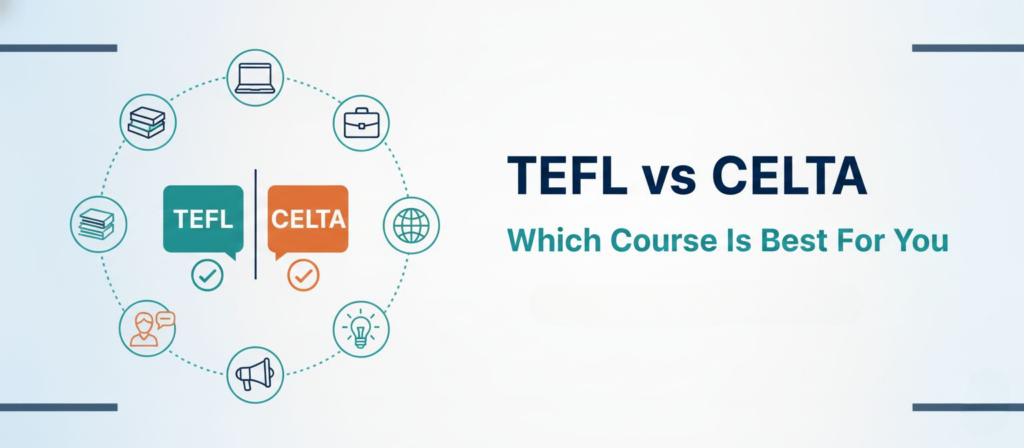
Certification is not a “one size fits all” standard. The Polish market has been opened to various qualifications, although the options for certified and unofficial education are generally provided either through online TEFL-based qualifications or an in-depth education course like CELTA or Trinity Cert TESOL, in person and with a depth of expertise.
What matters most is the credibility of the entity that issues the certificate, the quality of the course, and the extent to which the certificate meets practical teaching competence.
When selecting a course, aim for ones that incorporate a good methodology component (communicative language teaching, task-based learning, learner-centred approaches), micro-teaching, and clear assessment guidelines. For readers preparing to teach Polish learners in Poland or online, fundamental TEFL training and continuous professional development will offer opportunities for ongoing educational growth.
Initial Checklist for Candidates
A sensible initial step is to compile a short list of what you’re looking for from a certification:
- Flexibility: An online or blended certification.
- Depth: 120-180+ hours, teaching practice included.
- Recognisability: Acceptance by Polish employers and visa authorities.
Without a common national TEFL standard across Poland, schools are dependent upon the standing of the organisation issuing the TEFL certificate and evidence of the teaching practice.
Certification options at a glance
| Certification Type | Typical Hours | Typical Cost (GBP) | Recognition / Notes | Best For |
| Online TEFL | 120-150 | 150-350 | Widely accepted for entry roles; portable | Beginners seeking flexibility |
| CELTA | 120 | 1,000-2,000 | High employer recognition; strong practice component | Classroom roles in Poland; leadership progression |
| Ofqual-regulated | 120-180 | 350-900 | Regulated in the UK; credible in many European markets | Career progression, credibility with non-UK schools |
| Polish CPD | 20-60 | Varies | Useful for Polish context; complements TEFL | Local career support and renewal of credentials |
Note: Costs are indicative and vary by provider, format, and location. Always verify current prices, hours, and delivery mode with the course provider. For accuracy on regulatory aspects, consult official sources such as Ofqual and Poland’s government portals.
Certification Pathways and Ofqual Standards for Poland
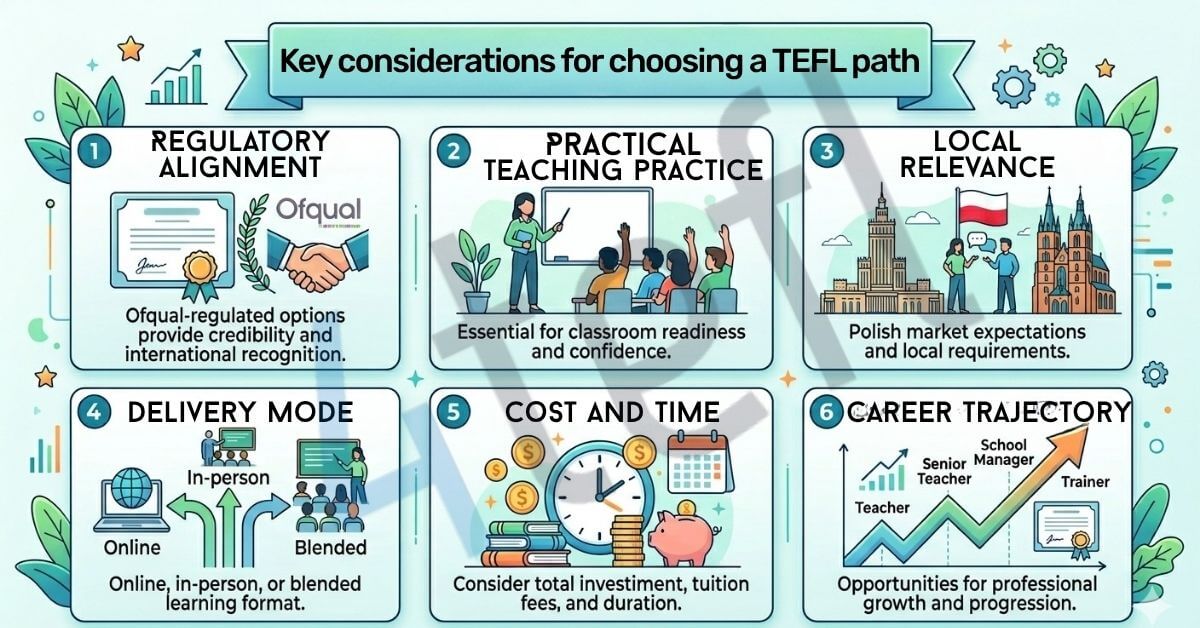
Ofqual certified and regulated TEFL qualifications have emerged as a recognised route for teachers seeking portability and credibility. Ofqual (UK regulator of qualifications) lists a range of TEFL-related courses that carry regulatory oversight, which can help employers perceive a training package as robust and consistently assessed.
With no national TEFL qualification for private language schools in Poland, employers look for certificates that reflect transparent assessment standards and offer a practical component to test the effectiveness of the qualifications. As a result, Ofqual-regulated qualifications can improve employment opportunities with well-respected language schools (particularly those that partner with international curricula or run multi-site programmes).
Practical Realities for Teachers
In reality, such is worth twofold for you:
- Independent Benchmark: You pick up a standard that many employers recognise as meeting professional standards.
- Polish Expectations: Poland lacks a uniform nationwide licence for English language teachers in private language centres, meaning recruitment often falls back on the reputation of the course provider.
If you plan to work in public institutions or with certain international schools in Poland, you may face extra hurdles (background checks and a few schools asking you to get some teacher training aligned with international standards, for example). As well, always check with interested employers on their certification requirements before enrolment.
Recommended Course Features
- Observed Teaching Practice: Essential for gaining feedback.
- Versatile Design: Ability to teach children, teens, and adults.
- Additional Modules: Workshops concentrating on classroom management, young learner pedagogy, or bilingual education strategies are highly appreciated.
The goal is to create a portfolio of evidence, teaching demos, reflective journals, and well-defined progression pathways that you can share with future employers.
The Polish Education Landscape: What Employers Expect
The education system in Poland has well-founded pedagogies, good communication with students and the capacity to modify teaching for mixed-age students and to various national and linguistic backgrounds.
Key Employer Priorities:
- Lesson Planning: Challenging lessons encompassing listening, speaking, reading, and writing.
- Technology: Use of digital tools and authentic materials.
- Digital literacy: Strong level of digital literacy for online or hybrid teaching.
- Professionalism: Reliability, punctuality, and a welcoming environment.
- Evidence of Skill: Teaching demonstrations, micro-lesson videos, and reflective journals.
A demonstration lesson (a micro-teaching module on how to teach using communicative language teaching, error correction and strategies of interaction with students) is usually standard in interviews in Poland.
Cultural sensitivity is another important variable: teachers who understand the motivations and the standard study practices and the local situations are often more effective in the classroom. Safeguarding and professional ethics policies are also becoming more and more important; pre-service teachers should prepare to discuss safeguarding, confidentiality and inclusivity.
Visa and Work Permits for Teaching Roles in Poland
For Non-EU Teachers
Obtaining a work permit is a crucial step towards legally securing employment. The process involves:
- Job Offer: Receiving an offer from a Polish employer.
- Work Permit: The employer initiating the permit application.
- Visa Application: Applying for a national visa (type D) or a temporary residence permit.
Since processes may vary by region (Voivodeship), it is advisable to find reputable schools familiar with navigating the bureaucracy.
For EU Nationals
EU citizens have the right to work in Poland under the framework of EU freedom of movement. However, long-term residency factors still apply:
- Registering as a resident.
- Obtaining a PESEL number.
- Securing a residence permit for work-related stays beyond a certain duration.
Required Documentation Checklist:
- TEFL/TESOL certificate.
- CV in English (or bilingual).
- Passport and photos.
- Employment contract.
- Criminal record certificate (Police background check).
Building a Career: Teaching Jobs, Salary, and Growth
The Polish TEFL market caters to a variety of positions in private language schools, as well as bilingual kindergartens and primary schools, universities, and online teaching.
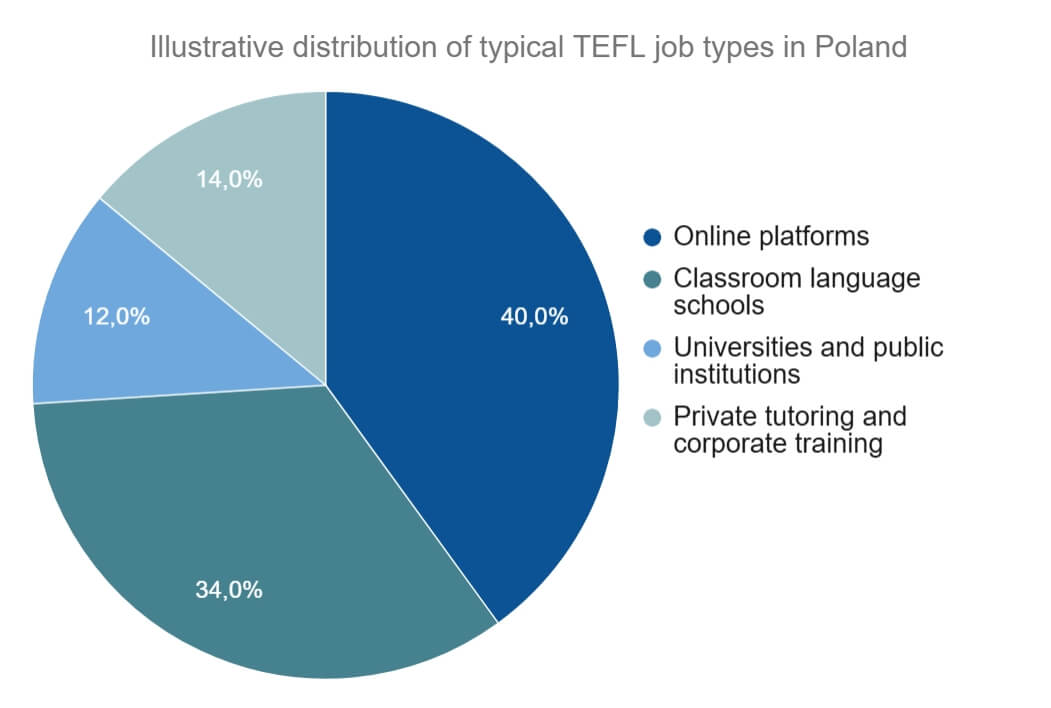
In large cities like Warsaw, Kraków, Wrocław, and Gdańsk, positions often include curriculum preparation, teacher mentoring, or coordination.
Salary and Advancement
- Pay Structure: Generally paid per hour in private schools and online platforms. Salary levels vary by city and international vs. local client base.
- Negotiation Factors: Teaching hours per week, workload, and extra responsibilities (e.g., resource development).
- Growth Path: Promotion to senior teaching roles, mentoring positions, or administrative staff roles such as branch director. Some seek further education (Master’s degrees) to become teacher educators.
Practical Steps to Get Certified and Start Teaching in Poland
- Objectives: Choose between CELTA/Trinity (high practice) or reputable online TEFL (flexible entry).
- Practice: Ensure it includes observed instruction and feedback loops.
- Documentation: Verify degrees, certificates, and professional CVs.
- Visas: Maintain close contact with your employer regarding timelines.
- Portfolio: Include demo videos, lesson plans, and digital resource samples.
- CPD: Update skills in hybrid teaching and young learner pedagogy.
- Networking: Join TEFL associations and local ELT communities to stay informed on market trends.
Supporting Resources: Accredited Courses and Delivery Modes
Online classes offer flexibility for those balancing work, while face-to-face courses provide intensive practice with direct feedback from tutors. Making sure your investment leads to employment opportunities is important; therefore, choose courses that clearly show alignment with international teaching standards, are based on observed practice, and provide a verifiable certificate. If you are seeking a route with Ofqual-regulated qualifications, ensure the provider states the regulation clearly and that the qualification is applicable for teaching in Poland and beyond.
Delivery mode considerations for Poland:
- Blended TEFL: beginner-friendly, easy to access, and applicable to online instructional roles.
- CELTA/Trinity: solid practical experience, strong market recognition, but more expensive and time-intensive.
- CPD modules: supplement initial certification and support long-term development.
- Instruction: courses conducted in English with clear evaluation standards.
Authoritative Sources and Fact Checks (References)
- Migrant.info.pl: Information on work permits, visas, and legal residency in Poland.
- Ofqual: UK government register of regulated qualifications and awarding bodies.
- British Council: Professional guidance on ELT standards and teaching English in Europe.
- EURAXESS Poland: Resources for researchers and educators moving to Poland, covering social security and local regulations.
- Cambridge English: Official details on the CELTA qualification and its global recognition.
Do I need an Ofqual certificate to teach in Poland?
No, you do not strictly need an Ofqual certificate to teach in Poland. However, Ofqual-regulated courses are respected and can improve employability, especially with international schools and online platforms. Poland’s private language sector relies on credible qualifications and strong teaching practice, and Ofqual-aligned options can help demonstrate that. Always verify the specific requirements with your target employer.
Can EU citizens teach English in Poland without a work permit?
Yes. EU citizens can work in Poland without a separate work permit due to EU freedom of movement rules. You may still need to complete registration and residency steps if staying long term. Non-EU applicants typically require a work permit arranged by the employer and a visa or residence permit, depending on circumstances. Check the official government guidance for the latest rules.
Which certification should I start with if I want to teach online?
For online teaching, a solid TEFL or TESOL certificate with a teaching practicum is a good foundation. Look for courses that emphasise online pedagogy, technology use in teaching, and online classroom management. An Ofqual-regulated or highly credible certificate can be advantageous when applying to international online platforms that publish transparent qualification requirements.
How long does it take to become employable in Poland as an English teacher?
Time to employability depends on your chosen pathway. A strong online TEFL with a practicum may enable you to secure online roles quickly, while in-person CELTA or Trinity Cert TESOL could yield classroom positions in a few months after completion, including time for job searching and visa logistics if required. Networking, portfolio quality, and responsiveness to applications also affect how quickly you secure roles.
What should I expect in a Polish language school interview?
Expect a demonstration lesson (micro-teaching) where you show how you plan and deliver a lesson, manage learner interaction, assess learning, and adapt to learners’ needs. Employers may also ask about your experience with different age groups, your approach to classroom management, and your ability to integrate technology. Having experience with learner assessment and lesson planning will help you present a strong case.
Are there government scholarships or government-sponsored routes to teach English in Poland?
Government sponsorship of English teaching positions is typically linked to public education contexts and international cooperation programs rather than private language schools. If your goal is to teach in public schools or universities, check for any exchange programs or formal teaching collaborations that may be available through official channels. Your employer or recruiting partner can provide current information about applicable programs.