
Teaching Business English A Practical Guide for Teachers


The Demand for Business English Specialists
An international market requires more and more specialists in business communication in English. Teaching Business English (BE) is more than just grammar and vocabulary; it is about preparing the language for professional tasks in the wider world, such as:
- Meetings
- Negotiations
- Presentations
- Email communication
- Cross-cultural collaboration
For teachers in the making, this means transitioning from teaching generalized English to a specific area where your classroom practice directly supports learners’ careers and organizational success. When done the right way, BE teaching is professionally rewarding and serves society.
However, a lot of prospective BE teachers are confronted with a maze of routes to certification, training providers, and employer demands. Questions are myriad:
- Which credentials really matter to schools and employers?
- How do I prove that I am good at BE for practical applications?
- What continuing education will keep me competitive in a saturated market?
This guide is an organized collection of evidence-based tips tailored to UK and international standards (Ofqual-regulated routes in some cases) that will help you design a credible career as a BE instructor—from theory, pedagogy, and certification options to classroom tactics, ongoing study, and beyond. Designed for TEFL/TESOL trainees, this practical guide combines theoretical perspectives and research-based principles with low-tech techniques.
Core Concepts for Teaching Business English
In this area, language learning and professional communication intersect. Learners are looking for BE to do their jobs better, whether they work in finance, IT, marketing, or services that support global teams.
BE programs of study foreground:
- Functional language: How to perform specific tasks.
- Discourse and genre awareness: How business texts and talk are structured.
- Intercultural communication competence: How to communicate across cultures.
A key principle of BE is task orientation: learners complete real-world tasks that simulate workplace procedures, with feedback focused on actual performance. In practice, this leads to:
- Role-plays of client meetings.
- Negotiations with suppliers.
- Presentations to senior stakeholders.
These are combined with authentic materials such as genuine emails, memos, or company reports. To teach well, the learning must balance form (grammar and lexis) with function (what the learner is doing) and genre (the conventions of business communication).
Practical Principles for Effective BE Instruction
Effective BE instruction is supported by the following practical principles:
- Linking language to concrete business scenarios: Through needs analysis and outcome-based planning.
- Giving prominence to pragmatic competence: Handling conversations, dealing with misunderstandings, and maintaining professional relationships.
- Instilling intercultural sensitivity: Recognizing how cultural practices shape negotiation styles, meeting governance, and feedback.
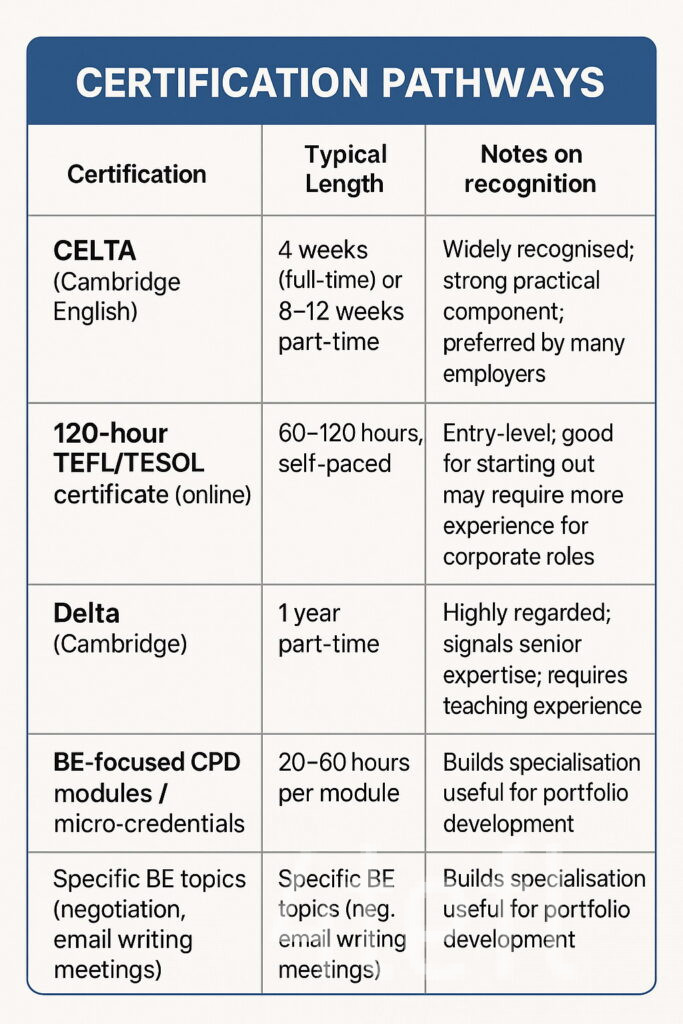
Evaluating Certificates in Teaching English for Business
To train as a teacher of Business English, the right certification pathway is crucial. The most widely accepted qualifications include:
- Professional teaching certificates such as CELTA (Certificate in English Language Teaching to Adults).
- More advanced learning credentials like Delta (Diploma in Teaching English to Speakers of Other Languages).
These certificates are usually issued by Cambridge English and accepted by international schools and corporate training programs. By contrast, a general TEFL/TESOL certificate (often advertised at 120 hours or more) can be a good entry into the industry for newcomers.
Customizing Your Certification Path
For BE, seek courses offering micro-credentials or modular options to customize your learning for BE contexts, such as:
- Email writing for business
- Meeting skills
- Cross-cultural negotiation
A potential route could involve moving from a basic TEFL or TESOL certificate to more advanced qualifications, such as CELTA or Delta, or BE-specific CPD via a phased approach.
When choosing a course, look for:
- The credibility of the provider.
- Evidence of supervised teaching practice.
- Presence of business-specific modules.
Real Classroom Activities for Business English Students
Effective “Can do” classrooms integrate needs analysis, Task-Based Learning (TBL), and authentic materials to focus on measurable improvements in learners’ workplace performance.
Step 1: Needs Analysis and Defining Outcomes
Start with a strong needs-analysis process:
- Interview learners and their managers.
- Survey job roles.
- Map predicted BE tasks to CEFR levels.
Define key observable learning outcomes directly linked to workplace tasks:
- Writing professional emails at B2 level.
- Conducting a short client presentation from B2-C1.
- Negotiating a deal at B1-B2.
Step 2: Task-Based Learning (TBL)
Use TBL for authentic business tasks like writing a compelling proposal, giving a client brief, or running a short internal meeting.
Incorporate real company materials:
- Emails, press releases, marketing decks.
- Quarterly reports, and industry jargon.
Step 3: Performance-Oriented Assessment
Assessment in BE must be performance- and portfolio-oriented. Go beyond traditional tests and have students create things like:
- A print-and-present task.
- A negotiation video.
- A professional collection of emails.
Provide feedback on business writing, focusing on clarity, conciseness, tone, structure, and professional credibility.
Professional Perspectives and Continuing Training
Teaching Business English opens diverse career opportunities. Positions are available at:
- Brick-and-mortar language schools offering BE courses.
- Multinational companies for staff training.
- Internet platforms connecting corporate learners with BE trainers globally.
Salaries mirror qualifications, teaching experience, and demonstrated impacts on learners’ job performance.
Continuing Professional Development (CPD)
Continuing education is vital for maintaining a viable BE career. Consider Delta or BE-focused CPD to show advanced practice and leadership.
To develop professionally in BE teaching:
- Build professional networks: Join BE associations or teacher groups.
- Participate in Conferences: Engage in peer observations and exchange BE teaching materials.
- Develop a Transparent Personal Brand: Create a BE-centered resume, sample work, and a brief teaching philosophy linking BE pedagogy to learner outcomes.
The combined effect of practical BE knowledge, reputable certification acknowledged by businesses, and impact on business results is key to becoming a desired BE teacher.
Do I need a CELTA to teach Business English?
Generally, CELTA or an equally recognised certificate is highly valued by employers, especially for roles in schools and corporate training. However, many organisations also hire teachers with online TEFL/TESOL certificates when combined with practical teaching experience and a strong BE portfolio. Ofqual-aligned and reputable BE qualifications further enhance credibility for more demanding roles.
Is online TEFL/TESOL certification acceptable for BE teaching?
Online TEFL/TESOL certificates can be a viable starting point, particularly for online BE platforms or entry-level teaching. For visa-regulated or in-person roles, employers often expect more extensive training, supervised teaching practice, and a higher-level credential such as CELTA or Delta.
What CEFR level should BE learners have?
BE learners typically span from B1 to C1 levels, depending on their roles and tasks. Foundational BE courses may target B1–B2 for practical communication, while advanced BE programmes frequently aim at B2–C1, enabling learners to negotiate, lead meetings, and produce professional-level documents.
How long does it take to become BE-qualified?
A practical BE teaching path often starts with a recognised TEFL/TESOL certificate (a few weeks to a few months), followed by supervised teaching practice and, if desired, progression to CELTA or Delta. Ongoing BE CPD modules can be pursued as you teach to deepen subject-specific expertise.
How can I tailor BE content to corporate clients?
Start with needs analysis: interview learners and stakeholders, collect job tasks, and map these to BE outcomes. Use authentic tasks, real business texts, and sector-specific vocabulary. Ensure measurement through performance-based assessments, and provide feedback tied to workplace impact.
What ongoing training should BE teachers pursue?
Consider a mix of advanced BE qualifications (Delta or equivalent), BE-specialised CPD modules (e.g., negotiation, email writing, cross-cultural communication), and digital teaching credentials (online course design, learning analytics). Regular participation in professional networks and BE-related research can help you stay current.