Teaching English in Colombia: Career Paths, Certification & Training


Colombia is one of the most accessible destinations for teaching English in Latin America, offering both convenience and quality.
Here’s the good news, the path is well defined for aspiring teachers:
- Private language schools
- Bilingual schools
- Universities
- Online platforms linking teachers to learners from around the world.
But the process of securing a position in Colombia can be complex: employer expectations vary, visa rules apply and there is a range of TEFL/TESOL certificates with different recognition. This section provides a clear starting point. It relies on proven frameworks and reliable, non-commercial sources to help readers plan credible entry routes into Colombia’s English-teaching market.
For anyone who wants to teach abroad or online, the first obstacle is clarity about what employers expect and which documentation is most credible. In Colombia, demand is strong but requirements vary by role. A well-chosen TEFL/TESOL certificate, preferably with online teaching modules and recognised accreditation, can significantly improve employability and make the transition easier. It is important to plan ahead and keep your documents organised.
Teaching English in Colombia: Career Paths and Jobs
The Colombian market offers different routes for English teachers, offering both stability and quality.
- Private language schools (idioma centres): A common entry point for newcomers. They offer group classes with adults and young learners in cities such as Bogotá, Medellín and Cali.
- International schools: Often bilingual or English-medium, offering opportunities for more experienced teachers who may need a higher level of qualification and a stronger teaching record.
- Universities and teacher-training programmes: Can also provide roles, particularly for teachers with advanced credentials.
- E-learning: The growth of e-learning has opened up options to teach learners in Colombia or abroad from a home office, allowing flexible hours and wider time-zone choices.
Typical Professional Profiles and Tasks
- Entry-level roles: Often include conversation practice, grammar support and pronunciation work, using teaching units designed by a programme.
- Bilingual schools: Responsibilities may extend to supporting curriculum delivery, contributing to language-development initiatives and coordinating with local teachers and teaching assistants.
- Advanced tasks: In many settings, teachers may also design courses, assess learners regularly and communicate clearly with parents or school coordinators.
- Online roles: Teachers are expected to plan lessons efficiently, manage digital classroom routines and provide structured feedback.
Practical Reflections on Occupational Security
Salaries and contract terms vary by city, sector and whether the work is in-country or online.
- Private language schools: Often offer fixed-term contracts with monthly pay.
- Universities and international schools: May offer longer-term contracts with additional benefits.
Unlike other choices, in most cases it is preferable to secure a role before you arrive or before you begin the visa process. What’s interesting is that networking through local recruitment agencies, education fairs and professional networks can improve access to opportunities. Colombia employers and immigration authorities value thorough preparation and clear documentation.
Career paths at a glance
| Sector | Typical requirements | Work format | Common hours | Notes |
| Private language schools | TEFL/TESOL certificate (120h+) with practicum; bachelor’s often preferred | In-person | Evenings/weekends common | Entry-level path; good for building classroom experience |
| International schools | Bachelor’s degree; CELTA/TESOL and higher; native-level fluency | In-person | Full-time with school calendar | Higher pay potential; stricter requirements |
| Universities/Language centres | Bachelor’s degree; TEFL/TESOL with practicum; research or teaching experience | In-person or hybrid | Daytime classes; some evenings | Opportunities for university credits or professional development |
| Public schools | Teaching credentials and compliance with national curricula; visa sponsorship varies | In-person | School hours; occasional after-school hours | Competitive entry; often requires longer adaptation period |
| Online teaching | TEFL/TESOL; reliable internet; strong digital pedagogy | Online | Flexible; regional time-zone alignment | High flexibility; may require self-promotion and scheduling discipline |
Statistics and Market Snapshot
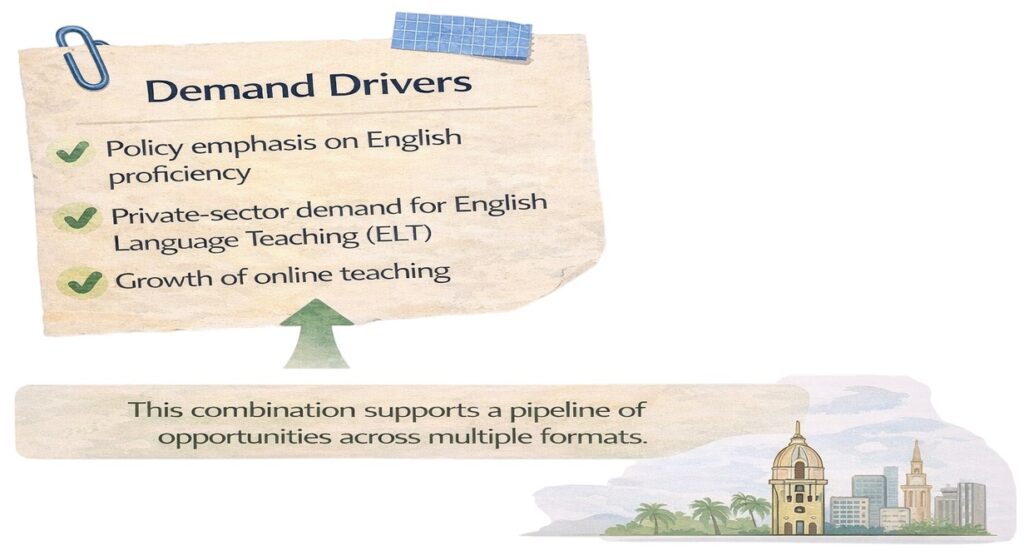
You’ll find that demand for English education in Colombia has increased over recent years and policy initiatives have aimed to strengthen English in public education, combining functionality with artistic appeal. UNESCO and associated education authorities often frame English as a useful competency within wider development goals in the region. For background, see UNESCO’s policy guidance for Latin America. These trends contribute to steady demand across sectors.
For an overview of the policy context, consult UNESCO and Colombia’s national education authorities. The crux of it is that most new teachers begin in private language centres or schools, using these roles to build experience and a portfolio before moving into higher positions in bilingual schools or universities.
The most popular cities are Bogotá, Medellín and Cali, where language schools compete for qualified teachers and often offer more structured career pathways.
Where to find reliable, government-backed guidance
- Migración Colombia: Sets out visa and work-permit requirements for foreign nationals seeking paid work, including the need for an appropriate work visa supported by an employer. In plain English, this information helps prospective teachers plan immigration steps alongside recruitment.
- The Colombian Ministry of National Education (MEN): Responsible for national education policy, including English-language education standards, curriculum guidance and teacher-training expectations that affect schools and institutions hiring foreign teachers.
- UK Regulators: Information on regulated qualifications may also be supported by the relevant UK regulator and awarding-body guidance, which helps explain how certain TEFL/TESOL certificates are structured and verified.
Certification Essentials for TEFL in Colombia
A TEFL/TESOL certificate forms the foundation for many teaching roles in private institutes and in many bilingual schools, offering both convenience and quality. A typical entry-level option is a 120-hour TEFL/TESOL course that includes a practicum. More intensive options, often with additional teaching practice and assessment, can be preferred by more selective employers. In practice, the quality of training and observed teaching can matter as much as the certificate title.
Distinctions between TEFL, TESOL, CELTA, DELTA and related routes
- TEFL and TESOL are broad terms for many types of courses.
- CELTA and CertTESOL are programmes with recognised teaching practice.
- DELTA is an advanced qualification and is often considered a higher-level credential, especially if employers need strong evidence of classroom performance.
What you’ll notice is that in Colombia many employers accept well-structured TEFL/TESOL certificates, while more competitive roles prefer programmes with assessed teaching practice and clear evaluation, combining functionality with aesthetic appeal. Here’s the thing: the key is to choose a course that includes practical teaching and a portfolio you can show employers, combining functionality with aesthetic appeal.
Quality and accreditation factors
You’ll see that a programme accredited or aligned with a credible framework can strengthen your credibility with employers. TEFL/TESOL certificates are not regulated in the same way as some university degrees. Choose a programme with clear learning outcomes, strong teaching practice, supervised training and transparent assessment methods. Even better, if a provider offers verifiable transcripts or detailed course outlines, this can help support your application.
Practical guidance for selecting a course
- Verify scope: 120-150 hours minimum with teaching practicum.
- Prioritise practicum: 6-20 hours of supervised teaching is valuable.
- Check credentials: Ensure the certificate is issued by a registered awarding body and cross-verify via the awarding body’s official information where possible.
- Evaluate support: Career guidance, job placement help and access to teaching materials and lesson-planning resources.
- Align with your goals: CELTA may suit some international school pathways, TEFL/TESOL with online pedagogy suits online platforms.
Certificate options and what they signal to Colombian employers
| Certificate option | Typical length | Teaching practicum | What it signals to employers | When it’s most advantageous |
| 120-hour TEFL/TESOL | ~4 weeks–3 months | 6–20 hours | Solid entry-level credential with practice | Starting in private language schools or online teaching |
| 150–200-hour TEFL | ~2–4 months | 20+ hours | Strong practical foundation; broader scope | Applications to bilingual schools or language centres |
| CELTA or equivalent | ~4 weeks full-time | 6–12 hours | Highly regarded; strong classroom readiness | International schools or universities with strict standards |
| Ofqual-regulated | Variable | Variable | Official transcripts; traceable regulatory status | Employers seeking verifiable regulatory alignment |
How to verify a course
Ask the provider for the awarding body, total hours and credit framework, practicum duration, how teaching is observed and assessed and whether you receive verifiable transcripts. Where relevant, cross-check the awarding body through official portals. The Colombian market values clarity and evidence of real teaching practice.
The value of continuous professional development
Certification is a starting point and ongoing training matters. Teachers who continue developing skills, including higher-level qualifications where appropriate, tend to access more opportunities and stronger job security, streamlining your progression.
Accreditation, Ofqual standards and training routes
UK regulatory and awarding-body guidance can help explain which qualifications meet recognised standards and how certificates are verified. Some TEFL/TESOL providers offer programmes aligned with formal frameworks, which can improve portability and credibility for teachers working internationally, including in Colombia. Training routes that include assessed teaching practice and clear assessment criteria are often valued by language centres and international schools. Digital teaching modules and online classroom management are also increasingly important, even when courses are not regulated in the same way.
Future teachers should:
- Confirm the awarding body and verify its status through official sources where possible.
- Obtain a transcript or certificate that lists modules, hours and teaching practice.
- Request a short course description and any guidance that shows how training links to classroom outcomes.
- Check what employers in your target sector prefer.
- Keep a portfolio of lesson plans, reflections and evidence of learner progress to show Colombian employers.
Training routes for different career goals
- Private institutes and bilingual schools: A solid 120-hour TEFL/TESOL certificate with practicum is commonly accepted.
- International schools or university-linked roles: A bachelor’s degree plus stronger qualifications and a proven record of teaching practice can improve access.
- Online teaching: Choose a TEFL/TESOL course with digital teaching modules, strong online lesson planning and video-conferencing skills.
Job Market in Colombia: Online and in-person teaching
In big cities, private language schools remain a central entry route for new teachers, offering both convenience and quality. International schools and universities often provide more structured roles for experienced teachers with a strong portfolio and relevant qualifications. The online segment has grown and can suit teachers who want to combine local employment with online work across time zones.
Professional Considerations
- Authorization: Effective work in Colombia requires authorisation. If you work in a Colombian school, your employer can usually support the visa process.
- Contractors: Online platforms may treat teachers as independent contractors rather than employees, which can affect taxation and social protection.
- Pay Structure: Pay varies by sector. Private institutes often offer predictable monthly pay. International schools and universities may offer stronger benefits.
A practical pathway to early success
- Obtain a recognised TEFL/TESOL certificate with practical hours.
- Apply to local language schools and bilingual programmes and highlight your practicum and teaching outcomes.
- Build your online presence: job-board profiles, a short teaching demo video and a portfolio.
- Seek observed or mentored teaching early to strengthen your skills.
- Join professional teacher networks or local meet-ups to stay connected with demand and best practice.
Online Teaching from Colombia: Platforms, best practice and compliance
Online teaching can connect you with learners globally, including students in North America and Europe who prefer flexible hours or specialised training.
- Selection: When selecting platforms, review teacher support, moderation and payment terms.
- Visibility: A professional online presence, such as a polished profile, a short video introduction and a sample lesson, can improve visibility.
- Technical Preparation: Key skills include clear lesson planning, engaging delivery, effective use of multimedia and structured feedback. Reliable equipment and stable internet are essential.
- Tax Compliance: If you work online as an independent contractor, you may be responsible for tax reporting in your country of residence and possibly in Colombia depending on status and income.
Preparation roadmap: a step-by-step plan
Step 1: Foundation (0-3 months)
Get this: choose your path in private schools, international schools, universities or online roles.
Plus, choose a TEFL/TESOL certificate with practical teaching, ideally 120-150 hours or more.
Plus, start a portfolio: lesson plans, a short demo video and a practicum report.
Step 2: Build practical experience (3-9 months)
You know what? Complete the practicum with constructive feedback and gather reference letters from tutors.
Here’s the thing: seek short-term teaching opportunities, volunteer or paid, to diversify your experience and strengthen your CV.
Step 3: Visa steps and preparation (9-18 months)
Plus, apply to private language schools and bilingual centres and approach international schools if eligible.
You know what? If you are planning to work in Colombia, confirm visa requirements with the employer and plan the process with Migración Colombia.
Step 4: Portfolio expansion and continuous development (18+ months)
You know what? Pursue additional qualifications, DELTA or advanced TEFL/TESOL, as you target higher-level roles.
Plus, attend professional development workshops and build an ongoing support network.
Step 5: Online and hybrid work (12-24 months)
Here’s the point: build an online teaching practice alongside in-country commitments, allowing greater flexibility and more varied income.
Authoritative Sources and Fact Checks (References)
- Migración Colombia (Official Site): Official government portal for work visas, work permits, and immigration regulations.
- UNESCO – Education in Colombia: International oversight and reports on the Colombian educational system and language policy.
- Ofqual Register (UK Government): To verify the accreditation and level of UK-based TEFL/TESOL awarding organizations.
- British Council Colombia: Information on English language education projects, teacher resources, and local cultural context.
Do I need a Colombian visa to teach English in Colombia?
If you are employed by a Colombian institution and receive payment, you usually need an appropriate work visa or permit, often coordinated between the employer and Migración Colombia. Always verify current requirements with the employer and official immigration guidance.
Is CELTA required to teach in Colombia?
CELTA is highly regarded, especially for international schools and more formal positions, but many Colombian private language schools accept well-structured TEFL/TESOL certificates with a solid practicum. It depends on the employer and the level of the role.
Can I teach online from Colombia?
Yes. Online teaching offers flexibility and can complement in-country work. You’ll need a strong internet connection, a quiet space, and a TEFL/TESOL certificate with a focus on online pedagogy.
What kind of salary can I expect?
Salaries vary by city, sector, and whether the role is in-person or online. Private language schools usually offer fixed monthly pay, while online roles may provide per-hour or per-student compensation. Higher-tier roles in international schools and universities generally offer higher pay and benefits.
What’s the best way to choose a TEFL/TESOL course for Colombia?
Prioritise a course with a substantial practicum, credible certification, and a clear transcript. If possible, select an option with Ofqual alignment or recognized international accreditation. Ensure the course provides practical teaching experience and a portfolio you can show to Colombian employers.
How can I improve my chances of success in the Colombian market?
Build a strong teaching portfolio, achieve a robust practicum, and consider combining in-country experience with online teaching. Networking with local recruiters and continuously upgrading your qualifications can create more opportunities over time.