Teaching English in Paraguay: Career Paths and Certifications

Paraguay is emerging quietly but steadily as a promising destination for English language teachers. Many aspiring teachers, though, are not sure where to start. The job market includes private academies, international schools, universities and an online sector with each requiring its own mix of qualifications, experience and visa arrangements. The bottom line is that preparation matters especially for bilingual candidates.
Here’s what you should know: for anyone looking to teach English abroad or online, Paraguay offers practical possibilities for those prepared to plan strategically, providing a strong balance of structure and flexibility. Success depends on how qualifications, teaching expectations and local culture fit together.
Navigating the TEFL World in Paraguay
This guide lays out a clear framework for navigating Paraguay’s TEFL world:
- What certificates matter
- How roles differ
- What career routes exist
- How to move from entry-level positions toward more senior opportunities
You’ll find distinctions between online and on-site work, insight into employers’ priorities, and guidance on choosing training that aligns with Paraguayan standards. The goal is simple-to give you accurate, grounded information so you can make informed choices about TEFL or TESOL training and chart a sustainable teaching career.
A Comprehensive Look at TEFL Careers in Paraguay
Here’s something cool: Paraguay’s TEFL market is diverse, with multiple entry points for teachers at different levels of their careers, providing a strong symmetry of form and role. Here’s what you should know: private language schools often hire teachers who hold recognised TEFL/TESOL certificates as well as a bachelor’s degree, sometimes with a preference for those who have classroom experience. Trying to improve your situation? The truth is, international schools tend to require higher qualifications, including accredited certifications and, in some cases, prior teaching experience or a degree linked to education, which can make a difference for any position. Universities and higher-education language programmes may also set specific requirements.
This is absolutely indispensable: online programmes widen the field further, enabling teachers to work with learners in Paraguay and across the region while keeping flexibility around time zones, offering both convenience and calibre. This is worth noting: experience matters in Paraguay yet the country rewards commitment to professional growth. Networking with local language schools, attending education fairs and joining regional TEFL communities can lead to referrals and short-term contracts that develop into longer-term positions, helping you succeed in any setting.
What makes this different is that for newcomers, an organised plan – start with an entry-level certificate, build classroom experience through part-time roles and gradually target higher-responsibility roles – tends to work well, offering both flexibility and stability. This approach helps you build a stronger profile as you adjust to Paraguayan classroom culture, including local expectations around classroom management and learner needs.
The local setting matters and many Paraguayan learners are multilingual. One thing to remember is that incorporating Guaraní-friendly explanations or cross-cultural activities can support inclusion and participation, offering both convenience and quality. Employers value adaptability: the ability to tailor lessons to different age groups, from young learners to adults studying Business English or exam preparation. As with many Latin American markets, strong interpersonal skills, reliability and consistency in lesson delivery tend to stand out to employers and help teachers secure repeat contracts, giving you peace of mind.

| Role | Typical Employer | Required Certification | Typical Hours/Week | Notes |
| English teacher (young learners) | Private language schools | TEFL/TESOL certificate (120h commonly preferred) | 15–25 | Emphasises classroom management and engaging activities |
| English teacher (adults) | Private institutes, corporate English programs | TEFL/TESOL + some experience | 20–30 | Focus on practical language use and professional English |
| Online English tutor | Online platforms / local schools | TEFL/TESOL certificate; high-speed internet | 20–40 | Flexible hours; requires reliable tech setup |
| International school instructor | International or bilingual schools | Bachelor’s in education + certification; CELTA/DELTA a plus | 25–40 | Lower tolerance for inexperienced teachers; strong formal credentials valued |
| University language centre staff | Universities | Teaching-focused master’s/PGCE or TESOL with experience | 10–20 | Often includes curriculum planning and assessment work |
| Curriculum developer / trainer | Large language schools, edtech partners | TEFL/TESOL certificate + experience | 0–15 (part-time) | Requires experience and familiarity with local needs |
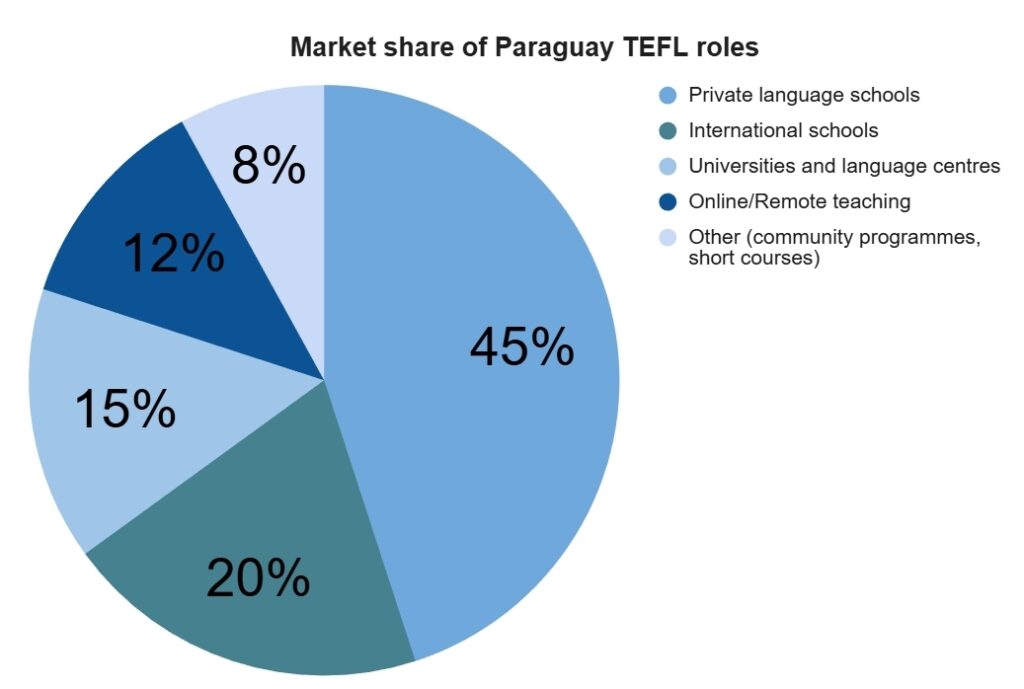
In short, this market rewards certified, adaptable teachers who keep learning and show results.
Certification and Career Pathways
Your qualifications largely decide where you can work. A recognised TEFL or TESOL certificate-usually 120 hours of coursework-remains the foundation for most entry roles in private schools. CELTA is highly respected and often preferred by top-tier institutions. For university or international school jobs, a bachelor’s degree and a more advanced teaching qualification are usually essential.
A typical route begins with a TEFL or TESOL course, then a term or two of part-time teaching. Once you’ve built classroom confidence, you can transition into:
- Coordination
- Mentoring
- Curriculum development
Many teachers boost their trajectory by teaching online alongside in-person work. Strong digital communication, stable internet, and an understanding of asynchronous learning all make a difference in landing online contracts.
Paraguay’s schools value teachers who keep training. Micro-credentials in phonology, lesson planning, or technology-enhanced learning can set you apart. So can assessment training or workshops in classroom management. Local English teacher associations often share resources, and joining them can expand your network and credibility.
To stay competitive, assemble a professional portfolio: a core 120-hour TEFL/TESOL certificate, plus short specialised courses in your teaching interests. Those who aspire to leadership should consider CELTA, DELTA, or postgraduate study in applied linguistics or education. Keep records of tangible impact-student results, feedback, or your own reflective notes. This evidence helps when applying for better roles.
Essential Certifications and Training
Context is everything. Paraguayan classrooms often mix Spanish and Guaraní speakers, which shapes how English is taught. Prospective teachers should aim for certificates recognised internationally but practical locally. The baseline remains a 120-hour accredited TEFL or TESOL qualification with assessed teaching components. For senior positions, CELTA, DELTA, or a master’s degree in education can open doors to higher pay and longer contracts.
Employers in Paraguay expect both paper credentials and proof of ability. Real classroom experience-even through internships or volunteering-adds credibility. Understanding the bilingual environment helps too. Teachers who can communicate clearly with Guaraní-speaking learners or explain concepts through local examples earn trust quickly.
Daily duties go beyond teaching. Many schools expect:
- Lesson planning
- Progress tracking
- Contribution to shared materials
A detailed teaching portfolio-with sample lessons, student feedback, and reflections-often makes applications stand out.
Local training opportunities exist. Some Paraguayan universities and language schools offer TEFL courses, while international online providers bring accredited options at reasonable cost. When choosing one, verify recognition by reputable education bodies, ensure at least 120 hours of instruction, and look for a practicum component.
Different sectors value different qualifications:
- Private academies hire TEFL/TESOL holders.
- International schools may require CELTA or even a degree in education.
- Online platforms look for professionalism, clarity, and experience rather than paperwork alone.
Keep your certificates current and don’t hesitate to upskill-education technology evolves fast, and teachers who adapt are the ones who last.
Career Growth: Blending Online and On-Site Work
Progression in Paraguay rarely follows a straight line. Teachers often combine in-person classroom hours with online teaching to build income stability and varied experience. Starting roles in private schools or after-school programs help sharpen your craft-lesson design, assessment, rapport, pacing. Over time, consistent performance can lead to promotions:
- Senior teacher
- Coordinator
- Trainer
- Curriculum lead
Online teaching remains a strong complement. It offers flexibility and exposure to regional learners, useful for expanding your professional network and refining your teaching approach. The strongest Paraguayan educators combine both modes, switching seamlessly between physical and virtual spaces.
Career advancement here comes from three pillars:
- Experience
- Evidence of results
- Ongoing learning
Extra certificates in phonology, pronunciation, or digital learning increase your appeal. Employers tend to reward teachers who are dependable, communicative, and collaborative-people who help teams function smoothly and learners succeed.
Financially, pay varies by setting. Private schools often pay per hour, with bonuses linked to attendance, student satisfaction, or retention. International schools and universities may offer fixed monthly salaries, though competition is stronger. The public sector remains limited for foreign hires, but the private and online markets continue expanding steadily. Those who build a strong reputation locally often enjoy repeat contracts and referrals.
Paraguay’s TEFL Market: Trends and Openings
You’ll find that Paraguay’s English education marketplace has shown steady growth as English becomes more important for higher education, work and tourism, offering both flexibility and quality. Facing challenges? The proliferation of private language institutes and the expansion of online education have made a space where teachers can experiment with blended learning approaches and digital tools. Basically, this movement is supported by wider Latin American education trends that emphasise communicative competence and practical language use rather than only grammar-focused teaching, allowing you to make your life easier. For teachers, this implies.
This is remarkably utilitarian: you’ll notice that the need for English instruction among younger learners and professionals continues to rise, creating opportunities for teachers who can adapt courses to specific learner needs, combining functionality with aesthetic appeal. What makes this different is that Paraguay’s bilingual setting means teachers who understand Guaraní-speaking learners and can bridge language gaps with clear explanations and engaging activities are particularly valued. Want better answers? International schools and private language centres often seek instructors who bring extra skills, such as Cambridge or other exam preparation, or interdisciplinary knowledge linked to business, tourism and technology, making it ideal for your needs.
The amazing part is that online platforms diversify access to work with learners beyond the country’s borders, allowing experienced teachers to adjust schedules and broaden income streams, providing a strong balance of form and function. Here’s what you should know: a practical takeaway for prospective teachers is to combine strong qualifications with local market knowledge. Need a fuller picture? Engaging with Paraguayan education networks, staying informed about visa and work-permit requirements and building a portfolio that demonstrates learner progress can support stable long-term opportunities, leading to exactly what you’re looking for.
Visa, Work Permits, and Life Logistics
Working legally in Paraguay means sorting your visa early. Most teachers secure a job offer first, then proceed with the employer’s sponsorship to obtain a temporary residence or work visa. Processing can take time, so start before arrival.
What makes this special is that employers may request proof of qualifications, degree verification and authenticated certificates, combining functionality with aesthetic appeal. Here’s the point: some provide visa support while others expect you to manage it independently. Always confirm requirements through official immigration channels or a trusted legal adviser before committing to travel, helping you make your move easier. Keep your documentation organised – TEFL certificate, degree documents and any required legalisation.
Beyond paperwork, practical lifestyle factors matter, creating a good balance of form and function. Paraguay offers affordable housing, accessible healthcare and a relaxed pace of life that many teachers appreciate. Settling in may take a few months and learning basic Spanish or Guaraní phrases helps significantly. Building social ties early also helps. Those connections can make settling in smoother and often lead to better opportunities over time, supporting a lasting balance of structure and routine.
Teaching in Paraguay brings a mix of stability, cultural discovery, and long-term professional growth. For teachers ready to invest in their development and engage with a bilingual culture, it’s a country full of possibilities.
Authoritative Sources and Fact Checks (References)
-
Dirección Nacional de Migraciones (Paraguay) – official residency pathways and document requirements (temporary residence validity, background checks, apostille/legalisation, and key benefits).
-
Ministerio de Relaciones Exteriores (Paraguay) – consular guidance pointing to the official Migraciones requirements for temporary/permanent residence.
-
Hague Conference on Private International Law (HCCH) – Paraguay’s accession and entry-into-force date for the Apostille Convention (useful for certificate/legal document preparation).
What language skills are most helpful for teaching English in Paraguay?
English is the target language, but familiarity with Spanish and, to some extent, Guaraní helps. Being able to explain concepts cross-linguistically improves learner understanding.
Is a 120-hour TEFL certificate sufficient in Paraguay?
A 120-hour TEFL/TESOL certificate is a common benchmark for many private language schools in Paraguay. Some employers may prefer CELTA or more advanced credentials for certain roles. Always check the specific job requirements.
Do I need a local degree to teach English in Paraguay?
For many private language schools, a bachelor’s degree plus a TEFL/TESOL certificate is sufficient. For universities or higher-level programmes, more advanced qualifications (e.g., a master’s degree in education or a related field) may be required.
How does work-permit processing work for foreign teachers?
Typically, it starts with a job offer, followed by employer sponsorship and visa paperwork. Processing times vary, so plan ahead and work with your employer to complete the required steps.
Are online TEFL courses recognised in Paraguay?
Many online TEFL/TESOL courses meet international standards and are accepted by employers, especially when combined with practical teaching experience. Verify accreditation with the course provider and cross-check with potential employers.
What salaries can TEFL teachers expect in Paraguay?
Salaries vary by sector, location, and experience. Private language schools often offer competitive rates, with online teaching providing additional income streams. Focus on building experience and a strong certifications portfolio for better earning potential.
What are typical visa options for teachers from outside Paraguay?
Temporary work visas or sponsorship-based arrangements are common. Check with your country’s embassy and the Paraguayan immigration authority for the latest requirements.