TEFL, TESOL and TESL Demystified: Core Distinctions

Many English language teachers start a career with a certification. But the acronyms TEFL, TESOL and TESL can be confusing, and how you choose which to use can also determine where you teach, how you will teach, and the value of your qualifications abroad or online. This article unpacks the core distinctions practical pathways and the considerations you should weigh when choosing a certificate. Drawing on established definitions and widely recognised standards we’ll translate terminology into concrete decisions you can act on today.
Understanding TEFL, TESOL and TESL: Core Distinctions
TEFL overview.
TEFL is short for Teaching English as a Foreign Language. The general approach is the teaching of English in contexts where English is not the native or most widespread language. A TEFL certification is most often targeted at learners who live abroad and thus are often employed within English language environments or in other countries where spoken English is required as a foreign language. The certificate has an almost universal commitment to lesson planning classroom management and practical teaching practices appropriate for a non-English speaking learner. In numerous countries a 120 hours certificate is a general minimum but the variety of programmes is highly variable. Based on widely quoted reference sources TEFL is a relatively flexible umbrella term used all over the world referring to certification for classroom English instruction outside of an English-speaking country. Due to this flexibility it is also a popular entry route for newcomers to English teaching in Asia Latin America and certain regions of Europe.
TESOL overview.
The term TESOL is translated as Teaching English to Speakers of Other Languages. More commonly in several jurisdictions across the globe including the UK USA and other settings the title is employed to describe the practices and theories used in teaching English to people whose primary language is not English. TESOL credentials can vary from those required for short courses and programmes to those offered at university level and typically span a blend of pedagogical theory language skills and practicum. Depending on the programme’s design and accreditation a TESOL certificate is often developed to equip instructors for both international and local contexts. In practice TESOL adopts a blend of language teaching methodology and authentic classroom use and varies in the degree of practicum or teaching practice.
TESL overview.
TESL is Teaching English as a Second Language. This refers most widely to teaching English in English-speaking countries to learners for whom English is a new language. TESL has its roots in North American contexts and has to some extent been used in university or college education programmes community college certificates or other credentialing routes geared towards ESL contexts. The focus is on how students use English successfully in day-to-day life in school and work in an English-speaking context. Like the other terms specifics of the content and practicum will vary with the certification provider and location.
Certificate Type Snapshot
| Certificate Type | Typical Focus | Typical Duration | Common Regions of Focus | Entry Requirements | Notable Features |
| TEFL | Teaching English abroad to non-native speakers; classroom practice in foreign-language contexts | 120-150 hours common; some programmes up to 180-200 hours | Asia, Latin America, parts of Europe | Usually high school equivalent; some courses require prior teaching practice | Widely recognised for international placements; often non-university-based |
| TESOL | Broad language-teaching methodologies for diverse contexts, including domestic and international settings | 100-150 hours typical; some university programmes longer | Global; varying emphasis by country | Varies; often bachelor’s degree in related field preferred | Emphasises practical pedagogy and language awareness; may include practicum component |
| TESL | English language instruction in English-speaking countries; focus on ESL within domestic settings | 60-120 hours common; practicum varies | North America; some programmes in other English-speaking regions | Might require evidence of language proficiency; sometimes open access | Common in North American teacher preparation pathways; linked to local ESL programmes |
Key Certification Differences Across TEFL, TESOL, TESL
TEFL-specific characteristics.
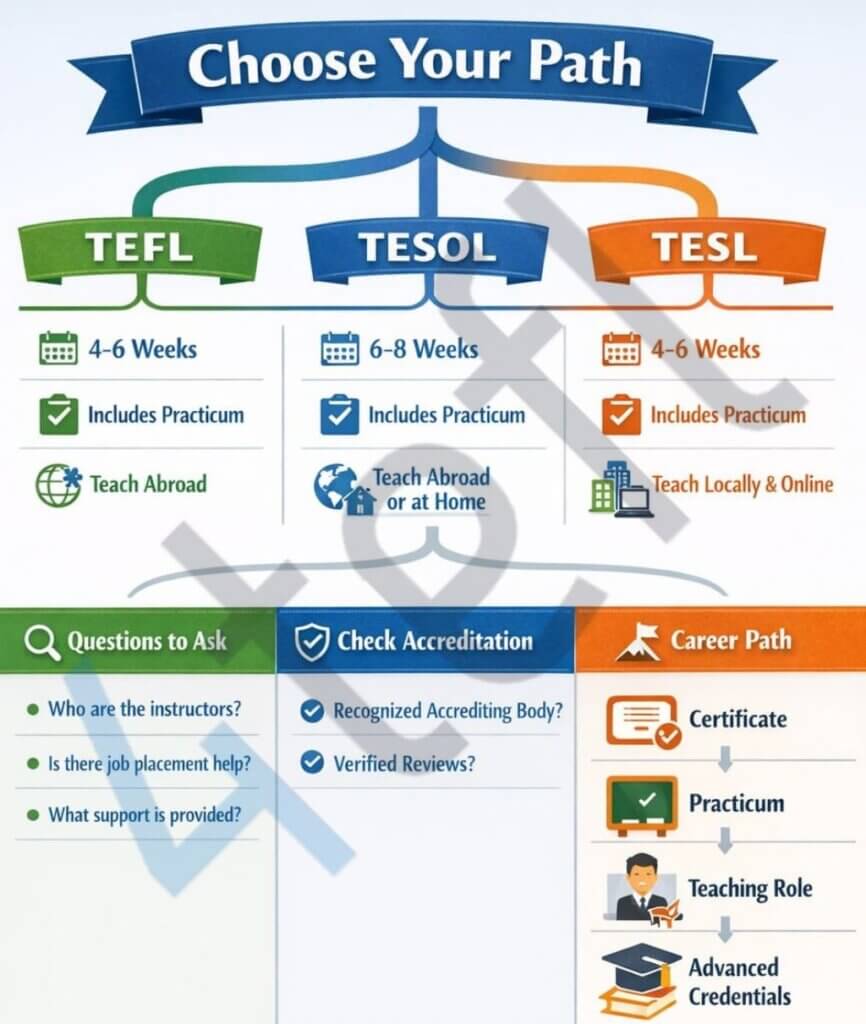
TEFL qualifications are often designed for teaching students English in foreign-language contexts. The focus is on practical classroom knowledge lesson delivery and classroom leadership specific to students in countries where English is not widely spoken at home. TEFL courses are available in online in-person and hybrid formats. Certification lengths are typically around 120 hours and some providers offer courses longer than that that also include practicum or observation components. Accreditation differs by country and provider so a good rule of thumb is to investigate the awarding body’s recognition and any local employer requirements.
TESOL-specific characteristics.
TESOL is a general term encompassing both education and training purposes. TESOL programmes generally combine theoretical perspectives with practice with the aim of preparing teachers to work with speakers of other languages in various settings such as schools language institutes and online environments. Programmes can be shorter or longer than TEFL programmes and may be university-based or private with practicum included or offered as an optional component. Employers may request a TESOL certificate as evidence of knowledge of methodology as well as its application in the classroom.
TESL-specific characteristics.
TESL refers to how English-speaking countries teach English to speakers of other languages within English-speaking environments. It is typically associated with teacher preparation pathways and ESL programmes in colleges and universities. TESL educational credentials may correspond with local college certificates or degrees and may emphasise language support interventions assessment and culturally responsive teaching in the community. Like other certificates content and practicum requirements vary by programme.
Practical pathway considerations
- Where you want to teach is important: for international postings in non-English-speaking countries the default position is TEFL; TESOL is more versatile if you are looking for jobs in a global environment; TESL tends to be more context-specific for ESL within an English-speaking country.
- Practicum: employers care about evidence of hands-on teaching practice. Certifications with an observed teaching component or a supervised practicum can enhance employability.
- Accreditation and recognition: providers may be accredited by local or international bodies, look for transparent information about accreditation scope of the course and the credentials awarded.
How TEFL, TESOL and TESL Qualify You for Global Teaching
International opportunities and visa considerations
Before teachers can gain work visas or find teaching positions in schools or language centres many countries require them to hold a qualifying certificate. TEFL is widely accepted in foreign countries especially where English is taught as a foreign language. TESOL and TESL certificates can also be recognised but this will depend on the destination and employer criteria. It is important to verify local authorities’ expectations for professional credentials and any additional requirements such as background checks or language proficiency tests.
Online teaching and blended roles
Online English teaching is a growing profession and many platforms that teach English accept TEFL or TESOL certificates as entry criteria. Programmes with a strong practicum component for online roles can indicate strong teaching readiness though many employers favour reliable scheduling good communication skills and the ability to design effective online lessons. Some regions prefer certificate evidence of practicum or tutoring experience while others emphasise the teacher’s ability to engage learners in virtual spaces.
Academic progression and stacked credentials
Teacher certificates can form part of a broader language teaching pathway at TEFL TESOL or TESL level and may lead to more advanced qualifications such as master’s degrees in Applied Linguistics or TESOL or professional certifications from language-teaching associations. Pathways that allow graduates to develop enhanced pedagogy assessment strategies and language acquisition research are offered by universities and recognised awarding bodies. In several regions a certificate combined with a recognised degree improves employment opportunities in formal schools and higher education institutions.
Practical Pathways: From Certificate to Classroom Success
Step-by-step route from certificate to classroom
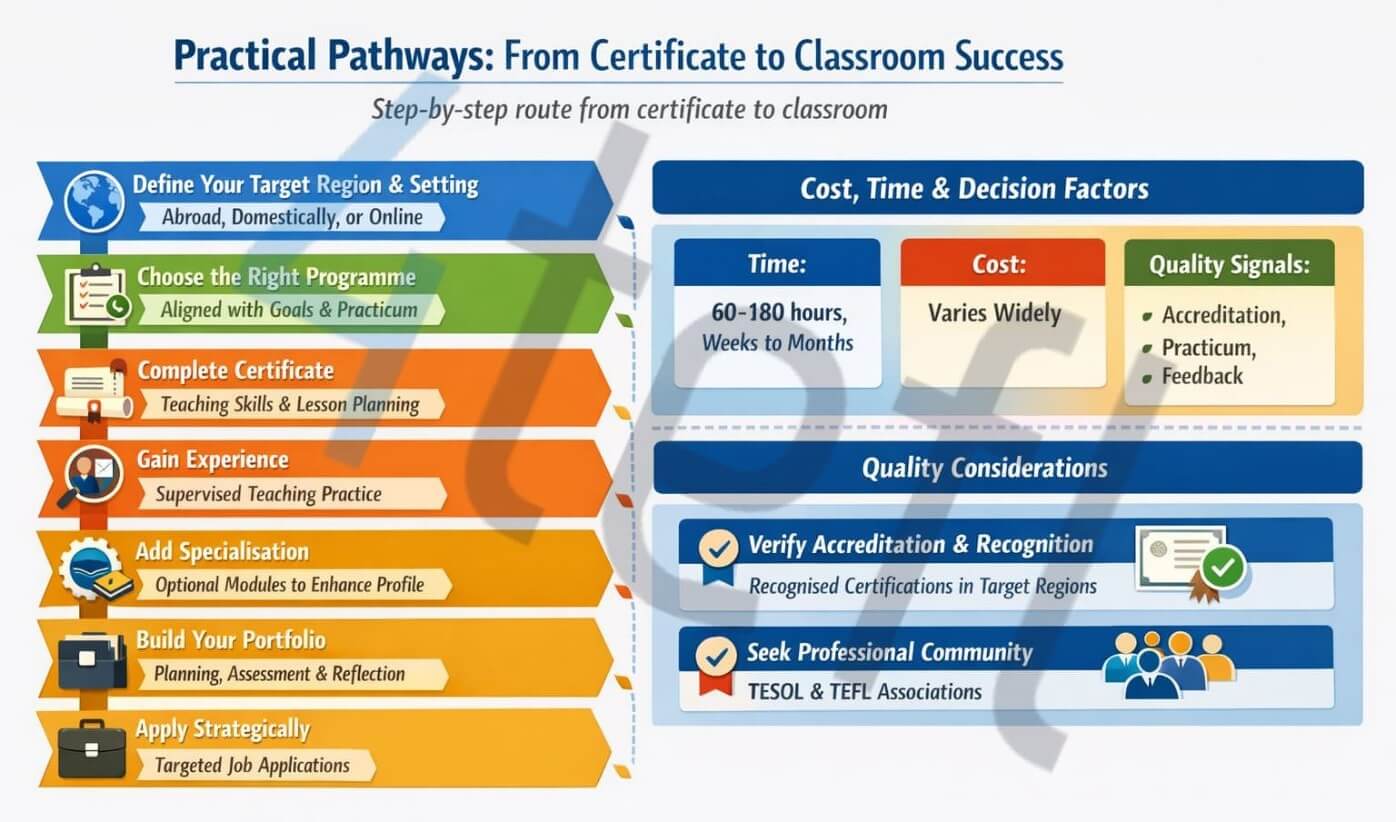
- Describe your target region and setting: abroad in a foreign-language context domestically in an English-speaking country or online.
- Select a programme that matches your goals and offers a clear practicum experience.
- Complete the certificate with a focus on practical teaching skills lesson planning and classroom management.
- Actively seek supervised teaching practice or observation hours to build real-world experience.
- Add optional supplementary qualifications such as speciality modules or language awareness courses to differentiate your profile.
- Build a portfolio that demonstrates planning assessment and reflective teaching.
- Apply strategically prioritising schools and platforms that value your certification type and practicum experience.
Cost time and decision factors
- Time: Most 60-180 hour certificates can be completed in a few weeks to a few months depending on delivery mode and practicum requirements. Longer university-affiliated programmes may extend this period but can offer deeper theoretical grounding and more robust practicum supervision.
- Cost: Fees vary significantly from modest online courses to in-person university-affiliated programmes. Budget for application fees practicum supervision and potential travel expenses if in-person components are required.
- Quality signals: Look for explicit learning outcomes practicum structures clear accreditation and feedback mechanisms. Check whether the certificate is aligned with recognised language-teaching standards and whether there is ongoing professional development support after certification.
Quality considerations and choosing wisely
- Accreditation and awarding body: check that the provider has credible accreditation and that the certificate is recognised by potential employers in your target locations.
- Practicum and mentoring: a supervised teaching component or experience-based approach can help to demonstrate teaching readiness. If practicum is optional consider arranging teaching practice with a partner school or a mentoring arrangement.
- Professional networks and communities: joining a recognised TESOL or TEFL association can provide professional development opportunities job boards and peer networks.
Regional considerations and credential alignment
| Region / Context | Preferred Certificate Signals | Employer Expectations | Practical tips |
| Asia (non-English speaking markets) | TEFL or TESOL with strong practicum; job postings often highlight 120-150 hours | Preference for practical classroom skills and cultural adaptability | Seek programmes with country-specific placements or partnerships |
| Europe (varied, some language schools) | TESOL or TEFL with legitimate accreditation; emphasis on language awareness | Employers value certified classroom ability and compliance with visa rules | Confirm recognition with potential schools or recruiters in target country |
| North America (ESL contexts) | TESL or TESOL; college-level certificates common | Local ESL programmes may prioritise formal training and practicum | Consider a North American-credential route if targeting domestic posts |
| Online teaching platforms | TEFL or TESOL with clear online teaching methodology | Clear evidence of online lesson design and student engagement | Choose courses that include online teaching practicum or micro-teaching |
| Global online and hybrid roles | All three (TEFL/TESOL/TESL) depending on platform requirements | Platform-specific rules; look for certificates that mention online pedagogy | Build a diverse portfolio including digital-tools competencies |
Global Recognition Accreditation and Standards
- Accreditation and transferability: for many employers, especially in formal schools, the presence of recognised accreditation improves transferability of credentials across countries and jurisdictions. Look for certificates from providers that publish their accreditation status and that map to widely accepted teaching standards.
- Regional expectations: some countries prioritise specific types of credentials or require additional licensing background checks or language proficiency verification. It is prudent to verify before enrolling what the destination country’s authorities require for teaching English.
- Professional communities: membership in established professional associations can supplement credentials, provide ongoing professional development, and connect you with job opportunities.
Practical Pathways: From Certificate to Classroom Success
- Begin with a plan: abroad in a non-English-speaking country domestically in an English-speaking country or online teaching. Choose a certificate aligned with that goal and with reputable practicum options.
- Construct a strong portfolio: lesson plans sample student work and reflective teaching notes. A portfolio is a demonstration of what you can do beyond the certificate.
- Pursue focused professional development: after earning certification continue your studies with modules in young learners business English or exam preparation to broaden your options.
- Network with peers and employers: connect with other professionals, attend seminars, and search job boards promoting roles in TEFL, TESOL and TESL. These networks can act as sources of market demand and referrals.
- Learn continuously: language education is dynamic. Learn about pedagogical research digital language learning tools and inclusive teaching.
The choice between TEFL, TESOL and TESL does not simply mean naming categories. It is about choosing at the right time matching your career aspirations the type of teaching environment you want and understanding what employers value most. With careful selection hands-on teaching and a plan to maintain and develop your career your certificate can open the door to teaching in classrooms across the globe or to remote teaching positions. This transition from certificate to classroom success requires clear goals credible accreditation and a commitment to reflective teaching that supports learners wherever they are.
Authoritative Sources and Fact Checks
- British Council – LearnEnglish: A world-leading authority on English language teaching and international TEFL/TESOL certification requirements.
- Cambridge English: Provides insights into the standards of TEFL/TESOL teaching qualifications and international recognition.
- U.S. Department of State – English Language Programs: An authoritative resource for ESL/EFL teaching standards and global education initiatives.
Is TEFL the same as TESOL?
They are related but not identical terms. TEFL usually emphasizes teaching English in foreign-language contexts, while TESOL is a broader umbrella term that includes various contexts and approaches. TESL is typically used in English-speaking countries to describe teaching English to speakers of other languages within those environments.
Which certificate is best for teaching in Europe?
There is no one-size-fits-all answer. In many European markets, a well-recognised TEFL or TESOL certificate with strong practicum, issued by a reputable provider, is well-regarded. Some schools may prefer or require additional national qualifications; always check specific job postings and visa rules.
Do I need practicum to teach?
Practicum is highly valued because it demonstrates real teaching ability. Programs offering a practicum component provide hands-on feedback, which many employers view as essential. If your chosen certificate lacks practicum, arrange independent teaching practice or a supervised placement to strengthen your portfolio.
Can I teach online with a TEFL certificate?
Yes, many online teaching roles accept TEFL or TESOL certificates, particularly those with clear instruction in online pedagogy and lesson design. Some platforms may have minimum hour requirements or prefer certificates with a practicum component.
How long does certification take?
Most TEFL/TESOL/TESL certificates can be completed in a few weeks to several months, depending on hours, format (online vs in-person) and practicum requirements. Longer programmes often offer deeper theoretical grounding and enhanced practicum supervision.