Why DELTA Certification Matters for Global English Teaching Careers


For many English teachers the jump from foundational training to forward-looking practice is the key to opening leadership roles international positions and sustainable professional growth.
DELTA calibrated for teaching English to adults at postgraduate level demonstrates a rigorous and internationally recognised pathway that combines:
- Theory
- Inquiry
- Classroom practice
In a field where demand is global and opportunities exist across brick-and-mortar schools online programmes and language centres DELTA stands out for its intellectual depth clear direction and long-lasting impact on learners resulting in more efficient use of time and effort.
DELTA as a Catalyst for Advanced ELT Careers
DELTA is an additional qualification, but it also acts as a catalyst for the design, delivery and evaluation of English language teaching. The qualification is awarded by Cambridge English, part of the University of Cambridge and is internationally recognised by:
- Schools and Universities
- Language organisations worldwide
- UNESCO
For practising teachers, DELTA supports mastery in key areas such as language systems, advanced methodological decision-making and evidence-based classroom practice, improving professional efficiency. Multinational employers often value DELTA because its career impact translates into practical outcomes such as improved learning results, more effective team collaboration and increased professional credibility among peers.
Academic Rigour and Reflective Practice
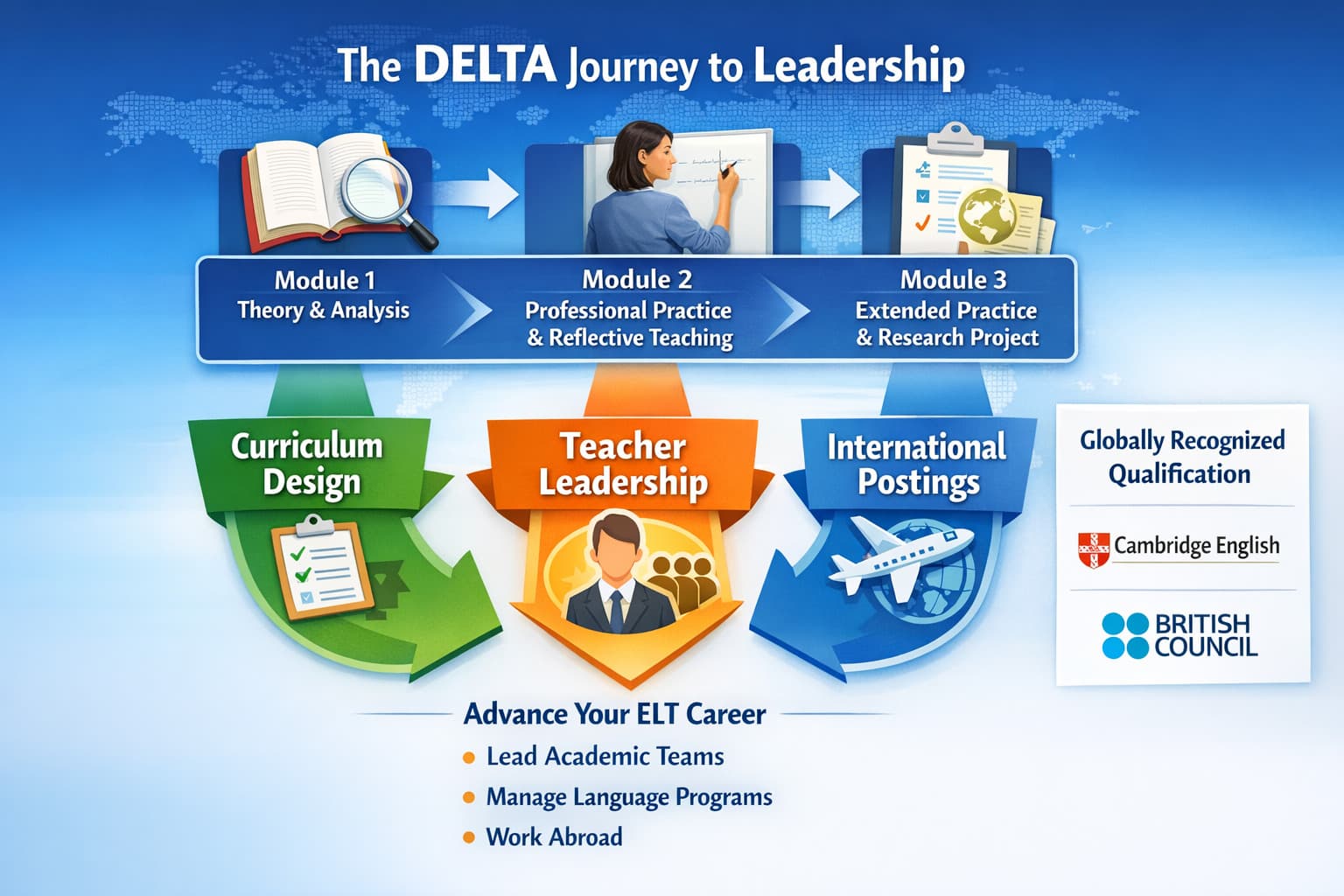
DELTA’s reputation is based on its three interconnected modules, designed to move teachers beyond surface techniques towards analytical thinking and reflective practice. This structure ensures that knowledge is not isolated but integrated into:
- Planning
- Assessment
- Day-to-day learner support
As syllabus demands and accreditation requirements become more rigorous, DELTA enables teachers to align their practice with evidence-based principles and adapt to different learning profiles and cultural contexts, as noted by the British Council and Cambridge English.
Beyond the Classroom
DELTA’s career benefits extend beyond the classroom. Graduates often report greater mobility and opportunities in teacher education and training roles in international schools or further education contexts.
Letters of recognition frequently indicate to recruitment panels that a candidate can manage complex classroom dynamics, design effective lessons and contribute to organisational development. In short, DELTA supports the move from classroom delivery to strategic leadership, a transition increasingly valued in the global ELT market where learner expectations continue to rise and institutions seek leaders who combine rigour with sensitivity.
DELTA Modules at a Glance
| Module | Focus | Typical Assessment |
| Module 1 | Knowledge of language, methodology, and resources for teaching | Written examination with tasks analysing language, learner needs, and classroom contexts |
| Module 2 | Developing professional practice | Coursework comprising a portfolio of teaching practice, reflective tasks, and professional development activities |
| Module 3 | Extending practice and ELT development | Extended assignment exploring a research-informed classroom project and a detailed teaching task portfolio |
Future-Proofing and Changing Landscapes
Looking ahead, DELTA equips teachers to respond to changing ELT landscapes including online delivery, blended learning and competency-based assessment.
As teachers are increasingly expected to demonstrate impact, DELTA’s focus on enquiry-led practice and reflective analysis provides a sustainable framework for long-term professional development. Education authorities and major organisations recognise DELTA as a qualification that supports workforce development in language education.
DELTA remains a strong driver of professional growth in the design, delivery and evaluation of English language learning. Awarded by Cambridge English and recognised internationally, it emphasises advanced language awareness, informed methodological choices and evidence-based classroom practice. Employers value the qualification because it leads to measurable improvements in learning outcomes, more effective teamwork and stronger professional trust.
Career Elevation with DELTA: Global Teaching Opportunities
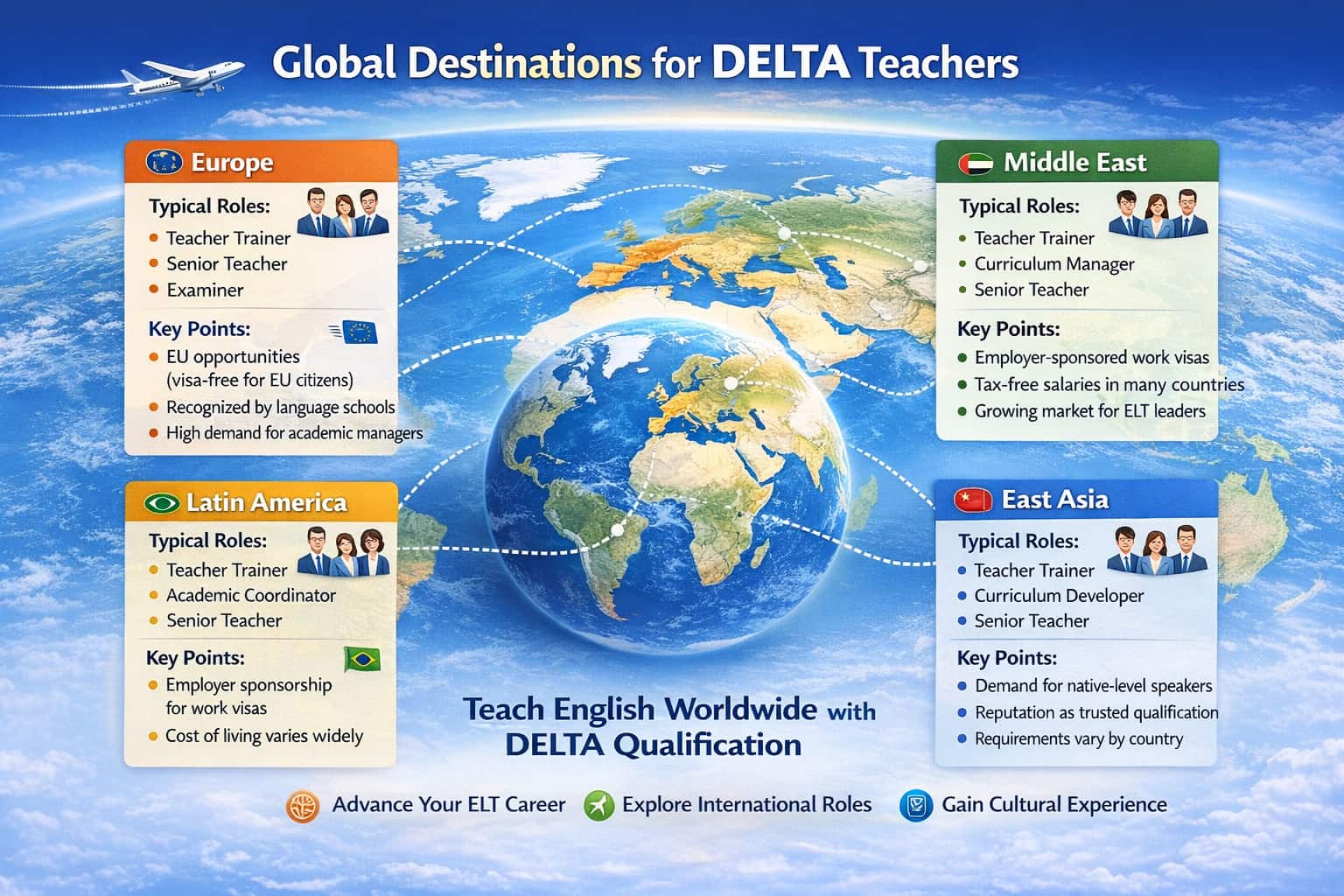
You’ll find that DELTA’s reputation as a career qualification is strengthened by its widespread international recognition, offering both convenience and quality. Importantly, many state-funded language schools, universities and language programmes are actively seeking qualified DELTA teachers for:
- Senior positions
- Programme design roles
- Regional leadership posts
This overall demand is driven by the need for teachers to deliver high-quality pedagogy in diverse cultural settings, meet local requirements and contribute to policy discussions on language education, helping save time and effort. The intercultural skills are highly valued.
What is particularly useful is that since DELTA is a recognised qualification, teachers often enjoy greater mobility, including opportunities to teach in multiple regions or to move between schools, universities and online programmes with relative ease, offering both flexibility and quality.
Digital and Global Mobility
DELTA also supports career progression in online and blended learning environments. Employers value the qualification for roles that require strong instructional design and quality assurance in digital contexts. For teachers considering work abroad, DELTA supports applications to:
- Public education systems
- International schools
- Exchange programmes
In many countries, the qualification is linked to recognised accreditation frameworks, which can support visa processes and professional recognition. Key data points show that the global English language learning market continues to rely on experienced professionals who can work at scale. Organisations such as UNESCO and the British Council highlight the ongoing demand for teachers who apply innovative, research-informed methodologies. The DELTA model, integrating theory, practice and research, helps teachers meet these expectations while expanding professional influence and career horizons.
Structured Pathways: Certificate Credibility
DELTA’s credibility comes not only from its academic rigour but also from its structured and career-oriented design. The three modules guide teachers progressively from theoretical understanding to practical application and classroom-based enquiry. Employers value this progression because it demonstrates the ability to:
- Analyse learning contexts.
- Plan effectively.
- Engage in reflective practice.
For many teachers, the DELTA qualification provides access to senior language programmes, assessment roles or teacher education, often with advanced standing. Universities and teacher training departments frequently recognise DELTA as preparation for higher-level study, reducing barriers to postgraduate progression. By aligning professional practice with research-informed approaches, DELTA supports ongoing professionalisation within schools and organisations that value reflective practice and evidence-based decision-making.
A practical way to view DELTA’s credibility is as a professional passport. Its balanced assessment model, combining examinations, portfolios and extended assignments, reflects the realities of modern classrooms. This balance between theory and practice remains a defining feature of DELTA and explains why it continues to be a trusted benchmark for ELT professionals seeking credible and sustainable career development.
Future-Proofing ELT Careers through DELTA Certification
From a future perspective, DELTA stands out as a reliable option for ELT professionals. In short, the global English language education marketplace continues to evolve due to demographic change, educational policy and the spread of digital learning.
This is reinforced by UNESCO and the British Council, which stress that English remains a central component of international education and professional mobility and creates a sustainable demand for teachers who can deliver forward-looking practices to diverse learners. DELTA trains teachers to do this.
Evidence-Based Practices
Here’s what you should know: one of the strengths of DELTA is the emphasis on evidence-based practices. Teachers learn how to apply them. This is straightforward: these data-based approaches have measurable effects in classrooms and improve career progression within institutions.
For e-learning and blended contexts, DELTA graduates can design digital materials, evaluate online pedagogy, and apply QA standards that maintain consistency beyond individual programmes.
As a result, a professional profile remains relevant when introducing innovative technologies, developing hybrid learning models or reorganising curricula to new skills and frameworks.
Summary of Impact
In short, DELTA is distinguished by its depth and rigour and by its tangible impact in the ELT marketplace. Recognition shows that a teacher can:
- Put theory into practice.
- Guide curriculum development.
- Contribute to a high-quality school or institution in the long term.
For teachers seeking international opportunities or flexible online roles, DELTA offers credible recognition, structured pathways and a set of permanent qualifications that remain relevant to the development of ELT.

Next Steps:
The next steps for candidates include contacting accredited DELTA centres for programme details, confirming module options and seeing how the course fits personal career goals. By committing to this advanced training, you join a global community of practitioners who prioritise excellence, continuous learning and a proven commitment to improving language education for learners worldwide.
Authoritative Sources and Fact Checks (References)
- Cambridge English (University of Cambridge): DELTA – Diploma in Teaching English to Speakers of Other Languages
- British Council: The Value of DELTA in Professional Development
What is DELTA?
DELTA is the Diploma in English Language Teaching to Adults, a postgraduate‑level qualification offered by Cambridge English that covers knowledge of language, teaching practice, and research‑informed development. It is designed for teachers who want to advance beyond CELTA‑level training and assume more leadership and curriculum‑development responsibilities.
How does DELTA differ from CELTA?
CELTA introduces foundational practical teaching skills, whereas DELTA deepens theoretical understanding, professional practice, and research‑driven development. DELTA’s three modules build from knowledge to practice to extension, enabling teachers to operate with greater autonomy and influence in their institutions.
Is DELTA worth it for teachers aiming to work abroad?
For many teachers, DELTA improves employability in international schools, universities, and language organisations, and it can support visa and licencing processes in various regions. The credential is widely recognised by employers and is frequently linked to leadership opportunities, curriculum design roles, and senior classroom responsibilities.
What are the entry requirements for DELTA?
Entry requirements typically include a bachelor's degree and TEFL or ESL teaching experience. Some training centres may require a CELTA or equivalent qualification and language proficiency that demonstrates readiness for postgraduate‑level study. Specific prerequisites vary by programme provider and country.
How long does DELTA take to complete?
Delivery varies by provider and mode (part‑time, online, or intensive on‑site). Most candidates complete each module over several months, often spanning a year or more in total, to balance teaching commitments with study. Prospective candidates should check with accredited DELTA centres for exact timelines.
What does the cost involve, and is funding available?
Costs vary by country, centre, and delivery mode. Some institutions offer scholarships or employer sponsorship for staff who commit to professional development. Prospective applicants should discuss funding options with the training provider and their employer early in the application process.