Age in TEFL: Navigating Online and Abroad Careers

Begin your journey as a TEFL/TESOL teacher by learning to teach English across borders (or from a laptop at home). But age is, alongside qualifications, experience, and visa rules, a factor to consider.
The question often presented to future teachers is not “can I teach?” but “what age limits exist, and how do they influence training and deployment?” ### Introduction This article explains how age and distance-learning options, and then what you can do to pursue and thrive in a successful TEFL career, will help you achieve your goals. For example, if you have dreams of teaching either in Asian or African classrooms or delivering exciting lessons to students anywhere on the globe, understanding age-related needs will help you set a sensible course of action.
The criteria above support widely recognised requirements (including Ofqual-regulated and international training standards) and include information you can trust, with absolutely no commercial emphasis, so that you make the right choices when registering. By linking age to your goal – online flexibility, destination-specific visa requirements, and recognised qualifications – you will learn about the most effective ways to ensure you are able to select courses, prepare documentation for your plans, and map an achievable timetable for starting or progressing in your TEFL career.
Do TEFL age limits apply to teaching online and abroad?
There are different age thresholds in TEFL across countries/platforms, but they are defined by the same regulations in numerous contexts. Laws governing online teaching are generally less specific than laws for work abroad, but online platforms and schools usually establish policy regarding age.
- Online Platforms: The most professional platforms in general insist that teachers are 18 years of age or older, with some exceptions that older teens, 16–17, are permitted to work online, but only with parents’ consent and under specific programmes. This is an interpretation of the responsibilities of contract law, taxation, and safeguarding in TEFL, rather than a universal TEFL age rule.
- Teaching Abroad: Age requirements for teaching abroad tend to be more specific and country-specific. Visa-based job sites frequently stipulate that applicants must be adults, often 18 or older, with some places favouring those over the age of 21 in some jobs or teacher visa-eligible jobs.
In fact, employers and recruitment agencies often use this threshold as a pragmatic filtering device (as visa requests, work permits, and contract terms often correspond to the norms of adult employment). Checking the official guidance from your target country (government pages, embassy advisories, in-country education authorities) and your course provider’s enrolment requirements is also key.
Regulation and Enrolment
Age policies can differ by your qualification level and any other regulatory status of the course within UK and international training organisations.
- Ofqual-regulated: Some Ofqual-regulated TEFL qualifications and higher-level TESOL programmes have minimum entry ages of 18, in line with England’s regulatory provisions.
- Non-regulated: Other non-regulated TEFL certificates, such as those available online, may also announce a lower entry age, but require adult permission to enrol, pay for, or sign contracts.
Refer to the programme requirements and the rules of the employer or visa authorities before you enrol. In short, there are age limits applicable in most TEFL settings, but the details vary depending on where you are in the world, the type of programme you are working on, and the sort of platform you are using. If you are under 18, then you can wait until you have reached the ideal 18+ and then look into online options with parental involvement, but with a good game plan of how you will get to the 18+ standard. For better guidance than that, you will need to refer to what your training provider says, to a country’s official immigration pages, and the platform’s own policies.
Practical takeaway: Begin by listing your target destinations and platforms, then confirm the minimum age cited by each official source and by the training provider you’re considering. This triangulation helps you avoid misalignment between your age, training, and work opportunities.
Key age thresholds you should know for TEFL careers
Age limits in TEFL careers align with 3 key milestones:
- Entry into training.
- Eligibility to work (especially overseas).
- Eligibility for more senior positions or visa-controlled employment.
Although national differences exist, an easily useful lens comes into play as time for a general framework is used when you graph age with TEFL career stages. Many providers set 18 as the cut-off age for entry into training for the minimum age to work. It also corresponds to the legal ability to sign contracts and to accept payment for courses. Junior routes with parental consent could be available in some online programmes, but these are rarer than common TEFL/TESOL degrees.
If this is your target age for Ofqual-regulated courses in England, you’ll need no surprises when it comes to the benchmark – generally from 18, although more advanced courses will sometimes be aimed at mature learners (like late teens or older) needing a higher degree of professional specialisation.
Visa Rules and Maturity
When teaching abroad, age thresholds are often set by visa and employer rules. The vast majority of places will need teachers to be adults – most often 18 or older. However, in some places, 21 is either preferred or mandatory for certain teaching visas or positions with housing allowances, medical coverage, or contractual protections. The other side of that coin is that there is no formal age floor for short-term teaching jobs that can be signed out for elsewhere, although sponsorship depends on the applicant’s legal capacity to work under the country’s immigration policies.
Make sure you check the visa regulations in your chosen country before signing up for a position. Employers in a lot of markets often anticipate a few years of experience going along with advancement (and for some of the more senior roles we may be looking at, between 25 and 30 years old). Senior and graduate positions, teacher trainer positions, and management positions often value proven classroom outcomes, training certificates, and maturity (which is age- and experience-related). Although there is no age limit across the TEFL curriculum, older entrants can utilise their experience and background (e.g. Level 5 Diploma, CELTA/Trinity TESOL, or Ofqual-regulated qualifications) to achieve supervisory or curriculum design postings. This illustrates the importance of career planning which is more age-appropriate in specific skill and responsibility types.
Summary Table: Key Minimum Ages by Context
| Context | Typical Min Age | Notes |
| Entry to TEFL training | 18 | Most providers require 18+, some exceptions with consent. |
| Online teaching platforms | 18–21 | Commonly 18; some platforms allow 16–17 with parental consent. |
| Abroad teaching (Work Visa) | 18–21+ | Visa rules vary by country; always check official immigration guidance. |
| Senior / Training roles | 25+ | Age often aligns with experience and advanced qualifications. |
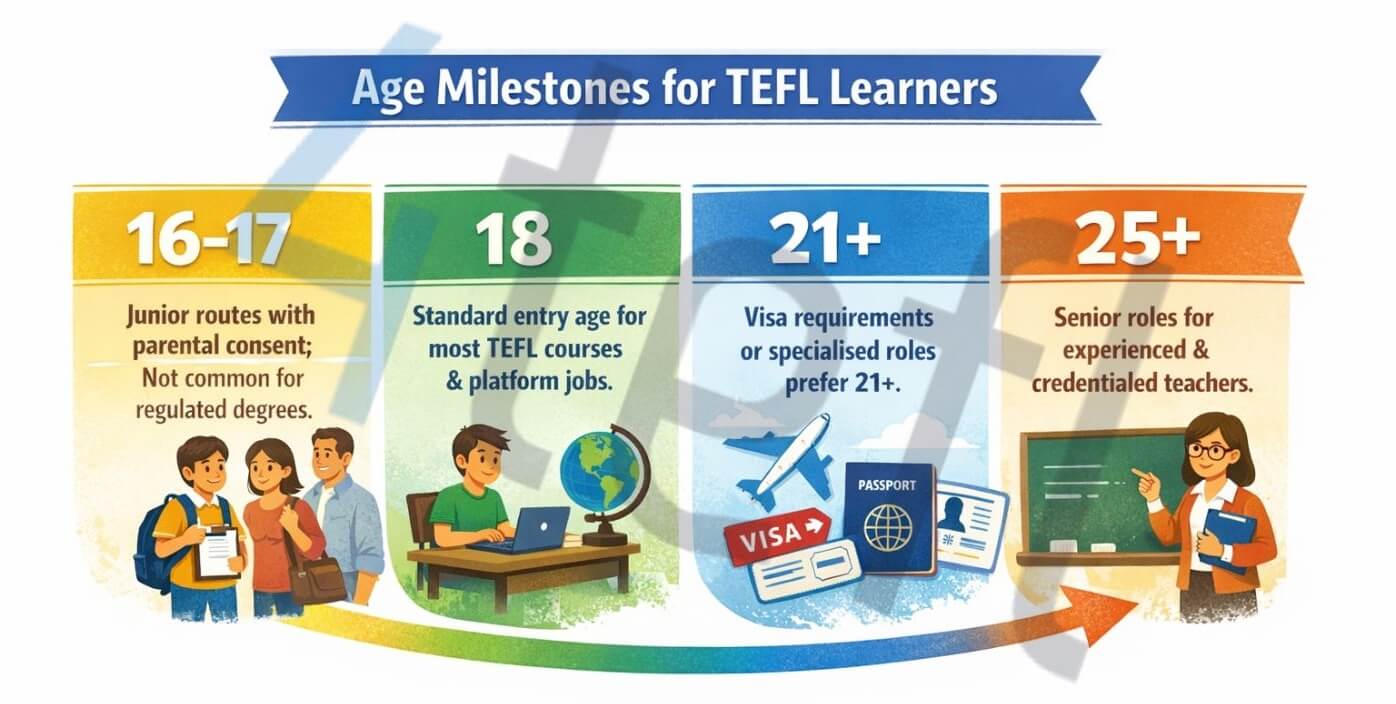
Notes on the thresholds above: The exact minimum ages depend on the country, the employer, and the training provider. Always confirm with your prospective destination’s government pages and the course provider before enrolling or accepting a job offer. A careful cross-check helps you avoid delays in visa processing or employment start dates.
How age relates to Ofqual standards, visas, and training
Age has significant intersections with regulation, with credentialing, and with international mobility in TEFL.
1. Ofqual Standards
In England, Ofqual-regulated courses provide learners attempting to realise their formal qualification with a defined means of achieving qualification at the national level that meets national standards for assessment, quality assurance, and progression. A number of TEFL qualifications are not Ofqual-regulated; however, options exist at Level 3, Level 4, and Level 5 through Ofqual-registered providers. If safeguarding, professional practice, and portability of credentials are important to you, then it can make sense to take an Ofqual-compliant route – especially if you’re looking to teach in the UK or where regulated qualifications are a priority.
2. Visas and Work Authorisation
Age is also a real driver of eligibility in the context of visas and work authorisation overseas. In terms of entry, most visa schemes require a minimum age of 18 and may have higher age requirements for dependants or certain types of employment. Visa policies are highly country-specific and will change over time – so consult official government guidance at your destination. UK-based guidance on immigration and work permissions, for example, has emphasised visa-specific requirements rather than a universal TEFL age standard, and country-specific immigration portals outside the UK give you the most authoritative age thresholds for teaching positions.
3. Training and Employability
Put simply, age guides your visa journey by reference to the rules of the destination country and the recruitment criteria of the employer. Teaching instruction itself intersects with age via qualifications. TEFL qualifications with Ofqual regulation have defined access and progression requirements, such as minimum ages, and standards of assessable competency. If you select an Ofqual-approved course, it might make you more employable in education settings that value formal recognition and the ability to transfer your qualifications across international markets. On the other hand, unregulated TEFL certificates – often shorter online courses – are broadly accepted by many online platforms and private language schools, but may not be as widely accepted for certain visa routes or more regulated markets.
The best approach is to align your age, visa strategy, and career goals with a training option that provides robust recognition and clear pathways to employment.
Practical steps for meeting age standards and enrolment
- Develop a Matrix: First, find out where you want to focus and the platforms you want to use. Develop a brief matrix that details the minimum age requirements for training providers and potential employers, plus visa rules for each country. This upfront effort minimises the chances that you’re signing up for a course that doesn’t align with your desired career path and enables you to prioritise courses that are age-appropriate.
- Chart a Schedule: Secondly, chart out a practical schedule in which you might reach the target age. If you are not yet 18, put this into a timetable that follows completion of a recognised course at approximately your 18th birthday and use other parental-approved online routes as interim stages. For those aged 18 or above, concentrate on a career path well established in the industry (such as Ofqual-regulated programmes or CELTA/Trinity-approved certificates when appropriate) to enhance your chances of gaining employment and a visa.
- Ensure Compliance: Third, ensure compliance with regulations and accreditation. Choose courses from Ofqual-registered providers if you will be working in regulated placements. Check the learning objectives of the course, the assessment tools, and quality assurance.
- Gather Paperwork: Gather all the necessary paperwork early – identity papers, proof of age, academic records, and any parental permission if applicable. This initial preparation accelerates enrolment, visa applications, and contract discussions.
Actionable Next Steps
- Decide on your geography: online-only or specific abroad destinations.
- Check minimum age requirements for both training and employment in that geography.
- Choose a course with clear entry criteria and, if possible, Ofqual regulation for portability.
- Create a timeline with milestones: course completion, visa application window, and first teaching assignment.
- Collect required documents (identity, proof of age, and any parental-consent forms if applicable) and set reminders for application deadlines.
Quick-start Checklist
Target countries and platforms identified
Minimum age confirmed with official sources and provider
Ofqual-regulated option considered (if UK-regulated work is planned)
Documents prepared and verification completed
Realistic start date set for first teaching assignment
Authoritative Sources and Fact Checks (References)
- GOV.UK – Office of Qualifications and Examinations Regulation (Ofqual): The official regulatory body for qualifications in England, providing standards for TEFL Level 3–5 courses.
- TeachingEnglish | British Council: A global programme for English teachers and teacher educators.
- Cambridge English – Teaching Qualifications: Provides details on CELTA and other globally recognized teaching standards and age requirements.
Do TEFL age limits apply to online teaching?
Yes, in practice most online teaching platforms set a minimum age - typically 18. Some providers may offer pathways for younger applicants with parental consent or with non-teaching roles, but the norm is 18 for direct teaching and contract signing. Always check the platform’s terms and any parental-consent requirements before applying.
Are there minimum age requirements for TEFL courses?
The majority of mainstream TEFL certificates require entrants to be 18 or older. Some online providers may offer junior routes with parental consent; however, these are less common for recognised TEFL/TESOL qualifications, particularly those with formal accreditation or Ofqual-regulated status.
Can you teach abroad with a TEFL certificate if you’re under 21?
It depends on the destination country’s visa rules and the employer’s requirements. While some countries allow younger teachers to teach with appropriate contracts, many destinations prefer or require candidates to be at least 21 years old for visa eligibility or to satisfy certain employment criteria. Always verify the official visa guidance for your target country.
Do Ofqual-regulated TEFL courses have age restrictions?
Ofqual-regulated courses typically specify a minimum entry age of 18, aligning with adult-education and professional practice standards. If you aim to work in the UK or in organisations that prioritise regulated credentials, this is an important consideration. Always check the specific course’s entry requirements.
What should I check before enrolling in a TEFL course?
Verify (1) entry age requirements, (2) whether the course is Ofqual-regulated or otherwise nationally recognised, (3) the course’s assessment methods and pass criteria, (4) portfolio or practicum components (for teaching practice), and (5) any visa or work-permit implications if you plan to teach abroad. If you intend to teach in the UK or in regulated settings, prioritise Ofqual-regulated options.
How can I stay competitive if I’m young or older?
Regardless of age, focus on building a strong, relevant portfolio: a well-regarded certificate (preferably Ofqual-regulated if UK-relevant), supervised teaching practice, and language-teaching experience (even volunteer work). Gaining additional credentials such as CELTA or Diploma-level qualifications can boost eligibility for selective positions and visa routes. Networking with employers and joining professional TEFL communities also helps.
What is the typical age range of TEFL teachers globally?
TEFL teachers span a broad age range worldwide. Online platforms attract younger entrants alongside mid-career professionals, while many teachers abroad are in their 20s–40s, with a growing number in their 40s and 50s due to mid-career shifts and retraining. There isn’t a universal cap or peak age; employability depends more on qualifications, teaching experience, and visa eligibility than age alone.