Are Online TEFL Certificates Recognised by Employers?


English teaching has undergone a clear pivot towards both online and hybrid formats in recent years. For beginning teachers, the flexible, affordable online TEFL course is a smooth path, and there are job prospects abroad or at home if they want.
With a large market of providers, online TEFL certificates have raised doubts in learners’ eyes about the recognition they get from employers, whether they be recognised even online. The short response is: Yes, in many instances – but only with critical caveats.
Recognition depends upon:
- The quality of the course
- Recognised awarding bodies
- Practical aspects
- In-market employer expectations you meet.
It helps you select courses that actually add to employability, not just add a letter to your CV. This article unpacks what employers think about online TEFL training, what they are looking for in online courses, how Ofqual and other international awards and standards apply, and some guidelines on choosing accredited online TEFL programmes.
We base our discussion on well-studied standards and reliable sources to provide you with a comfortable perspective on the market. If you want to teach in the UK, Europe, Asia, the Americas, or online for platforms worldwide, you can easily build a platform while looking to move to other countries – provided that you get the right online TEFL course to take along with the requirements of employment and certification norms.
Key Note: When contemplating choices, keep in mind that recognition is not a monolithic, absolute status. Different employers and areas can have differing requirements in practicum experience and teaching ability, to be assessed in one particular way or another.
The current paper focuses on the need for evidence-based standards for credibility and realism, and references trustworthy indicators from regulators and international experts. By the end of your coursework, you’ll be able to assess courses, predict what employers are going to say, and how to make your job market competitive.
Are Online TEFL Certificates Recognised by Employers?
With online TEFL certificates, the concept has developed a strong background of legitimacy as an approach to teaching English, specifically in the context of online roles and entry-level positions in the global marketplace. Many employers understand that an excellent, well-organised delivery of an online TEFL course prepares you with key learning and teaching skills, classroom management, lesson planning, etc.
Critical Factors for Recognition
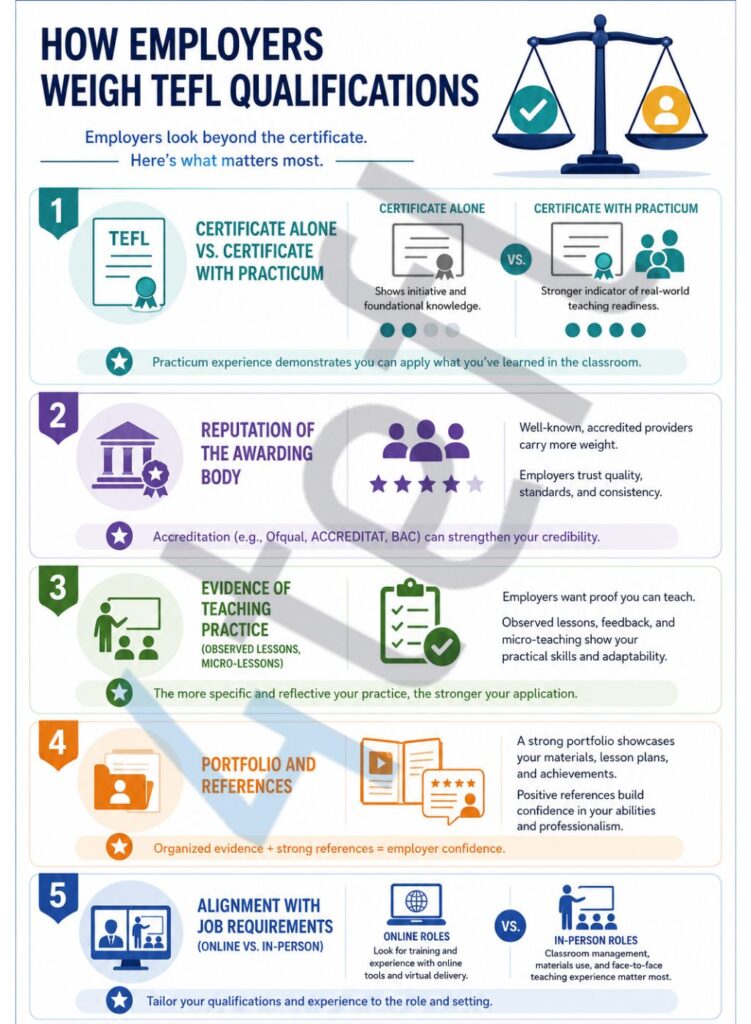
But recognition does not come automatically. Employers are equally very critical in determining the quality of the course, which awarding body is appointed, and whether it is actually training which involves real teaching practice or a real practicum.
In the online domain, reliable certificates emerge mostly from reputable, well-established providers that have demonstrated supervisory backing and a clear profile of graduate outcomes. Another nuance is the nature of employment. Across conventional language schools, and within a number of face-to-face postings in Europe, Asia, and the Middle East, a certificate may be inadequate in the absence of a live teaching practicum or a collection of micro-lessons.
On the other hand, online teaching sites and distance teaching curricula in some universities focus more on the evidence of an effective teaching profile and teaching portfolio rather than the certificate alone. This divergence mirrors employer expectations in differing degrees: some focus on formal qualifications, while others emphasise practical teaching evidence and solid methodological expertise.
Credibility and Regional Norms
The important takeaway: credibility does not only depend on the certificate title; its design should be a consideration. Finally, there are regional accreditation norms you should consider.
- UK and Commonwealth: Often rely on well-known, regulated qualifications or widely recognised TEFL/TESOL certificates, containing practicum components.
- Other Regions: Might accept a wider range of online TEFL, given that the course is provided by a reputable institution and includes verified teaching practice.
In an attempt to avoid disappointment, look at what those employers need and compare them to the specifics of any online TEFL course you’re interested in, and do not just believe marketing. It is likely that while regulated status and international recognition are not universal, they are good cues of the credibility of that position’s future employment. One point is that regulators such as Ofqual differentiate between regulated qualifications and courses provided by organisations not in formal regulatory environments. The difference matters if you’re preparing to work across borders or seeking positions that favour official accreditation.
Recognised Elements in Online TEFL Courses
| Element | Typical Employer Expectation | How it Affects Recognition |
| Course duration (hours) | 120+ hours commonly preferred | Signals depth of study; aligns with standard TEFL expectations |
| Teaching practicum | Required by many schools; some online platforms insist on real teaching hours | Prerequisite for credibility; demonstrates applied skills |
| Observed teaching | Highly valued for assessing teaching ability | Critical for practical assessment; improves employability |
| Course accreditation | Prefer recognised awarding bodies or regulators | Increases trust; reduces risk for employers |
| Portfolio | Helpful for interview-ready demonstrations | Provides tangible evidence of capability |
| Transferability | Regional preferences vary; international recognition useful | Broadens opportunities across markets |
When utilised wisely, an online TEFL certificate can be a strong stepping stone in a teaching career. It works best when paired with a practicum or portfolio, and when earned through an established, well-regarded provider. For learners who have demonstrated strong teaching demonstrations, who plan lessons well, and whose classroom management skills are demonstrable, it may serve as a credible entry point. A certificate leading to real employability is heavily built on clear evidence of learning outcomes, feedback from supervisors, and opportunities to apply what you have learned in real teaching contexts. Recognition, in other words, is based on quality, evidence, and relevance to the job you want.
What Employers Expect from Online TEFL Training
In assessing online TEFL credentials, employers are becoming more inclined to pay attention to a balance of theoretical understanding and practical skill. This balance is important in both online and offline teaching environments. Good online learning usually needs structured lessons in:
- Language acquisition theory
- Lesson design
- Classroom management
- Assessment methods and feedback mechanisms
- A substantial practicum or micro-teaching component
Core Employer Assumptions
The primary assumption behind these courses is that you will ideally see a credible curriculum and, in reality, you have been taught through a practicum in which hours are actually taught in your classroom or simulated online. Classroom-taught lessons, comments from qualified mentors, and a reflective teaching journal are helpful because they illustrate your practice by providing support for applying theory to the classroom.
Additional expectations include:
- Effective Lesson Design: Employers appreciate an idea of what effective, thoughtful lessons look like; how to create and deliver these fully constructed lessons. That includes objectives, outcomes-based activities, and flexible materials that cater to different kinds of students.
- Evaluation Skills: It is imperative that teachers be able to evaluate learners, offer meaningful feedback, and measure progress. TEFL training that includes a significant focus on assessment approaches (both formative and summative) is generally favoured.
- Digital Pedagogy: For online-oriented positions, employers focus on online teaching tools, techniques to be effective in the virtual classroom, engaging online materials, and the ability to understand time zones and technological challenges.
Language academic institutions and online learning platforms are becoming more inclined to demand that their candidates prove their knowledge of and comfort with technology-enhanced learning and adaptability to various delivery modes. Last but not least, employers typically measure soft skills: communication, reliability, professional behaviour, and reflective practice.
In the UK and overseas, respected bodies argue the job market is a mix of established qualifications, practical evidence in teaching, and flexible, learner-centred practice. Especially for those thinking of teaching online, evidence of teaching techniques that address digital pedagogy and experience with online platforms can have a big impact on employability. In short, employers care about certificates that come with a solid practicum, have a strong teaching portfolio, and demonstrable outcomes.
Ofqual and International Recognition for TEFL Certification
Ofqual, the UK’s regulatory body for qualifications, explains how recognition actually applies. Ofqual makes a distinction between regulated qualifications (those based on government-regulated assessment standards) and qualifications provided by organisations without regulation.
For learners who expect to work across borders or who want credential portability, this distinction matters. Many TEFL certificates are generated by private providers, which are not regulated by Ofqual; however, awarding bodies may work within recognised qualifications or apply for accreditation from reputable international authorities.
Global Perspective
Prestigious certificates linked to reputable organisations – like CELTA through Cambridge Assessment English and TESOL certificates given by respected colleges – stand as widely recognised indicators in the academic field. Schools and websites all over the world recognise such credentials, especially for positions which include a combination of face-to-face and virtual pedagogical methods.
Data from UNESCO highlights the worldwide growth in English learning, stressing the role of authentic qualifications in offering quality teaching in different countries. It is very important that your course matches international standards in order to increase its mobility and global job prospects.
When considering how regulated qualifications may differ from non-regulated courses offered by private providers for UK learners, Ofqual’s guidance is a very useful reference. (Ofqual: regulated qualifications; gov.uk rules about qualifications; UNESCO Institute for Statistics on demand for English language learning).
In practice, decisions about pursuing Ofqual-regulated accreditations or internationally recognised qualifications must be informed by your long-term career objectives. If you are looking to teach in the UK or rely heavily on transferability across Europe, a qualification that falls under a regulated framework or has an international reputation can better assure employers.
If you are looking to teach online with the option to work across the globe, a good-quality online TEFL course, complemented by a strong practicum and teaching portfolio, can be considered credible, so long as it is offered by a reputable awarding body. For a significant portion of teachers, the ideal combination of an online TEFL certificate, a reputable practicum, observation hours, and an early-career portfolio creates the most effective path to credible recognition, even when the main TEFL certificate may not be regulated. The overarching message is to give weight to the veracity and quality of evidence, clarity of outcomes, and demonstrable teaching capabilities in addition to the certificate. (Ofqual; gov.uk summary; UNESCO reports on language learning trends.)
Guidance on Choosing Accredited Online TEFL Courses
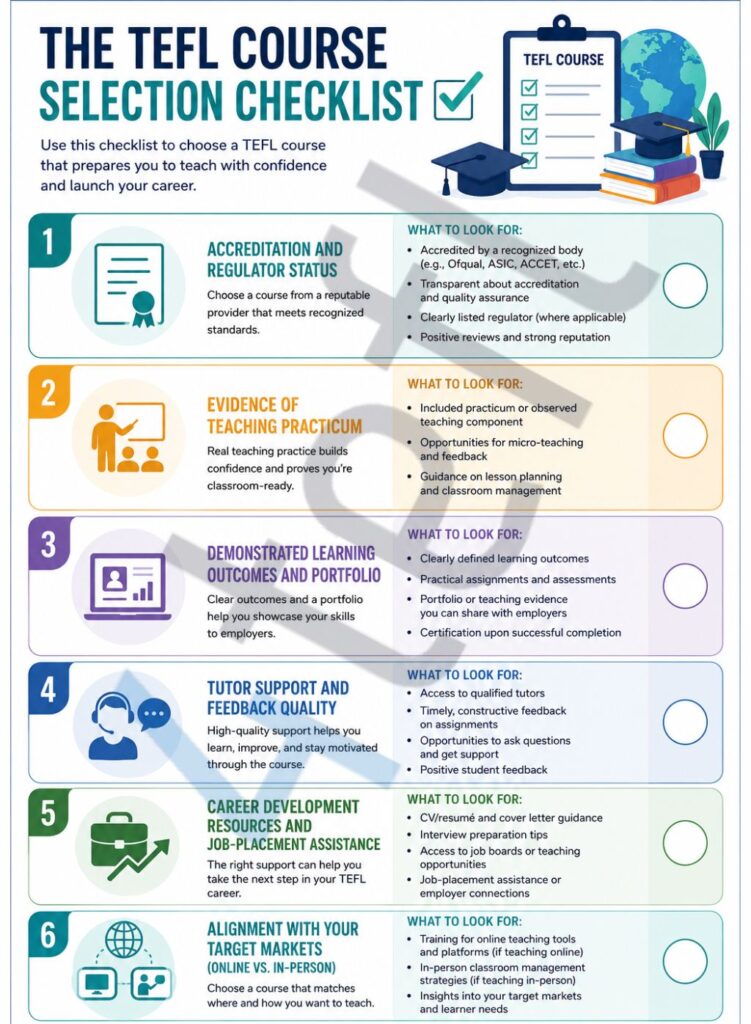
An accredited online TEFL course should be selected through a systematic process.
Step 1: Verify the Awarding Body
Verify the awarding body and regulatory status. Look for well-regarded institutions or organisations that offer courses with recognised accreditation. Choose courses provided by brands where available, and only where providers with recognised credentials (for instance, CELTA/TESOL-compatible courses) are clearly identified. Don’t depend on marketing promises alone; ensure that information about the provider’s accreditation, mode of delivery, and way of assessment is transparent.
Step 2: Survey Course Design
Survey the course design and practical elements. Seek comprehensive syllabi which include language teaching techniques, classroom management strategies, assessment procedures, and planning. An authentic programme will require an extensive practicum (preferably with observed teaching hours and feedback from a mentor).
Step 3: Assess Support and Pathways
Assess the flexibility and support of the course. Online programmes must strike a balance between accessibility and quality support, offering tutors, feedback loops, and professional portfolio development opportunities. Consider the length of the course, its delivery modes (live, asynchronous, or mixed), and the presence of learning communities or mentoring.
Finally, the course’s academic pathways and career prospects need to be considered. Review the “flow” from coursework to a job-ready outcome: some providers offer career advice, CV templates for specific TEFL jobs, interview preparation, and employability support networks. And lastly, cross-reference your target job markets where regional preferences apply.
Common Attributes to Verify When Choosing an Online TEFL Course
| Attribute | Why it matters | How to verify |
| Regulated accreditation | Improves credibility with employers | Check awarding body via Ofqual or equivalent listings |
| Substantial practicum | Essential for practical readiness | Look for documented mentor feedback |
| Observed teaching | Demonstrates real teaching ability | Seek evidence of recordings or live assessments |
| Clear learning outcomes | Ensures measurable progress | Review syllabus and assessment criteria |
| Portfolio components | Enables interview-ready evidence | Confirm required artifacts (lesson plans, reflections) |
| Career support | Helps translate certification into jobs | Check for CV guidance and interview prep |
| Accessibility | Practical considerations | Compare total cost and synchronous vs. asynchronous content |
And if you want a sample of their course materials or a trial lesson before committing, it’s a good idea to ask to see them. Read independent reviews where available, and compare the provider’s stated outcomes with industry standards and regulator expectations.
If you would like work where there is strong evidence to support your credibility, the online certificate could be supplemented with further credentials; for instance, you might also take a CELTA/TESOL pathway or a validated practicum through a partner school. For teachers who hope to become successful in the career, the best strategy is to choose a strong online certificate with an included practicum, backed by a well-documented portfolio and continued professional development.
In contemporary traditional and remote English teaching contexts, credible accreditation, hands-on teaching, and measurable results continue to be the most important indicators of successful employment. (Ofqual guidance; UK government on regulated qualifications; UNESCO data on global English learning demand.)
Authoritative Sources and Fact Checks (References)
- Ofqual (The Office of Qualifications and Examinations Regulation): Official Guide to Regulated Qualifications in the UK – Provides the primary regulatory framework for qualifications in England, ensuring that certifications meet high standards of quality and transparency.
- UK Government: Register of Regulated Qualifications – A comprehensive database where educators and employers can verify if a specific TEFL provider or qualification is officially recognized and regulated.
- UNESCO Institute for Statistics: Global Data on Language and Education Trends – Offers vital statistics and reports on the worldwide demand for English language learning, highlighting the need for standardized and quality-assured teaching credentials globally.
Are online TEFL certificates widely recognised by employers?
Yes, many employers recognise high-quality online TEFL certificates, particularly when they include a substantial practicum, observed teaching, and a strong portfolio. Recognition varies by region and employer, so research the requirements of your target markets and aim for courses from reputable providers with clear learning outcomes.
Do I need an Ofqual-regulated TEFL certificate to teach in the UK?
Not necessarily. Ofqual regulates a subset of qualifications in England, Wales, and Northern Ireland. Many TEFL certificates are not regulated by Ofqual but can still be valued by UK employers if they come from reputable providers and include practical teaching components. When in doubt, check job postings for specific requirements and seek programmes with transparent accreditation information.
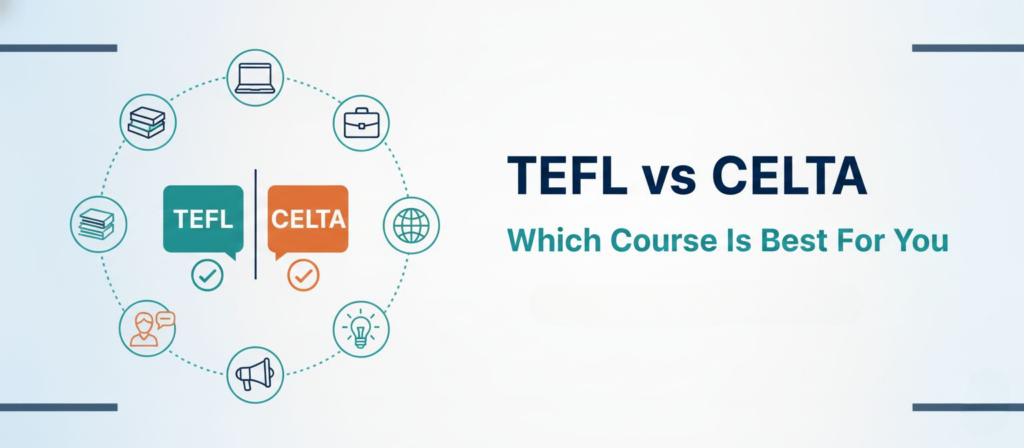
Is CELTA more valuable than a generic TEFL certificate?
In many markets, CELTA (Cambridge Assessment English) is highly regarded due to its rigorous assessment and internationally recognised status. However, a well-structured online TEFL course with a meaningful practicum and a strong portfolio can also be very credible, especially for online or entry-level roles. The best choice depends on your target positions and geographic focus.
How long should an online TEFL course last?
A common standard is around 120 hours of learning, including practical components. Some programmes offer longer formats with extended practicum opportunities. If you plan to teach online, look for courses that provide adequate teaching practice hours and opportunities to develop a portfolio, alongside flexible study options.
Can I start teaching online with a 100-hour TEFL certificate?
Some online platforms and markets may accept shorter certificates, especially for entry-level roles or as a stepping-stone. However, many employers prefer or require 120 hours or more plus a practicum. If you start with a shorter certificate, plan to supplement it with teaching practicum, micro-lessons, and a strong portfolio to improve your employability.
How can I verify an online TEFL course’s legitimacy?
Check the awarding body’s credibility, whether the course carries any regulatory recognition, the existence of a practicum or observed teaching component, and evidence of learning outcomes. Look for a transparent syllabus, clear assessment criteria, and access to tutor feedback. Read reviews and ask the provider for sample materials and a demonstration of the course’s portfolio requirements.