CELTA and Self-Awareness: A Reflective Teaching Journey


For aspiring English teachers, CELTA is not just a qualification but a reflective mirror that shows you your current practice and your potential for growth. This is an exercise through which you are invited to critically test beliefs, adjust for varying learners, and create a mindset of continual improvement. In classrooms abroad or online, it’s the ability to reflect and adapt that keeps you effective after you leave training. The article discusses how CELTA leads to self-awareness and provides tangible steps for maintaining that awareness.
At the very beginning, the programme evaluates your teaching through observation, feedback, and structured reflection. You’re urged to name your blind spots and to experiment with new methods in safe, supportive environments. It’s not just a matter of following that process, it’s about being increasingly informed as a teacher, so you can tell why a lesson went right or wrong. The long-haul payoffs are a professional identity that expands, as you learn to learn on the fly.
Finally, self-awareness is a skill that is transferable. Whether you are working in an online classroom, in a language school, or in a classroom overseas, the ability to measure your impact on students, and, as necessary, adapt, enables you to remain effective as student needs change. The design of CELTA is very much about transforming those obstacles in the classroom into opportunities for growth, rather than becoming impediments to learning.
How CELTA Mirrors Your Journey to Teacher Self-Awareness
CELTA starts with a new look at you and your teaching, observing experienced tutors, thinking with learners in mind, and feedback pointing to when you do well and when you’re not so good. This mirrors the arc of teacher development, as self-awareness is learned through exposure to excellent practice and honest critique. This course framework is specifically designed to intertwine observation, practice, and feedback so you can recognise your habitual responses and start to critique them constructively.
You will no doubt feel more or less confident about the nature of language teaching as you continue to meet a range of learners, types of classrooms, and approaches. This is exactly the point, as the CELTA journey operates within a cycle of self-discovery, echoing the philosophy of reflective practice advocated by the likes of Schön and Kolb. You begin linking the experiences on the ground of actual teaching with ideas in theory, so that you begin applying what you learn to make teaching decisions, objectives, and interactions in your classroom more responsive and purposeful, more supported.
As you grow, you increasingly articulate a teaching philosophy based on observation-led evidence. You observe the effects that phrasing, pacing, and error correction have on student engagement, and you begin to articulate why an approach worked in one lesson but not another. The end goal is not a single set of principles but a fluid, developing understanding of how you teach and what your learners respond best to in international contexts. This heightened self-awareness is what allows you to adapt when you encounter new classes, new curricula, and new cultures.
Developing Reflective Practice Through CELTA Training
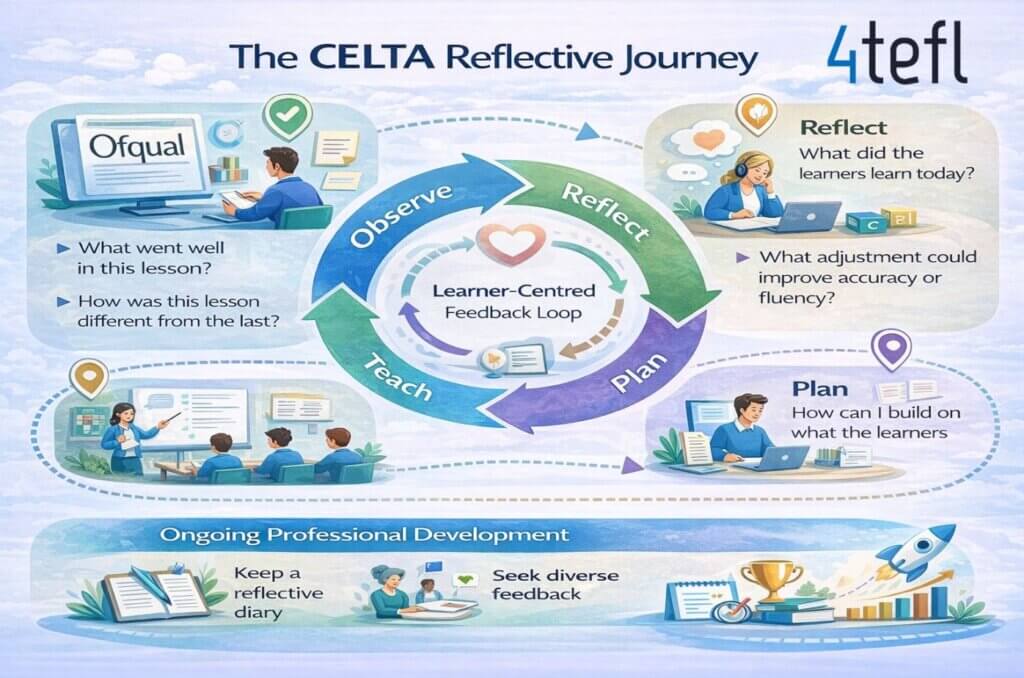
Reflective practice in CELTA is not merely a supplement, it is built into the daily rhythm of input sessions, observed teaching, and feedback loops. You record what happened in the classroom, think about why students responded the way they did, and strategise changes for the next lesson. This habit, questioning, testing, and refining, produces more than just better lessons, but also more professional self-knowledge.
This process is consistent with well-referenced frameworks for reflective practice in education which are premised upon practitioners taking experience, synthesising it into knowledge, and applying it in practice going forward. To facilitate this process, one central tool is the reflective journal or log. Trainees record observations, language use, and learner reactions, along with reflections on classroom management, task design, and assessment.
Over time, such information accumulates in a way that shows patterns, for example, what kinds of tasks consistently engage learners or where explanations confuse rather than clarify. Patterns like these, though initially appearing as random differences, start to provide the basis for deliberate, focused development. To formalise this, CELTA centres also make feedback explicit, feedback is not just praise or criticism, but guidance for the future. You learn to develop feed-forward plans, including what went well and what you can change next time for improved learner outcomes. The reflective loop, observe, reflect, plan, try, and observe, evolves into a professional habit. Through this, reflection in CELTA becomes a template for continued growth, well beyond the end of the course.
CELTA Components and Reflective Outcomes
| Component | What you do | How it builds self-awareness |
| Observed teaching practice | Watch and be watched; participate in teaching with real learners | Identifies micro-skills, pacing, and interaction patterns needing adjustment |
| Feedback sessions | Engage with tutor and peer feedback; discuss strengths and gaps | Clarifies personal biases and the impact of choices on learner engagement |
| Lesson planning with reflection | Plan activities, anticipate learner needs, reflect post-lesson | Links theory to practice; reveals how aims translate to classroom outcomes |
| Reflective journaling | Record observations, questions, and next-step ideas | Builds a repository of insights; tracks growth over time |
Self-Awareness Milestones for Teachers Pursuing CELTA
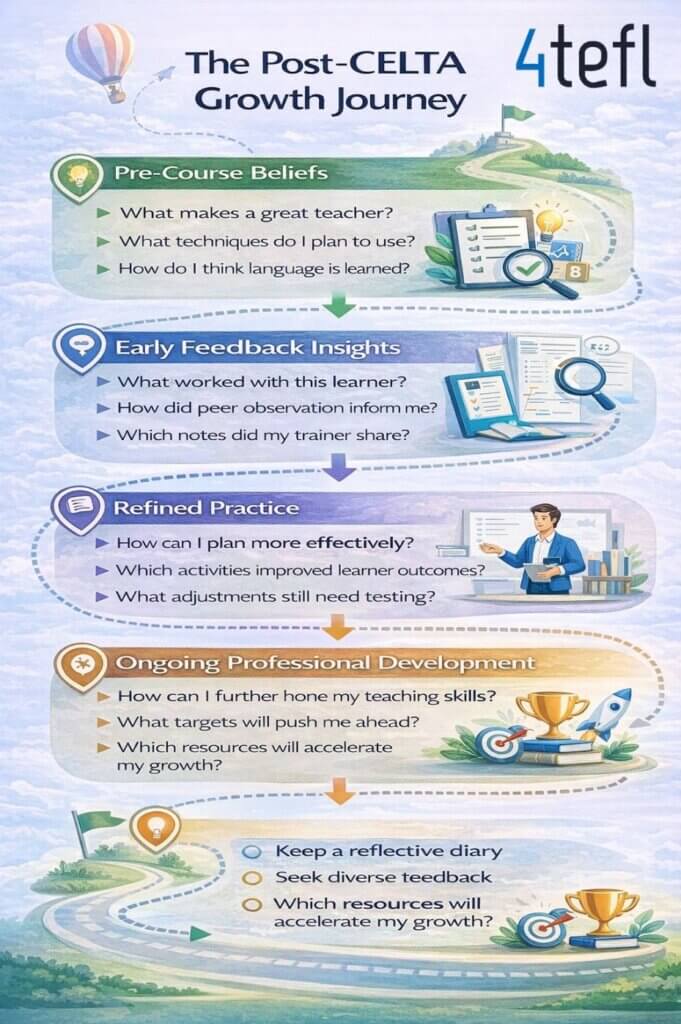
Milestone one takes place before you become more engaged in the course, you come with beliefs about language teaching and student learning. You begin to name assumptions through early observations and initial feedback and come together to create personal teaching goals. It’s also about awareness, the awareness that your current approach may serve some learners well but not all, and that there is room to grow.
The second point unfolds after the first major cycle of teaching practice and feedback. You begin to know which instructional decisions are successful in attracting learner attention and which do not. Your self-awareness grows from ‘I do this’ and ‘this happens’ to “this is how I need to change my language, pacing, and error correction patterns based on different learners’ ability levels.” There is a shift in how you experiment with changes, you don’t find it habitual and you feel the difference in their effect.
Finally, the last step is the final milestone in an individual’s development, you now have something you can point to at the end of the course, a new philosophy of education. At the same time, a concrete plan for continuing professional development has been developed. Through self-reflection, setting targets, and seeking out opportunities for yourself or others to co-teach, micro-teaching, co-planning, or mentoring outside the CELTA scheme. Finally, this milestone marks the move from student to practitioner, from being a learner in nature at first to a practitioner who can carry forward reflective practice under many different conditions, including those in online or international classrooms.
Turning Classroom Challenges Into Self-Evaluation Insights
Because classrooms don’t always function as ideally as they could and many struggles exist, dips in engagement, mixed-ability groups, limited time, these are ripe grounds for self-assessment. Instead of perceiving these moments as missteps, teachers who become CELTA-trained learn to pause, to see patterns, and to ask questions for clarification about who they are in the process and what role they play during learning.
This reframe is central to becoming a more autonomous and flexible educator. When a problem is turned into a series of reflective questions, you create a basis for future action. If, for example, after an extended listening-focused segment engagement falters, you ask: was it too complex a task or was the level of language misaligned with learner needs? Do you need more scaffolding, or pair work, to share the focus?
The goal is to establish a clear connection between a problem, your approach, the learners’ reaction, and an adjusted plan. Developing a habit of transforming classroom problems into self-evaluation insights strengthens your professional toolkit and builds resilience. It also allows ongoing improvements in delivery, pace, language accuracy, and student motivation. Over time, this approach keeps you responsive to learner feedback, adaptable to different contexts, whether abroad or online, and supports your growth as a reflective practitioner beyond CELTA.
Reflective Practice Checklist for Tackling Classroom Challenges
| Challenge | Reflective Question | Possible Adjustment | Expected Outcome |
| Low student engagement | What in my approach is not capturing interest? | Introduce shorter, more interactive tasks; vary grouping | Increased participation and energy in activities |
| Mixed-ability class | Are some learners left behind? | Add tiered tasks; provide targeted supports | Greater learner inclusion and progress across levels |
| Time pressures | Am I over-scaffolding or under-clarifying? | Streamline instructions; pre-teach key phrases | Clearer tasks; smoother pacing |
| Language focus concerns | Are errors addressed in a constructive way? | Use targeted error correction and model language | Improved accuracy without stifling fluency |
Practical Steps to Leverage CELTA for Lifelong Reflective Practice
Develop a habit of daily reflection from day one, close each lesson with a short note on what worked, what didn’t, and what you will try next. Use a consistent framework so your reflections become quicker and more precise over time. It becomes a personal compass for your ongoing development and helps you maintain momentum beyond the course.
Apply feedback systematically to drive improvement. Translate feedback into a clear action plan for the next session after each observed lesson. If a tutor suggests a different approach to feedback, try it in the next lesson and observe learner response. Revisit the plan after the lesson to close the feedback loop.
Sustain reflective practice by engaging with professional communities. Join online forums, attend local TEFL meetups, and seek mentorship from more experienced teachers. Continuity matters, the aim is to embed reflective practice into your professional identity so that it travels with you to every new classroom and region.
Steps for Sustaining Reflective Practice Post-CELTA
| Step | Action | Benefit |
| 1. Create a reflective routine | Schedule brief post-lesson notes | Consistency and clarity in growth |
| 2. Act on feedback | Implement one actionable change per class | Measurable improvement in practice |
| 3. Seek ongoing mentorship | Regular feedback loops with peers or seniors | Deeper insight and accountability |
| 4. Expand learning networks | Participate in local and online communities | Broader perspectives and resources |
Beyond CELTA: Sustaining Momentum in Self-Awareness
Maintaining self-awareness post-CELTA involves continuing to see teaching as a learning process rather than a fixed endpoint. You will want to explore different teaching styles, try different activities, and remain open to feedback from learners. The credibility of this strategy is supported by educational research showing that reflective practice and ongoing professional development are integral to teaching quality.
Long-term self-awareness relies heavily on professional communities. Interacting with colleagues from a wide variety of backgrounds introduces you to new language contexts, cultural norms, and teaching approaches. This exposure allows you to fine-tune your interpretation of classroom cues, how students react to instruction, and which prompts most effectively facilitate language use in different contexts. Set new targets regularly. Whether your focus is expanding your classroom repertoire, specialising in exam preparation, or moving into online teaching with different cohorts, maintain clear, targeted, and time-bound goals. The combination of goal setting and reflective practice keeps your professional identity evolving and ensures you remain adaptable to changing demands internationally or online.
Key Takeaways
- Mechanism: CELTA is about creating a more self-aware instructor through structured observation, feedback, and reflective practice.
- Processes: Core mechanisms that help turn classroom experiences into growth include reflective journalling, feedback discussions, and planned teaching practice.
- Milestones: CELTA milestones, such as recognising pre-course beliefs, learning through early feedback, and developing an evolving teaching philosophy for ongoing professional development, can be identified throughout the process.
- Insights: Converting classroom challenges into self-evaluation insights is a practical habit and supports continued development in any teaching context, including online and international settings.
- Momentum: Continued momentum after CELTA includes establishing daily reflective practice, building professional networks, and setting clear, ongoing development goals.
Authoritative Sources and Fact Checks (References)
- Cambridge English (CELTA Official Page): Primary source for course components and standards.
- British Council – Reflective Practice: Context on the importance of reflection in ELT.
- Kolb’s Learning Cycle (Simply Psychology): Theoretical framework for the “Observe, Reflect, Plan, Try” loop mentioned in the text.
Is CELTA essential for teaching English abroad?
CELTA is widely recognised as a standard entry qualification for teaching English as a foreign language in many countries and institutions. Some markets may accept alternative certificates or substantial teaching experience, but CELTA remains a robust, internationally recognised path for starting a career in TEFL. The recognition is supported by organisations such as Cambridge English and the British Council.
How long does CELTA take?
CELTA can be completed in a variety of formats, including full-time intensive courses typically spanning about four weeks, as well as part-time options. centres provide schedules that fit different personal and professional commitments. Cambridge English outlines the standard structure and requirements for the CELTA course.
Will CELTA instantly make me a better teacher?
CELTA provides the foundation for reflective practice and practical teaching skills, but improvement comes with deliberate application. The course emphasises observation, feedback, and practice that encourage ongoing self-evaluation, so sustained growth depends on how you apply what you learn in your own teaching contexts.
How can I start a reflective journal during CELTA?
Begin with a simple framework: note what happened in a lesson, why it happened, how it affected learners, and what you will change next time. Use a consistent template for quick daily entries, and review past notes regularly to identify patterns and growth areas.
Are there alternatives to CELTA?
Other recognised qualifications include DELTA and TESOL certificates offered by various accredited providers. These may suit different career aims, such as higher-level qualifications or specific specialisations. When choosing, consider which programme best aligns with your intended teaching contexts and professional goals.