Level 5 TEFL Course Verification: A Practical Guide

Whether teaching abroad as part of a TEFL qualification, or while teaching online, every would-be English teacher wants a TEFL qualification that matters. But the marketplace is clogged with courses that purport to be Level 5, promise rapid certification, or pair pricey tuition with nebulous outcomes. These students can waste their time or money on programmes that come with no credible accreditation and little real-world value if not fact-checked.
This actionable information provides you with the right standards and successful strategies to evaluate Level 5 TEFL courses in comparison with Ofqual standards, a reputable awarding body, and an accurate, achievable pathway for careers. It also provides you with red flags and what evidence to ask for before you sign up for the course.
The Core Issue
The real issue is not the aspiration to obtain a Level 5 credential, but the risk that marketing promises can be confused with regulatory practice. To teach confidently, you need knowledge and understanding of how Level 5 is conceptualised in the RQF.
An understanding of how awarding bodies function.
The ability to substantiate that a programme really does deliver a qualifying outcome.
A quick aside: while the TEFL market often mentions “Level 5” as an elevation, not every Level 5 claim is of regulatory significance. The focus is on verifiable regulation, credible accreditation, and transparent course design.
By the end of this guide, you will have a worksheet, sample questions for providers, and a framework to apply to any Level 5 TEFL offering, from online-only courses to blended programmes that include practical teaching components.
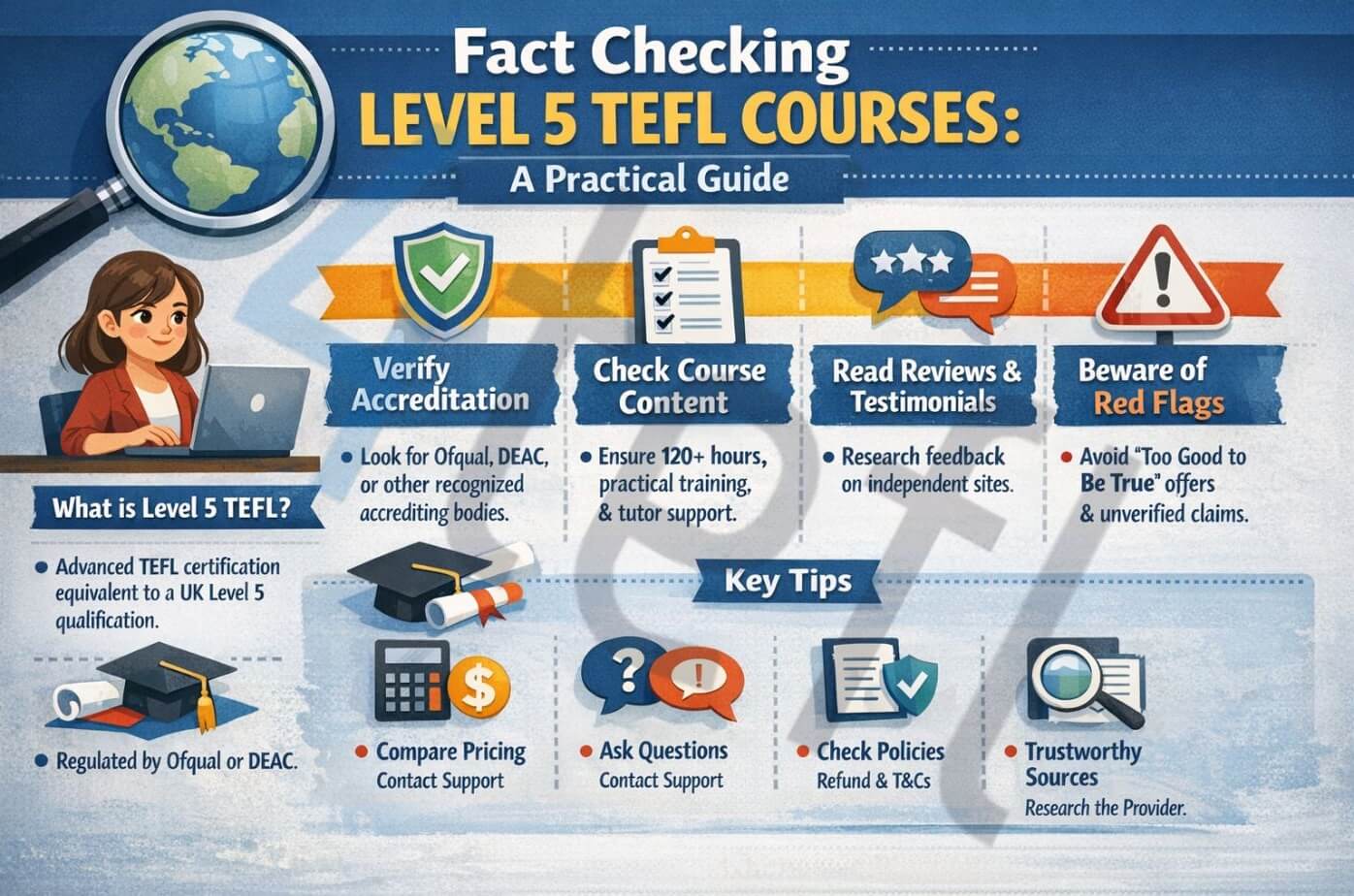
What to Verify in Level 5 TEFL Courses: A Practical Guide
1. Regulatory Status
Begin with a review of regulatory status. A real Level 5 TEFL course will be regulated under a qualification by a recognised body, such as the Office of Qualifications and Examinations Regulation in England.
All accredited qualifications consist of formal written lists, individual registration numbers, and publicly available information on learning outcomes, assessment methods, and awarding organisations.
Search the Ofqual register to check if a qualification is regulated and which awarding body administers it. This is your initial defence against misrepresentation.
2. Awarding Organisation & Qualification Type
Qualifications at Level 5 can take many forms, such as diplomas, certificates, or combined programmes. Any credible Level 5 TEFL course will be linked to a recognised awarding body who issues the certificates.
Specify the exact qualification type and level descriptor.
Provide a grid of knowledge and skills expected from students.
Warning Sign: If the provider is unable to name the awarding body or provide a formal qualification title registered with Ofqual or another recognised regulator, that is a significant red flag.
3. Learning Outcomes and Assessment Design
A strong Level 5 TEFL programme should show a clear sequence from theory to practice including lesson planning and feedback cycles.
Check for clearly defined assessments, including authentic assessment where teaching practice is observed and evaluated against explicit criteria.
Avoid programmes driven solely by question-and-answer testing or theoretical tasks with limited, if any, unscored practicum components.
Ask for sample modules or a detailed syllabus that directly corresponds to the descriptor for Level 5.
Quick Verification Checklist
| Item | What to verify | How to verify | Source to check | Red flags |
| Regulatory status | Is the qualification regulated? | Search Ofqual register or national regulator database | Ofqual | No regulator entry or unclear status |
| Awarding body | Named awarding organisation | Confirm with regulator and course brochure | GOV.UK | Missing or vague awarding body information |
| Qualification title | Correct Level 5 descriptor | Compare course title with official descriptor | Ofqual database | Title mismatch or mislabelling as Level 5 |
| Learning outcomes | Clear, standards-aligned outcomes | Request syllabus and mapping to outcomes | Course documents | Vague outcomes, no mapping to level descriptors |
| Assessment design | Practical teaching plus formal assessment | Review practicum, rubric, and grading policy | Sample rubrics | Only exams, no teaching practice, or anonymous grading |
| Evidence provided | Transcript, certificate with codes | Verify the certificate has an awarding body code | Official certificate | No official certificate code or verification method |
| Transparency | Access to regulator status and sample materials | Check publicly available information | Regulator pages | Information hidden behind login or paywall |
| CEFR alignment | Language outcomes align with CEFR levels | Look for mapping to A1–C2 in documentation | Council of Europe | No CEFR mapping or irrelevant outcomes |
Assessing Ofqual Standards in Level 5 TEFL Qualifications
Ofqual’s responsibility is to ensure consistency, fairness, and quality. When a Level 5 TEFL course is genuinely regulated, the descriptor and assessment framework are built on a published structure.
Validation: Use the Ofqual Register to confirm that a course and its awarding body are authorised.
Documentation: Look for a formal certificate issued by the awarding body, not merely a course completion letter from a private platform. The certificate should show the registration number or code.
CEFR Standards Alignment
While CEFR defines language proficiency (A1–C2), it is not a substitute for regulatory status. Many programmes use mapping for practical outcomes, but the key regulatory anchor remains the Ofqual-regulated status. Request a “crosswalk” showing how modules lead to observable teaching competencies.
Fact-Checking TEFL Course Claims for Certification
The “Hours” Claim
The critical question is not simply how many hours are completed, but how those hours are counted and measured.
Do hours relate to a recognised qualification, or are they just points in a schedule?
Ask for a mapping document outlining specifically how each module contributes to the Level 5 descriptor.
The “Worldwide Recognition” Claim
Fact-check this by requesting documentation on when the programme was recognised.
The awarding body’s accreditation.
Evidence of credible graduate outcomes such as verifiable employment records or testimonials.
The “Guaranteed Placement” Claim
Be skeptical of guaranteed placements or visa support. These are difficult to guarantee across jurisdictions. Always ask for details of any post-course support.
The formal structure of any job placement service.
A written statement outlining limitations or eligibility criteria.
Practical Steps to Verify Level 5 TEFL Accreditation
Start with an information-based, document-based verification plan and cross-check against the official regulatory databases.
The Main Validator: Use the Ofqual Register. If the course or awarding body is not listed, do not proceed.
Syllabus Review: Obtain the official syllabus and a sample assessment rubric. A credible course will have a clear grading scheme and observed teaching practice.
Comparison Pack: Create a one-page pack for each course containing course name, level, and contact information of the awarding body.
Case Studies and Real-World Outcomes
Case Analysis A: An applicant compared three courses and chose a regulated option with a visible practicum, successfully securing a job requiring regulated credentials.
Case B: A provider advertised “global placements” and visa assistance. Verification showed no formal partnerships, highlighting the importance of separating marketing claims from verified infrastructure.
Case Study C: A learner completed a course with a generic code that didn’t match the database. The employer rejected the credential, proving it unsuitable for professional use.
Common Pitfalls and How to Avoid Them
| Pitfall | Reality Check |
| “Level 5” Branding | “Level 5” can be a marketing label. Ensure registration with regulators and a named awarding body before paying. |
| Hours vs. Depth | High hours do not equal quality. Prioritise the quality of practicum supervision and alignment with level descriptors. |
| Guaranteed Jobs | Placement promises are often marketing hyperbole. Seek clear contractual terms and verifiable partnerships. |
Authoritative Sources and Fact Checks (References)
- Ofqual (The Register of Regulated Qualifications): The primary database for verifying if a TEFL qualification and its awarding body are officially regulated in England.
- UK Government – What qualification levels mean: Official guidance on the Regulated Qualifications Framework (RQF) and descriptors for Level 5.
- Council of Europe – Common European Framework of Reference for Languages (CEFR): The official source for understanding language proficiency levels and mapping teaching competencies.
- British Council – TeachingEnglish: A global authority on English language teaching standards and professional development credentials.
- ENIC-NARIC (UK ENIC): The agency responsible for the recognition and comparison of international qualifications and skills.
What exactly is Level 5 in the UK qualifications framework?
Level 5 refers to a qualification level within the UK Regulated Qualifications Framework (RQF). It is roughly equivalent to the second year of a university degree or a foundation degree. In the context of TEFL, a Level 5 course indicates a more advanced and in-depth programme, typically requiring 168–300+ hours of study and covering methodology, lesson planning, and classroom management in greater detail than lower-level courses.
How can I verify if a TEFL course is Ofqual-regulated?
To verify if a TEFL course is Ofqual-regulated, check whether the awarding body (not just the course provider) is listed on the official Ofqual Register. A legitimate provider will clearly state the name of the recognised awarding organisation and provide a qualification number. You can then search for both on the Ofqual website to confirm authenticity.
Do all Level 5 TEFL courses require a teaching practicum?
No, not all Level 5 TEFL courses include a teaching practicum, but many reputable ones do. A practicum (observed teaching practice) is highly valued by employers because it demonstrates real classroom experience. Courses that include supervised teaching practice - whether in-person or virtual - are generally considered stronger and more credible.
Is CEFR alignment essential for TEFL certification?
CEFR alignment is not strictly essential, but it is highly beneficial. The Common European Framework of Reference (CEFR) provides an internationally recognised standard for language proficiency. TEFL courses that align with CEFR frameworks tend to offer clearer learning outcomes and are more easily understood by global employers.
What documents should I request before enrolling?
Before enrolling, you should request:
- The course syllabus and module breakdown
- Information about the awarding body (if applicable)
- Accreditation or regulation details (e.g., Ofqual recognition)
- Sample certificate or qualification details
- Terms and conditions, including refund policies
- Details about tutor support and assessment methods
These documents help ensure transparency and legitimacy.
How can I assess the credibility of a course’s job placement claims?
To assess job placement claims:
- Look for specific data (e.g., placement rates, partner schools) rather than vague promises
- Check independent reviews and testimonials
- Verify any listed partner organisations or hiring platforms
- Be cautious of guarantees of employment, as these are rarely realistic
- Ask for examples of graduate outcomes or alumni success stories
Credible providers will present realistic, evidence-based claims rather than marketing hype.