Pathways to TEFL Success: Teaching Abroad Programme Choices


The idea of guiding classrooms abroad or online for future English teaching students is exciting but also daunting. There is no shortage of qualifications, formats, and destinations in the TEFL/TESOL community, however, and not all paths lead to the same outcomes.
The Foundation of Your Journey
Choosing a job-ready credential alongside hands-on teaching experience leads to faster career prospects, visa options, and supports long-term career progression. You use references from credible research such as UNESCO, the British Council, and OECD Education at a Glance to link your certificate with market demand, visa realities, and career prospects.
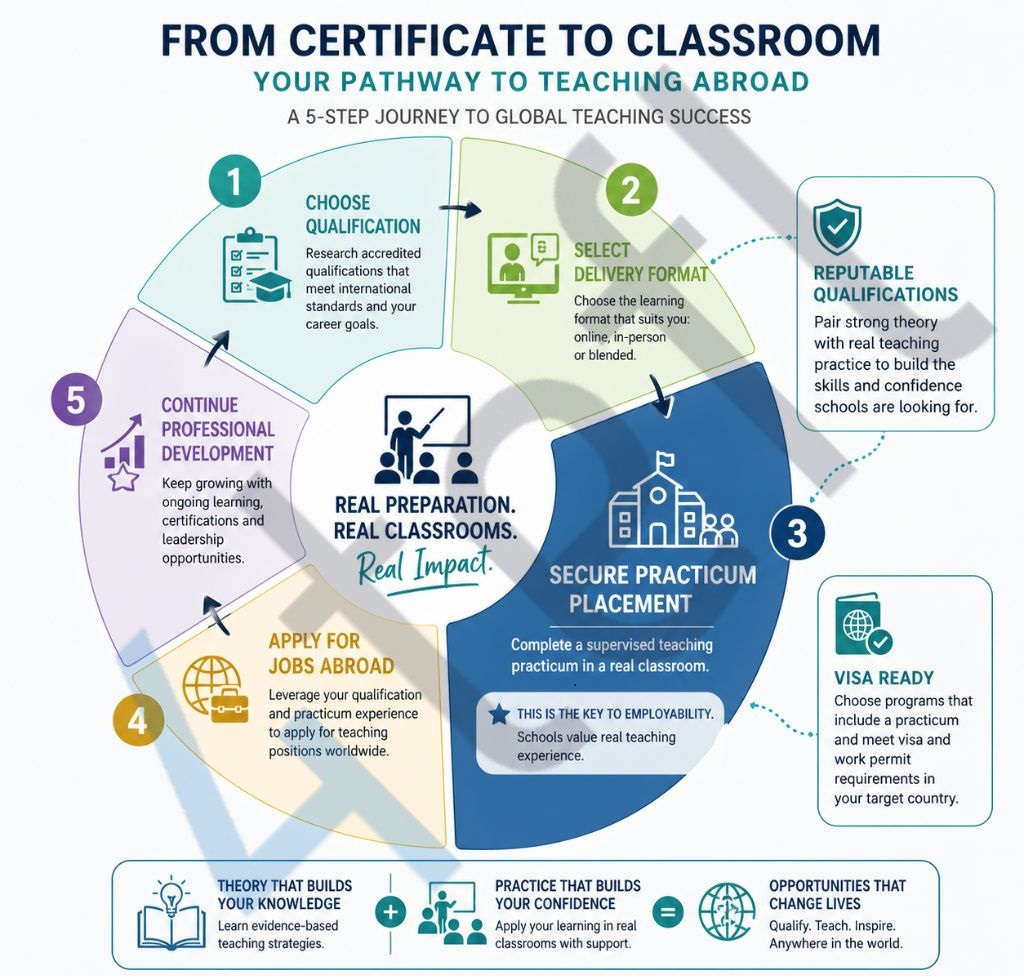
At the root of your journey and the first step of your journey is TEFL qualifications, the lifeblood of your journey.
- Standard Certifications: Usually around 120 hours.
- Advanced Options: Diplomas and master’s-level options for those seeking senior roles.
- Quality Indicators: Best programmes are provided by accredited programme providers and contain a supervised teaching practicum experienced closely enough to mimic a classroom environment.
Governments and trusted organisations stress that good preparation in methodology, lesson planning, and language comprehension ensures improved student results and greater legitimacy in your eligibility for international postings. This introduction is a guide for how to determine which areas make up your study and why you need to study for the path you choose.
Strategic Note: A well-defined working plan is every bit as valuable as the badge you don. You will have a strong qualification and practical experience, put applications to areas with achievable visa criteria, and maintain a professional portfolio showing that you can take on a range of roles.
In this way, following the ways laid out, you can make the leap from learner to assured practitioner, and have a plan that not only benefits in the moment to placement but the professional path into leadership in education over time.
Understanding TEFL Qualifications: What to study and why
TEFL / TESOL / CELTA
The TEFL/TESOL terrain has various entry points, and each has its own advantages:
- TEFL Certificate: Usually around 120 hours long, gives you a great foundation in pedagogy, classroom management, language awareness, and planning lessons. Combined with some real-world experience, it can play an excellent role in the virtual world of online teaching and even going abroad to practise for the first time.
- TESOL Certificate: Has a similar purview, focusing on English language teaching to speakers of other languages in a variety of situations and in many online or blended cases.
- CELTA (Certificate in English Language Teaching to Adults): Seen as a rigorous, practice-based option with a considerable component designed for practicum; employers commonly value CELTA’s “visible” state of readiness and capacity to be applied in the classroom across countries.
- Diploma / Master’s-level TESOL: For teachers who need higher-order theory, leadership, or research components. These lead to curriculum development and teacher education.
Global Validation
Evidence and advice from the international level confirm the importance of good preparation.
- UNESCO: Recognises a global need for trained English teachers and encourages educators to be professionally prepared; it is vital that there is a strong need for qualified and effective English teachers and that it is crucial to have high-quality and consistent professional preparation.
- The British Council: Emphasises that the best candidates have a credible credential to bring to bear – and practical experience.
- OECD’s Education at a Glance: Reports connect teacher quality with student achievement, shedding some light on why a carefully designed certification backed by practice in the real world is important for your career trajectory.
Summary of Choices:
- TEFL: A good launchpad if it features observed teaching practicum.
- TESOL: Generally equivalent (emphasis by provider may vary).
- CELTA: Challenging practical learning, highly valued by employers.
- Diploma/MA: Best for top school positions or higher education.
Accredited Training Formats: Online, In-person, Hybrid
Delivery formats determine how you learn, how you practise, and how quickly you are ready to enter the classroom.
Online Certificates
- Pros: Adaptable for work, family, or travel; usually less expensive.
- Checklist: Seek organisations with clear measures of evaluation and tutor feedback as opposed to just a list of online modules. The crucial question is whether a supervised practicum is included.
In-person Programmes
- Pros: Hands-on immersion, real-time feedback, and classroom visits.
- Impact: Boosts confidence and classroom presence. Particularly helpful for regions where local culture and classroom norms are very different from your own.
Hybrid Models
- Pros: Balances asynchronous content with on-site practicum days.
- Strategy: Align with visa and job market requirements, including visa timelines.
Choosing Destinations: Work Visas, Climate, Language Skills
The field in which you want to teach hugely impacts your approach to qualifications.
- Visa Realities: Rules vary significantly. Some destinations require a recognised teaching qualification plus a job offer; others provide more flexible entry points. Identifying visa requirements early on helps you plan your start date and search strategy.
- Climate & Culture: Some thrive in temperate conditions, others in dynamic urban centres with strong expatriate networks. Context and cultures are constantly evolving, affecting daily life and classroom dynamics.
- Integration: While basic local language skills may not impact instruction directly, they promote cooperation between colleagues and deepen student involvement. Fluency facilitates health insurance procedures, housing, banking, and community involvement.
Salary Outlook and Career Trajectories
TEFL wages and career opportunities vary widely between regions, types of institutions, individual skills, and qualifications.
- High-Demand Regions: Middle Eastern countries or parts of East Asia often offer strong pay, housing, flights, and allowances.
- Evaluation Tip: Total compensation packages – not just headline salary – must be evaluated, including housing costs, insurance coverage, and contract length.
- Progression Paths:
- Early Stage: Increasing teaching hours and taking on mentor roles.
- Advanced: Moving into leadership, teacher training, or school administration.
- Specialisation: Exam preparation, English for academic purposes, or digital teaching leadership.
Finding Programmes with Real Classroom Practice Abroad
For any TEFL qualification to be considered credible, there must be a concrete, hands-on practicum.
Key Features of a Quality Practicum:
- Formal lessons observed.
- Feedback from competent tutors.
- Chances for reflective practice.
- Clear learning objectives and a transparent observation framework.
| Programme type | Typical duration | Delivery mode | Focus | Notes |
| TEFL Certificate (120 hrs) | 4–12 weeks | Online or blended | Teaching fundamentals | Accessible entry point; verify practicum |
| TESOL Certificate (120–150 hrs) | 4–8 weeks | Online or blended | Classroom skills | Widely accepted; check accreditation |
| CELTA | 4 weeks (full-time) | In-person | Practical teaching | Highly regarded; intensive |
| Diploma / Advanced TESOL | 6–12 months | Part-time | Advanced practice | Suitable for senior roles; theory/research |
Funding, Scholarships, and Budgeting
Smart budgeting helps to avoid upfront stress and ensures you can focus on learning and placement.
- Costs to Consider: Tuition, travel, visa fees, insurance, accommodation, and living expenses.
- Funding Sources: Scholarships, employer sponsorship, university grants, and government programmes.
- Warning: Don’t be led astray by job-related schemes that offer jobs in return for payment of fees – reputable programmes are underpinned by strict commitments.
- Advice: Base your funding plan on authoritative guidance from sources such as UNESCO or the British Council.
Key Takeaways for a Successful Journey
- Begin with Respect: Choose a respected qualification with a practicum and international recognition.
- Format Matters: Select a format that works with your life and budget while keeping practicum at the centre.
- Global Outlook: Study destinations for visa ease and professional growth, not just pay.
- Long-term Vision: Develop an outlook that covers continued professional development (CPD) and leadership.
- Benchmarking: Use UNESCO, the British Council, and OECD criteria to verify potential value.
Next Steps: Practical Insights for Your TEFL Path
- Start with the Region: Choose programmes that explicitly integrate a supervised practicum.
- Verify: Contact admissions teams to confirm practicum arrangements and visa-aligned outcomes.
- Plan: Develop a realistic timeline for credentialling, visa timings, and job searches.
- Prepare: Establish an honest assessment of language and cultural preparedness.
Conclusion: Taking a TEFL journey is a deliberate choice that links study, practice, and global experience. Your first step is to choose the qualification that you believe combines theory and a significant practicum, plus has the backing of the employers in your region of interest. Stay curious and connected—the path promises the opportunity to impact students from more countries, broaden your own horizons, and contribute to the global community of English language teaching.
Authoritative Sources and Fact Checks (References)
- UNESCO (Education 2030): Insights on global teacher standards and the importance of professional preparation.
- British Council (Teaching English): The leading authority on English language teaching (ELT) standards, certifications (CELTA/Trinity), and career development.
- OECD (Education at a Glance): Statistical data linking teacher qualification quality to student educational outcomes.
What is the best entry point for TEFL beginners?
A credible TEFL or TESOL certificate with a practicum offers a solid foundation; CELTA can provide additional portability and recognition for certain markets.
How do I maximise employability abroad?
Combine a recognised certificate with a robust practicum, accumulate teaching experience, and build a professional network of schools and language centres.
Are online qualifications as good as in-person ones?
Online can be effective when paired with practicum and supervision; in-person components often enhance practical teaching confidence.
How should I evaluate a TEFL provider?
Look for recognised accreditation, credible practicum supervision, tutor-to-student ratios, alumni outcomes, and clear post-course support.
Is a bachelor’s degree always required?
Not universally, but it is widely preferred and often needed for visa eligibility in many destinations.
What are the most trustworthy sources for guidance?
UNESCO, the British Council, and OECD provide widely accepted guidance on qualifications, quality standards, and career pathways.
How should I plan financially for TEFL training?
Create a detailed budget including tuition, travel, insurance, visas, and living costs; explore scholarships, employer sponsorship, and university grants, and beware of scams.