Teaching English in Sweden: Certification and Careers


Sweden is an accepting place for English teachers, as the country has had a strong focus on language learning in the past, and there is a huge demand in private language schools, adult education centres and online classrooms.
For new teachers, the issue is not simply what to teach, but how to certify your work, what to do with permits, and how to sustain a career in a nation whose education model combines civic obligation with an energetic private system. This guide offers practical, fact-checked advice on what happens during certification, accreditation, licensing and career pathways in Sweden, and is based on the knowledge of authoritative sources to lead you confidently in planning.
If you are choosing to be a teacher abroad or online (such moves are making waves), you shall find that you need clarity on two fronts:
- The formal requirements for teaching English in Sweden.
- What certification provides you with entry.
Public-school jobs and many municipal projects in education all require recognised qualifications, while private language schools or online platforms would prefer educators to have TEFL/TESOL certificates with practical teaching practice. The field is less black and white, though, and whether what you are trying to do is to teach in the traditional state-sanctioned classroom environment or in the private/online sector, where flexible certs will be highly appreciated, depends. This guide is there to clarify that landscape, so that you will see a pathway that fits your career goals and your time frame for your migration to Sweden.

Certification Pathways for Teaching English in Sweden
When you plan to teach English in Sweden, you will know the full range of certification routes, from focused TEFL/TESOL diplomas all the way up to full teaching degrees.
- Public Sector: In Sweden, the prevailing qualification required for teaching in the public sector is a recognised teaching qualification, giving you permission to work in primary and secondary schools. This typically requires completing a teacher education programme and obtaining licensed qualifications from Skolverket (Sweden’s National Agency for Education).
- Private & Online Sector: On the other hand, private language schools, universities and a large portion of online teaching positions will accept TEFL/TESOL certificates, particularly those that contain significant practicum training, on a very large scale.
But the difference is subtle: if you want to teach in public schools or in state-funded programmes, a recognised teaching degree will usually be required; if you want to teach only in private language schools or online teaching, a decent TEFL/TESOL certificate (but it has to include classroom practicum) will be sufficient to start.
The path to certification can be a variety of routes. Most people will want to register for a TEFL/TESOL certificate (usually 120 hours) with a practicum option to cover the practicum aspect of the application for a position. CELTA (Cambridge) or CertTESOL (Trinity) is a stricter choice with structured instruction, micro-teaching and observed teaching practice. Education at the tertiary level – university or college – or experience of teaching in English, usually with student teaching practicum, is the most basic way to get into the public sector in Sweden. Some candidates also combine a college or higher education credential with an international TEFL/TESOL certificate to marry theoretical breadth with practical classroom skills. To that effect, make the process fully understood and accepted by the Swedish authorities and/or the organisations you want to work for.
Comparison of Certification Pathways
| Certification Type | Typical Duration | Best For | Sweden Relevance (Public vs. Private) |
| TEFL/TESOL certificate (120 hours online) | 4–8 weeks | Private schools, online teaching | Private sector; good entry point |
| CELTA (Cambridge) | 4 weeks full-time | Hands-on classroom practice | Highly valued in both sectors |
| CertTESOL (Trinity) | 4 weeks | Practical teaching with assessment | Solid in private sector |
| University degree in Education | 3–4 years | Comprehensive teaching theory | Strongest basis for public-sector |
| Diploma/Master’s in Education | 1–2 years | Advanced pedagogy, leadership | Beneficial for career progression |
Accredited TEFL/TESOL Courses for Sweden Careers
Accreditation is relevant when selecting TEFL/TESOL courses for work in Sweden. The courses are reputable, correspond to the best practices globally and offer real classroom practicum with a clear pathway and opportunity for obtaining post-academic qualifications.
In the UK and elsewhere, a number of qualifications exist as part of Ofqual-regulated frameworks, providing employer confidence in quality. Ofqual – the UK authority to measure qualifications – demands principles that underpin the process of strong assessment and authentic credentialing. Though not all TEFL/TESOL certificates fall under Ofqual, courses associated with Cambridge CELTA, Trinity CertTESOL and other programmes are considered to be internationally recognised in Sweden and other countries in Europe.
In judging courses, consider:
- Real practicum with observed teaching.
- Positive feedback from experienced teachers.
- A clear assessment schedule.
- A clear assertion about transferability (to European or Swedish contexts).
In Sweden, quality courses will have a combination of theory and practice, language awareness and practical teaching experience. Online learning options can work in harmony with your schedule, but not at the point of losing out on practicum, monitoring from classroom observation of learning experiences or feedback. Autumn and spring starting dates, set teaching practice and cooperative agreements with local language schools or universities make it more employable. For readers looking at the Swedish market, it is beneficial to select courses that offer a tangible bridge to real teaching placements – even if those placements are undertaken in partnership with partner schools outside Sweden – but could open doors to future positions in Sweden. Our goal is to give you transferable teaching skills that are recognised and valued by Swedish schools.
Accredited Course Selection Checklist
| Feature to Check | Why It Matters | What to Look For |
| Practicum | Demonstrates real-world skills | 6–12 hours of observed teaching |
| Assessment | Ensures professional standards | Written feedback on lesson planning |
| Alignment | Facilitates recognition abroad | Aligned with CELTA or CertTESOL |
| Further Study | Supports long-term growth | Path to a degree or diploma |
| Placements | Increases employment chance | Partnerships with local schools |
| Recognition | Builds credibility | Backed by university-affiliated programs |
Within Sweden, an increasing number of institutions value providers which have a strong practicum component and credible partnerships. Employers will also show better interest when you can showcase practical classroom experience and a strong understanding of lesson planning, assessment and differentiation for diverse learner groups. For those seeking government-acknowledged pathways, CELTA and CertTESOL remain the two most accepted credentials that maintain high professional standards worldwide – including Sweden. For more comfort, get clarification from Sweden’s education authorities and your own provider on how the certificate applies to Sweden-specific teaching eligibility.
Work Permits, Teaching Licences and Employers in Sweden
If you want a job teaching English in Sweden, particularly for you who are not an EU/EEA national, having a solid grasp of work permits, licensing and employer expectations is important.
Legal Requirements & Permits
Sweden has a work permit system that is run by the Migrationsverket (Swedish Migration Agency).
- Non-EU/EEA Nationals: Unless you are an EU/EEA citizen, typically you need to be offered a job before being granted a work permit. The next step for the employer is to prove that the post actually is legitimate and that you satisfy the requirements of employment for the job or role, and that conditions are in line with Swedish standards. The permit usually is linked to the job and employer, so a clear contract is crucial. It requires several months to apply, so it is vital to plan ahead.
- EU/EEA Citizens: Citizens of EU/EEA countries might get to work via a different mechanism. You can be stationed in Sweden without a work permit, but if you do remain long term it might still require registering with the Skatteverket (Swedish Tax Agency) to make sure you follow local residency requirements.
Licensing & Qualifications
As for licensing and qualification for all teachers, public sector teaching in Sweden tends to be recognised by Skolverket after passing a national teacher education programme. Private and foreign schools or language institutions usually accept TEFL/TESOL certificates that bring within reach a good practicum experience with strong classroom practice. If you get into the public sector, look to formally legitimise your qualifications to Swedish standards as their equivalent teaching qualification.
Employer Landscape
In Sweden employers can be found at:
- Private language schools.
- Adult education organisations.
- International schools.
- Universities.
- The municipal education sector.
Private providers and/or non-profits commonly recruit English teachers with TEFL/TESOL certificates and relevant teaching experience. While both public or municipal schools and municipalities tend to require recognised teaching certificates, they also offer relatively stable careers and relatively well-established career paths, and even can have an opportunity to focus on specialisation in English teaching in an area of education for all subject areas (such as language learning). The employer context is complemented by platforms and other opportunities that enable remote education for students in Sweden or elsewhere, along with remote teaching opportunities online offering the flexibility to build up your own diversified teaching portfolio while you first settle in Sweden. For a more precise set of options in visa requirements, consult Migrationsverket, Skatteverket for tax advice and Skolverket for licensing pathways.
Career Prospects in Sweden: Schools and Online TEFL Roles
A Swedish national language teacher is the best of all English teachers, and future career prospects for them are influenced by such factors as the continued demand for language acquisition in schools and the growing prominence of online language instruction.
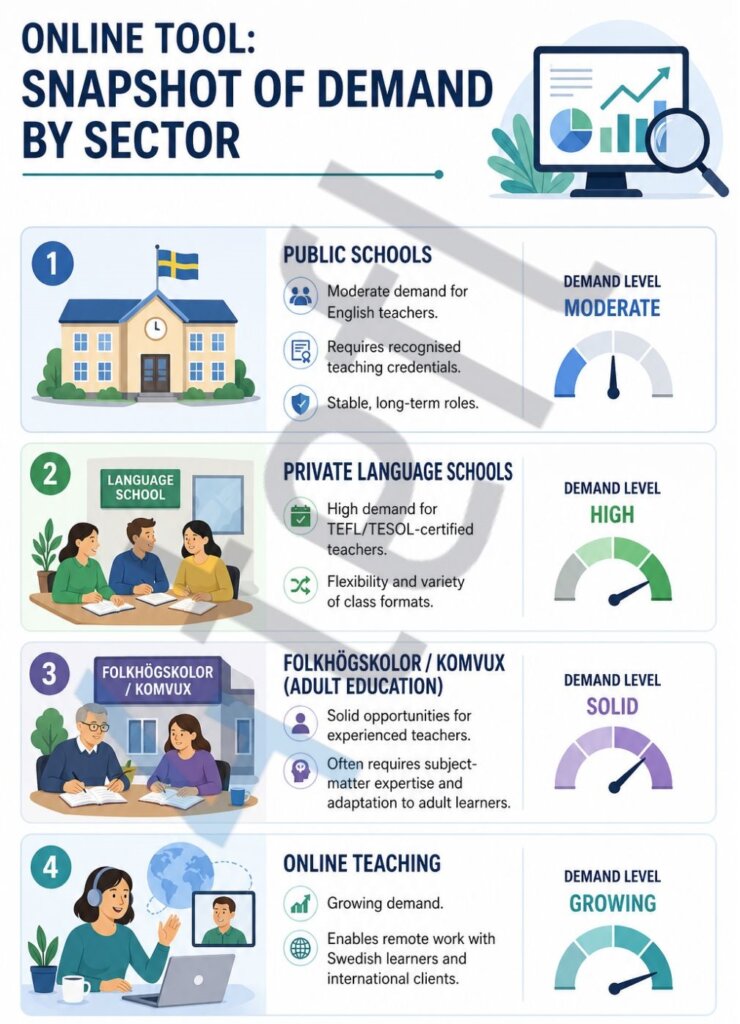
English skills are regarded as strategic assets in the Swedish education system and are learned from the very early years, reinforced for pupils in compulsory schools. Hence, English teachers are a necessity in public schools, private language schools and higher education settings.
Diverse Teaching Environments
Besides the usual classroom roles, there are also significant demands for:
- Experienced adult education and lifelong learning teachers.
- Komvux (municipal adult education).
- Folkhögskolor (folk high schools).
The private sector of teaching is growing, as there is an increasing need for immersive English programmes, conversation classes, exam preparation, corporate training and more. The online course environment also provides opportunities for Swedish learners who prefer flexible, remote methods of learning.
Career Growth & Development
Sweden’s formal system (national curricula, national schools) shapes the core of teaching opportunities in Sweden. Usually, to teach in these environments, you will need a recognised teaching qualification and an ability to meet Skolverket’s standards for teacher accreditation. There are a number of career pathways within private language schools and universities: for classroom teaching, child and adolescent English instruction, adult exam preparation and conversation classes, and corporate language training.
Online TEFL roles extend to tutoring, one-to-one teaching, small groups and asynchronous course support. The online market has also seen an increase in demand for teaching in Sweden, but is now global, so there remains the case of online learners in Sweden, where technology offers convenience, scheduling flexibility, high-quality teaching and accessibility to all levels of the population.
CPD (Continuing professional development) is also critical for ongoing education beyond formal employment. Ongoing CPD opportunities for Swedish teachers are available, including university extension courses as well as professional networks. Since pedagogy, assessment and learner-centred approaches are critical, many teachers develop CPD or specialisations, e.g. digital education, inclusive teaching or English for specific purposes (ESP). Networking also plays a very important role; joining teacher associations and attending local education events can help to promote your knowledge and lead to job opportunities. For online teachers, developing a diverse client portfolio, improving online teaching skills and becoming familiar with digital platforms increase your market share and can eventually lead to more stable and better-paid work.
Employer Landscape and Contracting for TEFL in Sweden
The job market in Sweden for TEFL teachers in the local school system consists of private language schools, universities, folk high schools and municipal education providers.
- Private Operators: Traditionally allow for more flexible schedules and a greater variety of course formats, including evening classes and intensive language bootcamps for professionals.
- Public/Municipal Programmes: Have formal qualification requirements, and generally also stipulate a set of formal accreditations as well as national standards, often requiring collaboration with local governments and authorities.
Some roles are part-time at universities or language centres, while others are full-time teaching jobs within school timetables or on campus. Negotiate workload, class size, preparation time, assessment responsibilities and available professional development opportunities.
Practical Recruitment Tips
A practical approach to employment in Sweden depends on proactive outreach and recognising the value of local networks.
- Tailored CV: Write a specific CV that presents your teaching certification, practicum experience and language skills.
- Highlight Practicum: If you have a TEFL/TESOL certificate, highlight practicum and classroom management aspects, and any experience of teaching Swedish or other languages as evidence of cross-cultural competence.
- Networking: Contact language schools, adult education centres and university language departments; participate in teaching fairs and local events; and look for opportunities via online channels and job boards relevant to Sweden.
- Legal Prep: If you are relocating from overseas, ensure that you have a work permit or visa, a contract and a plan to register with Swedish authorities if required.
- Hybrid Approach: Consider combining in-person roles with online teaching to develop a mixed portfolio that meets the changing needs of Swedish learners.
Career Prospects in Sweden: Schools and Online TEFL Roles – Key Takeaways
- Market Strength: Sweden’s English instruction is strong in both public and private contexts, where the distinction between public school licensing and private language instruction and online platforms is especially prominent.
- Certification: Accredited TEFL/TESOL courses with practicum are a good way to enter the field – especially if combined with CELTA or CertTESOL-level training for greater employment access.
- Legal Status: Permits and licences differ in terms of citizenship; for EU/EEA members, access to work is easier, while for non-EU/EEA candidates a job offer and visa are generally arranged by the Swedish Migration Agency.
- Flexibility: Online TEFL roles can complement onsite teaching and open up opportunities for those who wish to teach remotely or develop an international teaching portfolio in Sweden.
- Growth: Networking is key to long-term success, and participation in teacher associations and continued education supports career growth and stability.
Authoritative Sources and Fact Checks (References)
- Skolverket (Swedish National Agency for Education): Information on teacher certification and the Swedish education system.
- Migrationsverket (Swedish Migration Agency): Official guidelines on work permits and visas for non-EU/EEA citizens.
- Skatteverket (Swedish Tax Agency): Procedures for civil registration and tax obligations for residents.
- Study in Sweden: General information on living and working in Sweden within the academic sector.
- Westbridge CPD Institute: CPD Accreditation: CPD accreditation for organisations and professionals. Recognising quality learning, training and development across all industries.
Do I need to learn Swedish to teach English in Sweden?
For most private language schools and online teaching roles, you can start with English-only credentials, especially if your focus is conversation classes or English for professional contexts. However, to teach in public schools or municipal programmes, you will typically need a recognised teaching qualification that aligns with Swedish licencing standards, and some knowledge of Swedish is highly beneficial for classroom management and integration with the education system. It’s wise to invest in at least basic Swedish language skills if you intend to pursue long-term employment in Sweden. Sources: Swedish education authorities and national guidance discuss teacher qualifications and the role of language in classrooms.
Is TEFL/TESOL sufficient for Sweden, or do I need a Swedish teaching licence?
TEFL/TESOL certificates are valuable for private language schools and online roles. For teaching in Sweden’s public sector, a recognised Swedish teaching qualification (often aligned with Skolverket’s requirements) is typically necessary. If you plan to work across sectors, pursuing a combination of a reputable TEFL/TESOL certificate and a university-level teaching credential can maximise opportunities. Official guidance from Migrationsverket and Skolverket provides the framework for these requirements.
How long does it take to become eligible to teach in Sweden?
Timeframes vary by pathway. A TEFL/TESOL certificate with practicum can be earned in a few weeks to a couple of months. A CELTA or CertTESOL course usually runs over 4 weeks (full-time) or an equivalent blended format. A university degree in Education or English requires 3-4 years for an undergraduate, or 1-2 years for a taught master’s route in some programmes. Public-sector eligibility usually hinges on completing a recognised teacher education programme and meeting licencing standards, which can add additional time before you commence teaching in a school.
What about work permits for non-EU/EEA teachers?
Non-EU/EEA citizens typically need a job offer before applying for a work permit under Sweden’s immigration system. The employer must demonstrate the post’s legitimacy and the offered terms must meet Swedish standards. EU/EEA citizens have free movement for work but may need to register with the Tax Agency and potentially meet residency requirements for longer stays. Always check the latest guidance from Migrationsverket before making any plans to relocate.
Can I teach English online from Sweden?
Yes. Online TEFL/TESOL work is common and can be an excellent way to supplement on-site teaching or build experience before pursuing local roles. When teaching online to Swedish learners, ensure you comply with data protection rules (GDPR) and any platform requirements, particularly if you handle student data or payments electronically. Online roles can provide flexibility while you navigate visa and licencing considerations.
How can I advance in my Swedish teaching career?
Focus on a combination of formal qualifications, practical experience, and professional networking. Seek opportunities to observe experienced teachers, reflect on your practice, and pursue CPD in areas such as assessment, inclusive education, and digital classroom tools. Engaging with teacher associations and participating in local teaching events can help you access job opportunities and stay informed about evolving standards in Sweden.