A Practical TEFL Guide for Teaching English in the UAE

The United Arab Emirates is a vibrant context for English teachers: slick schools, a variety of classroom types, and a clear need for qualified teachers. But newcomers typically find themselves overwhelmed by a host of qualifications, visa procedures and school expectations.
This guide wants to make some sense of the uncertainty and provides real and grounded insights on UK and international standards, also fact-checked. You will find out what qualifications are recognised, how to tailor your training to UAE employers’ expectations and the steps needed to be able to work safely and legally in the Emirates.
Many hopeful new teachers will ask, in fact, the right questions to answer: Where do I start, and what do these schools actually value in UAE schools?
It all depends on the mix of good academic qualifications, certificates from the university and professional certification, and a good knowledge of both visa and work permit requirements. By plotting out the path – from picking a good TEFL qualification that suits your UAE employers – with no difficulty, to the documentation necessary for residence and employment – your route to a fulfilling career in teaching is also a very achievable step-by-step route.
This reference list of practical classroom strategies that work best in the UAE, and a view of the market situation for employment both in school type and region, is also included, offering realistic views through the curriculum.
For those students gearing up to study TEFL, the takeaway is clear: invest in credible, regulated training, check your degree and background checks up front, and tailor your CV and interviews to the needs of UAE employers.
The next two chapters dissect your main topics for you to learn, and also give practical tips on how you can do it today to help you position yourself for future competitive positions in the UAE market. 
UAE TEFL Requirements and Recognised Qualifications
In the UAE, English teaching is decided on a national basis and also on the basis of the specific qualifications of the employer.
Minimum Requirements:
- As a minimum, most schools require a Bachelor’s degree, and you need to hold a recognised English-teaching qualification that proves you can teach English as a foreign language.
- For many private and international schools, a 120-hour TEFL certificate is a baseline entry credential when it comes to positions outside the public system.
- Those seeking more challenging roles, notably at international schools or universities, would be drawn towards a range of higher qualifications such as CELTA, TESOL with a practical teaching role, or a PGCE/teacher-licensure pathway.
This tiered strategy emulates global practice and also reflects the UAE’s dedication to developing high-quality professional teaching standards.
Verification and Compliance:
- Academic credentials and teaching qualifications are just one side of the picture. UAE employers also expect strong safeguarding checks and verified documentation.
- Attestation of a degree, particularly in the form of an application to your home country’s relevant authority, as well as to the UAE Ministry of Foreign Affairs and International Cooperation (MOFAIC), is a common requirement for getting residency and being able to teach.
- After securing a job, a background check as well as a medical examination is usually part of your visa as well.
- Public schools are often established by the UAE Ministry of Education (MOE) and that means you often need a locally recognised teaching credential in addition to your degree and TEFL certificate, while private and international schools may pay more attention to certificate quality, teaching experience, and demonstrable classroom outcomes.
What Constitutes a Credible TEFL Credential?
For the UAE, a credible TEFL qualification typically has 120 hours of instruction completed, complete with an observable teaching practice component.
Ofqual-regulated and UK-aligned certificates also have higher respectability due to their transparent certification, which is regarded as ‘standard’ by most practitioners in the UAE.
Providers who provide supervised practicum, in-country observation practice and a clearly designed assessment process also tend to develop greater employer confidence.
Part of what works for those pursuing higher-level roles is to have at least a 120-hour TEFL, complemented by CELTA or equivalent, which in practice can go a long way towards making a difference, particularly for international schools wanting real teaching proficiency and a clear demonstration that you can manage diverse classrooms.
The environment of recognition in the UAE as well says get ready to prove:
- Your Bachelor’s degree and official transcripts
- Your TEFL/TESOL certificate that provides hours & practicum
- Police clearance and medical checks if required
- MOFAIC or an approved authority attestation of your documents
- A valid passport and visa documentation during the onboarding process
- Academic credentials along with teaching qualifications and safeguarding.
In reality, qualifications (degree + TEFL + safety-awareness credentials) neatly correspond to the requirements of UAE employment.
After you finish preparing to be a teacher, you often receive an assessment or mock class as part of the recruitment process.
But international-accreditation-run schools increasingly deem safeguarding and child-protection training, although not always mandatory, imperative.
To ensure that you are properly equipped, your CV should show your qualifications, practicum hours, and prior teaching or tutoring experience along with references, including background checks and attestation of degrees.
In the case of the UAE, it is to verify credentials and obtain qualifications at a certain number of your professional as well as educational documents as part of a job application for your visa; the UAE requires that they are checked through the visa process.
This generally includes checking your professional and educational requirements.
Relevant government authorities (in-country and UAE MOFAIC) attest your degree and teaching certificates.
Authentication of your documents by your employer’s emirate or UAE embassy or consulate in your home country where necessary.
Although the process varies with each emirate and employer, the steps are unchanged in nature: obtain the employment offer, background check, obtain documents attested on this employment offer, undergo relevant document and medical examination before you start your teaching contract.
Practical Takeaway
- Start with a recognised 120-hour TEFL certificate and aim for an Early Practicum (mini-teaching blocks) to demonstrate classroom readiness.
- If you’re targeting international schools, consider supplementing with CELTA or a similar qualification for a stronger competitive edge.
- Prepare your documents early and arrange attestation well in advance to avoid delays in visa processing.
Choosing the Right TEFL Qualification Path for the UAE
The TEFL journey must map onto the UAE’s employer expectations, as well as the larger international market for the English classroom.
There’s a good variety of qualifications available in the UAE market but ultimately the best way to go is frequently determined by your longer-term objectives, the preferences you have regarding where you want to work (Dubai, Abu Dhabi, Sharjah or somewhere else in the Emirates), and what kind of institution you want to join.
A best practice would be to track your career ambition and map it to a qualification ladder that balances credibility, mobility and practical teaching skills.
Foundations: 120-hour TEFL vs Longer Certificate Programmes
For many new to the field, a TEFL certificate of 120 hours – with (ideally) an on-site teaching practicum – will serve as a good starting point. It’s the most useful source of theory-based resources on language acquisition, lesson organisation, classroom management and assessment, and provides real opportunities to observe and practise teaching.
If you plan to work in higher-tier private international schools or universities, you may wish to pursue an advanced certificate, such as CELTA or a specialised TESOL with substantial practicum hours.
Ofqual-regulated courses offer very clear criteria and are respected by UAE recruiters seeking consistent quality standards, which means it is an attractive level of training with a transparent methodology.
Targeted Pathways for Different Career Goals:
- Private language centres and local private schools: A 120-hour TEFL with a solid practicum and a few years’ classroom experience will be adequate.
- International schools and universities: Employers are often interested in candidates with CELTA certification or equivalent and proof of continuing professional development and experience with English for Academic Purposes (EAP) or Business English.
- Career changers or online-teaching routes: The right TEFL certificate (as well as practicum and post-certification teaching experience) can lead to future possibilities in the UAE including language centres, online-to-offline hybrid jobs, or part-time teaching in private schools.
Special Considerations: Ofqual-regulated Courses and UAE Alignment
Ofqual-regulated TEFL certifications (obtained from recognised UK awarding bodies) also provide an added layer of validation for many employers. They are an indication of compliance with a standardised assessment framework, and can be especially effective for schools which align with UK exam standards or international accreditation schemes.
When selecting a path, check:
- Hours and practicum: A good part of the practicum is observation in the classroom.
- Accreditation: Is the awarding body Ofqual-regulated or internationally recognised?
- Transferability: Is the certificate transferable to other jurisdictions and to UAE employers?
- Supporting materials: Is there strong job-search support, CV guidance and interview practice available for you?
Practical Takeaway
- If your objective is entry into UAE private or international schools, pair a strong 120-hour TEFL with CELTA/Trinity TESOL if feasible.
- If you’re targeting online teaching together with work in the UAE, a credible TEFL certificate with excellent practicum will set you apart in both online and on-site roles.
- Choose a course that provides clear evidence of teaching practice, feedback, and ongoing professional development opportunities.
Navigating UAE Visa Rules and Work Permits for Teachers
Visas, work permits, and residency in the UAE are administered via both employer sponsorship and government channels.
The system is straightforward: your school or institution sponsors your work visa; you undergo medical checks and receive an Emirates ID; you will then obtain your prolonged residency status.
The details vary depending on the emirate, employer category, and whether you are joining a government programme or private/independent schools.
The core principles hold: your employer will typically file the framework for your work permit; you must provide attested documents; and you will complete health and background checks before getting your UAE residence visa and Emirates ID.
Key Steps in the UAE Visa Process for Teachers:
- Job offer and sponsorship: Secure a formal offer; employer initiates visa process.
- Entry permit: Arrives before you travel to the UAE, allowing you to enter the country for employment purposes.
- Medical examination: In-country or on arrival; tests typically include blood work and a chest X-ray.
- Emirates ID application: Your employer assists with the application once you are in the UAE; this ID is essential for resident status and access to services.
- Labour card or work permit status check: Historically a separate “labour card” existed, but processes have evolved; the core requirement is employer sponsorship and MOHRE compliance.
- Residency visa stamping: The final step is the issuance of the UAE residence visa, linked to your Emirates ID, typically valid for 2–3 years depending on contract and policy.
Common Documents and Steps for UAE Teaching Visas
| Document / Step | What it covers | Notes |
| Job offer and employer sponsorship | Legal mechanism to work in the UAE | Ensure the contract specifies sponsorship terms, salary, contract length, and renewal options |
| Entry permit | Legal permission to enter the UAE for employment | Usually issued after the employer initiates the process |
| Educational and professional credentials | Degree, TEFL certificate, and teaching qualifications | Ensure professional documents are attested for MOFAIC and UAE embassy/consulate requirements |
| Background check / Police clearance | Verification of criminal history | May be requested from home country and/or UAE authorities; required by many employers |
| Medical examination | Health clearance | Often includes blood tests and chest X-ray; completed in UAE or in home country if arranged by the employer |
| Emirates ID application | Residency identification | Essential for opening bank accounts, utilities, and local services |
| Visa stamping and contract finalisation | Legal residency status and employment rights | Validation depends on employer’s processes and government timelines |
Practical Takeaway
- Start the visa and document checklist early. Ask for official copies of your degree, transcripts, and TEFL certificate and translations so you can expedite attestation.
- Verify with your employer the specific MOFAIC/embassy steps required for attestation and whether any country-specific steps are needed.
- Prepare for processing times that could last longer during peak periods or government holidays; don’t leave visa steps to the last minute.
Practical Classroom Strategies and Job Prospects in the UAE
The actual classroom in the UAE is typically diverse and large, with multilingual learners.
The best teachers marry a robust language teaching approach, cultural sensitivity, and flexible, learner-centred activities.
You will often have to juggle grammar, vocabulary, pronunciation, and communicative competence – and manage different levels of proficiency in one class – in an EFL context.
With growing emphasis on critical thinking and 21st-century skills, UAE classrooms reward teachers who create interactive, technology-enabled lessons that engage learners in meaningful language use.
Three Practical Classroom Strategies That Work Well in the UAE
Practical Takeaway
- Start the visa and document checklist early. Ask for official copies of your degree, transcripts, and TEFL certificate and translations so you can expedite attestation.
- Verify with your employer the specific MOFAIC/embassy steps required for attestation and whether any country-specific steps are needed.
- Prepare for processing times that could last longer during peak periods or government holidays; don’t leave visa steps to the last minute.
Practical Classroom Strategies and Job Prospects in the UAE
The actual classroom in the UAE is typically diverse and large, with multilingual learners.
The best teachers marry a robust language teaching approach, cultural sensitivity, and flexible, learner-centred activities.
You will often have to juggle grammar, vocabulary, pronunciation, and communicative competence – and manage different levels of proficiency in one class – in an EFL context.
With growing emphasis on critical thinking and 21st-century skills, UAE classrooms reward teachers who create interactive, technology-enabled lessons that engage learners in meaningful language use.
Job Prospects in the UAE: Where You Might Teach:
- International schools: Generally top levels of pay, ample scope for professional development and curricula that are aligned to international standards; demand is strong in Dubai and Abu Dhabi.
- Private language centres and academies: Many TEFL-certified teachers have frequent entry roles; more flexible schedules and shorter-term contracts.
- Universities and higher education institutions: EAP and academic English opportunities that demand more fixed contracts with requirements on the level of degree attainment or formal teaching credentials.
- Public schools (MOE-affiliated), with slightly more stringent entry requirements, are generally very sought after for long-term career benefits, but may have a higher intensity of competition and a demanding set of skills.
Responsive Classroom Management in Multicultural Classroom Practice:
- The classroom: UAE classrooms with diversity.
- As a teacher, you’ll face students who come from a range of linguistic and cultural backgrounds – in Arab, South Asian, European and African contexts, to name a few.
- Effective classroom management relies on clear routines, consistent assessment approaches, and culturally sensitive communication.
- Keep in mind those gaps as you plan your lessons and plan activities with the goal of encouraging confident and engaging language and that children will draw on strengths and have the opportunity to take risks with language usage.
Salary and Job Security and Training Opportunities:
- Entry-level opportunities: With private language centres and language academies, a lot of new teachers can secure classroom experience and an early collection of classroom skills that can help in portfolio building.
- Development routes: With experience, they are able to transfer to lead teacher positions, curriculum design and, in some universities or schools/language centres, teacher training.
- Professional development: Most UAE schools have policies, guidelines and frameworks for continuing education, and staff education in observation feedback, mentoring, and training in EFL methodologies.
- The future state, and practice, is essential for both employers and employees, as part of the core value proposition.
A Study on the Cultural and Professional Integration of Teachers in UAE Schools
A professional teacher’s long-term success in the UAE requires that they adapt and conform to local culture and professional norms.
The place they live may be very cosmopolitan, but there are cultural norms and conventions at home that guide and influence everyday teaching practice, classroom behaviour and student-teacher interaction.
Awareness of such norms enables teachers to develop strong relationships with students, staff members and parents and has implications for how classroom environments are maintained and for job satisfaction.
Key Cultural Considerations:
- Time and dress: In most UAE school programmes, there are modest dress codes and culturally sensitive practices.
- It’s wise to understand the rules governing school dress codes, especially during Ramadan or any time of Muslim cultural or religious activity.
- Etiquette and communication: Establishing a professional relationship with students, parents, and colleagues is important.
- In many contexts, formal address and a polite tone are respected.
- Family and parental involvement: Schools in the UAE often actively engage with families; forming relationships with parents can be a pathway for student advancement and for the development of the school community.
- Ramadan and school hours: School hours may be adjusted during Ramadan (when people are fasting and praying).
- Expect modified timetables in some schools.
- Policy on language and Arabic literacy: While English is the primary language of instruction at many UAE international schools, you will still encounter students from Arabic backgrounds.
- Even a basic understanding of the cultural and linguistic context can be useful.
- A few words or culturally relevant references and a few Arabic phrases – used respectfully and with consent – can build rapport and make the training more inclusive while still covering English-language objectives to a greater extent.
- If we were to ask for help, some teachers observed this.
Practical Tip:
- To obtain a position, research school policy; specify attendance, what is expected during Ramadan, what parents expect regarding communication with their child, and how intercultural issues tend to be resolved.
- Develop cultural competence by consulting supervisors and colleagues; participate in whole-school training or professional growth on inclusive teaching activities.
- Create a warm, professional CV that highlights your experiences leading diverse classrooms, tailoring activities to mixed-ability groups, and incorporating technology into class.
Finding Trusted TEFL Training Providers Aligned with UAE Standards
Choosing a good provider should also be a critical point for those readers planning to study TEFL or TESOL in an attempt to work in the UAE.
Seek out programmes that set clear outcomes to learn from, offer a real practicum and have a recognisable accredited awarding body.
This is also why Ofqual-regulated certificates can be trusted by UAE employers, a situation that is even easier to resolve when complemented by strong practicum training and evidence of reflection in teaching.
Look into suppliers which provide direction on job opportunities in UAE job markets, visa arrangements or processes for visas, interview preparation and preparedness for interview with the UAE; such services can provide a smoother transition from training to teaching.
How to Evaluate a TEFL Course and Be Ready for the UAE:
- Accredited status: See if the awarding body’s eligibility criteria apply and whether the course is, indeed, Ofqual-regulated as well as internationally recognised.
- Practicum quality: Make sure the course has supervised teaching hours and feedback from mentor teachers.
- Transferability and acknowledgement: Confirm that the certificate is accepted by a number of UAE employers, including international educational organisations.
- Support and guidance in a job: Seek out CV/interview coaching, job-placement advice and current UAE visa and contract expectations.
- Localisation: Providers can provide country-level guidance on UAE specifics (e.g. requirements, document attestation, and onboarding methods).
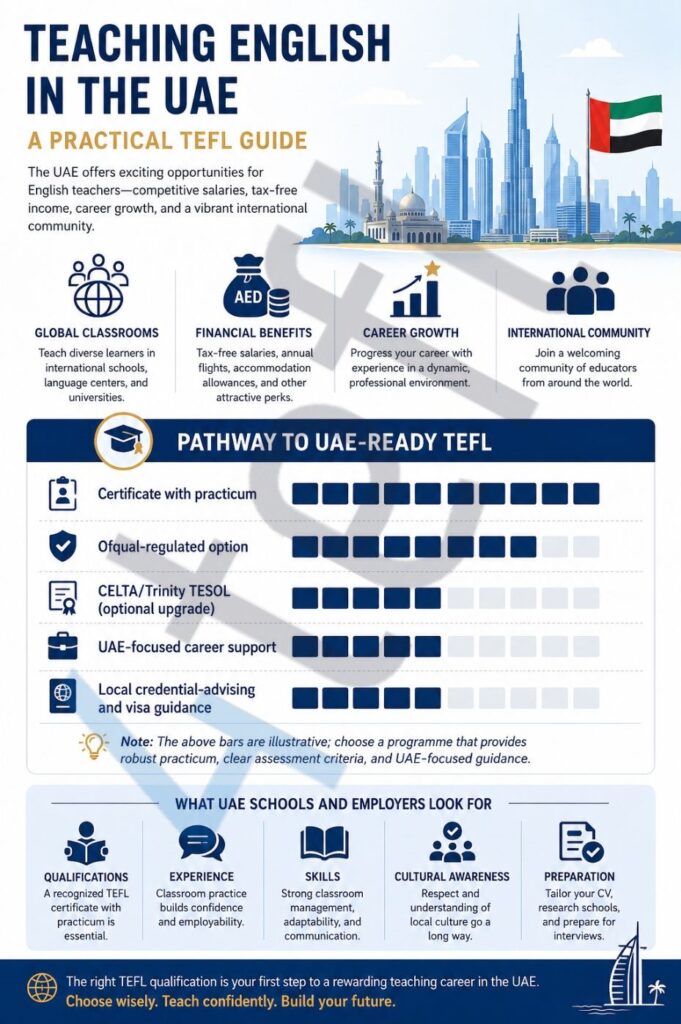
Practical Takeaway
- Prioritise courses with practicum and direct teaching experience, not only theory.
- If your budget allows, pairing a 120-hour TEFL with CELTA or equivalent can strengthen applications to top employers.
- Ensure your chosen course offers guidance on UAE document attestation, visa processes, and school recruitment cycles.
Authoritative Sources and Fact Checks (References)
- UAE Ministry of Education (MOE): Official regulations and teacher licensing standards.
- UAE Ministry of Foreign Affairs (MOFAIC): Document attestation and legalization procedures.
- Ofqual (The Office of Qualifications and Examinations Regulation): Information on regulated UK qualifications.
- The Official Portal of the UAE Government: Visa and Emirates ID information.
Do I need a CELTA to teach in the UAE?
Not universally. Many private language centres accept a solid 120-hour TEFL with practicum, especially for entry-level roles. International schools and universities often prefer more advanced credentials such as CELTA, TESOL with extensive practicum, or a teaching licence. The best approach is to target the type of school you want and align your qualifications accordingly.
Is a 120-hour TEFL certificate enough for UAE private schools?
For many private language centres, a 120-hour TEFL with a strong practicum will be sufficient to start teaching. However, competition is high for international schools, and longer qualifications with practicum and classroom experience tend to improve your prospects.
What documents are typically required for UAE work permits?
A job offer and employer sponsorship, attested degrees and TEFL certificates, police clearance, medical examinations, and an Emirates ID application. Document attestation via MOFAIC and UAE embassies/consulates is often required before arrival or early in the onboarding process.
How long does the UAE visa process usually take?
Processing times vary by emirate and employer, but it commonly ranges from a few weeks to a couple of months. Starting early, having complete documentation, and staying in close contact with your employer helps keep the process on track.
What is the best way to prepare for teaching in the UAE?
Build a strong, evidence-based teaching portfolio with lesson plans, unit- and course-level outcomes, and examples of student work. Secure a solid professional network, including recruiters who specialise in UAE placements, and keep your CV tailored to the UAE market. Research the school culture and curriculum you’re applying to, and ensure you are ready to adapt to a multicultural classroom environment.
Are there any ongoing professional development requirements in UAE schools?
Many employers support ongoing professional development and may require or encourage attendance at workshops, conferences, or school-internal training. It’s common to engage in reflective practice, peer observations, and lesson-planning improvements as part of career progression.