

Mastering the 10 Essential TEFL Skills for Success

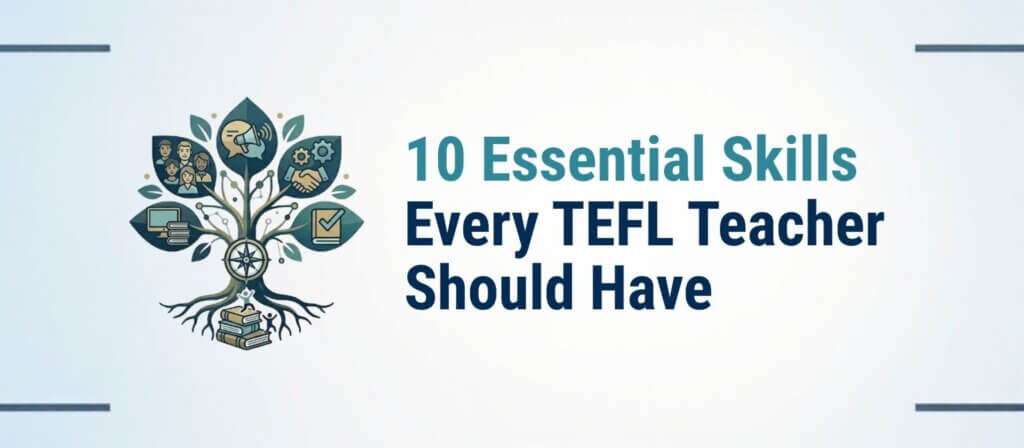
The teaching of English as a foreign language (TEFL) has brought with it plenty of opportunities – from teaching abroad to online tutors. Yet, many prospective teachers underestimate the many different teaching skills involved in this process.
Moreover, the most successful TEFL teachers bring clear communication skills, adaptive pedagogy, dependable assessment methods, and comfortable access to digital technologies to bear on their teaching practice. The result is an authentic and inclusive curriculum.
This work considers ten core TEFL competencies and explains the path towards acquiring them as they exist in practical, valid ways that are attuned with international standards.
Global Context and Standards
The demand for learning English for foreign students is increasing worldwide. English continues to be the most studied language in the world and is used by learners in classrooms, schools, and online communities, according to UNESCO. It is to this context that robust TEFL training and accredited certifications are particularly relevant.
Whether you are considering classroom teaching abroad or online tutoring from home, learning these ten skills will enable you to be on students’ learning journeys, adapt to differing contexts, and advance in your professional career. The advice in this paper aims to be applicable, evidence-based, and within respected frameworks (CELTA/DELTA) and in-country CPD standards.
In the rest of the paper, which follows, we will provide practical strategies, examples of how to develop the skills, effective practice, and tips on getting certification and applying for a job – we will also post notes about proof of mastery with regard to certification and in job applications. We hope to provide you with a trustworthy blueprint of what is best practice for your TEFL journey in terms of your safe, confident, and measurable impactful experience in your classroom.

Clear Communication and Classroom Management Skills
TEFL teaching relies on clear communication and classroom management. In order to feel safe and engaged, students require succinct instruction along with organised tasks and predictable routines. When students see what each task is and what successful completion looks like, they are in tune with language production, and they do not lose sight of what the teacher wants from them. It lays the groundwork for the development of a positive learning environment where behavioural expectations are clearly communicated and consistently enforced.
Clear communication starts with language clarity and voice control. Training for enunciated speech, pacing of the spoken words, and natural intonation makes for faster meaning and comprehension, especially because learners are working on words new to their vocabulary and grammar. Combine this with simple scaffolded instructions and demonstration of tasks to set expectations at the beginning of the task.
Visual supports – pictures, charts, and realia – support understanding and decrease cognitive load. Such classroom management ensures that language is encouraged. Establishing routines (beginning-of-class warm-ups, pair-work protocols, clear transitions) minimises downtime and confusion. It also helps streamline how classroom dynamics are managed, such as mixed-ability groups and multilingual classes. Having a well-managed classroom gives teachers the opportunity to circulate and, when absolutely necessary, respond with sensitive, constructive language and feedback.
Learner motivation and attention stay high over the course with ongoing and positive reinforcement in class rules. Tip-based practices for this skill set consist of specific signposting, exit tickets at the end of a lesson to measure your understanding, and bite-sized feedback during pair or group exercises. Teaching frameworks based on evidence highlight the value of learner talk time, many means of input, and guided practice. In certification courses, we typically assess you on your ability to plan and teach lessons that exemplify these behaviours and your adaptability in real time.
Section 1 Summary:
- Paragraph 1 recap: Clear communication reduces ambiguity; structured routines support learning.
- Paragraph 2 recap: Voice, pace, and visual supports aid comprehension; demonstrations matter.
- Paragraph 3 recap: Routines, signposting, and positive management practices sustain engagement and safety.
Adaptive Teaching for Diverse Learners and Contexts
An adaptive teaching approach values that every classroom is and should still be a living ecosystem of learners with needs, backgrounds, and goals different from anyone else. For TEFL classrooms, all types of learners – students at different ages, levels of language, cultures, or ways of learning. An adaptive method makes all materials accessible, challenging, and enjoyable for everyone.
This does involve, in practice, proficient differentiation, flexible grouping, and responsive pacing that respects learner autonomy while providing targeted support where needed. Some crucial approaches are to scaffold the tasks from learner readiness to readiness, provide various access to specific tasks and input adjustments (e.g., simple words for novices or authentic resources for advanced learners), and make use of input changes (e.g., simplified language for beginners).
It also requires us to consider cultural backgrounds as something to be celebrated as assets, rather than barriers. For instance, facilitating the learners to compare their own language structures with English may enhance the understanding and motivation. Adaptive teaching also involves diverse contextualisation of context, which entails the choice of materials and content that are in line with the cultures and the common usage.
Finally, adaptive teaching and reflective practice cannot be separated. Consider the lesson and what worked and what went well for learners, and where a different strategy might work better next time. Standards in TEFL certification stress such things as how to arrange lessons for students of different capabilities, to track progress through ongoing assessment, and to redesign tasks without sacrificing results. This is especially needed when teaching online, where the environment of the learner – bandwidth, device access, home environment, etc. – can affect what is available in a given lesson.
Section 2 Summary:
- Paragraph 1 recap: Diversity in learners requires intentional differentiation and flexibility.
- Paragraph 2 recap: Scaffolding, multiple entry points, and cultural relevance boost engagement and understanding.
- Paragraph 3 recap: Reflective practice closes the loop on adaptive teaching and informs future planning.
Assessment, Feedback and Progression Planning
Assessment literacy is fundamental to identifying learners’ progress and directing instruction. Great TEFL teachers employ a blend of formative and summative processes which adhere to clear-cut criteria and clear learning objectives.
Formative assessment – continual checks for understanding as people participate in activities – equips teachers to adjust instruction instantaneously. Summative assessment at important points in time is evidence of achievement, which can also inform plans of certification and progression. Good feedback is both exacting and timely in its tone and, most importantly, it deals with language form and function.
Higher-quality feedback does not simply mark correctness, but can also help learners see where they are still missing things, analyse their errors, and develop some good ideas where they can improve. Feedback should be balanced, actionable, and should be given in a way that does not impact the learners’ motivation and self-belief. And this involves providing praise, guidance on what to do next, and opportunities to continue learning – whether with practice or revision.
Progression planning and curriculum mapping link daily activities to higher-level objectives. A good TEFL teacher implements syllabus objectives as sequenced lessons, units, and progression milestones. And you will want to map things up with those milestones so learners can feel how small progress contributes to greater ones. Certification organisations also have recognised that professional credibility hinges on the demonstrated ability to map progression, even in conjunction with engaging lessons. From a practical standpoint, this results in keeping records, annotating learner portfolios, and using standardised rubrics that are fair and transparent in practice.
Section 3 Summary:
- Paragraph 1 recap: Use a mix of formative and summative assessments aligned to outcomes.
- Paragraph 2 recap: Feedback should be specific, constructive, and motivating.
- Paragraph 3 recap: Plan progression with clear, trackable milestones and consistent rubrics.
Digital Fluency and Online Teaching Techniques
Digital fluency is more than knowing the hows and whys of clicking “record” or sharing a screen. It includes the choice of tools, creating accessible online activities, maintaining a presence on the Internet, and protecting students in online environments.
In today’s TEFL market, online teaching is central – whether you work for an online language school, conduct your own tutoring business, or teach in hybrid environments. Familiarity with learning management systems, videoconferencing platforms, and collaborative applications provides the ability to design engaging, inclusive platforms that will carry across well offline and online. Central to digital fluency are the types of tools students choose that are pertinent to their pedagogical aims, structuring of an online lesson so they continue to receive what they are learning, and using multimedia to expand their input.
You need to be comfortable with synchronous and asynchronous activities, to be able to customise what you do for bandwidth and device availability. You will also have to take into account issues such as digital safety, privacy, and the ethical use of materials with younger learners or international cohorts. Some part of certified TEFL training already contains modules on online pedagogy, platform characteristics, as well as the methods of remote assessment and feedback.
With these capabilities, teachers are well suited for high-quality instruction in time zones and spaces and to effectively teach high-quality teaching and learning experiences. Building engaging online experiences similarly benefits from a repertoire of ready-to-use activities: breakout-room tasks, polls, collaborative document editing, and gamified language practice. These tools help to keep learners motivated and engaged in meaningful language use. Use evidence of digital fluency as you prepare for certification exams or job applications; share specific examples when it came to online activities, what learners learned, and any reflective notes in terms of what worked in more general contexts. The contemporary TEFL position increasingly demands tangible evidence of both in-person and web teaching proficiency.
Section 4 Summary:
- Paragraph 1 recap: Digital fluency means choosing suitable tools and designing accessible online activities.
- Paragraph 2 recap: Maintain online presence and pedagogical intention across synchronous and asynchronous formats.
- Paragraph 3 recap: Demonstrate outcomes and reflective practice through quality online lessons and feedback.
Table: 10 Essential TEFL Skills at a Glance
| Skill | Focus | How it helps learners |
| Clear communication | Clarity of instructions and language use | Reduces confusion and speeds task completion |
| Classroom management | Routines, transitions, behaviour guidance | Creates a safe, productive learning environment |
| Differentiation | Adapting tasks to learner levels | Keeps all learners challenged and supported |
| Questioning techniques | Eliciting language and checks for understanding | Promotes active learner participation |
| Formative assessment | Ongoing checks for understanding | Guides timely instructional adjustments |
| Feedback strategies | Specific, actionable feedback | Supports self-regulated learning |
| Lesson design | Structured, coherent sequences | Builds predictable, goal-driven lessons |
| Digital fluency | Use of tech and online platforms | Expands access and engagement opportunities |
| Cultural competence | Awareness of learner backgrounds | Fosters respect and motivation |
| Reflective practice | Ongoing professional reflection | Drives continuous improvement |
Cultural Competence, Learner Motivation and Autonomy
Cultural competence in TEFL: Understanding students’ culture, language, and backgrounds as critical factors in learning. When educators are sensitive to cultural values, language use customs, and classroom social rules, learners are more open to joining a conversation or making a stand in their communication, researchers suggest. It is also important to know that culturally responsive teaching does not just add colour to confusion or misunderstandings that can come from assumptions about what is going on in the context or what students already know. In sum, being culturally competent fosters a safer, more inclusive, and more effective classroom.
Motivation for language learning has many aspects. Intrinsic (interest, pleasure) or extrinsic (grades, external rewards) motivation can affect a student’s motivation. TEFL teachers who teach English effectively are the ones who develop both, making tasks meaningful, engaging with students on objectives, having choices that support students’ autonomy, and giving opportunities for real language use. For example, student-led projects, topics, and self-assessment are ways to maintain and enhance student engagement and ultimately student performance. When students perceive relevance in what they are learning, they are more willing to apply it and overcome difficulty.
TEFL learning at a higher level of autonomy for learners is to be hoped for. Autonomy fosters autonomy through a gradual movement of planning, monitoring, and self-assessment from teacher to learner. This might include goal setting, reflective writing, and decisions about pacing and sequencing. Autonomy can be promoted online through tasks flexible to learner learning styles, clear rubrics, and a wide variety of resources. Certification criteria uphold teachers who actively facilitate learner agency and provide structure and support.
Section 5 Summary:
- Paragraph 1 recap: Cultural competence creates inclusive, respectful learning environments.
- Paragraph 2 recap: Motivation strategies link language tasks to learners’ goals and interests.
- Paragraph 3 recap: Autonomy development empowers learners to manage their own progress.
Reflective Practice, Professional Development and Certification Alignment
Teachers use reflective practice to transform experience into better skills. This includes being able to look at one’s own classes, seek feedback from peers or supervisors, and evaluate results based on the learners’ experience to determine what you will change next. Reflection creates a habitual practice that promotes progressive development and alignment with changing pedagogical perspectives. It also equips you to take certification exams that test your proficiency in lesson planning, delivery, and adaptability.
TEFL professional development (PD) is never really over. The field continues to develop as technology, pedagogy, and global learner needs change. See if you can get CPD training – whether through formal learning experiences, workshops, online courses, or accredited teacher education programmes – to keep up to date with research-informed practices.
Educational institutions like Cambridge English (CELTA, DELTA) also prioritise applied effectiveness, lesson planning, and reflective ability. A focus on standardised teaching and learning – PD tied to recognised standards – not only improves your teaching but also better positions you to work in a given country and to be eligible to work in various countries.
Lastly, certification matching means that your training corresponds to recognised qualifications that are common to employers and meet the realities of the job market too. This is the step to consider when choosing a TEFL/TESOL programme, including what kind of curriculum, micro-teaching, observed teaching practice, and a lesson plan portfolio to include. Employers in many countries expect formal training to conform to international frameworks. Some require evidence of documented formal training. Accredited programmes are often Ofqual-regulated or aligned with equivalent national standards, which give your credentials a certain degree of legitimacy and help bridge the gap between countries or the host platform.
Section 6 Summary:
- Paragraph 1 recap: Reflective practice translates experience into improved teaching.
- Paragraph 2 recap: Ongoing PD keeps you current with research and technology.
- Paragraph 3 recap: Choose certificated programmes that align with global standards for career mobility.
Authoritative Sources and Fact Checks (References)
- UNESCO – International Bureau of Education: Learning and Teaching English in a Globalized World – Data on global language trends and educational standards.
- Cambridge English: CELTA and DELTA Frameworks – The gold standard for TEFL certifications and professional development.
- British Council: TeachingEnglish Resources – Evidence-based practices for classroom management and digital literacy in ELT.
- Oxford Academic – ELT Journal: Research in English Language Teaching – Peer-reviewed studies on adaptive teaching and student motivation.
- Ofqual (The Office of Qualifications and Examinations Regulation): Register of Regulated Qualifications – Information on the accreditation of TEFL/TESOL certificates in the UK.
Do I need CELTA or TESOL to teach English abroad?
While not always mandatory, CELTA or equivalent TESOL qualifications are highly regarded internationally and can improve job prospects. They provide practical teaching practice and assessment that many employers recognise.
How long does TEFL certification typically take?
It varies by programme, but many certificate courses range from 4-12 weeks for a standard 120-hour programme to longer, in-depth routes like CELTA (as delivered by Cambridge). Shorter options exist but may offer fewer practicum hours.
Can I teach online with minimal technology?
You can start with basic tools, but strong digital fluency helps you design engaging online sessions, manage learner participation, and assess progress effectively. Investing in a solid online teaching toolkit is recommended.
How important are cultural skills in TEFL?
Cultural competence is essential for creating inclusive classrooms, reducing miscommunication, and engaging learners who come from diverse backgrounds. It supports motivation and long-term learning success.
How do I demonstrate progression planning in a job interview?
Be ready to describe how you map lessons to learning outcomes, show sample progression charts or rubrics, and explain how you adjust a plan based on formative assessment results.
Are there official standards for TEFL professional development?
Many countries and organisations endorse standards aligned with international practice (e.g., Cambridge CELTA/DELTA, TESOL standards, CPD frameworks). Always verify how a programme aligns with your target country’s requirements.



Responses