Australian English Teaching: Pathways, Roles, Rewards Explored


Aspiring English language teachers dream of sunlit classrooms, diverse learners and unlocking another learner’s potential. Australia offers a bright future in terms of multicultural communities and education, which is well suited to TEFL/TESOL professionals. But it’s not a uniform pathway to teaching English Down Under. It combines formal certification, a spectrum of professional roles, visa requirements, and ongoing professional development. This article describes these elements, drawing on respected sources to demonstrate what you will encounter and what you will need to learn when teaching English in Australia.
Paths into Australian English Teaching: Certifications
Certification foundations
Australia has recognised TEFL/TESOL qualifications as an entry route into many positions in the field of English language teaching, particularly in private language schools, corporate training and online classes. For classroom work in private schools, for example, a certificate or diploma may be enough to begin, whereas public schools require more formal teacher training and state or territory registration. This means prospective teachers may begin with a basic TEFL/TESOL certificate (or university-equivalent qualification) and then build from there through experience or further study.
The professional bodies that recognise these skills emphasise practical classroom skills, assessment practice and classroom management as key areas of practice in Australian teaching. Official guidance, including AITSL guidance on teacher registration and professional standards, can help prospective teachers distinguish between academic teaching roles and English language teaching roles.
Specialisation and progression
In addition to a basic certificate, many aspiring teachers work towards more advanced qualifications such as Diplomas or Master’s degrees in TESOL/Applied Linguistics, or graduate certificates that focus on areas such as exam preparation, online pedagogy or English language teaching for migrant learners. In Australia, the AQF (Australian Qualifications Framework) defines the relationship between qualifications in terms of levels and recognised outcomes and offers a framework for understanding progression from certificates and diplomas to postgraduate study and professional practice. Higher-level credentials can be particularly valuable for employers looking for professionals to design courses, train teachers or develop curricula.
Registration, checks, and practical steps
Being a teacher in Australia often requires registration with the relevant state or territory authority, especially if you want to teach in formal schooling. Even for English language teaching roles, many employers may expect background checks and a Working with Children Check (WWCC) or other safety clearances. The process varies by jurisdiction, so it is best to start with Australian Institute for Teaching and School Leadership (AITSL) guidance and relevant state or territory education portals.
Successful applicants typically combine solid TEFL/TESOL credentials, evidence of teaching skills and a commitment to continued professional learning. For migrant or adult education programmes such as AMEP (Adult Migrant English Program) or similar programmes, there are targeted pathways that integrate language teaching with settlement services.
Certification Pathways
| Pathway | Typical Duration | Core Focus | Typical Settings |
| TEFL/TESOL certificate (120–200 hours) | 4–12 weeks (full- or part-time) | Classroom teaching foundations, lesson planning, assessment | Private language schools, online platforms, initial classroom roles |
| Diploma in TESOL / Graduate Certificate | 6–12 months part-time | Pedagogy, assessment systems, curriculum design | Language schools, project roles, teacher training positions |
| Master’s in TESOL / Applied Linguistics | 1–2 years full-time or longer part-time | Research methods, specialist topics, leadership in language education | Higher education, program leadership, curriculum development, teacher education |
| AQF-aligned teacher education (where applicable) | Varies by level | Pedagogy for general schooling | Schools, regional campuses, training roles |
Note: The table provides a structured summary to help plan your studies. Always verify current state requirements and sector expectations; official sources such as AQF, AITSL, and state education departments provide the authoritative guidance.
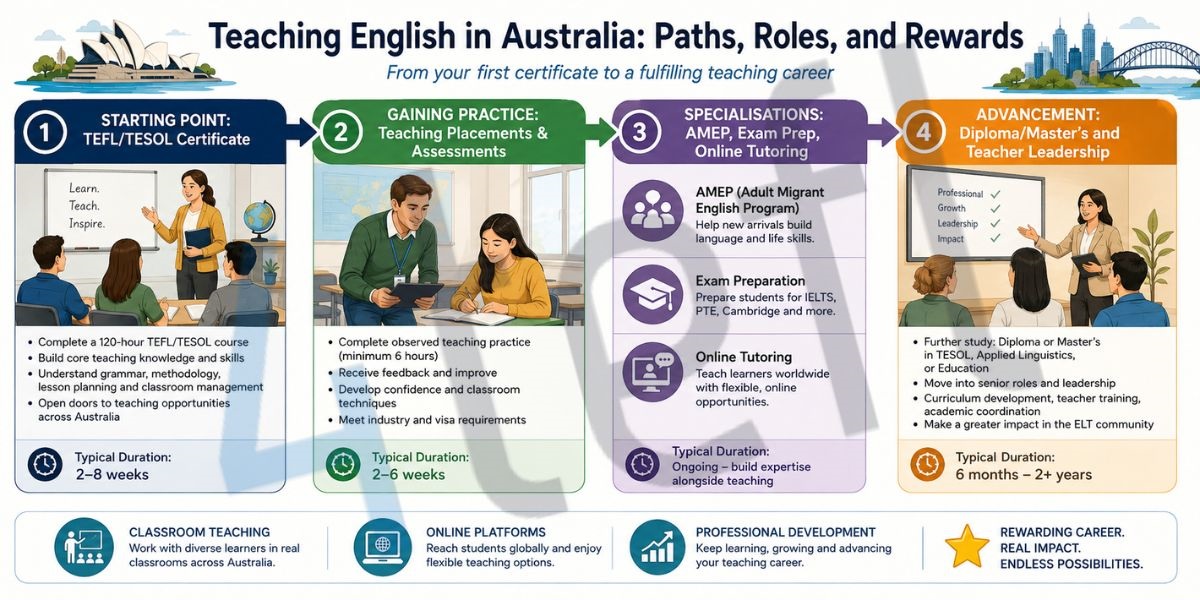
Diverse Roles for TEFL Educators in Australian Context
Classroom and language school roles
TEFL/TESOL professionals in Australia can work in private language schools and language centres, as well as in corporate training programmes. In major urban hubs such as Sydney, Melbourne, and Brisbane, English for Specific Purposes (ESP), conversational English and exam preparation can provide opportunities for teachers working with international students and migrants looking for language skills for study, work and settlement. There is a range of roles, including teacher, course designer and examiner, with clear learning objectives, placement and ongoing assessment expected. The environment can suit practitioners who combine rigorous pedagogy with cultural sensitivity when working with students from various linguistic backgrounds.
Migrant and local communities
For migrants and local communities, there are public-facing and migrant-education pathways. Beyond the private sector, educators contribute to programmes supporting migrants and local communities. AMEP and similar adult English programmes operate in many states, providing language instruction and settlement support. Teachers in these settings typically work with learners at different English levels, which means they need the capacity to teach in a supportive environment and work with settlement staff to provide appropriate support. These positions can be highly rewarding and have social impact, while requiring teachers to use assessment methods to measure real-world language development. Government and university-related programmes also emphasise professional standards and ongoing professional development.
Higher education, corporate, and online
Universities, TAFEs, and private training organisations offer opportunities for TEFL/TESOL professionals in areas such as curriculum design, teacher training and English language pedagogy. In parallel, online English teaching and hybrid delivery present opportunities for teachers looking for flexible and location-independent work. Online jobs often require strong digital pedagogy that can facilitate real-time interaction on a virtual platform, with an emphasis on feedback quality and student engagement. Networking with professional associations and staying current with relevant standards can help teachers move across settings while maintaining a coherent career path.
Rewards and Challenges for Teaching English Down Under
The benefits of teaching English in Australia
Teaching English in Australia can have a meaningful impact on learners, contributing to their immediate and long-term educational, professional and personal goals. Cross-cultural exchange and international education can also provide opportunities for mutual learning. Teachers can build professional networks and support students who go on to study, work or settle in Australia or elsewhere. The social value of English teaching is closely connected to communication, integration and educational opportunity, reflecting broader international approaches to language education and social inclusion.
The typical challenges and how to deal with them
Common challenges include visa uncertainty, differences in pay scales across sectors and the cost of living in large cities. Regional postings can offer lower living costs and closer ties to communities but may also involve professional isolation or limited funding. Work-life balance can also be influenced by teaching schedules and the need for ongoing professional development and programme reporting. Building professional networks, keeping up to date with local expectations and investing in relevant professional development can help address these challenges. Be aware that the landscape varies with policy changes and funding cycles, so it is important to keep up to date with government guidance.
Practical ways of thriving
Teachers should continue to develop their practice through continuous professional development, workshops, further educational experience and higher-level qualifications. Connecting with local teacher communities can also support professional growth. A good approach to thriving in the field is to focus on reflective practice, use evidence and assessment data, and collaborate with colleagues from diverse backgrounds. Reading recent guidance from AITSL and state education portals can help ensure that your practice aligns with relevant professional standards. With a well-planned career path and strong professional support, the rewards of teaching English in Australia can extend well beyond the classroom.
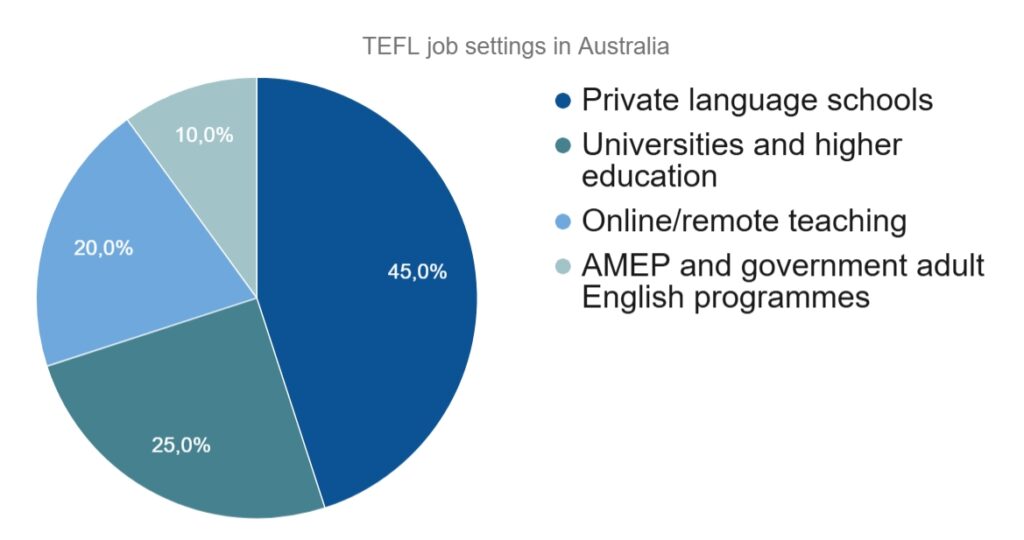
Note: This chart is illustrative to convey the diversity of settings. Actual distributions vary by city, sector demand, and state programme funding. See sector surveys from UNESCO and British Council for broad context on language-teaching ecosystems.
Key insight: The Australian context rewards flexibility and continuous learning, with a spectrum of settings that can suit different personal and professional goals.
Work Visa Pathways, Accreditation, and Ongoing Rewards
A pathway to teach in Australia
For long-term work in Australia, there are skilled migration and employer-sponsored routes that may lead to permanent residency, depending on the occupation, visa requirements and individual circumstances. Visa options can include employer-sponsored and skilled migration pathways. In general, applicants may need to meet requirements relating to occupation eligibility, sponsorship where applicable, English language proficiency and work experience. Applications should be made directly through the Australian Government Department of Home Affairs, where you can find up-to-date visa categories, occupation lists and documentation requirements. A job offer from an approved employer may be required for some pathways, while regional placements may offer specific incentives or concessions.
Accreditation and recognition of qualifications
TEFL/TESOL qualifications can be valuable when they align with the requirements of the relevant sector and employer. Although TEFL certificates may be sufficient for some private language teaching positions, public schools and other regulated programmes may require specific teacher education qualifications and registration. Requirements should be checked with the relevant state or territory registration bodies and employers. AQF guidance provides a framework for understanding Australian qualifications and their levels.
Relevance and professional development after graduation
TEFL/TESOL teachers in Australia can develop their careers by specialising in areas such as ESP or migrant language education and by becoming involved in curriculum design or teacher training. The combination of professional standards, further study and opportunities to support communities can provide a long-term career path for many teachers. Postgraduate study, targeted professional training and membership in professional associations can help teachers progress towards more advanced roles in universities, colleges or government-funded programmes. This broader framework encourages ongoing learning, reflection and professional development.
Conclusion: Realisations and next steps
- Have a clear target setting: Private language schools, migrant English programmes, higher education or online teaching.
- Develop a unified credential path: A strong TEFL/TESOL certificate can be a useful starting point, while a Diploma or Master’s in TESOL may support progression into leadership or curriculum design positions.
- Understand visa and registration requirements: Know which state or territory requirements apply to your intended role and which visa options may be available to you.
- Invest in ongoing professional development: Attend practice-based workshops, undertake assessment training and connect with other professionals to stay up to date with policy and pedagogy.
- Strategically plan for regional opportunities: Regional Australia can offer different professional and lifestyle opportunities, as well as the chance to make a meaningful contribution to local communities.
Authoritative Sources and Fact Checks (References)
- Australian Institute for Teaching and School Leadership (AITSL): National standards for teachers and school leaders, providing official guidance on registration, professional growth, and qualifications framework alignment in Australia.
- Australian Qualifications Framework (AQF): The national policy for regulated qualifications in Australian education and training, outlining the distinct levels for certificates, diplomas, and master’s degrees.
- Australian Government Department of Home Affairs: Official immigration portal detailing skilled migration pathways, permanent residency options, and work visas including Subclass 482 and Subclass 186.
- Department of Employment and Workplace Relations (Adult Migrant English Program – AMEP): Official guidelines and information regarding government-funded English language education and settlement support programs for eligible migrants.
Do I need a Bachelor's degree in Education to teach English in Australia?
Not necessarily for private language schools or online work, where TEFL/TESOL certificates are often enough. For many formal schooling positions, or roles within AMEP or university programmes, a teaching qualification or higher-degree in education or TESOL is typically preferred, along with state or territory registration requirements. Always check the specific employer and jurisdiction guidelines.
Are online TEFL certificates accepted in Australia?
Online TEFL/TESOL certificates are commonly accepted for many private language-school roles and online platforms. Some employers may prioritise in-person practicum or higher-level credentials, and you’ll want to demonstrate solid teaching practice and reflective portfolios to enhance your prospects.
How long does it take to obtain a TEFL certificate?
Most certificate courses run between 4 and 12 weeks, depending on intensity, delivery mode, and the amount of practicum included. Diploma or Master’s-level qualifications take longer but offer deeper pedagogy and career options.
Which visa is best for TEFL teachers?
The choice depends on your circumstances and long-term goals. A temporary visa (like a 482) can be a practical starting point for Australian work, while a skilled independent or nominated visa (189/190) offers clearer pathways to permanent residency. Consult the Department of Home Affairs for current visa categories and requirements.
How much can TEFL teachers earn in Australia?
Earnings vary widely by city, sector, and experience. Private language schools may offer hourly rates or salaries that reflect market demand, while roles in universities or government-supported programmes may follow standard pay scales. Consider the cost of living in your target location and negotiate terms with prospective employers.
What are the essential steps to start teaching English in Australia?
Gather a recognised TEFL/TESOL certificate (and consider higher qualifications if you plan university or government work), obtain any required state checks or WWCC, explore visa options with the Department of Home Affairs, and connect with local networks and professional associations. Start with your target jurisdiction’s guidelines, then build practical teaching experience and a professional portfolio.