Teaching English in Morocco: Your Guide to TEFL Certification and Career Opportunities

There is a vibrant environment for English language teaching in Morocco, where there is demand from public schools, private language centres, universities, and online platforms. In the interest of the new teacher, the road to high employment opportunities is usually a formalised TEFL/TESOL certificate, practical teaching experience, plus familiarity with the culture. Certification is typically the ticket to better opportunities, a larger salary, and better prospects for promotion, and in Morocco, a strong certification can create opportunities in a variety of areas.
The teaching market in Morocco is one of tradition and modernisation. Although French continues to be widely used in many classrooms and professional settings, English is becoming more and more popular in business settings, especially tourism and higher education. In this new environment, it is now possible for qualified teachers of English who possess recognised TEFL status to have very wide options, whether on a local or tertiary level, with language schools in major cities, university language centres, or distance teaching programmes.
It’s a practical, evidence-based guide which will tell you how to plan your TEFL journey, how to obtain accreditation, and how to live and work in Morocco. To make the information usable, we are also in strict alignment with well-accepted international practices and have consulted primary sources. You’ll hear about pathways to certification, training standards, visas and other factors, and also explore real career options along with reference to UNESCO data and guidance from the government where applicable. It means that by the end you’ll know which credentials to pursue, what to expect in Moroccan classrooms, and where to position yourself for success.
TEFL Certification: Opening Teaching Roles in Morocco
The first professional milestone that most aspiring English teachers in Morocco do is to secure certification. A strong TEFL/TESOL certificate shows that you are well versed in key teaching techniques, classroom management, lesson organisation, and assessment. In Morocco’s blended learning context, a professionally developed certificate, normally consisting of 120–180 hours, complemented by practicum work, communicates to schools and centres that you possess a solid theoretical knowledge base as well as hands-on experience.
A good certificate type for your job may affect hiring opportunities, visa status, and potential employment that you will receive in some domains, such as in private language schools and universities, where teaching formalities are highly appreciated. Most candidates select blended or in-person TEFL course teaching, with 6–20 hours of observed teaching. This practicum aspect is especially critical in Morocco, where teachers have to be mobile with multilevel, non-English-speaking students, heterogeneous teaching and research resources, and students require adaptability in their daily class life.
Online courses with an intentional practicum, or practicum with a peer or partner, may also meet employers’ needs to develop practicality and foreign experience. Choose a course with clear learning goals, a strong teaching practicum, and compatibility with recognised best practice. This alignment also enables the transferability of your certificate to other schools and, in some cases, to teaching in foreign locations outside of Morocco.
In Morocco, certification pathways that are often recommended include:
- A 120 to 150 hour certificate for entry-level positions in private language centres.
- A 150–180 hour programme with high-quality practicum requirements for classroom-ready teachers.
- Advanced options, up to 200+ hours, combining language analysis modules, sequential learning, and micro-teaching.
Certificates that are Ofqual-regulated or professionally recognised internationally could provide some additional credibility in the job market, and they can at times ensure entry to higher education or international teaching. Whatever route you decide to take this year, make sure you have course objectives, teaching practicum support, and feedback from experienced instructors. This emphasis on practical teaching skills will serve you well in Moroccan classrooms and beyond.
Certification types and their typical features (illustrative)
| Certification type | Hours | Practicum | Suitability |
| Entry-level TEFL | 120 | 6–10 hours | Language centres, online teaching, beginner roles |
| Standard TEFL | 150–180 | 12–20 hours | Public and private schools, classroom-ready roles |
| Advanced TEFL | 200+ | 20+ hours | University language centres, program leadership, teacher-training roles |
Note: The table above is illustrative. Seek courses with practicum and mentor feedback, and confirm local credibility with potential employers.
Career Paths for TEFL Teachers in Moroccan Schools
In Morocco, TEFL-certified teachers find an array of different posts in several industries in their various fields that have varying expectations, the nature of the particular professional culture and expectations when employed. Public schools and accredited language centres are also popular entry points to the career paths of recent graduates. Public schools are typically aligned with national curricula and provide fixed teaching contexts, while private language centres provide an easier route to the classroom and often flexible time slots. Universities and higher education language centres may have access to higher degrees or require further credentials or education experience, but can also provide opportunities to teach English for specific activities, to prepare students for exams, or to become part of teacher development.
The development of Moroccan teaching is usually a very well-defined course of progression. Teachers can progress into more senior roles in the school with more experience, they can become lead teachers, curriculum coordinators, or teacher trainers. In major cities, there is the prospect of working with international programmes, leading workshops between colleagues, and joining school improvement committees. Some TEFL professionals also move into teacher education and support teacher mentoring, as well as training materials and learning to teach, and support professional development.
Develop a network, be it through local teaching associations, university partner programmes, or alumni groups for TEFL providers, to gain access to higher-responsibility roles, teacher training, and longer-term career stability. Many Moroccan teachers branch out into online teaching, international tutoring, or programme management beyond regular classroom teaching. Online platforms allow teachers working remotely to work flexible hours, making local job income a potentially lucrative option for teachers with high levels of digital skills and reliable connectivity. Those looking for permanent residency or career advancement will benefit from a combination of on-the-job training in the classroom and further professional education, an advanced certificate, specialised diploma in ESP, or a master’s in TESOL, if they want to increase their participation in Morocco’s education industry and broader global society. The pursuit of continued professional learning and an openness to working in a multicultural classroom will continue to contribute to long-term success in Morocco’s developing English-teaching environment.
Accredited Training Standards for TEFL in Morocco
Conducting an accredited, reputable TEFL course is one of the essential choices for teachers. Accreditation ensures the existence of a programme which meets set quality requirements, fosters authentic teacher growth, and follows international standards. This is especially significant in Morocco’s growing language-teaching sector, where a clear practicum, supportive teacher guidance, and some form of external validation, through an international platform or a recognised regulatory framework, would facilitate job applications to private language schools, universities, and teaching programmes.
Consider the outcomes from courses to determine whether your teaching will benefit students, the quality of the practicum itself, feedback from your mentor, and how well the training works in Moroccan classrooms. Outside the UK, some TEFL/TESOL courses are also attached to regulatory bodies to confirm course quality. Ofqual-regulated qualifications reflect recognised standards within the UK framework, but the variety of Ofqual-regulated TEFL options available varies by provider. Readers who aim to practise or study abroad, including Morocco, are likely to benefit from international accreditation of courses, sound practicum guidelines, and well-defined assessment criteria. Make sure the course has a practical teaching programme, feedback from experienced teachers, and is recognised by employers in Morocco and overseas in education. Last but not least, verify if any selected programme can provide adequate support in job placement or visas at a later date.
Compact reference for evaluating options:
- Hours: 120–180 hours for standard entry-level to classroom-ready certificates.
- Practicum: 6–20 hours (observed teaching with feedback).
- Delivery mode: in-person, online with practicum, or blended.
- Accreditation: international accreditation, or Ofqual-regulated where available.
- Outcomes: lesson planning, classroom management, assessment, and micro-teaching skills.
- Support: post-certification mentoring.
Living and Working: TEFL Careers in Morocco Explained
Unlike other developing countries, TEFL jobs are available in Morocco, where there is a vibrant cultural scene and work opportunities in many cities. Casablanca, Rabat, Marrakech, and Tangier have numerous language schools, colleges, and university language centres, as well as international initiatives that need English teachers. Living costs in some major cities are higher than in rural areas, but good private language education can offer decent salaries, especially with housing allowances or accommodation stipends that some employers provide for expatriate teachers, allowing for a comfortable lifestyle. When setting up your life, it’s important to explore neighbourhoods that are closer to schools, transport, and amenities, and to have language support, French and Arabic, when making living arrangements.
This paper highlights the role of cultural adaptation in successful Morocco TEFL. English teachers in Morocco work alongside multilingual learners and colleagues with diverse linguistic and cultural backgrounds. For example, knowing some simple Arabic or French words can help with daily life and conversations, which is beneficial in the classroom, while considering local customs and holidays fosters a warm and friendly relationship with students, parents, and administrators. Besides classroom work, teachers also participate in school activities, meet with parents, attend professional development sessions, etc., which can enrich your understanding of the Moroccan education system and provide professional development opportunities.
Most expatriate teachers say that making time for travelling and exploring, from discovering historical, Mediterranean-inspired foods to learning about regional places, has helped them along the way. On a practical level, visa and work permit requirements must be met before moving. Typically, you’d need to apply for a work visa through a Moroccan employer, who then verifies your employment and provides information such as whether you have a valid passport and academic credentials. Regulations may change, so it’s wise to consult official sources or the local Moroccan embassy for the latest guidance. Public safety and health services are well described in international resources, staying updated with information on neighbourhood safety, emergency contact lists, and related health services is a reasonable approach for any international teaching mission. With language acquisition, integration into the community, and practical implementation of expectations regarding costs and lifestyle, you will have long-lasting satisfaction with this TEFL experience in Morocco.
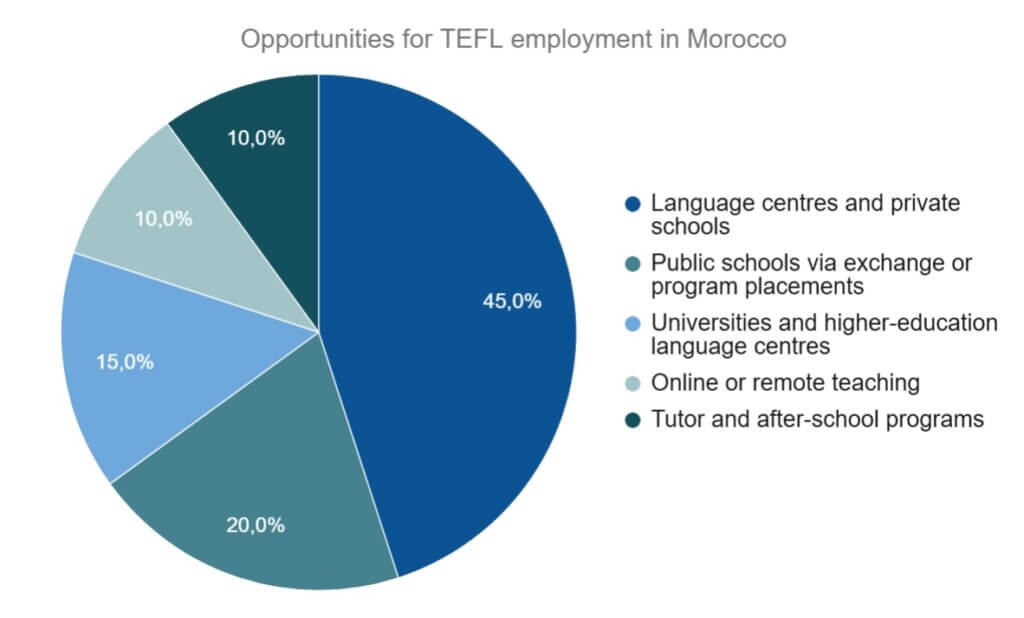
Note: The above distribution is illustrative to help plan your job search. Real-world opportunities vary by city, season, and the local education sector.
Authoritative Sources and Fact Checks (References)
- UNESCO Institute for Statistics: Morocco Profile: Data regarding literacy rates and educational infrastructure in Morocco.
- British Council Morocco: Insights into English language demand and professional development for teachers in the region.
- Ofqual (The Office of Qualifications and Examinations Regulation): Information on regulated qualification frameworks for TEFL/TESOL.
Do I need a degree to teach English in Morocco?
In many cases, a bachelor’s degree plus a TEFL/TESOL certificate is preferred for public schools and higher-education settings. Some private language centres hire teachers with a strong TEFL certificate but without a degree, depending on the employer and the programme. Always check country- and school-specific requirements before applying.
Is TEFL certification required to teach English in Morocco?
Certification is not always strictly required for every private language centre, but it significantly improves employability and potential salary. For public schools and government-supported programmes, a recognised TEFL certificate plus a degree is typically the standard expectation, and some roles may require additional credentials.
What visa or work-permit do I need to teach in Morocco?
You will generally need a work visa supported by your Moroccan employer. The exact process can vary by employer and visa policy. Check with the Moroccan embassy or consulate in your home country for the most current requirements and timelines.
How long does a TEFL course take, and what should I look for in a programme?
Most entry-level certificates take about 4-12 weeks (part-time) or 2-6 weeks (full-time), depending on the format. Look for courses with clear learning outcomes, a substantial practicum, qualified mentors, and pathways to ongoing professional development or certification recognition.
What is life like for teachers in Morocco?
Morocco offers rich cultural experiences, a welcoming expatriate community, and diverse teaching settings. Costs of living are city-dependent, with higher costs in major urban centres. Networking, language exposure (Arabic and French), and cultural openness can greatly enhance your experience.
Can I teach English online from Morocco?
Yes. Online TEFL opportunities allow you to teach students abroad from Morocco, often with flexible schedules. Ensure you have reliable internet, a quiet teaching space, and time-zone alignment with your students.
Is there demand for English teachers in Morocco?
English is increasingly valued for business, tourism, and higher education, with a growing pool of students and professionals seeking proficiency. UNESCO’s language and education data indicate ongoing emphasis on English as a global language, which supports demand for qualified instructors (UNESCO Institute for Statistics).