
Buenos Aires TEFL: Practical Steps for English Teaching Abroad


Given its cosmopolitan culture, vibrant atmosphere, and a thriving private language sector, Buenos Aires attracts prospective English teachers globally. This attracts TEFL work – and you want to roam your own journey because of the city’s diverse neighbourhoods, artsy atmosphere, and rich university scene.
Teaching abroad does not come easy, though; everything needs to be planned ahead: knowing where TEFL takes students, navigating visas, adapting to a new educational culture – without a roadmap it can be exhausting.
This text is designed for those starting out in the process of choosing a TEFL opportunity in the Argentine capital, whether you are new to your certificate journey or if you are planning for long-term placement. (And you will get a solid snapshot of demand, legal considerations, teaching culture, and career pathways, plus actionable steps, work norms, and realistic expectations.) It is to put you in the best position to feel comfortable settling into a real job and a career in teaching for the long term in Buenos Aires.
Leveraging trusted sources and local realities will allow you to ground your coursework to make learning to teach English in Buenos Aires a professional chapter of your own. Then, along the way, you’ll learn what to do in order to adapt to local life, connect with learners and keep yourself going in an international context.
Understanding the Buenos Aires TEFL Landscape and Demand
In Buenos Aires, English language learning is a cross between private language schools, university programmes, and the growing demand for corporate training. Data from UNESCO and the national education service suggest that English is still a key foreign language in Argentina and particularly in urban areas, and students want more ways of studying, travelling, and working. That requires, in fact, not only a vast number of language schools, but also a range of courses, from general English to exam preparation to business communication.
For teachers, that landscape is multi-front: classrooms in neighbourhood language schools, university extension programmes, and one-to-one tutoring that supplements formal sessions. The city’s education-rich, cosmopolitan profile ensures a healthy market for English as a medium for adults as well as professionals. In areas like Palermo, Recoleta, and Microcentro, you will encounter established language brands as well as smaller, independent schools.
There is an increasing demand for university-preparatory courses and continuing education courses, which collaborate with private providers, and that is an indicator of continued demand for good lecturers who are capable of integrating skills gained from communicative practice and formalised syllabi. Understanding that class needs change with the academic year, evening and weekend classes start increasing more often because practitioners want flexible learning. A well-organised CV which focuses on practical teaching experience as well as a practicum certificate is generally highly sought after by schools situated in this urban setting.
Learner Landscape & Settings
The following descriptions of typical settings and learner profiles are used to describe the learner landscape:
- Private language institutions often organise around work hours (with intensity during school holidays).
- Most of the time it is group sessions in the late afternoon, but at other times across the week, and often in the mornings or at weekends for working adults.
- Universities offer a more formal curriculum, such as preparing students for tests and providing international students with language assistance.
- Although not a mass format like private schools, corporate training is still very much sought after where firms need targeted language development for employees.
An infographic in this guide provides an additional diagram of what a certificate looks like in practice, and the balance between classroom hours, private tutoring and professional development.
Typical teaching roles in Buenos Aires
| Role | Typical Hours/Week | Setting | Notes |
| Private language schools | 15–25 | After-school, evenings, weekends | Most common entry point for new teachers |
| Universities and academic programs | 6-12 | Daytime; campus-based | Often more formal; exam prep focus possible |
| Corporate training | Variable | On-site at client offices | Usually higher pay; scheduling can be flexible |
| Online teaching (blended work) | 6-20 | Remote; flexible | Great for supplementing local hours; time-zone management essential |
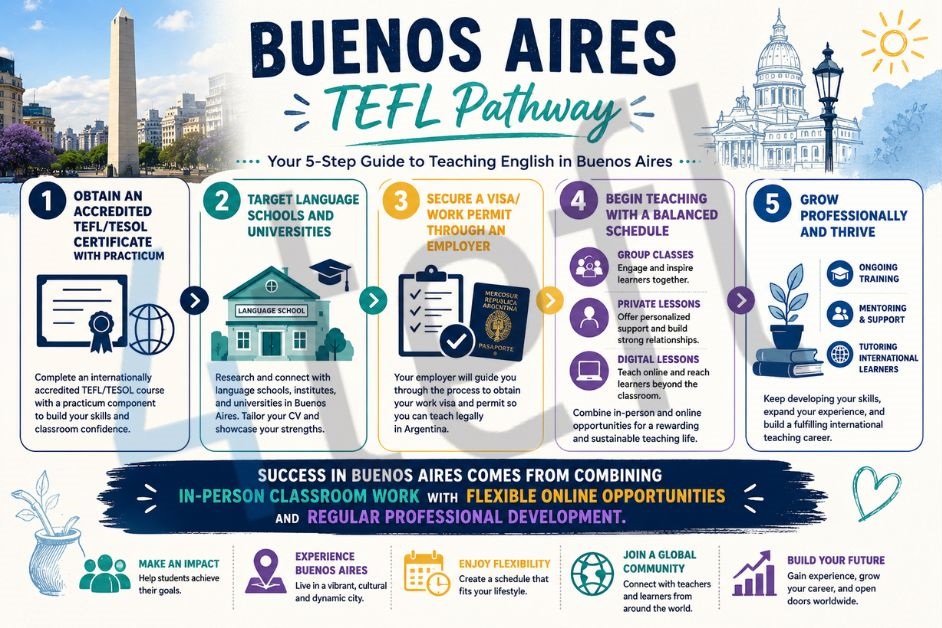
A note on data: International organisations such as UNESCO and the British Council emphasise high standards in TEFL training and local adaptation when teaching English abroad. Argentina’s education authorities also stress quality teacher preparation and ongoing assessment. While exact figures vary year to year, Buenos Aires consistently presents a dense ecosystem of private schools, public university partnerships, and corporate language training that creates abundant entry points for capable, well-prepared educators.
Legal and Practical Visa, Work Permits, and Workloads
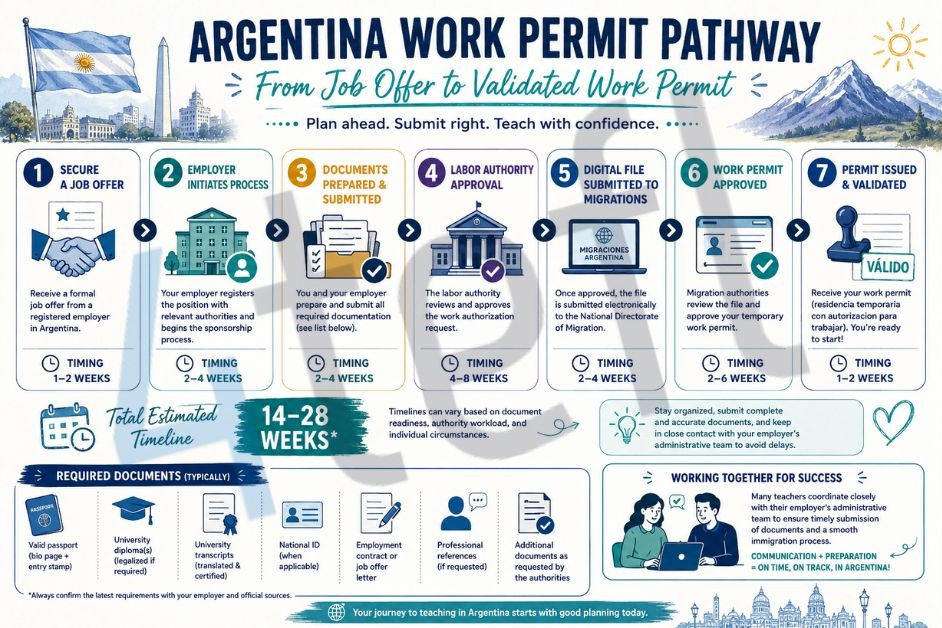
Argentina’s visa landscape focuses on clear work authorisation. Most teaching roles have a work visa or permit attached to formal employment, and working on a tourist visa is prohibited. Employers generally sponsor the required paperwork, following the country’s migratory regime managed by Migraciones Argentina. Because policies can change, you need to make sure you check your existing requirements against government guidance when you can, and with your future employer when possible.
On arrival, make sure your contract clearly outlines the terms of your employment, such as your hours, how much you are expected to earn, days off, and terms for contract renewal. A structured contract ensures you have some protection and that both parties have a fair idea of responsibilities and compliance requirements.
Workloads for Buenos Aires TEFL teachers are sector-dependent. The average role at a private language school might be 15 to 25 contact hours per week and may be adjusted to include additional time for planning, materials production, and student evaluation. Many teachers fill these extra hours with private tutoring either in the evening or during weekends, a practice also common in the city’s densely populated urban lifestyle. Scheduling may also reflect seasonal demands, e.g., school holidays and university terms when students increase the intensity of study. When the need is more severe – and everyone is able to manage both online work and face-to-face training – time management is essential. Safety, reasonable workloads, and contract clarity are the keys to a sustainable teaching career in Buenos Aires.
Visa & Workload Management Tips
- start with an employer-led visa arrangement,
- secure an agreement with your employer in order to begin on a visa basis after receiving a comprehensive written contract,
- and collect copious documentation on every teaching commitment.
Don’t use informal sources: use government migration pages and recognised TEFL organisations rather than relying on your friend group. Know local tax liabilities; some teachers are employees, whereas others are contractors, depending on the arrangement with the school. If you are serious about staying long term, you could build relationships with a number of institutions to create a balanced schedule and exposure to a variety of learners.
Cultural Adaptation and Language Tips for Learners
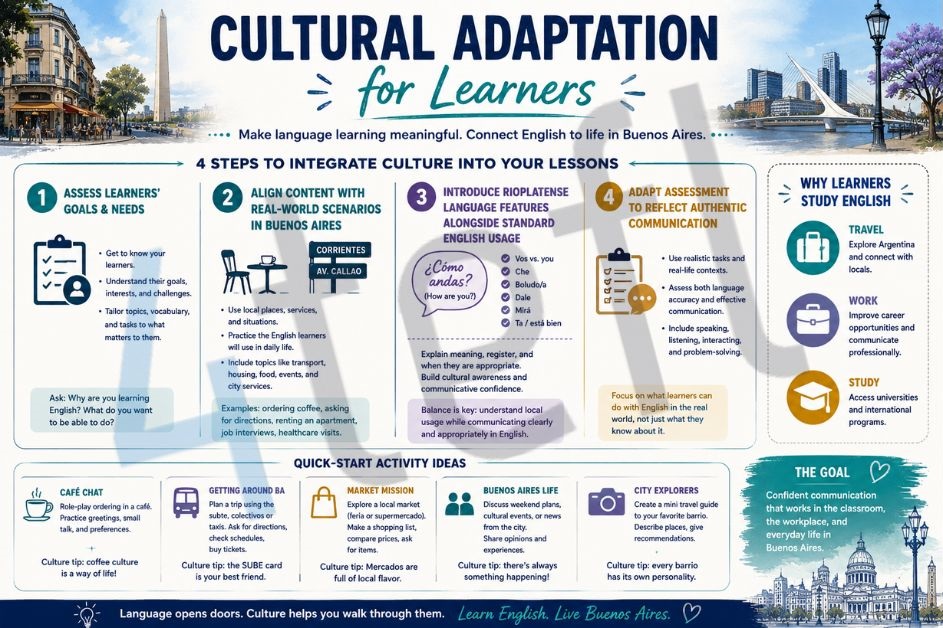
Argentine Spanish (e.g., Rioplatense pronunciation) colours classroom dynamics. Since students arrive armed with dialect differences and different motivations, a cross-cultural perspective will need to be regularly woven into lesson planning. And some of these communication styles are local, like a preference for direct, pragmatic discussion and a strong emphasis on interpersonal rapport, which help you get to know learners faster. One should recognise that rules around punctuality may differ in different contexts; time is crucial to many professionals, while some social or informal study groups may take a more flexible approach. Adaptability and respect in varied contexts will help to develop learner engagement and retention.
As far as teachers are concerned, the application of real-life topics that speak to learners in Buenos Aires is a very practical matter. Use localised references – arts, football culture, street markets, getting around on public transport – to make lessons relevant and memorable. At the same time, you’ll help students develop real-world language skills that could carry over to work, school, travel and everyday life. A balanced programme frequently combines communicative skills with structured grammar, vocabulary and pronunciation exercises aligned with the ages and goals of participants. Maintain a flexible inventory of activities that work well in a busy classroom or private sessions that are fine-tuned to fit either a student-dominated lesson space or a quiet one-to-one session, and be willing to pivot or adjust the pace based on student feedback and the learner’s voice.
Career Paths, Certification, and Hiring in Argentina
Certification is still a basic element of credibility for Buenos Aires TEFL teachers. Trusted schools highly value certification from reputable institutions, including a CELTA or Trinity TESOL qualification, and any certification with hands-on experience (often with a practicum) is valuable for jobs that require carefully cultivated skills in classroom management and student assessment.
A 120-hour TEFL/TESOL course with a practicum will allow you to achieve nearly all of what employers demand, but a more demanding certificate or degree (or higher education/language qualification) may open the door to university-level training or greater corporate exposure. As such, the certificate you graduate with should correlate with the role you’re most interested in – classroom teaching, exam preparation or specific business English – with an eye towards further continuing professional development opportunities in Argentina.
Having a university degree usually benefits applicants seeking jobs at more selective private schools and university extension programmes. Some Buenos Aires institutions value teachers who offer supplementary qualifications – whether it’s experience preparing students for Cambridge or IELTS exams, classroom management skills, or curriculum planning.
Teachers might be encouraged to pursue a combination of on-site and online teaching and gradually expand it to meet their students’ needs and earn extra income. Career progression can lead to roles as a senior teacher, curriculum designer or teacher trainer, particularly if you create a strong portfolio of results and student reviews.
Most positions in Buenos Aires require:
- A CV or résumé developed in line with Argentine standards,
- An interview (usually by video),
- And a short pedagogical demonstration.
References from former employers may be useful, as well as examples of lesson plans or a brief teaching sample. Contracts must outline working hours, pay, probation periods, renewal terms – and detail visa status as well as legal work permissions. You will gain visibility – and find more stable, rewarding opportunities – through connections, local teaching meet-ups, professional associations, networking with colleagues and beyond.
Market Realities: Salaries, Timetables, and Institutions
The Buenos Aires TEFL market covers a broad spectrum of opportunities due to its scale and consistent demand for English proficiency within the city. Salaries and pay structures differ by institution, but many teachers start with either an in-person weekly timetable or a combination of in-person and online sessions. The ability to balance teaching with a flexible schedule, while still delivering structured lessons, allows teachers to maintain a constant supply of learners.
In established language schools, you may also receive paid holidays and a formal contract, while private tutors set their own prices, produce bespoke content and book classes directly with learners. The best teachers will combine multiple streams – group lessons, private lessons, online work – to create a flexible income.
Buenos Aires has rhythms that are shaped by local schedules. Adult learners studying after work typically fill afternoon and early evening slots, while weekend morning classes typically attract students based on their personal and professional commitments. The opportunity for on-site corporate training is a great draw for business English and professional communication teachers in particular. Learning how to work around school schedules, clients and students is useful not just professionally; it also helps you build a sustainable workload that avoids burnout. In reality, many teachers turn to online tutoring to expand their business overseas, grow their professional network and maintain their earnings.
In terms of institutions, private language schools remain the single largest destination for beginners, with universities and research institutes offering extension courses. Corporate training is still a relatively small but profitable niche that few teachers choose because it requires sector-specific knowledge such as business, finance or technology. Most English teachers in Buenos Aires don’t just spend time in classrooms; they also take advantage of opportunities to join local professional networks, attend language conferences or meet-ups, build professional teaching portfolios, and demonstrate tangible learner progress. As you develop your practice and progress in your career, your prospects and ability to pivot in the long term will probably increase.
Authoritative Sources and Fact Checks (References)
- Argentina National Directory of Migration (Dirección Nacional de Migraciones): To verify visa classifications, legal entry requirements, and the transition from tourist status to formal work residency.
- Ministry of Education of Argentina (Ministerio de Educación de la Nación): For framework guidance on local school terms, public educational goals, and language training recognition.
- UNESCO Institute for Statistics (UIS): Grounding data regarding Argentina’s educational structure, foreign language curriculum mandates, and literacy/enrollment trends in urban territories.
Is it feasible to combine online teaching with in-person work in Buenos Aires?
Yes. Many teachers integrate online sessions with local classes to supplement income, reach international learners, and maintain flexible schedules. Online teaching also helps you adapt to seasonal demand fluctuations and can be a useful bridge while you settle into a new city. It’s important to establish clear boundaries, manage time zones effectively, and ensure you have reliable internet and a comfortable workspace to deliver quality lessons.
How should I prepare for interviews with Buenos Aires schools?
Prepare by tailoring your CV to Argentine expectations, highlighting practical teaching experience, and including a brief teaching demonstration. If possible, provide references or letters of recommendation from previous employers or training programmes. Be ready to discuss classroom management, assessment strategies, and how you adapt materials for different levels. A calm, professional interview demeanour helps build trust, and having questions ready about visa, contract terms, and integration support indicates serious intent and reliability.
What ongoing professional development is common for TEFL teachers in Buenos Aires?
Many teachers pursue ongoing professional development through local teacher meetups, online courses, and workshops offered by TEFL organisations and universities. Opportunities include advanced TEFL certificates, exam preparation specialisations, and courses in curriculum design or learner assessment. Engaging with fellow teachers and seeking feedback from learners supports continuous improvement and better learner outcomes. The culture in Buenos Aires rewards practical, evidence-based teaching and a willingness to adapt to learners’ needs over time.