Certification and Training for English Teaching in Portugal


The English teaching scene in Portugal offers plenty of options – from private language schools in Lisbon and Porto to online jobs around the world. For budding teachers, the road to meaningful positions is paved with solid certification, careful training, and familiarity with local conventions.
This article summarises:
- Certification routes
- Training and ways to adapt to Portuguese expectations
- Practical pathways to teaching English in Portugal, including online routes
It is based on sound, non-commercial references, helping you plan a sound, career-oriented TEFL/TESOL programme.
Executive Summary & Market Context
The Portuguese market for English teachers is diverse. Employers vary from private academies and language schools to universities and online platforms. Although specific employer requirements differ, a recognised TEFL/TESOL certificate accompanied by an appropriate degree is highly regarded, in addition to:
- Pedagogical ability
- A strong lesson plan book
- A willingness to respond to student requirements and CEFR-aligned goals
In Portugal, as in many other countries, certification is not a one-size-fits-all ticket: it is the best way to show employers readiness for professional roles in general, and for jobs beyond the volunteer sector in particular.
As a reference, international standards for language assessment and certification are based around:
- Quality control
- CEFR (Common European Framework of Reference) alignment
- Continuous professional development (the subject of much debate within UNESCO and at the European level)
This article helps you navigate those standards while keeping you focused on practical job outcomes.

Certification Paths for TEFL Teachers in Portugal
Knowledge of various certification pathways allows you to select certifications that relate to your chosen career in Portugal. Different types of certificates are listed in this section, as is acknowledgement by Portuguese employers and the mapping of different paths to jobs.
Certifications Recognised and Their Place in Portugal
Within Europe, there is a wide range of certificates for TEFL/TESOL (a common duration of 120–150 hours in many courses) that have strong acceptance among many language schools in Portugal. Employers are very much in search of certified teachers with:
- Specific teaching experience
- Lesson planning skills
- Classroom management capabilities
Exhibiting evidence of teaching practice has led to the adoption and widespread application of internationally recognised certificates in cities including Lisbon, Porto and the Algarve, opening doors to employment.
Note on Supervised Practice:
Schools that seek strong, supervised teaching practice generally prefer CELTA and similar formats. CELTA is a UK-based programme; however, the focus on real-time teaching practice at the CELTA site appeals to a good number of Portuguese private schools and academies.
In relation to these professional opportunities, employers interested in online and hybrid pathways prioritise a strong 120–180 hour TEFL/TESOL certification with a demonstrable and direct focus on communicative teaching, lesson design and assessment that is conducive to recruitment for both in-person and online roles.
Educational Prerequisites and CEFR Compatibility
Many roles – especially in private language schools and online platforms catering to adult learners and professionals – require a bachelor’s degree in English, Education or a related field in order to attain entry-level qualifications. While being a professor is not strictly a requirement, employers are now requiring:
- Proof of language proficiency
- Classroom preparedness
- A record of successful lesson delivery
Goals must also fall under CEFR objectives so that what you are teaching can lead to tangible outcomes for learners of all levels.
Public sector or semi-public positions (e.g. private schools hiring an internal employee) also have country-specific expectations, such as background checks, written contract conventions, and a requirement for ongoing professional development.
For some other reasons, tutors who have proven experience working on courses that are equivalent to TESOL/TEFL, with a known teaching background and strong demonstrable teaching examples to back them up, are best placed. Based on the CEFR in Portugal and Europe, the CEFR framework is a stand-by point for employers to understand where a young learner has started and the expected progress.
Certification from Portuguese Employers and Schools
In Portugal, TEFL/TESOL certificates recognised by international standards are typically accepted, particularly for private language schools and academies, provided the provider has:
- Good quality assurance
- Course validation
- Qualified trainers
Some large private schools may also want certificates which contain observed teaching practice and lesson observations of a practicum nature (the latter being signals of classroom practice).
There may be better job prospects for teachers seeking consolidation or career progression (coordinating teachers, teacher trainers, etc.), although there may be a need for higher-level qualifications (DELTA-type study abroad, master’s-level TESOL programmes), but such programmes might not be necessary.
The Best Credential Mix in Portugal:
In short, is usually a high-status TEFL/TESOL certificate, plus an associated degree and a portfolio of lesson plans, micro-teaching demos and student feedback samples. Employers see such a mixture as both knowledge and practice.
Portugal TEFL Training Options and Career Outcomes
Training options vary by location, format, and intensity, with many leading in-person training facilities in major cities and online formats growing increasingly popular. This section examines paths and outlines how training has real-world, career-relevant outcomes.
Option A: Training In Person on the Ground in Portugal
In Portugal’s major cities (Lisbon, Porto, and Algarve hubs), TEFL/TESOL training centres provide intensive training and supervised teaching practice. In-person programmes often offer:
- Structured modules on lesson planning, classroom management, and assessment.
- A practicum component with observed teaching to develop confidence and classroom preparedness.
- Local networking via language schools and job recruitment.
The advantages: instant feedback from experienced instructors, hands-on exercises with actual groups, and a path to create a local CV that clearly demonstrates dedication to the Portuguese market.
Option B: Online Courses or Blended Models
Online TEFL/TESOL courses offer flexibility for individuals with travel, work, family, and other commitments. Properly conducted online courses typically contain the following:
- A well-developed syllabus that relates directly to CEFR outcomes and communicative teaching techniques.
- A prolonged practicum or micro-teaching component with video presentations or a live online session.
- Access to digital teaching portfolios, instructor feedback, and international career support.
Hybrid models mix virtual theory with in-class practice, in which the basics are taught remotely with hands-on experience in a local or partner school setting.
Career Prospects and Job Prospects
People who complete certified TEFL/TESOL training in Portugal usually have a favourable perception of their employability in the private sector, online platforms, and language academies. Students often report:
- A higher likelihood than those who appear to be just degree holders or informal job seekers of receiving a paid position as a teacher.
- Entry-level classroom position opportunities which can easily develop into leadership roles (lead teacher, curriculum coordinator) over time.
- Working with varying groups of learners, from young adults to professionals interested in Business English.
Geographic influences matter: cities tend to provide many more job openings and higher demand for English language teaching and learning, as well as English language instruction, while more rural regions may have slower recruitment or require travel to teaching hubs.
Estimates and market context: though Portugal’s market for learning English as a foreign language is developing, international qualifications paired with some local experience are likely to be the best option for professional success.
Adapting to Portuguese Certification Standards
By adapting to local expectations, your qualifications can be smoothly integrated into the Portuguese job market. This section highlights the connection between foreign qualifications and local behaviour, standards, and regulatory expectations.
CEFR and Local Course Expectations
Portugal’s educational system for language education revolves around CEFR-compliant learning objectives, so your TEFL/TESOL classes must align well with the CEFR levels (A1 through C2). A clear link between learning goals and tangible results builds employer confidence.
- CEFR Descriptors: Include CEFR descriptors when creating learning objectives, assessments, and learner progressions. For teaching and learning, Catholic and public Portuguese schools are known for communicating progress towards CEFR goals to students and their parents.
- Course Design: When possible, choose classes that offer sample CEFR-aligned lesson plans, assessment rubrics, and advice on how to assess students against CEFR standards. These are particularly crucial for private-sector schools that market specific CEFR levels for their courses.
Methods to Achieve Recognition for Overseas Qualifications
If your teaching certification is foreign, you may also need to submit documents in Portuguese and prove compatibility with local standards. Some employers will accept your credential as a sign of competence; others might require equivalence verification or a brief local orientation.
- Step 1 (Documentation): You can obtain what might appear, on paper, to be an official statement from your course provider that outlines the course scope, hours, observed teaching practice, and CEFR alignment. This allows potential employers to review your credential and assess your suitability for employment.
- Step 2 (Portfolio Readiness): Produce genuine course materials and a teaching portfolio showing that you have met CEFR targets, apply communicative methods, and adapt to students’ needs.
- Step 3 (Networking): Connecting with language schools, recruitment agencies, and professional associations in Portugal could shorten the process by explaining which documents employers in the city you plan to target tend to value highly.
Quality Assurance and Accreditation
Most international standards involve quality control, instructor certification, and curriculum-level orientation (CEFR). In the UK and Europe, there are regulatory bodies offering guidance on qualification levels and recognition based on certification provided by Ofqual (UK). It may be useful to understand how these standards relate to the certificates you hold and how they may be perceived by Portuguese employers.
Alignment of training with CEFR and CEFR-inspired lesson plans provides an effective method of demonstrating international standards within a local context.
Continuous Professional Development (CPD)
Look for opportunities to undertake professional development in areas such as communicative language teaching, task-based learning, and assessment for learning. Employers want teachers who focus on learning and adapt to their students.
Pathways to Teaching English in Portugal: Online
Online TEFL/TESOL courses have become extremely popular and continue to grow, offering flexible pathways to start or advance in Portugal’s teaching economy. In this section, we provide the main online tracks and how they are integrated with on-the-job opportunities.
TEFL/TESOL Courses Online and Telecommuting
In the online world, many high-quality online TEFL/TESOL programmes offer structured learning, teaching, and study activities with teacher supervision, culminating in a portfolio. Find programmes with:
- Ongoing support
- Career coaching
- Job placement guidance
- Options that specifically reference CEFR alignment and include a practicum component
Classes can be conducted online with schools in Portugal and overseas, and with platforms that help connect teachers with learners everywhere. Successful candidates often demonstrate an effective online teaching presence, good digital literacy, and a portfolio of virtual lessons.
For non-Portuguese residents, online positions may be a good path to teaching English (such as remote support for Portuguese learners, combined online and in-person teaching opportunities, hybrid positions, etc.) in Portugal. Building a bilingual or multilingual teaching portfolio if you speak Portuguese can further expand your exposure to local schools running bilingual programmes.
Platforms and Licensing for Online Teaching
Selecting online platforms involves consideration of:
- Number of students from the Portuguese and European regions.
- Flexibility during the working day to accommodate Portugal’s time zone.
- Transparency, payment terms, clear contractual conditions, and student privacy/safety policies.
Some platforms require standard background checks or evidence of teaching experience; others might focus on a strong demo lesson and a range of teaching materials. Online qualifications are often complemented by local classroom experience (or even a local teaching licence) if positions are sought in Portugal.
Pros and Cons of Online Teaching in Portugal
Advantages (Pros)
- Flexibility: Teaching from home or while travelling.
- Audience: A diverse student body, including Portuguese and international learners.
- Accessibility: Easy entry if you hold an internationally recognised TEFL/TESOL certificate, with a strong portfolio.
- Career Growth: Potential for repeat employment, course development, and career growth.
Challenges (Cons)
- Competition: Strong competition for positions among experienced online instructors.
- Instructional Pressure: The pressure to cater to different expectations, levels, and learning environments.
- Logistics: Time-zone considerations that can impact scheduling, student engagement, and long-term income stability linked to platform regulations.
Practical Guide: Getting Started
Whether you aim to teach in Portugal’s classrooms or online, the following practical steps help you build a credible profile and accelerate job prospects.
Certification Pathways and Practical Steps
| Pathway | Duration | Focus | Output |
| Pathway 1: In-person TEFL/TESOL in Portugal | 4–8 weeks (intense) | Practicum, classroom management, lesson planning | Teaching portfolio, observed teaching evidence |
| Pathway 2: Online TEFL/TESOL with practicum | 8–12 weeks (flexible) | Theory, micro-teaching, remote teaching | Digital portfolio, video teaching samples |
| Pathway 3: Hybrid (online theory + local practicum) | 6–14 weeks | CEFR-aligned lesson design, assessment | CEFR-aligned unit plans, lesson observations |
| Pathway 4: Non-TEFL/TESOL routes with degree plus targeted certificate | 2–4 months | Compatibility with CEFR and private-sector demand | Completed portfolio, job-ready CV |
Recommended Portfolio Elements to Prepare:
- Curriculum Vitae (CV) tailored to Portugal (highlight TEFL/TESOL certificate, degree, teaching experience, and languages).
- Demo lesson (video or in-person), 20–30 minutes, aligned to a CEFR level.
- Sample lesson plans (at least 4, covering different levels and ages).
- Student feedback or assessment samples (anonymised).
- References from previous teaching roles or practicum supervisors.
Finding Jobs in Portugal:
- Target Private Academies: Start with local language schools and academies in Lisbon, Porto, and the Algarve; look for recruitment events when possible.
- Build Networks: Leverage professional networks and TEFL/TESOL communities online to learn about openings and employer expectations.
- Bridge with Platforms: Consider online platforms as a bridge to gain experience and diversify your teaching portfolio while you pursue in-country opportunities.
Job Market Insights and Career Progression
Knowing the larger picture helps you plan where to begin, how to progress, and which qualifications are most important.
Target Market
- Private language schools remain a core market for TEFL/TESOL teachers in Portugal, with online teaching offering flexibility and complementary roles.
- Public-sector English education in Portugal often requires different qualifications and contracts, and the job market is more limited for non-Portuguese individuals unless they hold specialist qualifications and demonstrable local experience.
Regional Hotspots
- Lisbon & Porto: The capital city (Lisbon) and the northern city (Porto) are generally popular locations with demand for English language professionals due to their high population density, business activity, and international exposure.
- The Algarve: Provides a steady flow of language schools catering to the tourism and service sectors, with seasonal peaks.
Career Ladders
- Teachers may move into senior roles, as well as positions such as programme coordinator or school administrator, supported by teacher training, curriculum development, and leadership qualifications.
- Progression will depend on performance, language skills, and effective work with a wide range of learners.
Salary and Benefits
- Teacher salaries in private language schools for TEFL/TESOL-certified teachers vary depending on the city, employer, and contract type.
- There may be additional income opportunities through online classes.
- While detailed salary figures may vary, the combination of CEFR-aligned teaching, compelling micro-teaching evidence, and a quality portfolio will generally lead to better pay and more secure contracts.
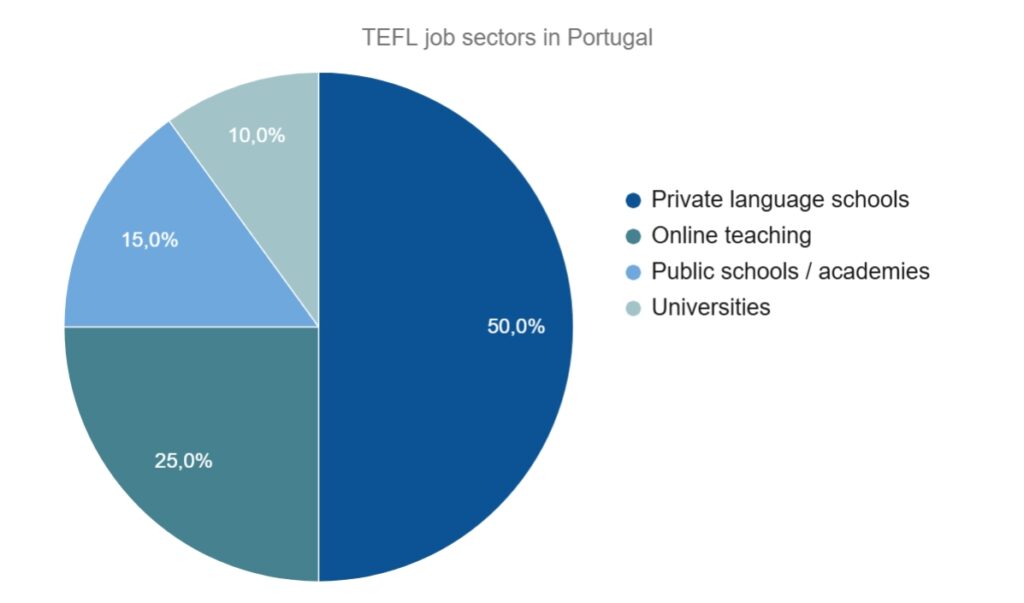
Note: This distribution is illustrative and reflects common patterns in European TEFL markets. Actual proportions vary by city, institution, and year. Use it as a guide for planning your portfolio and applications, not as a guaranteed market split.
Authoritative Sources and Fact Checks (References)
- Council of Europe (CEFR Guidelines): CEFR – Common European Framework of Reference for Languages: The official global standard framework used in Europe and Portugal to measure language proficiency.
- British Council Portugal: English Language Services and Opportunities in Portugal:
An authoritative agency detailing English learning, standard qualifications, and localized educational practices in Portugal. - Direção-Geral da Educação (DGE) – Ministry of Education, Portugal: DGE Ministry of Education portal: The official Portuguese state entity regulatory body managing academic curricula and language guidelines across primary and secondary schools.
- Cambridge Assessment English (CELTA/DELTA): Cambridge English Qualification Standards: The foundational certification framework and quality metrics reference for UK/EU recognized teacher qualifications.
- UNESCO: Teacher Development and Global Frameworks: Provides high-level guidelines for the ongoing professional development of educators and global educational policies.
Do I need a CELTA to teach English in Portugal?
Not universally, but many employers prefer CELTA or an equivalent recognised certificate, especially for in-person roles that include a teaching practicum. A strong TEFL/TESOL certificate with a robust practicum can also be competitive.
Can I teach in Portugal with a non-English degree?
It depends on the employer and the role. Private language schools often accept TEFL/TESOL certificates, especially when paired with relevant teaching experience. For public-sector or more formal roles, a degree in English, Education, or a related field is commonly preferred.
Is online TEFL/TESOL valid for teaching in Portugal?
Online TEFL/TESOL can be a credible route to enter the field and build a portfolio. In-person or hybrid certification combined with relevant experience is typically more job-ready for local employers.
What is the CEFR relevance for Portuguese teachers?
CEFR alignment is widely used in Portugal to describe learner progress and to structure lesson goals. TEFL/TESOL courses that explicitly map to CEFR levels are particularly valued.
What should I include in my portfolio for Portuguese employers?
Include a CEFR-aligned unit plan, a demonstrated micro-teaching video, sample lesson plans for multiple levels, a teaching demo video, student feedback (with consent), and letters of reference.
Are there visa considerations for non-EU teachers?
Yes. Non-EU teachers typically require a work visa or residence permit and an employment contract. Start by securing a job offer and work with the employer to obtain the necessary permits. Check government guidance for up-to-date visa requirements.
How can I improve my employability in Portugal?
Build a strong TEFL/TESOL certificate with observed teaching practice, create a CEFR-aligned portfolio, gain local classroom experience (even via short-term placements or volunteering in Portugal), and actively network with language schools and professional groups.