Teaching English in Sri Lanka: Navigating Certification and Career Paths

From an aspiring teacher’s perspective, Sri Lanka offers a good opportunity for aspiring English teachers – it has a robust legacy of English education, a booming private language school sector, and a huge range of international projects and online teaching opportunities.
For many prospective teachers, it can feel a little unclear: which certificate to choose, which courses really get recognised, and how to build a credible CV for a Sri Lankan employer.
Mapping clear TEFL pathways, accredited courses and realistic pathways for career development in the ESL sector in Sri Lanka, this paper examines current international standards and local factors. Its mission is to equip graduates, career changers and online instructors to pursue certification and develop a realistic and standards-based career plan.
Practical teaching ability and reliability often play a pre-eminent role in Sri Lankan ESL hiring, beyond immigration status or academic knowledge. A good TEFL/TESOL certificate, together with supervised teaching practice, can lead to many entry-level roles in Colombo, Kandy, Negombo and other cities. But the market is wide: private language schools, international schools, universities and online platforms all demand capable teachers with a strong command of classroom management, lesson planning and learner-centred practices.
Readers should recognise that expectations differ by sector and should consider a range of globally recognised certifications against sector expectations in Sri Lanka. By qualifying appropriately and undertaking genuine training, candidates can enter classrooms earlier and advance to more secure, high-impact positions.
In this article, practical recommendations on pathways, accreditation, market realities and career progression will be provided, all supported by reputable sources and aligned with international standards. As a result, you should be able to determine which certification pathway best corresponds with your ultimate goals (whether you choose to teach at a private language school, international school or online), and how to translate your training into impactful, memorable lessons in the Sri Lankan classroom.

TEFL Certification Pathways for Teaching in Sri Lanka
An early entry requirement for English teaching in Sri Lanka is a TEFL or TESOL certificate of about 120 hours, which is typically combined with practicum or observation-based teaching experience. This certificated foundation is well established among private language schools and many online platforms that hire teachers in Sri Lanka. Higher-level qualifications (e.g. CELTA or other recognised TESOL pathways that include observed teaching practice) are also a good choice and are in demand.
The Sri Lankan job market values demonstrable teaching capability and a strong professional profile; however, credible certificates with a practicum component are still a proven pathway to success. In reality, you want to find a course that includes real teaching and feedback, a good syllabus closely linked to international standards, and accreditation at an appropriate level. It is crucial for job seekers who would like to travel or teach online with confidence, because most employers want proof of teaching skill alongside theoretical knowledge.
Key Alternatives to Consider
From a concrete standpoint, there are many potential alternatives to consider:
- The first is an online TEFL cert or self-paced cert lasting 120 hours with a practicum component procured through partner schools or independent practicum providers.
- A second path is a hybrid model of online theory and a brief, real-world practicum, or a local teaching practicum set up in either a neighbouring country or Sri Lanka itself, depending on logistical constraints and the potential for new opportunities that may arise.
- A third path is higher-regulated qualifications such as CELTA or Trinity CertTESOL, which are internationally accepted and often preferred by international schools or training agencies.
- In addition, there are Ofqual-regulated TEFL certifications from UK or European providers that offer a formally regulated TEFL standard; these are increasingly sought after as a means of aligning certification with UK frameworks and can increase trust among a wider range of employers.
The most valuable elements generally include real English-language teaching hours and an authentic hands-on practicum component with real teaching hours to ground your teaching, accompanied by feedback to help convert theory into practice in the classroom. To plan your path clearly, start by determining your career goals: would you like to teach at a private language school, pursue opportunities at an international school, or concentrate on teaching online? Each of those objectives places a certain value on your training.
- If Sri Lanka’s private sector is your target, a basic 120-hour course together with a practicum will generally suffice.
- If your focus is to work with international or reputable online schools, you should seek CELTA or another industry-standard certificate and a strong package of observed teaching hours.
Reflect on where you are looking to live and teach – with many opportunities in Colombo and the Western Province, while rural or regional areas may be less popular and have different demand and wage structures – and prepare your practicum and visa arrangements accordingly. Lastly, you should secure your credential from a quality accrediting body or regulatory body such as Ofqual in the UK or another credible third party to facilitate portability and encourage employer confidence in the certification.
Accredited TEFL Courses for Sri Lanka Teaching Jobs
Importance of Accreditation
Indicates the quality of your course and the trustworthiness of the certification for employers in Sri Lanka and internationally, so it is important. In practice, this means identifying a set of TEFL or TESOL courses either Ofqual-regulated or from certified bodies or established providers with proven success in training teachers and supporting their careers. Certificates that are Ofqual-regulated are meant to follow UK qualification standards – something that many international schools and online platforms now recognise. Even if it is a course available online, a certificate is regarded as more valuable in the eyes of employers who need proof that proves teaching ability and professionalism when it comes to certification; an accredited course, supervision and good assessment are elements that employers value as well.
To students intending to teach in Sri Lanka or online to Sri Lankans, a course with transparent practicum placements, detailed feedback and post-programme career support is often more important (in preference to the location of the provider) than geographical location. Realistic standards and practical evaluation criteria are used to evaluate certified TEFL courses when comparing qualified courses.
How to Evaluate and Compare TEFL Courses
- Verify all the hours involved and whether they include a hands-on practicum with real learners. Observed teaching hours are a must; the more you can put theory to the test under a supervisor, learn from what learners need and experience, and monitor how a classroom works.
- Analyse the format of instruction and schedule: the convenience of online learning is a virtue, one that could perhaps be enhanced by arranging a real-life teaching practicum via alternative delivery modes, such as local and partner institutions.
- Confirm the course is a regulated one: Ofqual-regulated courses (or an equivalent valid regulation) signal quality and transferability.
- Check on job-search support: CV/checklist resources, mock interviews and a network of partner schools.
A solid accredited course is going to blend challenging material with the practical experience of teaching and up-to-date career advice, and that is all you need to make it easier to get a Sri Lankan job in your desired industry. Where you want to be offered opportunities for teaching in Sri Lanka, think of opportunities to develop courses that integrate theory and practice and give meaningful post-course support. And whereas international schools may appreciate degrees in education, or a degree in one of these areas – you’re expected to teach a specific subject – many English-teaching positions in private language schools or online platforms provide training in practical teaching skills and a dependable approach to practice.
In addition to Ofqual-regulated or other valid certificates, it may be useful to consider a provider with reputable regional ties, or good graduate attainment records in South Asia. The general rule of thumb goes here: choose a programme that offers 120–180 hours of core content in conjunction with serious practicum, ideally with many observed hours of teaching, a feedback loop that is both robust and rigorous, and a professional development pathway through which you take your next steps to specialise in young learners, business English, exam preparation or online tuition. Focusing on accreditation, practicum and career services will put you in an even better position for Sri Lankan employers and the ESL profession.
Notable considerations when choosing a course
- Prefer courses with Ofqual recognition or equivalent regulatory legitimacy, or those from well-established providers with transparent quality assurances.
- Ensure there is a substantial practicum with supervision and feedback from experienced teachers.
- Look for CV templates, interview coaching, and access to partner schools or job boards.
- Confirm that the certificate is recognised by international schools and online platforms, in addition to Sri Lankan employers.
- Compare price against hours, practicum quality, and career support rather than price alone, to maximise return on investment.
Common TEFL Pathways and Their Suitability for Sri Lanka Teaching Jobs
| Pathway type | Typical hours (certificate) | Practicum/teaching hours | Recognised for Sri Lanka roles? | Notes |
| Online 120-hour TEFL | ~120 | Included or arranged separately | Widely accepted for private language schools and online work | Choose providers with strong practicum options and credible accreditation |
| Online 180–250-hour TEFL + practicum | ~180–250 | 6–12 hours observed teaching | Highly credible for a range of roles | Strong for international schools and higher-level online work |
| CELTA or Trinity CertTESOL | Typically 120–130 | 6+ hours observed teaching | Strong for international schools; widely respected | May require more time and cost but can enhance eligibility |
| Ofqual-regulated TEFL | ~120–180 | Observed teaching hours required | High portability; credible to many employers | Ofqual-regulated status signals regulatory alignment |
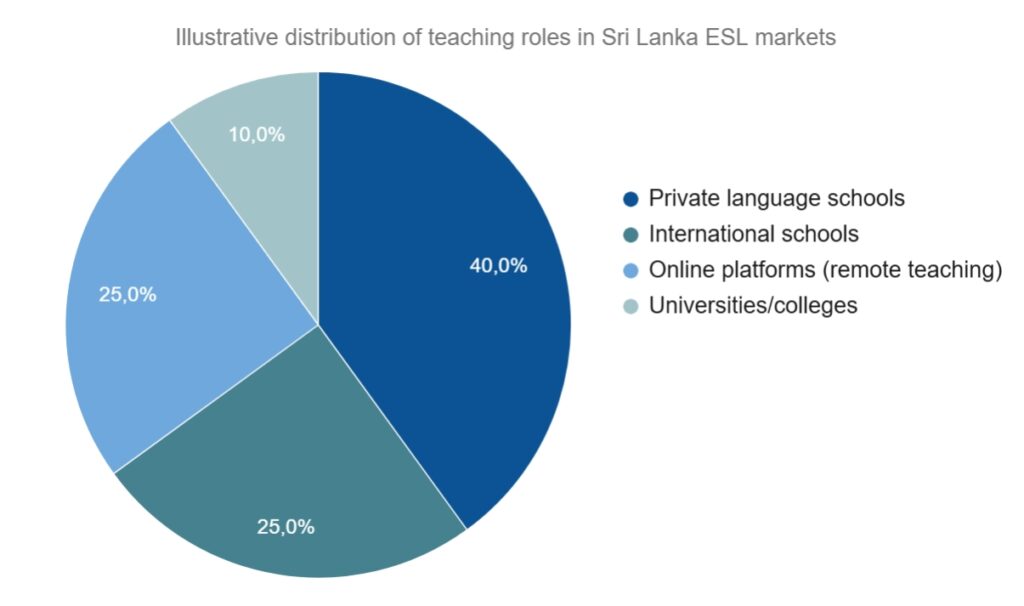
Note: These percentages are schematic, intended to illustrate how opportunities commonly cluster across sectors. Actual distributions vary by city, season, and economic conditions.
The job market in Sri Lanka is influenced by the demand for English within a range of institutions – from language schools to online platforms that serve learners locally and abroad. Accredited courses with a strong practicum are valuable for building a portfolio that resonates with employers. If you want something suitable for the busy private-language-school scene in Colombo, a solid 120-hour course with a practicum can be sufficient. If you are targeting international schools or online platforms with global hiring standards, you should consider more comprehensive programmes with extended practicum hours and a clear career-support component. The critical takeaway is that accreditation, hands-on practice, and post-course career assistance significantly boost job prospects in Sri Lanka’s ESL sector.
Salary, Demand and Career Paths in Sri Lankan ESL
This paper discusses the ESL workforce in Sri Lanka, with special reference to how local factors such as the cost of living, the increasing English-speaking population (both youth and adults), and the penetration of private education and online teaching are contributing influences on the ESL workforce. The skills of speaking different languages, and learning English, are still the mainstay of mobility and career opportunities across the economy, including tourism, business, education and technological provision in all aspects of life. Based on UNESCO and World Bank statistics, there are strong indicators of educational development in Sri Lanka and a continuing focus on the enhancement of English language proficiency for development purposes. Read alongside local market news, these sources point to a very resilient ESL demand in urban centres and a burgeoning online teaching ecosystem.
For readers, there is an expectation here that English teaching, with certifications, teaching methods and career pathways, is an accessible profession – even as salary ranges and career ladders vary widely by sector and geography. In terms of salary and promotion, starting positions in private language schools are often affordable locally based on the cost of living and wage expectations in Sri Lanka. International schools may pay better salaries but require much stricter prerequisites, including degrees, subject-area specialisation and, in some cases, prior teacher training. Online teaching offers flexibility and may well provide additional income, particularly for people operating outside Colombo or seeking supplementary earnings.
In the real-world marketplace, salary levels also depend on location, with teacher qualifications, language skills, tourism seasons and university terms influencing pay levels.
What does this mean for job-seekers?
Get a strong TEFL certificate with a practicum component, then prepare a tailored CV and search for roles that align with your level of qualifications and preferred type of work. Demand for the English language is stable enough to support a mixed ESL career market, available in private schools, international schools, universities as well as the e-commerce sector.
Four Major Employment Sectors
Four large categories dominate Sri Lankan ESL roles, each with different expectations and opportunities for success:
- Private language schools are the most common point of entry; they typically need well-organised teachers able to deliver well-structured courses to mixed-ability learners and manage a classroom effectively.
- International programmes may place greater emphasis on subject-matter expertise, bilingual/English-as-an-Additional-Language (EAL) support, and experience engaging pupils at a higher level.
- Universities and tertiary institutions sometimes recruit English teachers as academic writing and communication specialists, but these positions often call for higher-level professional credentials or research experience.
- With online platforms, students benefit from scheduling flexibility and access to global platforms, but performance also depends on demand and reliable internet connections.
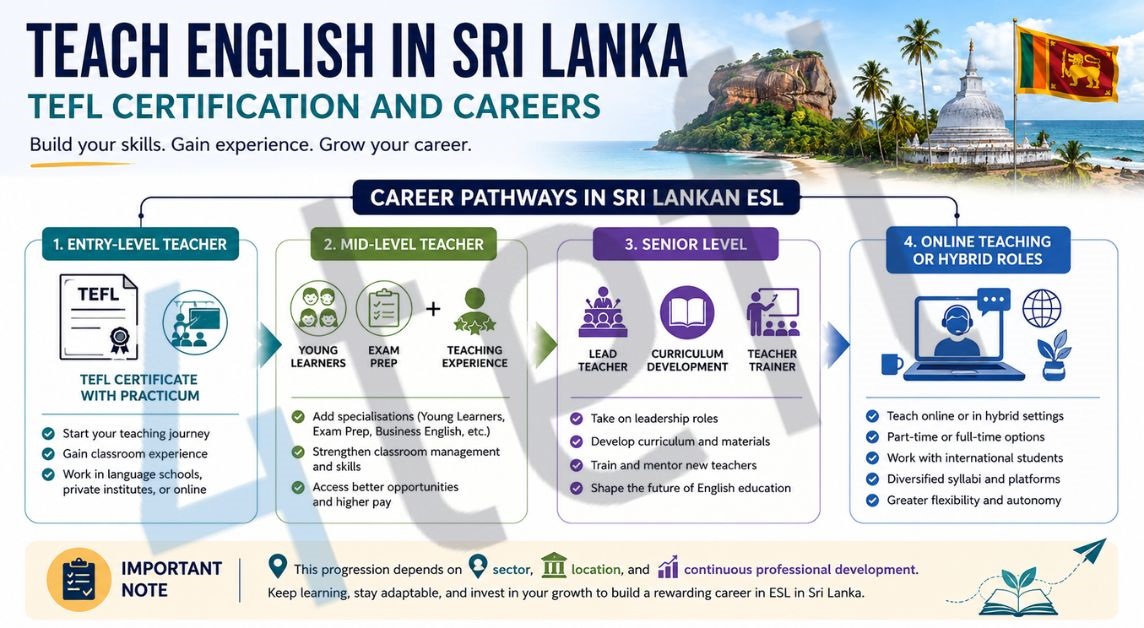
Career progression normally moves from classroom practitioner to mentor/trainer, lead teacher, curriculum developer and also manager/regional coordinator. Courses that focus on classroom management, assessment and feedback skills, language testing and so on can help to upskill teachers and provide the skills needed to move up the ranks.
Key Steps to Effective Career Progression in Sri Lanka
- Get a TEFL certificate with a practicum component from a local TEFL institute to gain classroom experience and confidence.
- Focus your CV on specific teaching examples, lesson plans, classroom management techniques, and outcomes.
- Gain local experience through volunteer teaching, participation in language clubs or job placements as a means of showing that you can adapt to Sri Lankan students’ lives and cultural settings.
- Undertake continuing professional development through short courses in topics such as learner-centred teaching, exam preparation (e.g. Cambridge- or IELTS-focused), or working with special populations (young learners, business English).
- Develop a professional network by participating in local TEFL groups or by joining Colombo-based language schools and universities, where collaborative projects and longer-term work prospects may be available.
This way, you can move from receiving your certificate into leadership roles in and beyond the classroom. With the flexibility to continue teaching in your field, whether in the classroom, online classes, or online courses, this progression remains achievable.
From Certificate to Classrooms: Sri Lanka TEFL Careers
To convert a TEFL certificate into a classroom role in Sri Lanka, you should start with some strategic planning. Begin constructing a strong teaching portfolio which includes sample lesson plans, videos of micro-lessons and evidence of successful classroom management. Your CV must be concise and suitable for Sri Lankan employers, focusing on practical teaching experience, adaptability to learner requirements, and continual professional development.
Get, if possible, a practicum in Sri Lanka or in a neighbouring country to show that you have local teaching experience, which is something that schools in Colombo may value. Networking is important too: go to local TESOL-related events, join online communities and reach out to recruitment agencies that have ESL roles in South Asia. This allows you to network, discover unexpected vacancies, and get feedback to enhance your application materials.
Interviews and demonstration lessons are normally key steps. You might also need to deliver a brief, interactive sample lesson or micro-teach to demonstrate your classroom presence, pacing, student engagement, and response to student input and feedback. Be ready to talk about how you differentiate, how you work with mixed-ability groups, and how you monitor learning and measure progress. Knowing Sri Lankan classroom behaviour and learner expectations will also allow you to present yourself as culturally sensitive and flexible.
Aside from on-site opportunities, look for courses available online with Sri Lankan learners, and also consider digital platforms with a Sri Lankan niche. One can choose teaching opportunities that may be a more adaptable way to enter ESL and which are often ideal for building up teaching hours and gaining a wider range of experience before moving ahead and applying for a teaching role.
Ongoing professional development can potentially improve long-term career progression in Sri Lanka. Specialising in important areas (e.g. Young Learners English, IELTS/TOEFL exam preparation, business English) may lead to better-paying and more senior roles. Higher qualifications, such as a Master’s degree in TESOL or Applied Linguistics, can be helpful when seeking positions in teacher training or curriculum design.
You will also benefit from maintaining professional connections, keeping up with policy updates in Sri Lankan English education, and monitoring changing learner needs, whether online or in local classrooms. A reputable certificate, a solid practicum, a professional portfolio, and career-building activities are all likely to be an advantage in Sri Lanka’s ESL classrooms.
Authoritative Sources and Fact Checks (References)
- British Council Sri Lanka: English Education Programs, Language Assistantships, and Teaching Standards.
- UNESCO Institute for Statistics (UIS): Education and Literacy Country Profile for Sri Lanka.
- World Bank Group: Sri Lanka Education Sector Development and Professional Training Projects.
- UK Government Office of Qualifications and Examinations Regulation (Ofqual): Registry of Regulated Qualifications and TEFL Level Descriptions.
What TEFL certification is required to teach in Sri Lanka?
There isn’t a single national requirement for all positions. However, most private language schools and online platforms look for a credible TEFL/TESOL certificate (often around 120 hours or more) with some teaching practice. International schools are more likely to require higher qualifications, such as a bachelor’s degree in education or a related field, plus teaching credentials. Always verify the specific employer’s requirements and ensure your certification includes supervised teaching practice.
Do I need CELTA to teach in Sri Lanka?
CELTA or another recognised certificate can be advantageous, especially for international schools or higher-tier roles. A well-regarded 120-hour TEFL with a solid practicum can also lead to many private-language-school positions. The key is to demonstrate effective teaching ability and a track record of practical classroom success.
Is work visa easy to obtain for Sri Lanka?
Work visas typically require a job offer and sponsorship from an employer in Sri Lanka. Employers often handle visa arrangements, but you must meet regulatory requirements and have a valid passport. Always verify current visa policies and employer sponsorship terms with reliable sources before committing to a position.
Are online TEFL courses accepted in Sri Lanka?
Yes, online TEFL courses are accepted by many Sri Lankan employers, particularly when the course has credible accreditation, includes a practicum component, and demonstrates practical teaching skills. If you plan to teach online to Sri Lankan learners or to students worldwide, ensure your certificate is from an accredited provider and includes observed teaching practice.
What is the job market like for ESL teachers in Sri Lanka?
The ESL market in Sri Lanka is diverse and dynamic, with opportunities in private language schools, international schools, universities, and online platforms. Demand is strongest in urban centres like Colombo but can be robust in coastal and tourist areas as well. Competition for higher-paid international roles exists, so building practical experience and a compelling portfolio is valuable.
What salary can I expect?
Salaries vary widely by sector, location, experience, and the type of institution. Entry-level roles in private language schools tend to reflect local wage norms, while international schools and online roles may offer higher compensation, particularly for teachers with strong credentials and teaching experience. Focus on securing a solid contract, understanding the cost of living in your target area, and planning for professional development that can lead to higher earnings over time.