Choosing the Right Online TEFL Certification: A Practical Guide for Teachers

The choice to take on an online TEFL certificate is a no-brainer for a lot of new teachers. And yet, it’s also difficult to know which programme is going to help you get a foot in the door compared to shutting it in an overcrowded field of offerings.
A credential that does not follow recognised norms is going to waste time, money, and inspiration. It is essential for teachers looking to work abroad or to tutor students on the internet to pick a course that fits within quality frameworks already established.
The Path to Credibility
There is an approach that is credible for your training. And then Ofqual-aligned standards will serve as the guiding light (as will strong practical training). Certification in online TEFL is more than tick-box training. This step is critical and can make or break visa eligibility, job choice, or confidence in the classroom.
Employers are more focused than ever on whether a certificate is based on a sound framework and incorporates validated teaching practice.
The encouraging thing is that there are reputable online TEFL courses in which you can study efficiently, with transparent results, and in which practicum can have a large impact. Through a focus on accreditation, course structure, and career support, you can select a credential that withstands scrutiny and ultimately aligns with your longer-term plan as a teacher.
You’ll discover a practical model for assessing programmes, discuss Ofqual-aligned pathways, a sample table of different types of accreditation, and help to establish what high-quality practical training and career support require. You will also find a graphic organiser, in the format of an infographic, describing some of our course components and a brief FAQ that covers common concerns.
The goal is to enable you to make a solid investment in a certificate that is credible (can be widely used), is portable, and is aligned with international standards.
Why Online TEFL Certification Is a Smart Career Move
Online TEFL certification gives you exposure to a globally portable set of teaching credentials that allows you to teach abroad or remotely with greater flexibility. Having a decent, credible certificate with a very stable and credible structure helps a great deal in achieving this, especially when visa requirements, employer expectations, and different regional expectations play key roles.
Global Demand and Opportunity
Demand for instruction in the English language worldwide is huge. UNESCO and other international institutions place emphasis on language instruction as an important key to global opportunity. Although economic and regional conditions differ, English is still the lingua franca of many students’ learning and working lives (e.g. in education, work, and travel in different languages).
A credible online TEFL certification places you on a firm footing in classroom practice, lesson planning, and assessment. This practical fit allows you to respond to this need with a solid foundation in classroom work, lesson planning, and procedures for practice, as well as assessing, planning lessons, and learning with confidence. Aligning yourself in practice also ensures that you can accommodate several classroom and learner settings and types of learners with ease.
Real-World Benefits
Lastly, online certificates provide real-world benefits, as students benefit from lower upfront costs, an asynchronous schedule of study, and the opportunity to combine work, study, and travel. For many teachers, the model means quicker access to classrooms or online teaching jobs than they could get with in-person training alone.
“A truly rigorous programme that marries learning theory with actual teaching practice and substantial support means a certificate can be more than simply a form of evidence. The right selection can speed up your career trajectory by providing what you need to showcase your skills and an impressive training base. To take an evidence-based approach, there are discussions around accreditation and quality assurance in recognised frameworks and government guidance on regulated qualifications. In practice, you begin by defining the destinations you want to work towards, the mode of teaching (face to face, online, or hybrid), and the rules of the market you want to work in. From there, you can chart a pathway to specific results: time spent learning, hours observed instructing, and outcomes that employers expect. An acceptable online TEFL certificate will enable you to demonstrate your abilities to schools, language centres, and online platforms, and create a firm base for further continuing professional development.”
Accreditation and Standards: What To Look For
Accreditation and standards matter because they point the way to quality, reliability, and portability. Ofqual is the independent regulator of qualifications in the UK, and it ensures that qualifications are held to a consistent standard that produces reliable results. An online TEFL certificate associated with Ofqual or a recognised university or awarding organisation is much more portable across markets and is found to convey more meaning to employers.
For readers beyond England, it is still beneficial to realise that Ofqual-regulated qualifications are common in markets where clearly regulated quality is valued. This distinction allows you to compare providers beyond surface-level claims. Be sceptical not only of flashy marketing but also of the following when appraising programmes.
First, look at what the course describes in terms of hours and the way it assesses itself. To some degree, credible certificates are supported by a large theoretical component (more frequently about 120 hours), a practical teaching practicum (hours of supervised teaching), and formal assessment. Practising is really important to translate what we learn into practical skills and to construct a tangible teaching portfolio.
Second, check the awarding body’s status. Does the certificate belong to an Ofqual-regulated awarding organisation (UK), a university partner, or an industry-recognised provider that carries out transparent QA processes?
Third, evaluate the quality assurance evidence. Reputable providers publish QA processes, learner response handling, and methods for resitting or retaking assessments.
Finally, look at career-support features: mentoring, job planning, CV and interview coaching, job search support, and continuing professional development options. It’s about how quickly you can turn this certification into employment and how easily you can convert it into something practical.
To help you judge at a glance, here is a concise table outlining typical accreditation types and what to expect from each. This is a practical reference to use when you compare courses.
| Accreditation Type | What It Means | What To Check |
| Ofqual-regulated (RQF) | Official recognition within England; potential portability to selected markets | Confirm the awarding organisation is regulated by Ofqual; verify the RQF level and total hours; check the provider lists Ofqual registration on its site |
| University-affiliated | Academic credibility with potential degree or credit transfer | Confirm partner university status; check for credited hours (ECTS/UK credits); ensure practicum is supervised and documented |
| Industry-recognised | Widely accepted by many employers; not government-regulated | Look for independent QA from language-teaching associations or universities; verify content, practicum, and employer recognition through credible sources |
In addition to accreditation, many courses emphasise the following for quality assurance:
- Clear learning outcomes aligned with practical teaching competencies.
- Adequate practicum with observed teaching and feedback.
- Transparent assessment methods and opportunities for remediation.
- Access to career services, alumni networks, and continued professional development.
An example of a legitimate certification that sits within Ofqual standards would be a regulated award with a documented audit trail, an accredited or supervised practicum, and recognised time and levels. To set the context of what constitutes a credible TEFL and/or TESOL certificate, educators and reference sources share similar pillars: structured theory, applied practice, and formal assessment, with practicum serving as the bridge to professional practice.
Top Online TEFL Courses Aligned With Ofqual Standards
When you choose an online TEFL course based on Ofqual alignment, you want to do so on demand, as well as in class or virtually. Common Ofqual-compliant offerings will describe a level (e.g. Level 3 or Level 4 on the Regulated Qualifications Framework in England) and a specified amount of study hours, a practicum component, and a list of assessment criteria.
The focus is on outcomes that you can measure – to teach in a classroom or on the internet. Among the key elements to note are an emphasis on clearly described practice teaching, reflective practice, and assessment that is sound and validated and can be shown in your teaching portfolio.
Look for an offer, whether it be a face-to-face teaching practicum or online observing with video submissions, for it to be a core differentiator between a purely theoretical programme and one that will prepare you for real classrooms. What is more, a reputable course aligned with Ofqual criteria will provide stringent quality assurance with formal teaching demo feedback and opportunities to close learning gaps.
If you would like your certificate to translate into your actual classroom experience, these elements also help, since you might be applying to schools in different regions or online. The journey should be thought of as three stages – theory, then practice, and finally assessment among those aiming for global teaching. Language pedagogy, learner needs, and method selection are addressed in theory.
Practice involves real or simulated teaching, with feedback from a mentor. Assessment verifies that you have achieved all the necessary skills. The intention is not to oversimplify but rather to guide you to identify whether a course presents a fair route to certification.
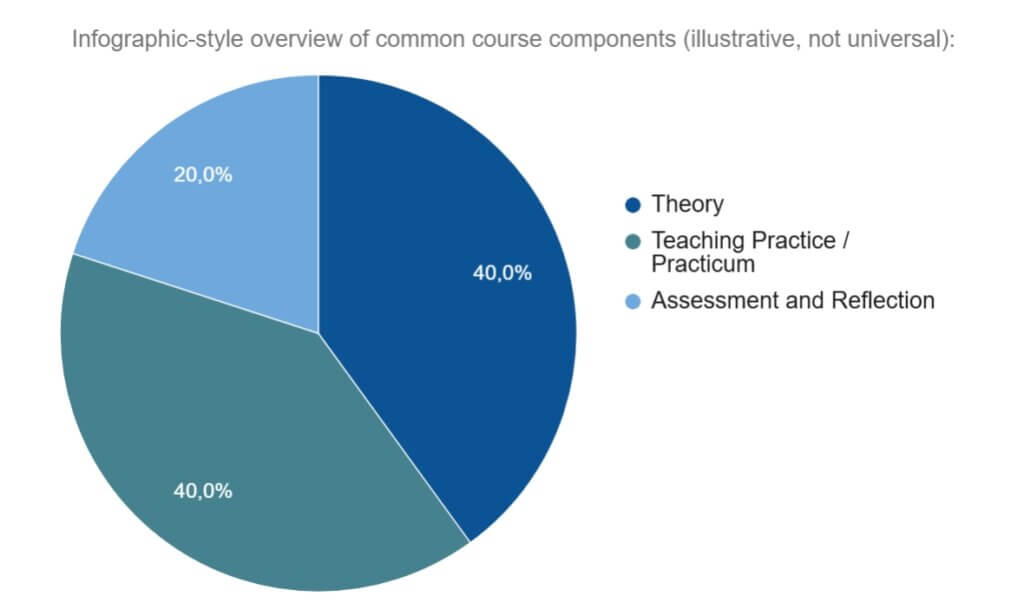
This distribution is consistent with the standard course formats reported in the TEFL literature and resonates with the notion that good programmes combine strong practice with a firm theoretical base. Percentages differ from provider to provider, but practice-driven learning and test-based assessment continue to be staples of Ofqual-aligned courses. When comparing courses, ensure you have a thorough map from the learnings from the course up until the portfolio you will be building for your job applications.
In practice, a credible Ofqual-aligned online TEFL course will typically include core modules on language awareness, classroom management, and lesson planning. It will also include a supervised practicum with observed teaching sessions and written feedback, as well as formative and summative assessments that contribute to the final certificate.
Before you enrol, you might be advised to request a sample syllabus, a practicum brief, and examples of candidate feedback. Evidence of this is a red flag too – if a provider cannot show you that.
You can also check the awarding body’s status with the UK ENIC (National Information Centre) to confirm recognition and how it is positioned in the UK framework. This process guarantees that the certificate you select represents verifiable quality and can be transported.
For more details on recognising and meeting standards in general, refer to Ofqual and UK ENIC resources. Practical training and support on the job after certification are what link one’s academic performance to practice as a teacher.
A programme that is thoughtfully structured will include continual mentoring and help with job applications (e.g. CV or résumé), interview preparation, and access to a network of schools, centres, and online resources. Post-certification support commonly consists of continuing professional development opportunities (i.e. micro-credentials for a specific approach to instruction, classroom technologies, language tests).
Furthermore, reliable providers often present assistance on visa and work-permit considerations, which is very beneficial for teachers in foreign countries. This confluence of practicum, reflective practice, and career support is going to make it much more likely that you secure the work you want – whether that be a classroom in a global setting or a well-performing online teaching career.
From a labour market standpoint, employers are looking for courses which deliver real teaching evidence and demonstrate they can do it effectively, rather than just understanding it on a theoretical level. Observations, feedback, and a documented portfolio matter more than a certificate alone.
Your programme choice should comprise a strong practicum, an ongoing skill development process, and real career services. The outcome is a credential, yes, but also a legitimate path to your desired teaching practice environment.
Practical Training and Career Support After Certification
A strong TEFL certificate is not just about passing exams but about having a practical toolbox you can put into action in the classroom. Such practical training must incorporate opportunities for observation and feedback, delivering lessons in context, as well as practising teaching with guidance.
Seek out courses that offer micro-teaching sessions, practice with experienced teachers, and feedback – you need to be as fine-tuned as possible. It is important to find practical teaching methods to apply theory to both novice and advanced students, online and in person.
Career support after certification is as important as what is taught in the course itself. Providers with strong career offerings commonly offer CV and cover letter consultations for TEFL roles, interview coaching, and advice on developing a professional teaching portfolio.
Having access to job boards, alumni networks, and employer partnerships ensures your first job opportunity is much easier to find. Some providers also provide information and support on visas and how to find accommodation, and even take into account licensing requirements where appropriate.
Not every country uses online qualifications in the same way, but an established programme will ensure you know how to present your credentials confidently to schools and language centres.
Finally, continuing professional development (CPD) can also increase employability and income. Seek opportunities for post-certification training (specialist micro-credentials, such as teaching young learners, online pedagogy, or exam preparation, as well as continuing education).
These demonstrate that you are a professional with a focus on advancement and help you stay up to date in an ever-evolving field. Even if you are teaching abroad or online, a focus on reflective practice, classroom-based action research, and peer collaboration can have broader and long-lasting effects on long-term career resilience.
Authoritative Sources and Fact Checks (References)
- Ofqual (The Office of Qualifications and Examinations Regulation): The official UK government register of regulated qualifications.
- UK ENIC (National Information Centre): The UK national agency for international qualifications and skills.
- UNESCO – Language and Education: International perspectives on language instruction and global opportunity.
- The Regulated Qualifications Framework (RQF): Information on qualification levels and credits in England and Northern Ireland.
Do online TEFL certificates expire?
TEFL certificates don’t technically “expire,” but their value depends on the recognised standards and ongoing career development. Some employers prioritise Ofqual-regulated credits or university-linked credentials, and many seek applicants who stay current with micro-credentials or CPD opportunities.
Is practicum required for a credible TEFL certificate?
Practicum is highly valued and often essential for robust, job-ready training. Many reputable online programmes include supervised teaching practice, which helps you build a demonstrable teaching portfolio for employers.
What exactly is Ofqual, and why does it matter for TEFL?
Ofqual is the independent regulator of qualifications in England. An Ofqual-regulated certificate carries official recognition and is generally trusted by employers across education sectors and international markets.
Can I teach online with a 120-hour certificate?
Yes, many online TEFL certificates of 120 hours (with practicum) are sufficient for online teaching roles, particularly when paired with strong teaching demos and a solid portfolio. Some platforms may require additional qualifications or demonstrable experience, depending on the employer.
How long does it take to complete an online TEFL certificate?
Typical online courses range from about 4 to 12 weeks for a 120-hour program, depending on study pace and whether you study part-time or full-time. Longer options exist that include more extensive practicum or postgraduate components.
How do I know a course is credible?
Look for: Ofqual-regulated status or university affiliation; a clearly defined practicum; transparent assessment methods; evidence of QA and learner support; and verifiable job-placement outcomes or alumni networks.
Are there pathways from TEFL certificates to higher degrees?
Some providers offer credits toward university-based TESOL or MA programmes, and certain certificates can be eligible for credit transfer in some university systems. Check with the awarding institution and the UK ENIC for guidance on credit recognition.