TEFL Certification: A Practical Guide for Your Teaching Career


If you have aspirations to teach English abroad or through the internet, then the term TEFL certification has probably entered your head. For instance, how do you choose a course that will not only look good on paper but also actually equip you to teach effectively? On-the-ground TEFL certification opens some doors – although the market is very varied.
For prospective teachers, feeling overwhelmed by the sea of applicants can be particularly difficult, since the landscape consists of advertisement postings and many do advertise for “certified” teachers without mentioning what that certification is or is not, or what kind of training is necessary to become a certified teacher.
In reality, a good TEFL certificate is not just about checking the boxes. Your job is to prove to employers that you have foundational skills in language acquisition, managing a classroom, planning lessons, assessing students, and delivering lessons to real students.
Credible training is valuable in today’s global world where English is the main lingua franca for business, travel, academia, and digital communication. It supports you in creating interactive tasks, catering for a wide variety of learning styles, and evaluating your pedagogy to promote successful achievement.
TEFL certification has been recognised as highly valuable based not only on hours of practicum but also on the quality of the practicum, feedback, and ongoing professional development that it offers.
This article offers an overview through a transparent framework: what TEFL certification will mean for your career and how to select a suitable course, including concrete pathways to teaching abroad or online, and how accreditation and standards are approached.
It’s intended for those just starting out in teaching and looking for sound international data that matches their own needs. Through it all, you will discover valuable guidance to help you select classes that align with your objectives, budget and timetable – and ultimately result in rewarding teaching posts.

What TEFL Certification Means for Your Teaching Career
(TEFL translates to Teaching English as a Foreign Language)
On the ground, a TEFL certificate is a credential that shows you have completed a structured training programme in English language teaching for non-English language learners. Such training is usually based on core knowledge of essential aspects of the curriculum, such as language analysis, lesson planning, classroom management, engaging activities, and methods of tracking student achievement.
A standard, well-known TEFL certificate is about 120 hours of study and includes a ‘teaching practicum’ – supervised teaching where you actually teach real lessons while being supervised. Many employers value this mix of theory and practice when reviewing an application for an English language teaching role during interviews.
The TEFL landscape is diverse:
- There are fully online courses – focused on theory and with no practicum – and hybrid formats combining online theory with a hands-on teaching component.
- There are varying tiers and equivalencies – from introductory 120-hour certificates to more advanced qualifications of 180–250 hours or more, usually augmented with a longer practicum or a micro-teaching component.
Employers in many markets are looking for more than just certification; they also require clear evidence of a rigorous practicum, reflective teaching, and an understanding of classroom dynamics. A higher-level certificate or additional diplomas may enhance qualifications and earnings potential for some roles, especially in well-regulated sectors.
Research and advice from professional bodies, including TESOL International, have stressed that well-designed programmes place a strong emphasis on pedagogy, practice, and ongoing professional development.
The implications of TEFL certification for employment can be divided into four parts:
- A simple certificate can open entry-level jobs with private language schools or after-school programmes, especially in areas with strong demand for English instruction.
- Highly competitive placements – in prestigious language schools, international schools, or government-sponsored programmes – frequently demand extensive practical teaching experience as well as an understanding of how to modify instruction to meet the needs of learners at different stages and levels of language proficiency.
Takeaway: Quality is crucial – find courses that combine theory and practice, offer constructive feedback on demonstrations, and provide mentoring and career guidance beyond certification.
If you select a strong programme, your TEFL certification becomes an appropriate sign of preparedness and not just a credential.
Choosing the Right TEFL Course for the Best Outcomes
Course types and formats vary widely, and the most effective choice will depend on your goals, budget, and timetable. Online certificates provide flexibility as well as reach to many potential teachers, making them a common entry point into the field. Often, online classes may include video lectures, reading assignments, quizzes, and a teaching practicum conducted in your local area or through a partner school.
Blended formats combine online education and a live practicum, which can work really well because you learn in the classroom and can still gain from the structure of digital instruction. In-person opportunities, despite being more resource-demanding, result in intensive, immersive practicum with immediate feedback and observation in real classroom settings. Blended learning for those who may work in both an office setting and a virtual one is frequently the most feasible and rigorous selection.
Look beyond just cost and duration when assessing TEFL training. Key elements are recognised course hours, quality and supervision of practicum, credibility of the awarding body, and post-course support including job placement help and mentorship. Courses must, in turn, clearly define learning outcomes, assessment methods, and the expected competences you will develop.
It is a good idea to check whether the programme is internationally recognised and compatible with the standards of language teaching and teacher education. Quality courses offer an open lecture plan, structured practicum with observation and feedback, and learning and experience development post-certification.
What’s more, make sure that the certificate is portable to the countries in which you plan to teach, and that it is backed by a genuine awarding body with clear policies for refunds, rescheduling, and support for students.
This table of common TEFL certificate patterns is designed to enable a rapid comparison of choices. It suggests what kind of combination of content, practicum, and market recognition one would expect in the market.
| Certificate Type | Course Hours | Teaching Practicum Hours | Assessment Methods | Recognition/Notes |
| 120‑hour online certificate | ~120 | None or limited (self‑guided teaching) | Quizzes, written assignments | Entry‑level, widely available; check practicum availability |
| 120–160‑hour online with practicum | ~120–160 | 6–12 hours | Lesson planning, micro‑teachings, reflective journals | Higher credibility; practicum usually supervised |
| 180–250‑hour blended certificate | ~180–250 | 12–20 hours | Observed teaching, video submissions, exams | Stronger evidence of teaching ability; preferred by some employers |
| Diploma or Level 5 certificate (UK‑based) | ~360+ (varies) | 20+ hours | Comprehensive portfolio, observed lessons, exams | Often regulated or recognised in the UK; higher level qualification |
Apart from hours and practicum, quality feedback is another practical aspect. Seek out classes which offer detailed, actionable feedback on teaching demonstrations and have a structured progression plan.
Note as well the post-certification value – including alumni networks, continuing professional development modules, and job placement support. Whereas a lower-hour certificate can serve as a baseline, a course providing solid practicum and mentorship more reliably results in improved preparation in the classroom and increased self-confidence in interviews.
Pathways to Teaching Abroad and Online with TEFL
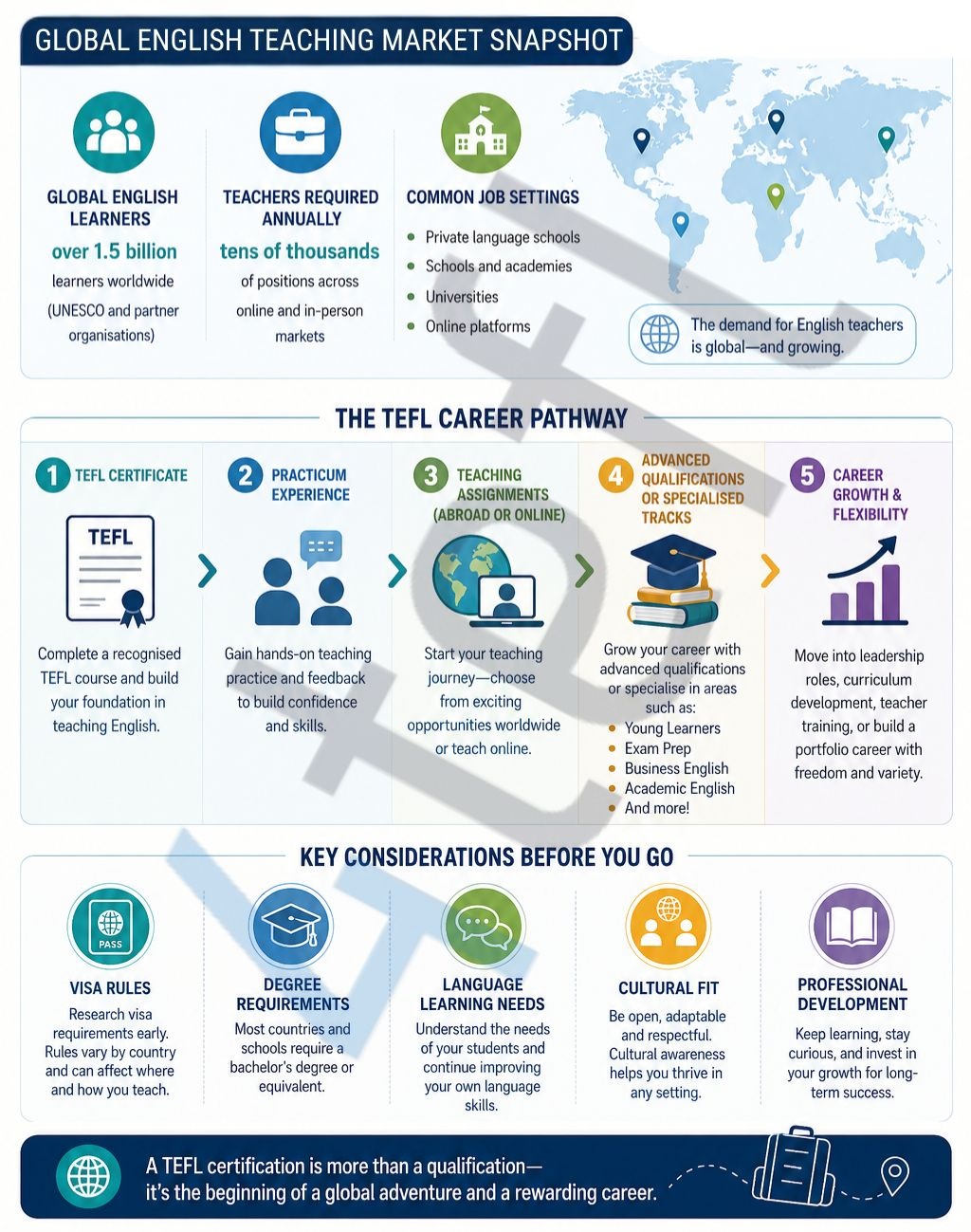
Teaching abroad is still the biggest goal for many TEFL alumni. The basics generally align, although not at a single point, across territories: a bachelor’s degree (though not always in TEFL), a TEFL/TESOL certificate, and then a work visa. For specifics, visa and work permit requirements differ by country, but you’ll find age, health, and criminal background check restrictions in many cases.
Some popular destinations, from East Asia to Europe, Latin America and the Middle East, have a mixture of private language schools and international education establishments that are in search of English teachers. Job openings often advertise classroom management skills, planning engaging activities, and the ability to work with students at varying levels.
With the variety of markets available to pursue, whether it be a high-intensity language school or a school-based environment with longer-term placement, there is flexibility to fit your preferences.
In recent years, online teaching has boomed, fuelled by more flexible learning needs and a larger than ever global network of digital platforms. Teachers can teach English to international students from wherever they live or work – typically in a co-working space or according to their own schedule.
Online teaching also allows freelancers to work independently (sometimes on sponsored platforms) with libraries, institutions, and schools for students learning from home, making the work available from anywhere.
The benefit of working remotely isn’t just the likelihood of steadier hours and a broader student base; strong digital teaching skills, reliable technology, and time-management skills are also essential.
It means preparing for a live online class by obtaining a certified TEFL certificate for the first time. A formal professional certificate is not enough; a robust curriculum supplemented by hours of teaching practice must support early career development and produce tangible results.
- Locally: volunteer or work with community education programmes, gather video clips, student feedback, and supervisor notes. Then explain transferable skills in your CV – lesson planning, clear communication, classroom management, and assessment.
As you gain confidence, you can extend your reach by applying to both online sites and on-the-ground postings in places where TEFL opportunities are often widely discussed.
Targeting destinations that suit your visa requirements, climate, language, and cultural fit, while taking into account market demands and regulatory situations, is a vital strategy for maintaining consistency.
Accurate and up-to-date information in the form of official literature and professional associations can guide you through country-specific requirements and seasonal hiring opportunities.
Accreditation and Standards: Measuring TEFL Quality
The standards and accreditation requirements are critical to make sure your TEFL qualification really is the education you need to be up to par for real classrooms. Accreditation is the formal designation of whether an institution of teaching and learning has achieved some level of high quality and is meeting the required standards.
Some TEFL/TESOL qualifications are regulated by national governing bodies such as Ofqual across the UK and many other countries: the UK’s Office of Qualifications and Examinations Regulation oversees the quality and recognition of certain Level 5 and higher TEFL qualifications from approved awarding organisations.
A course which is Ofqual-regulated also affords an extra layer of trust for standards, comparability, and transferability across institutions and jurisdictions. Not all high-quality TEFL programmes are Ofqual-regulated, however; some reputable providers operate independently and with international recognition.
The key is verification of the awarding body’s credibility and the specific programme’s fit with international teaching standards.
Teaching and Learning (TEFL) standards of practice refer to international standards that support teacher education and professional development. TESOL International Association and IATEFL (International Association of Teachers of English as a Foreign Language) publish standards, frameworks, and guidance that teachers can reference when setting expectations and supporting their teaching and training.
TESOL values language analysis, pedagogy, assessment, and reflective practice, while IATEFL focuses on continuing professional development, networks, and evidence-based teaching and learning from practical experience.
For future teachers, you can incorporate these principles into your curriculum in order to show that you understand quality standards, are committed to lifelong learning, and abide by professional ethics.
When selecting a course, you might use a simple checklist to assess accreditation and quality:
- Check the awarding body (regulators) and whether the qualification is recognised in its jurisdiction or elsewhere (or, for UK programmes, verify Ofqual recognition and awarding organisation status).
- Check your curriculum for alignment with common expectations of instruction (language analysis, lesson design, classroom management, assessment, reflective practice).
- Verify practicum elements – direct teaching, observation, and feedback by trained mentors.
- Analyse graduates’ history to see whether they have received job offers, taught across age groups, and continued upskilling.
- Seek out post-course support for job placement, career advice, and continued access to teaching materials.
Authoritative Sources and Fact Checks (References)
- Ofqual (Office of Qualifications and Examinations Regulation): The official government body regulating qualifications, examinations, and assessments in England, establishing the benchmark for Level 5 TEFL qualifications.
- British Council TeachingEnglish: A vital global resource offering research, professional frameworks, and standards for English teachers worldwide.
Do I need a university degree to teach English overseas?
Most countries require at least a bachelor’s degree, and many schools prefer or mandate a TEFL/TESOL certificate. Some destinations allow non‑degree teachers under specific programmes or with substantial teaching experience; always verify visa and employment requirements for your chosen country.
Is an online TEFL certificate as good as an in‑person one?
Online certificates can be credible if they include a solid practicum component, supervised teaching, and robust assessment. A purely online course without practicum is less attractive to many employers. Look for programmes that offer observed teaching and feedback to maximise employability.
What is the difference between TEFL, TESOL, and CELTA?
TEFL (Teaching English as a Foreign Language) generally refers to teaching English to non‑native speakers in non‑English‑speaking countries. TESOL (Teaching English to Speakers of Other Languages) is a broader umbrella term used in many regions. CELTA (Certificate in English Language Teaching to Adults) is a widely recognised in‑person qualification run by Cambridge English; it typically involves a more intensive practicum. All can lead to solid teaching opportunities; the key is quality, practicum, and how well the course fits your goals.
How can I evaluate accreditation when choosing a course?
Check whether the awarding body is recognised by national authorities (e.g., Ofqual in the UK) and whether the programme includes a supervised practicum, a clear assessment framework, and transparent policies. Also look at graduate outcomes, reviews from employers, and alignment with professional standards from TESOL or IATEFL.
Which career path is best for me: abroad or online?
Consider your priorities - travel, cultural experience, and visa access versus flexible scheduling, location independence, and the ability to teach from home. A combination of both can offer stability and variety, especially if you build a robust teaching portfolio with both in‑person and online experience.
What should I include in my teaching CV when starting out?
Highlight your TEFL certificate, practicum hours, age groups taught, lesson planning experience, classroom management strategies, and outcomes (e.g., improvements in student proficiency). Include sample lesson plans or short demo videos if allowed, and reference letters from practicum supervisors.
How long does it typically take to become job‑ready after completing a TEFL course?
This varies by course and individual effort. A well‑structured 120-160 hour certificate with a 6-12 hour practicum can prepare you for entry‑level roles in a few weeks to a few months, depending on your timetable and job market. Additional practicum or a diploma can broaden opportunities and competitiveness.