Mauritania TEFL Certification: Your Gateway to Teaching English Abroad


“If you aspire to teach English in a country where culture, desert landscapes, and a developing education sector meet opportunity, Mauritania should be your destination of choice.”
The English language lesson market is on the rise, propelled by private language centres as well as by international bodies and universities looking for experienced educators that can bring the latest TEFL techniques to the classroom.
But stepping into a role in Mauritania can be complex: standards for certification are different, visa procedures are not the same as elsewhere, and classroom realities demand varying instructional strategies. This article offers a practical, backed-up guide to getting TEFL certification for Mauritania, explaining why Mauritania is an excellent destination, how to gain the certification, teaching skills that you will need that work there, the career paths, and the benefits you will have. It combines some insight from expert sources, reliable data, clear guidance, and steps to help you understand things and ultimately to join a trusted TEFL/TESOL programme.
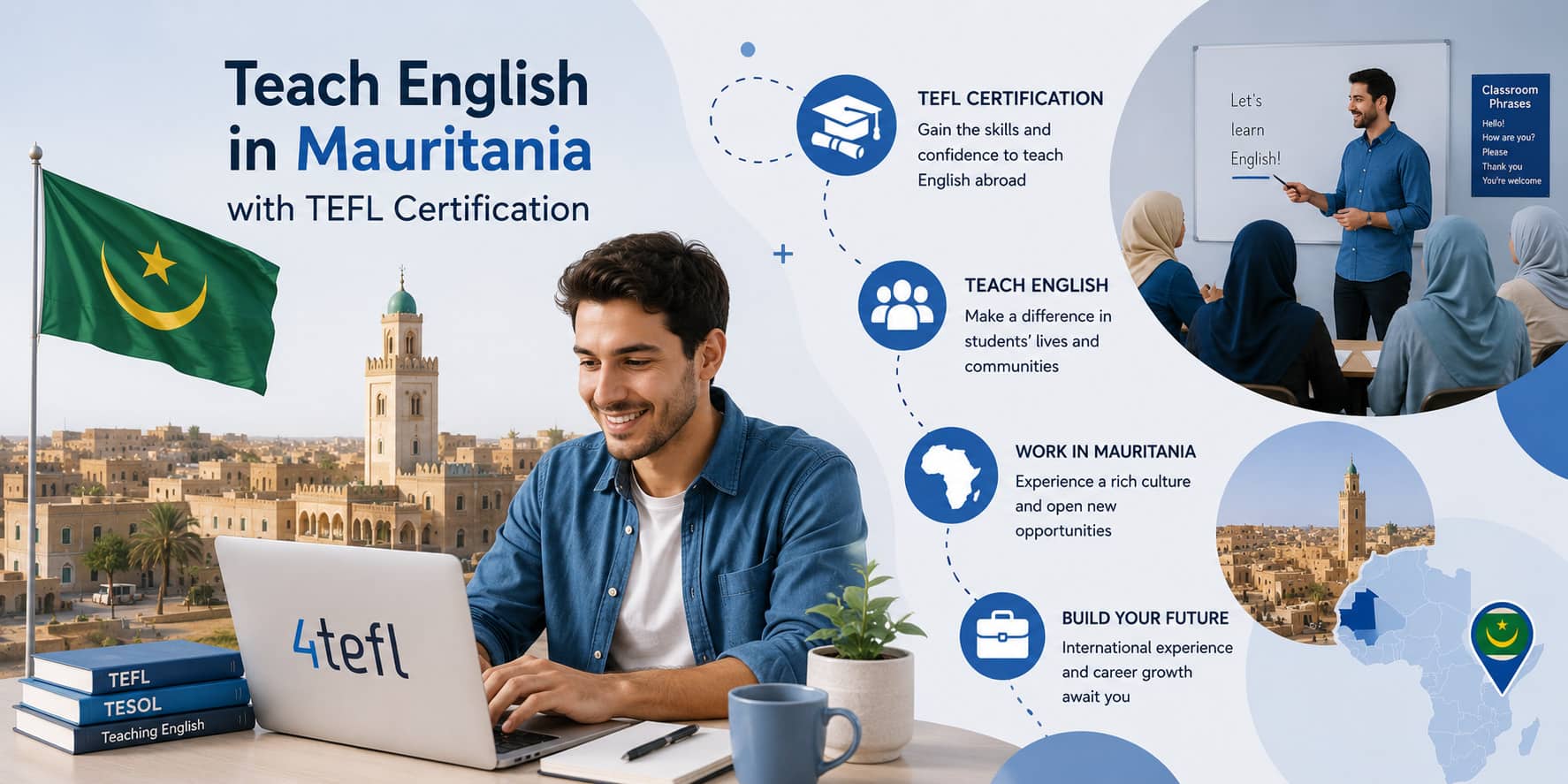
Why Mauritania Is Your TEFL Certification Destination
Mauritania is gaining attention in the English-speaking world due to its strategic location between North and West African countries. The demand for English in Mauritania is most pronounced in private language schools, higher education institutions, and international development programmes where English is used for communication, research, and cross-border collaboration. For optimistic educators, this creates opportunities that sometimes prioritise high-quality management with a focus on classroom management, communicative teaching, and culturally responsive pedagogy.
The official language of Mauritania is Arabic, with French playing a significant role in administration and higher education, and English being prominent in private education and international contexts. This multilingual environment allows for the employment of TEFL-certified teachers who can successfully implement ESL practices while remaining sensitive to the use of local languages, language usage, and the learning expectations of local communities.
In essence, Mauritania offers meaningful teaching roles to those who come with a degree and are willing to adopt flexible teaching styles. Adapting to Mauritania’s classroom reality also requires an understanding of the importance and limitations of the local environment. Many public schools have historically taught in Arabic and French, and English language education has often been supplementary or linked to private or international programmes. Consequently, a TEFL certificate that emphasises communicative competence, lesson planning for mixed levels, and classroom management in challenging socio-economic settings is particularly important.
The potential for a broader range of opportunities in West Africa and the Maghreb for many teachers – working for language access, participating in cross-cultural exchange, and gaining work experience that can be utilised – is what makes the country appealing to many educators. A well-chosen certification programme can align with international standards – crucial for moving to other countries or the online learning environment – while also establishing a professional profile with a strong focus that meets the needs of not just employers in Mauritania, but many others as well.
Language Landscape & TEFL Demand Indicators
| Language/Indicator | Notes |
| Official language | Arabic (modern standard Arabic used in formal contexts) |
| Common lingua franca | Hassaniya Arabic; French widely used in administration and education |
| Growing English presence | More private schools and international programmes are incorporating English |
| Typical teaching settings | Private language centres, international schools, universities, NGOs/aid projects |
| Certification alignment | Ofqual-regulated TEFL/TESOL certificates are recognised internationally |
Gaining TEFL Certification for Teaching in Mauritania
The selected TEFL qualification should be appropriate to the teaching realities of Mauritania. New teachers should be looking for programmes that put theory into practice, ideally incorporating observed teaching practice, strategies for managing a diverse class, and developing a programme of materials. A standardised programme, such as Ofqual-approved, serves to maintain standardised course content, assessment, and quality management.
Ofqual-compatible courses offer credibility to your application for jobs with Mauritanian schools, international organisations, and private language centres, and demonstrate that you are prepared not only to teach technically, but also to teach in a modern way, even when there are few resources available. It also makes logical sense to ensure that the certification provides a teaching component in which you can teach the practical content and a comprehensive assessment framework and offers continuing tutor support and feedback.
Concrete steps to achieve your Mauritania-ready TEFL qualification start with taking a course that is strong, globally accepted, and UK-approved. Seek courses that provide 120 or more hours of theory and 6 to 8 hours of observed teaching practice, while also making provision for job placement or interview preparation.
The course delivery mode and tutor’s feedback on lessons to be presented/organised (face-to-face, online, and blended) will also need to be factored in. Thus, in Mauritania, courses promoting adaptive teaching, lesson plans for mixed-ability classes, and low-resource methods with highly engaging activities will have the desired effect.
After completing your course, you typically receive a certificate which can generally be used for visa applications, job applications, and professional development records.
Finally, get information about your currency of knowledge sorted as you set out to apply. An exceptional bilingual teacher or someone who demonstrates an understanding of students’ culture and preparedness to work with local teachers will stand out. Mauritanian employers appreciate teachers who proactively pursue continuing professional development at most overseas postings, whether that be online courses, micro-lessons, or local teacher communities.
Then, when you link your certification to Mauritania’s labour market expectations and regulations – you make a strong case for getting into class, and for taking the right steps to extend your career over the long haul.
Core TEFL Skills for Mauritania Teaching Positions
Teaching core skills applicable to the Mauritania teaching profession focuses on pragmatic teaching and learning, cultural humility, and flexible instructional strategies.
- CLT is first and foremost: you need to plan speaking and listening tasks, which involve real-life use of English, even in larger teaching groups.
- Second, lesson planning that caters for different levels of English is especially useful in an English mixed-classroom environment like Mauritania, where learners may be at different phases of development.
- A third, classroom management and student-engagement approaches – pair work, collaborative projects, visually scaffolded activities – encourage an inclusive learning environment where learners are able to be actively engaged irrespective of resource limitations.
And a certification that has specifically trained you in these subjects will enable you to address the typical classroom realities of Mauritania, from large classes to minimal teaching materials available.
Aside from the basics, a lot of Mauritania teaching positions require some level of flexibility and problem-solving. For example, materials may need to be modified so they suit English-only contexts or be used with real-life examples to make connections to students’ lives. This means you will need training in materials development, assessment design, and feedback mechanisms that strike a balance between exhortation and a clear and actionable plan for learning improvement.
You’ll also be expected to communicate clearly with administrators, colleagues, and sometimes parents – often in multilingual environments – so professional communication is a key ingredient. Finally, a working knowledge of basic digital teaching tools and online resources can aid hybrid learning scenarios and self-study (for students who are not in the classroom).
It will be training providers who provide hands-on demonstrations of these skills, and feedback from experienced tutors, who can provide evidence of theory through practice. Alongside foundational skills in the classroom, Mauritania-friendly TEFL curriculum programmes also frequently highlight cultural readiness and ethical behaviour.
You might find yourself in classrooms where there may be gender norms, religious practices, and local expectations that inform everyday routines and form the basis for students’ involvement. And training – in cultural competency, inclusive pedagogy, and ethical classroom practices – will teach you how to function and succeed in these circumstances.
The same groundwork also backs up your capacity to connect in a constructive way, not only with local teachers and administrators and, as a result, to enhance and optimise the programme, but also your general career satisfaction. The most effective candidates will have theoretical understanding, practical know-how, and culturally sensitive leadership qualities that resonate with the classroom.
Career Paths and Benefits of Mauritania TEFL
The path to becoming a TEFL-certified teacher in Mauritania is both a career opportunity and an exciting one, as it offers career trajectories with considerable benefit for professional career advancement in Mauritania.
- Language centres and private academies are usually looking for teachers that can provide communicative training, speaking-oriented training, and exam preparation for internationally recognised exams (Cambridge, IELTS, TOEFL).
- There’s a big possibility that international schools create more formal, diploma-aligned curricula, in many cases, with the assistance of expatriate staff or an NGO-backed education programme.
- Universities and colleges may expect stronger academic English proficiency or have students with both general English and academic writing or research skills in addition to knowledge of academic research.
In all of those situations, a Mauritanian résumé will assist with wider access later in time, including specialising in private-sector language teaching, entering higher education, and regional posts in North Africa.
And there’s the enormous value in Mauritania TEFL: the chance to make a difference in education and development outcomes. English can offer students richer access to information worldwide, new opportunities in higher education, and international jobs.
Teachers in Mauritania frequently have high professional satisfaction when they witness their students gain confidence, learn a language, and leave the country for additional study or employment.
Together with an added sense of purpose, competitive salaries in some environments, and overseas organisation/NGO sponsorship opportunities, Mauritania has become an attractive place for committed TEFL professionals.
With time and experience, more experienced teachers can progress to programme leadership, curriculum design, teacher training, or supervisory roles, gaining broader influence in the country’s changing education environment.
The teaching experience in the Mauritania TEFL market is also a practical route to global teaching experience. A lot of teachers start with a certificate and a year-long contract and use that experience to search for jobs in Francophone Africa or the Middle East with bigger pay or more senior roles.
Training personnel with an understanding of Mauritania can help you map out a plausible career path, from initial posting to leadership responsibilities. They can also assist you in understanding how to manage living costs in Nouakchott or within regional towns, in meeting wage thresholds, and how to prioritise expenses alongside preparation for personal savings and career growth.
The right candidate finds Mauritania a springboard to a diverse, important, and globally oriented TEFL career.
Legal and Visa Considerations for Mauritania TEFL
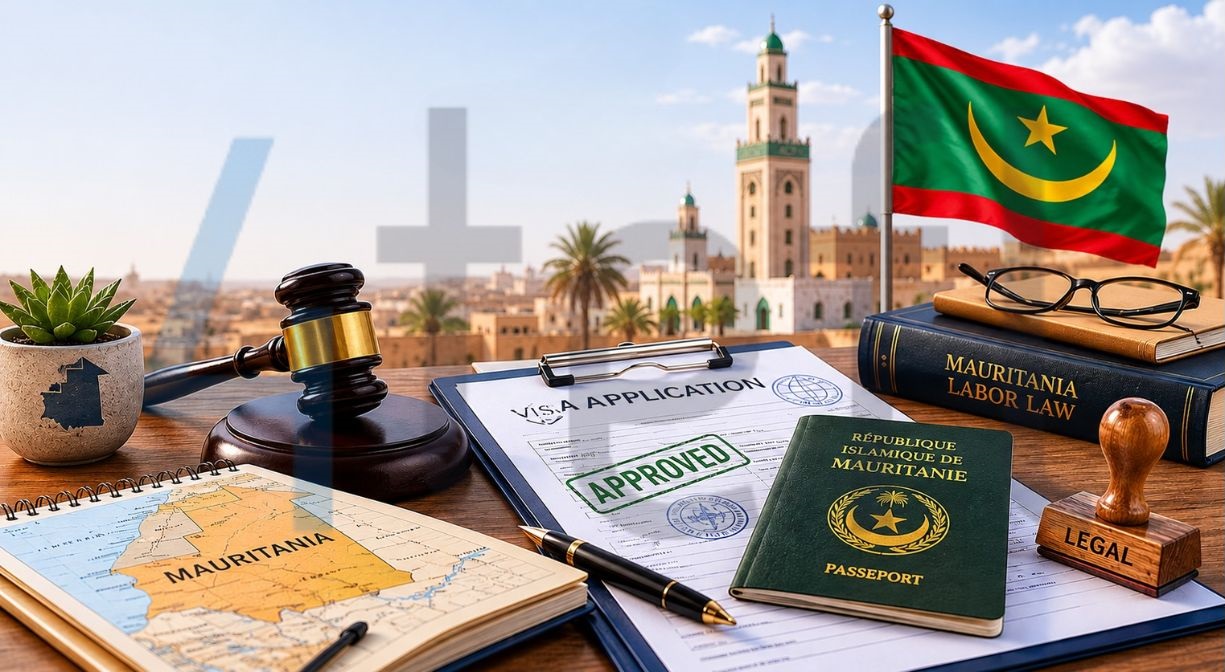
The legal and visa environment of Mauritania is a crucial aspect of your TEFL journey. Almost all teaching jobs in Mauritania require a work permit sponsored by the employing institution, alongside a valid passport and appropriate academic credentials. Most employers will aid with visa and work permit issues; however, it is necessary for candidates to provide degree certificates, TEFL certificates, government attestations (apostille or equivalent), and police clearance.
Depending on whether you manage to find a contract with a private language centre, an international school, or a university partner, you may know the very specifics. That’s why it is best to investigate visa timelines and document requirements early, and to liaise with your employer to verify that the visa is delivered on time.
Being familiar with Mauritania’s legal environment informs your anticipated practicalities such as terms and conditions of the contract, housing allowances, health insurance, and end-of-contract procedures. Contracts typically describe one-year terms with options to renew, but it’s also important to evaluate terms concerning flight allowances, aid in adapting to a new culture, and even things like gratuities and end-of-service benefits.
Your visa sponsorship and tax needs will be clarified by a reputable employer. To get your work sorted, you should validate the qualifications and whether they conform to locally or internationally recognised TEFL qualifications.
When your expectations match the regulatory realities, it reduces the chances of delays or misunderstandings and ensures a smoother adjustment to Mauritania’s teaching landscape.
Teaching and Living Logistics in Mauritania
To be able to live and teach in Mauritania, practical planning includes housing, healthcare, transport, and day-to-day living activities. There are a variety of accommodation options in Nouakchott and other metro areas, including both expatriate compounds and local apartments.
The prices for such complexes vary markedly based on district as well as proximity to schools.
To negotiate contracts, make sure that housing is included or subsidised, and consider how available facilities such as the internet and grocery shopping fit into your everyday life.
Mauritania usually has the best access to healthcare in major cities and in private facilities; international health insurance and assistance from your employer in accessing local medical services are also essential options.
When it comes to classroom logistics, language policies, and resource limitations, arrive with flexible teaching plans, printable materials, and digital resources, things that can be used offline.
Culturally responsive, resourceful, and able to adapt to Mauritania’s unique classroom environment, an experienced teacher can go on to lead a fulfilling lifestyle in the country.
Cultural preparedness also facilitates your interaction with students, families, and colleagues who operate in Mauritania. Modelling respect for customs, religious practices, and social traditions encourages harmony between pupils both in the classroom culture and with the local community.
And teachers who practise simple language and learn basic phrases in Arabic or greetings in French can connect with students and children on a personal level as well as with teachers and staff.
Join local professional networks, workshops, and joint planning with your local mentor to make yourself able to respond effectively to specific classroom needs.
But the net result is a meaningful, sustainable, student-centred practice that benefits children, schools, and you as an international educator, growing over time.
Authoritative Sources and Fact Checks (References)
- UNESCO: Mauritania Right to Education Framework: Insights on the 2022 National Education System Orientation Law, detailing reforms extending compulsory basic education to 9 years and language planning.
- Al-Fanar Media: English Language Trends in Mauritania: Discusses the rapid expansion of private English language institutes, state university alignment, and the growing demand for English skills in the local labor market.
Do I need a specific amount of TEFL hours to teach in Mauritania?
Most reputable employers in Mauritania recognise standard TEFL/TESOL qualifications, typically 120 hours of theory plus practical teaching practice. However, some positions–particularly in universities or private international schools–may require additional training, degrees, or master’s-level credentials. Always check job postings carefully and choose a programme that provides substantial observed teaching practice and a robust verification process.
Is Mauritania safe for English teachers?
Mauritania is a destination with a developing safety profile; regional and urban differences exist. Overall, many teachers work safely with the support of employers who provide orientation, housing arrangements, and local guidance. Before travelling, review up-to-date travel advisories from official sources and maintain contact with your employer’s support network. Ensuring comprehensive health coverage and a contingency plan is prudent.
What languages should I know to teach in Mauritania?
Arabic is the official language and widely used in schooling, with French common in education and administration. English is increasingly taught, particularly in private language schools and higher education contexts. While you do not need to be fluent in Arabic to begin, learning some basics can help you connect with students and colleagues and enhance your classroom effectiveness.
How long does it take to obtain a work visa?
Visa processing times vary by employer and location, but typical timelines include contract finalisation, document verification, and sponsorship arrangements. Expect several weeks to a few months from job offer to arrival, depending on regulatory steps and the issuing authorities. Your employer often provides guidance and may handle much of the administrative work.
What are common contract terms for TEFL positions in Mauritania?
Contracts generally cover salary, housing stipends or allowances, health insurance, flight allowances or arrival support, contract length (often 12 months with renewal options), and end-of-service provisions in some programmes. It is important to review clauses related to professional development, visa support, and repatriation terms before signing.
How can I maximise my chances of securing a teaching role in Mauritania?
Build a TEFL certificate with practice-based components, demonstrate adaptability and intercultural communication, and tailor your CV to highlight experience in resource-limited settings, classroom management, and project-based learning. Networking with reputable training providers and leveraging their placement support can also improve your odds. Additionally, be prepared to discuss how you can contribute to local education objectives and long-term capacity-building.