Navigating TEFL Careers in Austria: A Practical Guide


Austria is famous for its excellent standard of living, rich education, and numerous cultures.
For future TEFL educators, it includes private language schools and international programmes, alongside a range of university-level language services in Vienna, Graz, and Innsbruck.
The struggle is that it’s not just about securing a job, but about knowing visa requirements, the appropriate qualifications, and what the best way is to get started to secure a long-term teaching career in another country.
So, this article will provide you with field-tested practical steps for breaking into the Austrian TEFL market and understanding how it feels for a professional student to teach English in this country.
Whether you are in the preliminary stages of your TEFL journey or entering a regulated career, winning in Austria relies on knowing three things: market opportunities in your region, the visa and work permit ecosystem, and effective job-hunting strategies suited for Austrian schools.
The environment changes to accommodate regional demand, language requirements, and seasonal peaks around tourism and university calendar holidays.
By combining professional preparation with targeted outreach combined with genuine attention to your field, you can position yourself to get high-quality jobs that match your qualifications and future career requirements.
In the two sections to follow, you’ll view an organised tour – from figuring out what the demand is, practical visa considerations, and where and how to apply after you have a feel for it – and then follow up by offering interview advice and salary assumptions.
The material is based on common industry practices in Austria and corresponds to advice from leading education institutions on TEFL qualifications and international teaching standards.
So you can plan your next steps realistically and with ambition, with this as your roadmap.
Understanding the Austrian TEFL Market: Key Opportunities
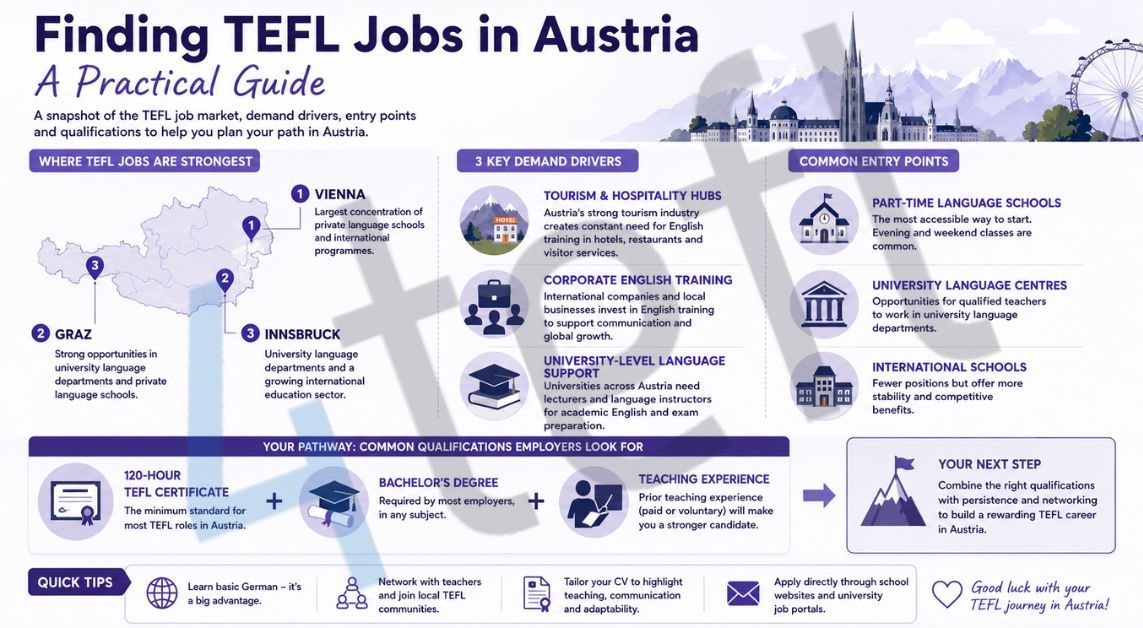
Austria’s TEFL market is influenced by Vienna’s international environment, tourist towns, and vast private language schools targeting both adults and younger learners.
The central city of Vienna – being home to the centre of diplomacy, business, and higher education – lends it a steady appetite for English language support in economic, educational, and community contexts.
Outside the capital, universities, exchange programmes, and language centres in Graz, Innsbruck, and Salzburg often look for professional teachers to teach the language at night, in specialised courses, and summer workshops.
It presents the means through which opportunities are opened for entry to the market from part-time to full-time within schools and language institutes themselves.
All aspects of TEFL in Austria are also bolstered by the broader education ecosystem that includes university language centres, international schools, and non-profit educational initiatives that provide English instruction to international students and exchange programmes.
Promoted by the British Council and UNESCO-recognised programmes, high-quality language teaching and professional development are also emphasised, and this results in some more organised opportunities for TEFL professionals who have clear pedagogical and classroom management methods.
The increasing focus on CLIL (content and language integrated learning) and exam prep will continue to increase the demand for qualified teachers who can deliver engaging, standards-aligned lessons.
For ambitious teachers, this landscape offers a ladder from part-time practice in the classroom to more professional, structured positions in institutions that see English as essential to a person’s mobility and professional advancement.
Typical TEFL opportunities in Austria by sector (monthly or hourly basis)
| Sector | Typical role | Hours per week (approx.) | Typical pay or rate (gross) |
| Private language schools | General English, exam prep, conversation classes | 6-22 | €18-€35 per hour |
| Universities / university language centres | Language support for degree programmes, summer schools | 6-18 | €2,300-€3,800 per month (full-time equivalent) |
| International schools / bilingual programmes | ESL support, content delivery in English | 8-20 | €2,500-€4,000 per month (full-time) |
| Corporate / private clients | In-house training, executive English | 4-16 | €25-€40 per hour |
Most teacher education pathways into the Austrian TEFL market fit a background teacher.
Those trained with a bachelor’s degree and a 120-hour TEFL certificate are ideally positioned to begin in private language schools, whereas roles in university settings and international schools may require stronger credentials or related degree specialisations.
For graduates aiming at public schools, the route may involve additional teaching qualifications or recognised teacher training to match up with Austrian educational standards.
In practice, the workplace has a strong focus on punctuality, dependability, and professionalism in lesson plan preparation and student assessment, be it in a school or subspecialty.
A handy tip: Connect with language schools and university language centres.
Taking advantage of city education fairs, open days, and professional development sessions will also connect you with hiring coordinators and give you a better idea of the different job requirements.
The best way to showcase your teaching certifications, any CLIL/exam-preparation experience, previous experience of effective classroom management, etc., is to keep it structured and on top of the list in a high-pressure environment.
For those moving to Austria, a tentative offer of a contract or teaching assistant role would help prepare you for life in Austria, as well as potential local referrals for your more permanent career opportunity.
Visa, Certification and Work Permits for Austrian Jobs
Because TEFL teachers wishing to travel to Austria are required to obtain visas and work permits, this becomes dependent not only on nationality per se, but also on how long and for whom they wish to work, and which institution they wish to be hired by.
EU/EEA nationals enjoy all manner of freedom of movement, including the freedom to work in Austria, meaning employment can easily be obtained with minimal bureaucratic obstacles.
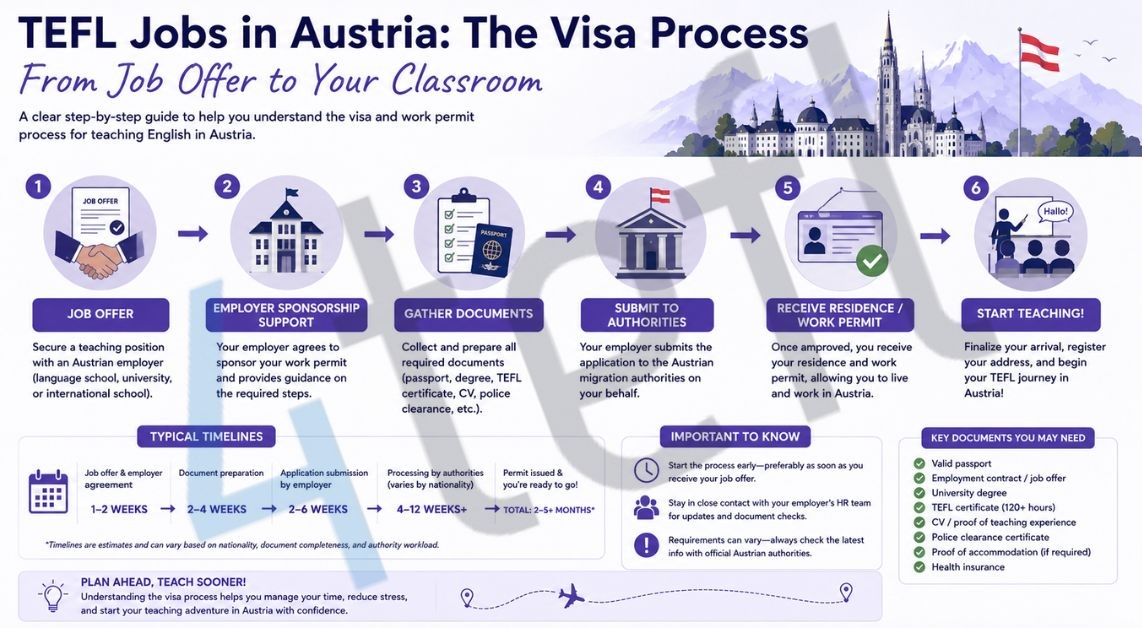
Non-EU citizens are often required to hold a work visa or residence permit attached to employment, and the process is usually initiated by your employer via a formal job offer.
Employers who use international talent can help you with paperwork, but applicants must be ready to handle administrative procedures such as registering a place of residence and passing a background check, depending on the job location and roles being provided.
A signed contract from an Austrian employer is usually the first key document you’ll require for a visa or residence permit application in all cases.
Certification is crucial in Austria, particularly for private language schools and university programmes that focus on pedagogy and student learning.
A recognised TEFL certificate (usually a 120-hour-long course with hands-on teaching components) is a good combination for many positions, along with a bachelor’s degree.
Certain roles, particularly those associated with university language centres or international schools, might require additional qualifications, for example, a teaching licence or experience in EAP.
Even though the language policy may vary depending on your area of practice, good references in education cite the importance of sound credentials and hands-on work in the classroom.
It’s wise to check potential employers’ current requirements via government web portals or Human Resources departments before making plans.
The permit process generally consists of a realistic sequence: secure a specific job offer, confirm the employer’s willingness to sponsor or help with a visa, obtain the necessary documents (a passport, certificates, transcripts, and proof of accommodation), and submit the application to the Austrian authorities.
Approvals are granted on a country-by-country basis and according to visa category, so do not rush your decision, as you should prepare well in advance.
The steps will be available from employers who regularly recruit foreign staff to help applicants navigate the process – and they can also provide a checklist.
It’s also worth noting that Austrian employers who frequently employ foreign staff will know the process and can offer a checklist if they are familiar with the requirements and can help by providing guidance.
It’s also worth noting that many Austrian employers value clear communication, reliability, and a record of commitment to long-term placements – and doing so tends to create a more favourable impression for potential applicants during the visa process.
Where and How to Find TEFL Roles in Austrian Schools
In Austria, the starting point for searching for TEFL positions is local private language schools and international programmes that regularly hire native speakers of English to work with students in general English classes, conversation clubs, and exam preparation.
University language centres and Summer Schools also provide teaching venues – especially during academic vacations or when intensive courses for visiting students are held.
Network amongst educational bodies: attending language education seminars, contacting tutors, and networking with people working in Austrian schools can provide referrals and early access to new job openings.
Schools typically prefer active applicants who show an explicit awareness of English language pedagogy and have a ready-to-teach attitude; therefore, it is worthwhile to prepare a succinct CV focused on making an impact and a brief teaching philosophy.
A great job-hunting strategy is one that pairs proactively reaching out to clients with targeted applications.
Write up a tailor-made CV for your Austrian market, listing relevant qualifications (such as a TEFL certificate, a bachelor’s degree, and teaching experience), methods of language teaching, and proof of successful student outcomes.
In your cover letter, refer to your adaptability, your ability to adjust to different learner profiles, and your willingness to work within local scheduling conditions (evening classes, weekend workshops, and term-based courses).
Further, look for ways of working in conjunction with language schools on projects, such as short-term workshops and conversation clubs, which can pave the way for more long-term contractual arrangements.
Sourcing tips: be advised to seek educational collaborations, exchange programmes, and corporate language training as other routes to a prospective TEFL position in Austria.
Big cities with high expatriate communities and international companies will have the most English-language programmes available and more options for corporate training.
If you’re just starting out, look at temporary openings or roles as a language and culture assistant to create local credibility and establish connections.
Local employer relationships may take time to build, but consistent, student-centred teaching practice will help you stand out in a fast-paced industry.
Practical Interview Tips and Salary Expectations in Austria
To prepare for interviews in Austria means blending professional presentation with practical demonstrations of teaching ability.
Expect questions probing your classroom management style, approaches to differentiating instruction, and how you evaluate student progress.
Have a simple framework of your teaching philosophy in mind and a ready discussion of how you would navigate common scenarios in a classroom (like a mixed-ability class or a learner who lacks motivation).
Show agility, work in a team-oriented spirit, and be punctual and cooperative in your planning because Austrian schools often like to plan ahead as a team – where possible, they like to communicate regularly with co-teachers and parents as well.
If you’re applying to private language schools, you might be given the option of teaching a short demo or micro-lesson; plan for a sample lesson of 20 minutes that will show your interest in your students and flexibility when it comes to working with differing proficiency levels to ensure your teaching demo is engaging and versatile in terms of content and delivery.
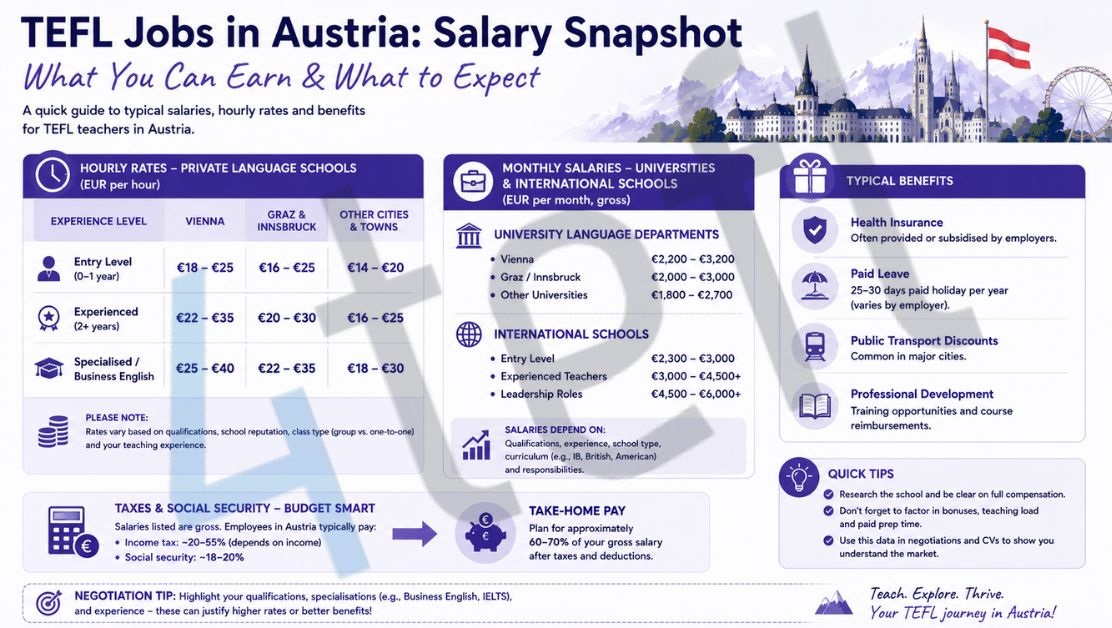
Salaries in Austria can depend on the industry and city.
For the most part, private language schools will have hourly rates that reflect experience, qualifications, and local market demand, with typical ranges that can easily be represented in a brief table of compensation and salary.
University and international schools may offer stable monthly incomes, as well as health insurance for employees, paid leave, holidays, and continuing education for educators.
If you are bargaining, discuss not only base pay but also the extension or increase of the contract term, possible overtime teaching hours, and access to professional development funding.
If you’re moving, clarifying how much it will cost to live in the city you’re targeting and understanding customary practice around tax withholdings and social security contributions will set realistic expectations and help avoid conflict down the line.
Example interview and salary considerations
| Topic | Guidance |
| Interview focus | Teaching demo, classroom management, differentiation, assessment strategy |
| Preferred formats | In-person in major cities or high-quality video interview where applicable |
| Salary planning | Research local rates, determine city cost of living, anticipate tax and social security deductions |
| Negotiation tips | Highlight transferable skills, request professional development funding, discuss contract length |
Practical Insights: Key Takeaways
Austria features a complex and diversified TEFL field with heavy demand in Vienna and other urban centres, as well as some private higher education and university language services, and a ready and easy career path for those with the required qualifications.
EU/EEA citizens may access the country with freedom of movement, and non-EU applicants should prepare for visa applications and employer support.
Having a 120-hour TEFL certificate, a bachelor’s degree, and relevant teaching experience should make a candidate well suited to a variety of positions, from evening lessons in private schools to more reliable contracts with international programmes.
Prioritise outreach and social connections as you organise your move.
Build a CV that prioritises pedagogy, learning outcomes, and classroom management, and fit your application to Austrian standards of punctuality, formality, and collaboration.
You might also start with a series of positions, either part-time or for a few months, to establish a local base of contacts and references.
Learn how English language learning practices are built into Austria’s education structure and CLIL settings to ensure you are able to deliver engaging, standards-driven lessons that connect with students and institutions at all levels.
What next: develop a realistic move plan, target potential cities, link up with schools and universities, prepare key documents, and create an ongoing continuing professional development plan.
If properly prepared, and prepared to involve yourself in the Austrian education system, you should create a rewarding TEFL career that brings together cross-cultural experience and professional development.
Authoritative Sources and Fact Checks (References)
- OeAD (Austrian Agency for Education and Internationalisation): Official portal for information regarding education, international mobility, and teaching opportunities in Austria.
- Migration.gv.at: The official immigration portal of the Austrian government, providing accurate details on visa categories, work permits, and residence requirements for non-EU/EEA citizens.
- Help.gv.at: The official Austrian government service portal, offering comprehensive guides on administrative procedures, taxes, social security, and residency registration.
- British Council Austria: Resources and insights into the standards of English language teaching and international education programmes currently active in the country.
Do I need a TEFL certificate to teach English in Austria, or are degree qualifications enough?
A 120-hour TEFL certificate is a widely accepted baseline for many private language schools, especially when paired with a bachelor’s degree. Some employers, particularly university language centres or international schools, may require additional qualifications or teaching experience. It’s best to verify each role’s specific requirements with the employer and align your credentials accordingly.
Are there opportunities for non-EU citizens to teach in Austria, and how does the visa process work?
lves applying for the appropriate residence and work authorization after securing employment. Employers accustomed to international hires can guide applicants through documentation and timelines, but you should anticipate additional processing time and ensure you have a clear plan for relocation and residence registration.
What are typical working conditions and pay for TEFL roles in Austria?
Private language schools commonly offer part-time hours at hourly rates that vary by city and the teacher’s experience, often ranging from €18 to €35 per hour. University and international school roles may provide more stable full-time salaries, roughly €2,300-€4,000 per month, depending on contract type and location. Working conditions frequently include structured lesson plans, standardized curricula, and performance targets, with some roles offering additional benefits like training support or professional development budgets.