Certification and Training for Teaching English in Austria


Austria sits at a crossroads of culture, education and tourism – a prime target for English teachers to grow. The means by which English can be taught in Austria starts with strong certification. It requires practical training, plus knowledge of how qualifications are recognised internationally.
And Austria has a very strong network of private language schools, universities, and corporate training partners, giving opportunities for classroom teaching, online delivery and blended roles. But the terrain can get confusing: which certificate should you choose, how do you show Austrian employers you pass through the motions, and what training paths will take you to employment most reliably?
It’s a great rundown on the basics of certification, accreditation requirements consistent with international standards, formalising training paths, and real career paths, along with concrete suggestions to inform whether or not an employee should do a course or make a move.
Whether you are beginning with nothing or if you are building on your reputation, the fundamental principle remains the same: an accredited certificate with actual teaching practice – plus a solid plan for ongoing professional learning.
In Austria, employers care about proof of teaching effectiveness and a demonstrated ability to deliver well-constructed lessons for different learners. The subsequent material is grounded in international best practice, though the Austrian state’s regulatory and labour-market environment is recognised. Readers will end up with such a practical map – what to choose for TEFL/TESOL that meets Austrian expectations, how to structure those pathways, and how to present yourself as a good candidate for English teaching positions in Austria.

Overview of TEFL/TESOL Certification for Austria
English certification for teaching is part of a broader range of credentials commonly referred to as TEFL (Teaching English as a Foreign Language) and TESOL (Teaching English to Speakers of Other Languages). In practice, employers in Austria – especially private language schools, corporate training providers and some universities – look for certificates that demonstrate both language-teaching theory and hands-on classroom practice.
High-quality TEFL/TESOL certificates usually include a structured curriculum, supervised teaching practice, and a methodologically strong approach to lesson planning, course delivery and evaluation.
Though not every school requires one Austrian minimum per se, a credible certificate with recorded teaching hours can go a long way towards improving job market prospects. On Austrian soil, like in many places in Europe, the importance of a certificate is rooted in the provider’s reputation and the programmes that are included.
Certificates from providers recognised, accredited, or regulated in the UK or the rest of the EU often carry more weight with employers than generic online diplomas with no teaching experience.
As TEFL/TESOL is not uniformly regulated across the entire private sector, Austrian hiring managers are increasingly looking for evidence of practical teaching ability, a syllabus that is clear and can accommodate different learner types. Based on international and European guidance on qualification recognition, this section outlines practical considerations for choosing a certificate in the Austrian context.
The central lesson for readers who plan to teach online – or in Austria’s private language schools – is straightforward: choose a certificate that integrates observed teaching practice, a clear syllabus linked to communicative language teaching, and a reputable provider that provides transparent assessment.
The remainder of the article addresses professional accreditation standards, training pathways, and realistic career opportunities with practical steps to enter the Austrian market. You can also find references from Ofqual and European qualification guidance for context on what regulators prefer from regulated qualifications, and how cross-border recognition works in practice.
Typical certificate types and what they include
| Certificate type | Hours and practicum | Typical employers | Notes for Austria |
| CELTA
(or equivalent TESOL with observed teaching) |
~120 contact hours; 6 hours observed teaching, 4 weeks full-time (in person) | Private language schools, online schools, corporate training | Widely recognised across Europe; preferred by many Austrian language schools; ensure practicum is verifiable |
| CertTESOL
or other TEFL certificates with practicum |
~120-180 hours; practicum varies (minimum hours vary by provider) | Language schools, some universities, online providers | Recognised when paired with credible practicum; check whether hours and practicum are documented |
| Online TEFL/TESOL
with practicum |
~120-180 hours; practicum often 6-20 hours | Online and hybrid teaching roles, some language schools | Flexible option; ensure the practicum is supervised and verifiable; assess how Austrian employers view online-only certificates |
| Postgraduate certificate/diploma
in TESOL or Applied Linguistics |
60-120 credits; 6-12 months part-time | Universities, teacher-education departments, private language schools | Signals advanced training; often useful for career progression or university teaching roles |
| Master’s degree
in TESOL/Applied Linguistics |
1-2 years full-time or part-time | Higher education institutions, language programmes | Strong academic credential; can open senior teaching roles and leadership positions |
Overview Notes:
- The table above is a practical guide to common pathways. Hours and practicum requirements vary by provider; always verify the exact details with the programme.
- In Austria, the emphasis is on evidence of teaching practice and the ability to plan, deliver and assess English language lessons across different ages and proficiency levels.
Accreditation Standards: Aligning with Ofqual in Austria
Ofqual in the UK regulates qualifications and maintains the quality of the products by the same provider. Although Ofqual’s main jurisdiction is the UK, UK-based or EU-based providers of TEFL/TESOL provide the qualification via Ofqual in order to demonstrate excellence and quality.
This leaves our Austrian readers with two practical questions: whether an Ofqual-regulated TEFL certification is of any more value in Austria and how should aspiring educators use this to assess accreditation as they look at teaching overseas?
This requires a first consideration, which is that Austria does not have one national licensing regime for TEFL teachers in private language schools. Austria’s public education system has its own teacher-training pathways for state schools, and private language schools frequently are independent of state licensing.
So in practice the emphasis for Austrian employers is on two things: the prestige of the certificate, and, for the candidate, their demonstrable teaching ability (through practicum hours and observed lessons).
The applicable cross-border recognition framework is EU rules and national recognition pathways for foreign qualifications. If Ofqual-regulated certificates are accepted, this is usually because the certificate is of high quality and includes a verifiable practicum which is accompanied by a transcript or portfolio in Austria, which is reviewable by the recognition process.
It is important to verify not only the certification’s name but also the provider’s credentials, the practicum’s standard, and the ease of checking transcripts and teaching evidence.
Second, cross-border recognition and portability are informed by broader frameworks in Europe. The EU offers guidance on the recognition of professional qualifications in its member states, but TEFL/TESOL is not regulated as a single profession in Europe.
Where a certificate is issued by an Ofqual-regulated provider, the value in quality being conveyed to Austrian employers will often be great, particularly when combined with an actual teaching practicum and a well-planned course syllabus.
Readers should also consider other Austrian-specific steps to support this approach: get a neutral transcription of hours and practicum, secure letters of reference from practicum supervisors, and prepare demonstrations of lesson plans and student outcomes in the interview room. For further information on recognition practices, refer to Ofqual (UK) and EU resources on recognition of professional qualifications, including authoritative guidance.
Lastly, how to deal with the “alignment with Ofqual” quandary in Austria. For example, if you aim to attend an Ofqual-regulated TEFL certificate, you should have clear information available to provide to Austrian employers about exactly what your curriculum covers, how many hours you’ll be exposed to, how and when you have to do the practicum, and what assessment you will use.
Maintain records of the teaching practicum (dates, schools, student level, observed hours) and the use of an official document or an additional certification to record and report the learning outcome.
Moreover, it also might be worth combining an Ofqual-licensed qualification with an EU postgraduate qualification (possibly including a TESOL PGCert or an MA in Applied Linguistics) to improve long-term job prospects in teaching English or teaching language programmes in Austria. For the regulatory context, refer to Ofqual’s guidance on regulated qualifications and EU recognition frameworks.
Structured Training Pathways for Austrian TEFL Careers
For readers who are aspiring to a teaching career in Austria, an organised training route is an important means of translating certification into real-world job skills. A practical, well-documented path – combining theory, practice and portfolio development – usually produces the best results given Austria’s private language schools and corporate training market.
Three common pathways vary based on the specific situation: face-to-face teacher training with practicum, online certificates (with practicum as another component of learning), and postgraduate study in TESOL or Applied Linguistics.
All paths yield advantages: face-to-face courses offer high levels of opportunity for practice and peer feedback; online courses provide flexibility for those who already work or are based outside Austria; and advanced qualifications provide a long-term career trajectory and potential opportunities to work in universities.
- Pathway A: face-to-face CELTA/TESOL-style courses with practicum. Core elements: 4 weeks full-time or equivalent, 120 hours, classroom teaching with actual learners; hands-on teaching; micro-teaching; and lesson planning. The advantages in Austria: strong evidence of practical ability, access to local language schools, and immediate opportunities to demonstrate teaching practice in interviews. Cons: higher upfront costs and travel requirements; need for a visa and accommodation if studying abroad.
- Pathway B: Online TEFL/TESOL with practicum. Main characteristics: flexible internet-based learning, 120–180 hours, practicum hours conducted in a local setting under supervision, digital assignments, and feedback. Pros in Austria: suitable for career changers; lets you stay in employment, while training remotely; can also be done from anywhere throughout Europe. Considerations: make sure the practicum is supervised by a qualified mentor, and that you can prove it is verifiable; some Austrian employers prefer in-person practicum evidence.
- Pathway C: graduate TESOL/Applied Linguistics opportunities. Features: postgraduate certificates or diplomas (60–120 credits) or MSc/MA programmes (general theory-based), research methods and curriculum design. Austria: senior-role credibility, leadership of language programmes, possibility to teach at university level or coordinate English language departments. Long time-to-completion-related consideration: it requires more time and considerable cost; it may require relocation or part-time study.
Structured training pathways table
| Pathway | Duration | Focus | What it delivers for Austria |
| In-person CELTA/TESOL with practicum | 4 weeks full-time (typical) | Teaching practice, classroom management, lesson planning | Strong on-the-ground teaching skills; highly regarded by language schools |
| Online TEFL/TESOL with practicum | 2–6 months part-time | Theory + practicum in local setting | Flexible entry; useful for career switchers and those based outside major urban centres |
| Postgraduate TESOL/Applied Linguistics | 1 year (part-time/online) | Language teaching theory, research, leadership | Opens senior roles; university teaching and programme leadership possible |
Notes on pathways:
- Regardless of the chosen pathway, Austrian employers tend to value a demonstrable teaching practicum, a solid understanding of communicative language teaching, and an ability to plan lessons that engage diverse learners.
- If you are aiming for private language schools in Vienna, Graz, Salzburg or Innsbruck, building a portfolio of sample lesson plans, micro-teaching videos and student feedback can be as important as the certificate itself.
- For those already in Austria, consider combining a practicum in a local language school with online coursework to balance immediacy with broader theoretical grounding.
Career Prospects in Austria: Teaching English Abroad
The English language teaching market in Austria consists of private language schools, university language centres, corporate training providers and online language teaching platforms. For the vast majority of English teachers arriving in Austria, however, the private sector remains the front line of employment choice, with professional opportunities in corporate communications and industry-specific language training for businesses following.
Cities such as Vienna, Graz and Salzburg feature the largest number of language schools and international institutions, with a steady demand for native English speakers capable of giving rich, interactive lessons and adapting to both adults and emerging language learners.
Although public schools (usually Austria-based) are in need of Austrian teaching credentials to fill seats in the classroom, TEFL/TESOL certificates are more prevalent for private language and short-term programmes, making these certifications feasible for newcomers to Austria.
What positions can you expect? Typical positions include:
- General English instructor in private language schools, language academies and franchise centres.
- Conversation or business English tutor for adults and the corporate world.
- Academic language tutor or teaching assistant at university-affiliated language centres.
- Online English teacher delivering synchronous courses from Austria in a hybrid format.
- Summer schools, youth programmes, and high school classes for students.
In-season demand is typically higher in Vienna, along with well-connected centres in Graz, Salzburg, and Innsbruck. Even the popularity of online teaching expands its potential and allows teachers to teach Austrian learners while residing elsewhere in Europe.
For readers, the practical takeaway is to target language schools, especially those valuing interactive pedagogy, formative assessment, and clear evidence of impact on learner engagement and outcomes. Austrian employers value progress measures on learner achievements, organised and structured lesson plans, and evidence of reflective teaching practice.
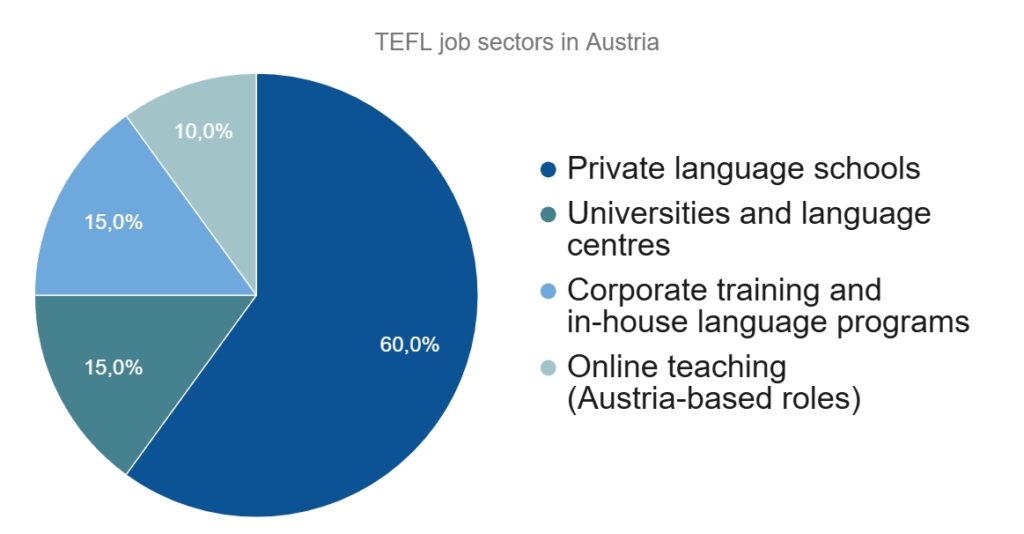
Note: This pie chart is intended as an illustrative guide to the typical distribution of teaching opportunities in Austria. Real shares vary by city, season, and market conditions. Readers should consult local job boards and employer networks to understand current demand in their intended region.
Key Considerations for Building a Successful Career in Austria
- A certified practicum with a strong portfolio boosts hiring confidence.
- Familiarise yourself with Austrian work visa requirements if you are not an EU/EEA citizen, and learn about Austrian government support regarding work permits and residence for skilled workers. Try to stay ahead of visa timelines. For work authorisation, refer to migration guidance.
- Build local connections by joining Austrian TEFL networks or language-teaching associations, attending local job fairs, and networking with language schools in your target cities.
- Whenever possible, write a bilingual CV and cover letter in both English and German, emphasising classroom management, learner-centred strategies, and examples of student progress.
- Be ready to give a brief demonstration lesson during the hiring process. Austrian employers appreciate the ability to clearly explain learning objectives, methods, and assessments.
Authoritative Sources and Fact Checks (References)
- Austrian Immigration and Residence Regulations (Red-White-Red Card): Official work visa options, points calculators, and legal requirements for non-EU/EEA teachers.
- Recognition of Professional and Academic Qualifications in Austria: Official Austrian information portal for the recognition and evaluation of foreign academic degrees and professional qualifications. Useful for individuals seeking validation of overseas credentials for employment, further study, or regulated professions in Austria.
- UK Register of Regulated Qualifications (Ofqual): Official register of qualifications regulated in England. Use it to check whether a UK-based TEFL qualification or awarding organisation is officially recognised within the Regulated Qualifications Framework (RQF).
- EU Recognition of Professional Qualifications Framework: European Commission guidance on the recognition of professional qualifications across European Union member states under Directive 2005/36/EC. Useful for understanding how qualifications may be recognised and transferred within the EU.
- Austrian Public Employment Service (AMS): Austria’s national employment service, providing labour market information, job vacancies, career guidance, and employment statistics across Austrian regions.
Do I need a specific certificate to teach English in Austria?
Most private language schools in Austria accept widely recognised TEFL/TESOL certificates that include teaching practicum. CELTA, CertTESOL, and other certificates with documented practicum are commonly preferred. For public schools, Austrian teaching credentials are normally required, and private TEFL qualifications may not be sufficient to teach in state schools.
Is Ofqual-regulated TEFL certification recognised in Austria?
Ofqual-regulated qualifications are often viewed as credible by Austrian employers because they signal quality and rigorous assessment. However, recognition is not automatic; verify practicum hours, transcripts and evidence of teaching ability with potential employers, and consider supplementing with EU or Austrian-recognised credentials where possible.
Can I teach English in Austria with an online TEFL certificate?
Online certificates with a verifiable practicum can lead to teaching roles in Austria, particularly in online or private language school settings. Ensure the practicum is supervised and properly documented, and be prepared to demonstrate the practical components in interviews.
Are there visa requirements for non-EU citizens to work as an English teacher in Austria?
Yes. Non-EU citizens typically require a work permit or residence arrangement. The Austrian immigration portal provides current guidance on work authorization, visa types, and application steps. Start early to align your certificate timing with visa processing.
How long does it take to become TEFL-certified in Austria?
Certification duration varies by pathway: in-person courses typically run around 4 weeks, online pathways range from 2 to 6 months part-time, and postgraduate certificates or master’s programs can take 9–24 months depending on study mode.
What are typical entry-level salaries for TEFL teachers in Austria?
Salaries vary by city, employer and whether work is full-time or part-time. In private language schools, entry roles often include a stipend or reasonable hourly rates, increasing with experience and qualifications. Large cities generally offer more opportunities and higher living costs, which can influence compensation expectations.
How should I choose a TEFL provider for Austria?
Look for programmes with verified teaching practicum, clear assessment processes, transparent transcripts, and a track record of graduates entering Austrian language schools. Prefer providers with international recognition and evidence of graduate outcomes. Check reviews and ask for contactable references from past students, ideally including those who taught in Austria.