Non-Native English Speakers Teaching Abroad: A Practical TEFL Guide

Teaching English abroad is a lively, flexible career that appeals to individuals at all levels. For the majority of those with aspirations to become teachers, the issue is not whether non-native speakers can teach English abroad, but how to gain the right qualifications, adapt to regional hiring practices, and build a long-term online or in-person teaching career.
This article is aimed at prospective TEFL/TESOL trainees with a desire to gather solid and practical information based on accepted standards and real-world application. You’ll discover concrete markers – from certification routes to industry realities – that help you develop a plan you can actually implement despite not being a native speaker.
Key Industry Insights
- Linguistic Shifts: There is still a lot of stereotypical language among recruiters around the benefits native speakers have, but there’s more evidence in linguistics and education suggesting that proficiency, cultural insight, and teaching strategies often trump birthplace.
- What Employers Value: Employers today place a higher value on proficiency, classroom management, and a well-constructed teaching portfolio than they do on poor assumptions around “natives-only” hiring.
- The Core Purpose: The purpose is not to take on the accent of a native speaker, but to perform with communicative competence, professionalism, and a deep educational comprehension of the process through which learners acquire language.
Our Goal: Based on practical steps, verified qualifications, and strategies to position you at the cutting edge of the market (whether you teach in practice in a foreign country or from home online), this guide highlights what you need to do to get that job.
In the sections to follow, you’ll discover:
- How non-native speakers can be offered great teaching experiences abroad.
- The most credible routes to certification and ways to progress.
- How Ofqual-aligned standards fit into the global TEFL market.
- Ways to support your online teaching career that builds on traditional classroom instruction.
Through the application of good certification and the approach you take to targeted job hunting, you can use your non-native perspective as a distinguishing professional element.

Opportunities for Non-Native Speakers: Teaching Abroad
There is still a strong global demand for English, and non-native speakers routinely secure roles in schools, language centres, universities, and corporate training programmes worldwide. Successful candidates have a valid TEFL/TESOL certificate supplemented with a bachelor’s degree, a confident teaching philosophy, and hands-on practicum or lesson-planning experience. Schools in most countries tend to value communication skills, reliability, and cultural fit more than whether the candidate’s first language is English. This offers meaningful opportunities for non-native speakers who are well prepared and can demonstrate impact in the classroom.
The Non-Native Advantage
Non-native speakers offer many benefits as teachers, including job security and professional growth:
- Empathy & Scaffolding: You are often familiar with learners’ struggles with language, clear strategies for scaffolding instruction, and sensitivity to cultural context – making classrooms more engaging and enhancing teacher-student rapport.
- Bilingual Connection: You might also use bilingual skills to connect with students and parents, particularly in multilingual environments where bilingual educators are valued.
- Niche Expertise: Most often, non-native speakers acquire niche knowledge – for instance, teaching pronunciation to students of a certain language family or creating curricula for exam preparation – that sets you apart from a broad field of applicants.
Action Plan: Targeting Regions
To seize the opportunities available, start by defining your target regions and settings:
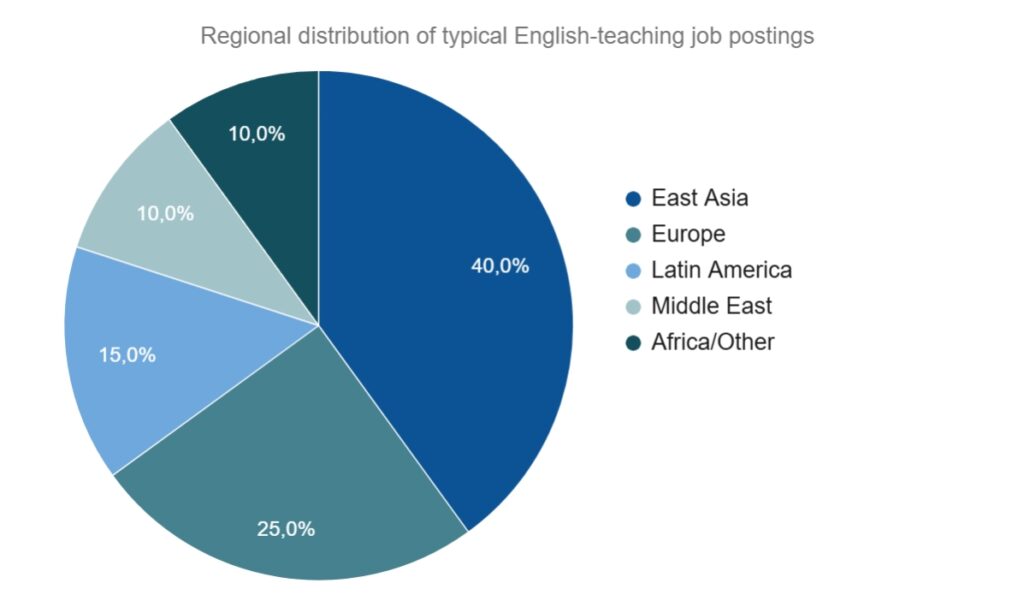
- Identify Markets: East and Southeast Asia, Europe, Latin America, the Middle East, and parts of Africa regularly employ English teachers with TEFL certificates.
- Review Requirements: Country- and institution-specific requirements differ, but common threads include a bachelor’s degree, a recognised TEFL/TESOL certificate (typically 120 hours plus a practicum), a clean criminal record check, and readiness to adapt to local teaching methodologies and assessment standards.
- Explore Options: Agencies, language schools, and international schools all offer different routes, with different visa and remuneration arrangements.
Practical Takeaway: Find two or three regions that you’d be excited to work in, then outline the certification and visa steps you’ll take to reach them.
Table: Regional Opportunities and Visa Realities
Many non-native teachers looking to teach abroad concentrate on where there’s demand based on their languages, their flexibility, and their visa options.
| Region | Market Characteristics & Opportunities | Visa & Contract Realities |
| East Asia | Long been a strong market for English teachers, where schools and language centres have structured contracts, with the added benefit of accommodation support and end-of-contract flights. | Some countries may require a work visa through an employer, while other countries offer work visa options that are either streamlined or seasonal. For these types of work, only a bachelor’s degree and a TEFL certificate are required. A criminal background check is also typical. |
| Europe | Both public and private institutions, with increasingly diverse student populations and varying visa schemes. | Visa realities vary greatly. Countries can also require health checks or additional documentation, and contract terms differ in terms of salary, housing, health insurance, and paid holidays. |
| Latin America | Dynamic nature offers teachers opportunities in classroom-type environments and community-based settings. | Visa realities vary greatly. Because visa conditions change over time, it is necessary to consult official government guidance and select reputable recruiters capable of offering current country-specific information. |
| Middle East & Parts of Africa | Competitive salaries and robust onboarding and safeguarding protocols. | Visa realities vary greatly. Because visa conditions change over time, it is necessary to consult official government guidance and select reputable recruiters capable of offering current country-specific information. |
When prospective teachers plan ahead – considering visa processing times, contract cycles, and possible language requirements – they experience less stress and can begin more smoothly.
Certification and Training: TEFL Paths for Non-Natives
Among the most important decisions for non-native speakers, choosing the right TEFL path is one of the most strategic.
Key Criteria for Selecting a Program
- Observed Practice: Selection of the correct programme will help in choosing a practicum component, clear learning objectives, and a clear evidence trail of accreditation. You will find that a certificate that contains observed teaching practice using real students shows that you are a planner, classroom manager, and evaluator of learning outcomes – critical skills for virtually any teaching job abroad.
- Employer Recognition: It is also appropriate to confirm whether your selected qualification is recognised in your chosen location by prospective employers and to have a transcript or certificate from the awarding body describing the qualification, hours completed, and the skills that students will learn.
- Standards Mapping: More than what you can obtain from any one piece of training, you will also benefit from knowing to what extent your training complements other professional standards.
Standards & Frameworks
Ofqual-aligned TEFL qualifications need to map to the UK’s Regulated Qualifications Framework (RQF), meaning they will demonstrate to others a level of achievement that’s recognised in other markets. Not all TEFL qualifications are Ofqual-compliant, but courses with Ofqual-compatible learning outcomes or those issued by accredited UK awarding bodies are therefore given more legitimacy when used internationally.
Considering the practicum hours provided (with and without tutor feedback), the range of content, young learners, exam preparation or business English, and how closely the qualification is aligned to more general professional practices, one would likely take into account the variety of potential teaching contexts. A good hybrid – in the form of a foundation certification with a practicum plus an advanced module or university-affiliated TESOL – guarantees flexibility with regard to markets and job levels.
Certification Pathways and Typical Hiring Focus
| Certification Type | Typical Duration | Prerequisites | What Employers Value | Ofqual Alignment | Notes |
| 120-hour online TEFL | 4–6 weeks (self-paced) | None, sometimes degree required | Convenience, breadth of coverage | Generally not regulated; check provider’s status | Best for getting started; practicum optional with some providers |
| 120–150 hour combined TEFL (online + practicum) | 2–3 months | Degree often preferred | Practical teaching practice, feedback | Some providers offer Ofqual-aligned options; verify | Strongly recommended for credibility |
| 150-hour classroom-based TEFL | 6–8 weeks | Typically degree | In-person instruction, peer teaching | May be Ofqual-aligned depending on awarding body | Good for hands-on experience; more costly |
| CELTA (Certificate in English Language Teaching to Adults) | 4 weeks (intense) | Bachelor’s degree often required | Global recognition, strong practicum | Not Ofqual-regulated; widely recognised internationally | Industry standard for many schools; rigorous |
| DELTA (Diploma in Teaching English to Speakers of Other Languages) | Several months (module-based) | CELTA or equivalent | Senior roles, curriculum development | Not Ofqual-regulated; prestigious in many markets | Advanced credential; plan for long-term progression |
| University-affiliated TESOL degrees | 6–12 months (full-time) | Degree, sometimes teaching practicum | Depth of theory and research, career versatility | Many are aligned with university accreditation, not necessarily Ofqual | Value for leadership roles; higher cost and time |
Selecting Your Pathway
In order to facilitate informed decision-making, countless providers release comprehensive descriptions of the certification pathway. Seek structured syllabi, clear assessment criteria, and support for job or visa placement guidance.
- Level 5/6 vs. CELTA: Some trainees choose to pursue a course (with the potential to further their qualifications) that leads to a Level 5 or Level 6 qualification in accordance with the UK Regulated Qualifications Framework (RQF); others choose to take an internationally recognised CELTA certificate for immediate classroom readiness.
- Weighing Factors: In any given situation, weigh cost, time to completion, and the credibility of the awarding body against the market for your ideal jobs.
- Practical Components: It is also worth mentioning that well-known TEFL courses will provide a sample lesson, micro-teaching opportunities, and ways to observe or co-teach with experienced teachers as part of a practicum.
Navigating Qualifications: Ofqual-Aligned TEFL Standards
Ofqual-aligned TEFL standards set a model by which learning outcomes are checked against the requirements of the UK Regulated Qualifications Framework (RQF). For non-native English teachers in both UK and international contexts, knowledge of Ofqual alignment will enable you to signal the extent of your training in a consistent and confident manner. For example, an Ofqual-regulated qualification carries formal recognition as a regulated credential, which can be particularly beneficial when applying to international programmes or schools that prioritise a hierarchy of qualifications. This makes sure that your certificate is benchmarked against expected thresholds for course content, assessment integrity, and learning outcomes across different countries.
Evaluating Ofqual Alignment
Look at whether a course is regulated under Ofqual or whether there is an Ofqual-aligned route:
- Regulated Providers: Some providers partner with awarding organisations in the UK, providing certificates that clearly state the RQF level, credit value, and assessment criteria.
- Non-Regulated Providers: Others provide courses that have broad acceptance and no official Ofqual regulation in place, and these still require you to be diligent in reviewing the course design, student support, and practicum quality – all of which determine employability.
- The Recommendation: For non-native teachers, the implication is to focus on programmes that include a practicum, diverse teaching contexts, and clear evidence of alignment to recognised standards (whether Ofqual or not). In areas with strong regulatory oversight, having an Ofqual-aligned qualification can be an appealing credential.
Step-by-Step Evaluation Protocol
Readers need to be able to weigh options in real time, so here’s how they can go about doing this:
- Verify whether the qualification is Ofqual-regulated or Ofqual-aligned through the awarding body.
- Check the level and credit value shown on the certificate to determine where it sits in the RQF.
- Review the course syllabus against job advertisements in your target markets and make sure the content matches what employers expect.
- Seek testimonials or case studies from graduates who have already worked in the region where you want to work to determine whether the qualification transfers well to real-life situations.
- Determine whether the course includes a practicum or observed teaching component is very important when securing contracts.
- If you’re not sure, reach out to the provider’s student support team or request a sample transcript and practicum outline.
Formal documentation of a practicum demonstrates your classroom competence, which links to career opportunities across a wide variety of roles.
Building Your Online Career: Teaching Abroad Realities
The web-based teaching landscape is very supportive of in-person teaching. Online teaching may also be suitable for non-native educators who require flexible working schedules, reduced relocation risk, and greater access to students globally. However, online education also necessitates strict timetabling, clear online communication, and effective safeguarding.
To take the next step, you’ll need a professional presence in the digital space, an organised course catalogue, and a dependable tech stack (reliable internet, a quality headset, and a flexible lesson plan library). Online markets reward clarity of delivery and active student involvement, as well as reliability in student support. Time zones, platform policies, and feedback loops with students are aspects you will need to navigate.
Key Online Strategies
In practice, building a successful online career alongside teaching in the school system demands many different strategies:
- Develop a small portfolio that includes sample lessons, brief micro-teaching videos, and a teaching philosophy.
- Choose a platform that matches your strengths, and ensure you have a strong focus on the needs of your students.
- Consider platform-specific requirements, such as student feedback mechanisms and teacher assessments.
- Prepare for future demands related to safeguarding and data protection online (confidentiality, privacy, student data, and content).
- Develop a work-life balance that takes advantage of peak demand times in other regions of the world while protecting your health and wellbeing.
- Establish your own personal brand that highlights your voice and how it can make a difference as a non-native teacher. This could include pronunciation training for certain language groups, cross-cultural communication, and exam preparation skills for students in your market segment.
The Teacher Toolkit
One practical tool used in online work is a “teacher toolkit”, a set of classroom resources that can be customised to fit your needs in an adaptable format.
- Provide basic classroom materials (lesson plans, slides, and worksheets), a repository of warm-up activities, and a few ready-made activities at all levels.
- An organised way of documenting and correcting exercises can lead to continuity of learning and help clients stay on track.
- Online work is more scalable and allows you to cater to learners from multiple regions without compromising quality.
Regional realities also remain important in online teaching. There is high demand for Business English, General English, and exam preparation courses. A non-native teacher who can balance online teaching with local on-site work typically develops a stronger, more well-rounded portfolio – which makes them more employable in both traditional schools and online platforms. The strategy is simple: align your work with your strengths and market demand, and ensure your online role complements your on-site teaching opportunities.
Career Pathways and Professional Development
The Foundation of Career Progression
To avoid the conventional career path of one that offers only initial training, non-native teachers should have a balanced path to career progression that combines:
- Certification
- Professional skills development
- Focused local exposure
Starting with a teaching portfolio and classroom-based practicum build-out helps to make an early career statement and demonstrate a track record. This provides you with entry-level opportunities and builds trust with local schools or language centres.
Diverse Career Trajectories
Career advancement for non-native English teachers is not limited to traditional classroom roles. Professionals in this field often branch out into specialized areas:
| Path A: Educational Specialists | Path B: Management & Design |
| Others become:
• Senior teachers • Teacher educators • Curriculum designers / materials creators |
Others move into:
• Programme management • Academic coordination (where their non-native approach to teaching at a technical level can facilitate the development of programmes that are more welcoming and effective) |
The Power of Networking & Professional Connections
Networking is still considered an underappreciated but paramount part of the career development process, and as a result is even more important now:
- In-Person Engagement: Go to conferences in person, attend TEFL conferences, join regional teacher communities and meet some of your certificate programme alumni.
- Digital Presence: Use LinkedIn and professional networks to pinpoint mentors, job openings and collaborative opportunities for lesson-planning projects or research.
Building a Strategic Route
A credible qualification goes a long way in creating a reliable route, and with the right direction, a dedicated but goal-oriented regional job-searching approach and career development, you can build and grow your future career path more strongly.
Conclusion
In conclusion, non-native teachers can develop a successful and long-term career overseas or online through:
- Good certification
- Ofqual-aligned standards (wherever possible)
- Practical teaching experience
- Personal development
Your Unique Advantage: Discover how to use your non-native perspective as a resource (it’s rooted in sound pedagogical principles, cross-cultural competencies and real-world application), and thus your path from certificate to classroom is not only successful but lasting.
Authoritative Sources and Fact Checks (References)
- UK Government – Register of Regulated Qualifications (Ofqual): Official database to verify if a TEFL/TESOL training provider is offering a genuinely regulated Level 5 or Level 6 qualification on the Regulated Qualifications Framework (RQF).
- British Council – TeachingEnglish: An authoritative platform offering evidence-based research, teaching frameworks, and resources showing how non-native multilingual educators excel in global ELT environments.
- UK Government – What Qualification Levels Mean (RQF Framework): Official guide explaining the different levels of education (e.g., Level 5 Certificate as equivalent to a foundation degree).
Can a non-native English speaker truly teach abroad?
Yes. The essential requirements are a recognised TEFL/TESOL certificate (with practicum), a bachelor’s degree (in many markets), and the ability to demonstrate strong teaching skills. Employers increasingly value classroom effectiveness, communication clarity, and cultural sensitivity over nativeness of English alone.
What certification is best for non-natives?
Aim for a certificate with a solid practicum component and a credible awarding body. If possible, choose one with evidence of Ofqual alignment or alignment with international standards, plus a certificate that includes demonstrable teaching practice and robust assessment.
Do Ofqual-aligned TEFL qualifications matter to employers?
Ofqual alignment signals adherence to recognised standards and learning outcomes. It can enhance credibility with international employers, though many markets accept non-Ofqual qualifications that satisfy basic teaching standards and practical experience. Always verify employers’ requirements for your target region.
Is it possible to teach online if I’m not in the UK?
Absolutely. Online TEFL is widely accessible and can be a viable route to gain experience while teaching abroad or from home. Focus on building a strong online teaching portfolio, mastering digital tools, and understanding safeguarding and privacy requirements for online education.
Which regions are best for non-native teachers?
Regions vary year to year, but non-natives commonly find opportunities in Europe, parts of Latin America, and select Asian markets when they have strong language skills and well-rounded teaching credentials. Always research current visa requirements, local norms, and typical compensation packages for your target region.
How can I improve my chances of getting hired?
Invest in a credible TEFL certificate with practicum, develop a strong teaching portfolio, gain classroom practice, tailor your CV to each region, prepare a concise teaching philosophy, and be prepared to demonstrate how you support diverse learners. Networking through alumni groups and TEFL events also helps.