Teaching English in Latin America: Certification, Training, and Careers

Latin America is a vibrant and growing market for English language teaching, with millions of learners seeking fluency for study, travel, and professional advancement. For aspiring teachers, the difference between a rewarding career and a missed opportunity often comes down to certification, training, and how well the chosen programme aligns with employer expectations in the region.
Introduction to the Guide
The article presents a practical, standards-aware guide to TEFL/TESOL certification, qualifying routes, and realistic career prospects, both in-country and online. It also explains how quality pathways, especially those aligned with Ofqual standards, can enhance credibility, portability, and long-term career options. Readers will find clear guidance on choosing reputable providers, preparing for Latin American work environments, and developing a career plan that blends teaching excellence with personal goals.
Certification Standards in Latin America
Certification of teachers in Latin America depends on a combination of worldwide best practice and localised hiring practices. TEFL (Teaching English as a Foreign Language) and TESOL (Teaching English to Speakers of Other Languages) certifications can differ significantly in length, depth, and practicum requirements, but a strong baseline is generally accepted:
- A certificate approximately 120 hours in length.
- Some type of teaching practice or practicum.
Many schools in major Latin American cities (Mexico City, Bogotá, Lima, Santiago, Buenos Aires) seek both credentialing and classroom-ready competencies. Institutionally, the standard for recruitment can be different, there are private language academies, multinational schools, and universities with differing standards. It is a great practice at times, and a recognised certificate has practical, useful information in relation to those positions where classroom management, lesson planning, and ongoing feedback of students are required.
The Importance of Accreditation
This is supported by the industry advice issued by reputable organisations, including the British Council, which highlights that well-designed TEFL/TESOL qualifications must be a mix of theory and practice in order to provide the necessary preparation for real classrooms, as indicated in the British Council resources on TEFL/TESOL pathways. Readers attempting to teach in Latin America can therefore benefit from knowing this difference in programmes, as it helps in deciding from these programmes to provide for the needs of learners, from beginners of all ages, to professionals.
There are numerous reasons why accreditation and other forms of recognition have high value, not only for staff who would work across borders and who wish to have a long-term goal of teaching, but also for those who want to use this sort of knowledge later in their careers.
Certification Formats:
- One-off online classes.
- Rigorous in-person or hybrid curriculum.
- Programmes featuring ‘hands-on’ teaching practices in a real classroom setting.
For employers in Latin America, more certifications are preferred where there is a practicum component or teaching practicum component that implies readiness to manage live classrooms and provide the teacher with feedback on students. CELTA and Trinity TESOL certificates are globally recognised qualifications that are being used in Latin America, to name a few, they are considered gold standards in teacher education. Nevertheless, many non-CELTA TEFL subjects which are underpinned by a strong training component are also praised, particularly when complemented with proof of ongoing professional development.
Regulatory Frameworks
Ofqual, UK awarded qualifications can sit within respected regulatory environments or frameworks that are recognised by employers as providing an assurance that standardised outcomes are to be expected. Just ask yourself, is the provider providing practicum with real students, and what course content, assessment methods, and learner outcomes you want review? High quality programmes and vital indicators to potential Latin American employers also have clearly articulated practical components, a transparent syllabus, and continual learner support as the keystones.
Expert Advice on Choosing a Provider
Choose a TEFL provider, which is a careful decision. “We hope that prospective teachers will look at the number of sessions and hours studied for certain courses, the kind of teaching you will do, the nature of the coursework you’ll be undertaking, opportunities for teaching supervised, the amount of teacher guidance available through assistance received, and post-certification support services such as opportunities for job placement or a visa,” Dr Chaudhary said.
Budget matters, but value should be considered in the long run, as a lower price course without practicum and no clear outcomes may feel like a disappointing experience when you do finally get into the field. Reachability (online vs. face-to-face), time requirements, and the possibility of leveraging credits for further professional development could affect your decision-making process. It’s also worth looking to see if the provider is forthright about what the certificate can and cannot offer the candidate in the job market in Latin America. Lastly, think over if the programme does provide a process in alignment with Ofqual or more formal, regulated qualifications, which may allow students to move and employ with more ease, if yes, of course. This is a region where good guidance from a TEFL training provider can also save time and expand your choices in the Latin America region.
Qualifying Routes and Training for Latin American TEFL Roles
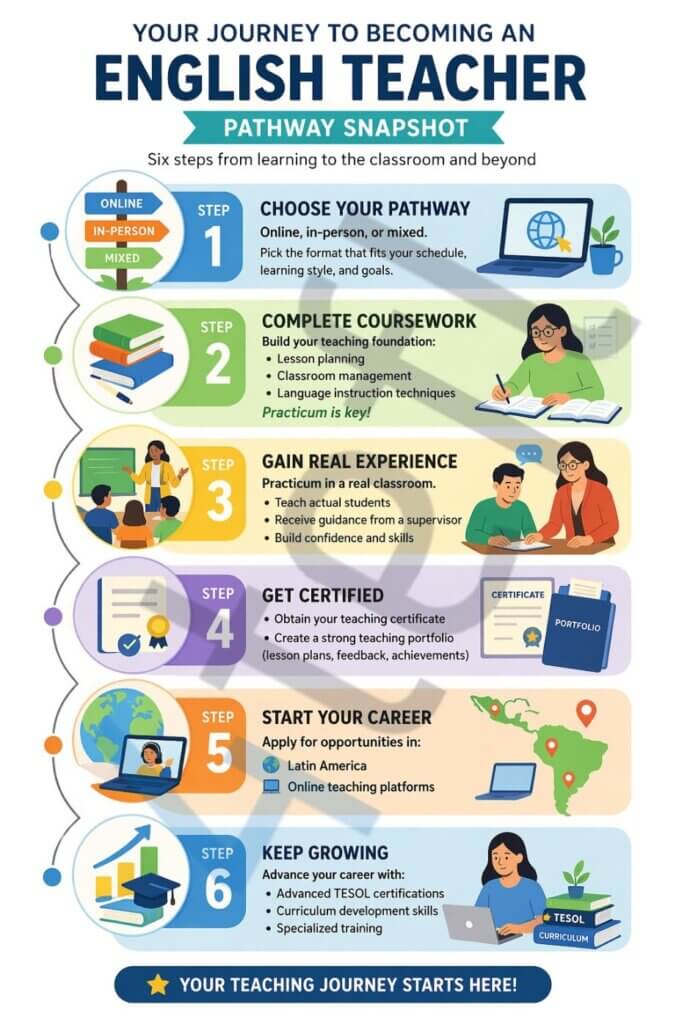
In Latin America, the paths to TEFL/TESOL employment include all aspects of a combination of online and face-to-face experience, along with regionally relevant qualifications. For most would-be teachers, it is up to them whether to go for:
- In-country training.
- An online programme.
- A hybrid model combining online with short in-person practicum.
In-country options usually include CELTA or similar qualifications through regional centres or partner organisations with an instructional placement in a classroom setting. Flexible online and hybrid routes offer additional choices for those juggling work, study, or family commitments.
The Ideal Training Model
But the top choices are those that combine a strong theoretical foundation with a supervised, hands-on, real-world teaching practicum where you are paired with teachers who have served more than three years in positions of authority and receive feedback, and you hone your classroom methodologies before walking into a live classroom.
Such routes seem particularly relevant because of the global demand for English language instruction, with many Latin American schools already using and engaging with schoolteachers from a large range of backgrounds and experiences so far, provided the candidate demonstrates solid classroom-ready skills and a professional approach to lesson design and delivery.
Core Training Content
The basic content on training materials varies generally between routes, typically focusing on:
- Science of language learning.
- English grammar and vocabulary.
- Lesson design and sequencing.
- Assessment and feedback.
- Classroom management.
Practical focus is crucial, from preparing and delivering lesson plans, to delivering micro-lessons and receiving feedback from mentor teachers. Educators then must learn to differentiate instruction to meet the needs of students with diverse proficiency levels, to modify material for individual students at different ages, and to have technology assist learning in a child’s environment.
Professional Development
Teacher development modules typically involve watching other teachers work and reflecting, as well as regularly scheduled professional development. In Latin America, schools can be spread across a variety of contexts, be it private language schools or public or international schools, thus a practicum that resembles the classroom is absolutely essential. That is with institutional advice that supports evidence-based teaching practices and reflective teaching practice to help ensure that teachers know how to localise their pedagogy according to the children in their local learning environment and the cultural issues that exist as part of the classroom.
Planning Your Path
When deciding on a route, focus on clear programme outputs, written teaching practice, and rigorous assessment that is evidence of progression from a novice to more developed teaching skills. A realistic route typically begins with an unambiguous stance and a plan for the next twelve to twenty-four months.
- For local flexibility: An online certificate is also the preferred option for those who are able to do a structured practicum as a facilitator in your community, library, or language club.
- For immersion: A CELTA/Trinity route in a nearby country, in which you have supervised delivery in real classes with an assessment of teaching competencies to help you get a clear sense of your practice.
In both scenarios, check whether the practicum is formally supervised by a professional trainer and whether you are given timely, specific feedback. Theory, practicum, and reflective practice are the three key components that distinguish a quality TEFL programme from an adequate one and lead to higher-quality teaching in Latin American classrooms. Ofqual-aligned pathways or regulator-supported pathways are also an additional level of assurance of the quality of your training and the eventual professional credential.
Career Prospects: Teaching English Online and In-Country
Teaching opportunities in Latin America, in-country, have also been available from private language schools, international schools, universities, and corporate training courses. Bigger cities such as Mexico City, Bogotá, Lima, Santiago, and Buenos Aires are filled with opportunities, and there are growing institutions for higher education and partnerships with e-learning companies.
Teachers with a strong TEFL/TESOL certificate, a sound lesson planning portfolio, and some teaching experience can sign full-time contracts containing benefits or lengthy contracts with more predictable income in most urban centres. Careers can involve wearing many hats at once, both for technical graduates and students.
Compensation and Market Research
Salary levels between countries, cities, or contract types are diverse. What a teacher makes will depend on:
- Full-time vs. part-time status.
- Total working hours.
- Additional duties (curriculum development or staff mentoring).
It is a must to see how the local market is doing, examine the cost of living, and consider pay in terms of competitiveness. One dependable way for prospective teachers to get their heads around options is by reading job descriptions and interviewing those who currently work in the area. This will set up expectations in terms of time, wages, visa requirements, and even potential career progression at work. Moreover, despite lower wages in some Latin American countries compared to global standards, the opportunity to train in various classrooms that are richly diverse is a solid precursor to building a career, including teacher training, curriculum planning, and academic leadership.
The Rise of Online Teaching
Online teaching has become an essential part of most TEFL career paths for Latin American teachers. The time-zone advantage, freedom of movement, and ongoing global demand for English language teaching make it a desirable supplement or alternative to in-country work as well.
Many online positions offer higher hourly rates than part-time in-country roles, with the caveat that competition in the market can be tough and some platforms require specific qualifications, like a bachelor’s degree, a minimum level of teaching practice, or a structured portfolio for lesson plans. For many teachers, online teaching offers a way to increase balance of income, continuity of projects, and a global teaching profile.
A Balanced Strategy:
In Latin America, a balanced career strategy might offer a mix of in-country teaching (giving classroom exposure and local certifications) and online work (stabilising income and building professional ties). In addition to salary considerations, teachers should research visa policies, work permits, and local regulations that govern foreign workers; many Latin American countries require work authorisation, and employers often provide guidance and support in going through these procedures.
Quality TEFL Pathways: Ofqual Standards and Latin Careers
Regulatory frameworks for clarity, accountability, and transferability of credentials are now recognised in high-quality TEFL pathways. Ofqual (the UK qualification agency) works based upon the guidance of a framework to make sure qualifications are fit for purpose from a national level and result in consistent learning outcomes.
Not all TEFL certificates are Ofqual-regulated, but some providers offer credentials that are regulated by the Regulated Qualifications Framework (RQF) or are also recognised by Ofqual through the awarding body’s registers. For teachers looking to take up an extended, globally competitive career which also includes opportunities potentially in the UK or elsewhere, seeking Ofqual-aligned or regulated pathways will give more comfort to employers who care about formal quality.
Verifying Your Credentials
During the assessment process, TEFL candidates should be able to verify:
- If the qualifications of the provider are registered with Ofqual or the UK Register of Regulated Qualifications.
- If the certificate has a recognised level (i.e. Level 3 or Level 5) on the Regulated Qualifications Framework.
This is the type of diligence that is part of creating credibility which will last beyond job postings, and it will be an ongoing credential during your teaching career.
Key Determinants of Quality
Given Ofqual standards, the quality of a TEFL pathway can be determined mainly by a number of aspects:
- Learning Outcomes: Must reflect concrete teaching competencies (lesson planning, classroom management, assessment, reflective practice).
- Supervised Practice: Must embed teaching practice with actual learners and structured feedback.
- Support Services: Strong follow-up including career guidance, visa advice, and links to employers.
- Transparency: Clear information about costs, time commitments, and accreditation processes.
If the pathway describes an Ofqual alignment, then there should be valid documents for the status, registration, and verification of the regulatory outcome. These features combine to ensure that TEFL graduates can exhibit transferable competencies desired by Latin American language schools, international schools, and online teaching platforms.
Certification Pathways and Their Features
| Pathway type | Typical hours | Practical component | Regulation status | Pros | Cons |
| 120-hour online TEFL (foundational) | 120 | Minimal or none | Typically unregulated | Flexible, low cost; good introduction | Limited employer acceptance for some roles; no practicum |
| 120-hour online + 6-20 hour practicum | 140-140+ | Yes, supervised teaching practice | Often unregulated but practicum included | Real teaching experience; better job prospects | Still may not be accepted by all employers; practicum quality varies |
| In-person CELTA/Trinity (TESOL) training | ~120 hours input; 6-12 hours teaching practice | Yes, extensive practice | Not always Ofqual-regulated, but highly recognised | Broad international recognition; strong employability | Higher cost; time away from home; logistics |
| Ofqual-regulated Level 3/5 TEFL qualifications | Varies (often 120-360 depending on level) | Yes or integrated practicum | Regulated by Ofqual (RQF) | Credible in UK and some international contexts; portability | Availability may be limited; can be more expensive |
Authoritative Sources and Fact Checks (References)
- British Council – TEFL/TESOL Qualifications: Guidance on choosing reputable teacher training pathways and understanding international standards.
- Ofqual (Office of Qualifications and Examinations Regulation): The official register for regulated qualifications in the UK, providing transparency for Level 3 and Level 5 certificates.
- Cambridge English – CELTA: Details on the gold standard for teaching English to speakers of other languages, frequently cited in the article.
- UNESCO – Education in Latin America and the Caribbean: Regional data on educational trends and the demand for language instruction in Latin American markets.
Do I need a bachelor’s degree to teach English in Latin America?
Requirements vary by country, school type, and visa conditions. Many private language schools will hire teachers with TEFL/TESOL certification, but a bachelor’s degree is commonly preferred and can be essential for work visas or positions in universities and international schools. It is prudent to research the specific country’s regulations and the school’s expectations before deciding on a certification path.
Is online TEFL certification acceptable for Latin American employers?
Online TEFL certificates can be acceptable, especially if they include a substantial practicum and demonstrate hands-on teaching experience. Employers often prioritise classroom-ready skills, lesson planning ability, and a proven track record with learners. Look for programmes that offer practicum with feedback and verifiable teaching practice hours.
How long does it take to complete a TEFL credential?
Completion times vary. A basic 120-hour online course can take a few weeks with steady study, while combined online/in-person pathways or CELTA/TESOL programmes typically run from four to eight weeks for intensive formats or longer for part-time options. It’s important to build in time for practicum requirements and for developing a teaching portfolio.
Are Ofqual-regulated TEFL qualifications useful in Latin America?
Ofqual-regulated pathways provide recognised quality assurance and can facilitate credit transfer or future teaching opportunities in the UK or other jurisdictions that value regulated qualifications. In Latin America, many employers prioritise practical teaching ability and demonstrable results over regulatory status, but a regulated credential can improve credibility, especially for long-term or career-spanning roles.
How can I find TEFL jobs in Latin America?
Start by networking with alumni from your TEFL programme, joining regional teaching communities online, and exploring job boards that specialise in Latin America. Use language schools, international schools, universities, and corporate training programmes as potential targets. Prepare a teaching portfolio that includes lesson plans, micro-teaching videos, and a reflective teaching journal. Consider visa and work-permit requirements early and seek providers or employers who offer support with relocation and licensing.
Should I learn some Spanish before teaching in Latin America?
While not always mandatory, learning basic Spanish enhances your effectiveness in the classroom, helps with classroom management and culture, and improves your ability to collaborate with colleagues and parents. Demonstrating cultural responsiveness and a willingness to engage with the local community can also strengthen your job applications and on-the-ground classroom performance.
What are typical career pathways after TEFL certification in Latin America?
Early-career teachers often focus on classroom delivery, lesson planning, and classroom management. With experience, you can progress into mentor or trainer roles, curriculum development, teacher supervision, or administrative positions within language schools. Some teachers also transition into online teaching to supplement income, or pursue further qualifications (e.g., advanced TESOL, leadership in language education) to broaden opportunities in international schools or institutions.
Is there value in a combined in-country and online teaching strategy?
Absolutely. A blended approach can provide financial stability, broader experience, and a resilient career profile. In-country teaching builds local credibility and cross-cultural skills, while online teaching expands your global reach, protects against market changes, and allows you to maintain a diversified client base. This approach is increasingly common among TEFL professionals aiming for long-term, flexible career trajectories.
What should I look for in a TEFL programme to ensure it helps me land a Latin America job?
Look for: (1) a clear practicum component with real learners, (2) demonstrated learning outcomes and a robust assessment framework, (3) post-course career services such as job placement assistance or interview coaching, (4) transparent pricing and refund policies, (5) evidence of quality assurance, such as feedback from graduates and, if possible, Ofqual-regulated status or recognition from established awarding bodies. A reputable provider should be able to discuss regional job markets, visa considerations, and how their graduates typically fare in Latin American settings.