Teaching English in Turkey: A Practical TEFL Guide


Turkey is a melting pot of cultures, cosmopolitan cities, and ancient heritage with great potential for newcomers as well as experienced teachers. But readers face a morass of questions: what qualification do I really need, which TEFL/TESOL course would be recognised, how do I secure a visa, or what are reasonable career routes?
This guide is meant to get through the noise, providing solid, evidence-based guidance aligned with global standards. It is built on credible sources and personal experiences to support prospective teachers planning, attaining certification, arriving, and working their way into Turkey, and further developing their careers in Turkey.
You start teaching English in Turkey by learning to teach and becoming certified through teacher training. Certification indicates to employers that you can, and do, apply pedagogical skills and classroom management strategies and that you have the language skills that would best fit classroom settings.
Because Turkey has a cocktail of private language schools alongside international campuses and universities, employers often value proven credentials rather than novices. At the same time, the market is quite diverse: entry-level roles may prefer a solid 120-hour TEFL/TESOL certificate, whereas more competitive positions – especially in the city centres – could favour or demand more thorough qualifications, observed teaching practice, or CELTA equivalents.
This article provides actionable strategies for selecting courses, familiarising yourself with Ofqual-aligned options, and working through the challenges of visas, contracts, and pay realities so you can make strategic decisions before you set foot in the local market. An overview of credibility and actionable steps will be presented in a systematic manner, supplemented by reliable checks and illustrative examples. Throughout, you will find actionable suggestions for comparing programmes and assessing employer expectations for the pathway from certification into classroom impact. You will also find a short reference table and an infographic-style guide to help you see the main options at a glance. All guidance is based on established standards and information in the public domain from valid sources.
Overview of TEFL/TESOL Certification for Turkey Positions
TEFL and TESOL are used interchangeably in job advertisements, and almost all entry-level jobs require candidates to hold a recognised certificate that will demonstrate both language competency and methodological competence.
In general, a certificate with a minimum of 120 hours of instruction, in addition to observed teaching practice or a practicum, is a baseline requirement. This practical component attracts much interest from Turkish hiring companies as it provides tangible proof that you can organise lessons, control a class, and modify activities according to ability levels. Although other schools will recognise shorter non-practitioner formats, a solid certificate along with a practicum is a sure advantage for job and career prospects.
Aside from the 120-hour cut-off, the market accepts a variety of certificates.
For most new teachers, the standard online TEFL with a practicum is both feasible and inexpensive when supplemented by in-class teaching practice under supervision.
More experienced students may qualify for CELTA or TESOL certificates issued by established authorities, which are reputable and recognised for their high-quality standards and intensive coursework.
In Turkey’s heterogeneous world of employers, certificate value is often attached to the reputation of the provider, observed teaching hours, as well as the qualification being in line with international standards. A comparative table below summarises typical certificate choices and what to look for in each.
Key features of common TEFL options
| Certification option | Typical hours | Practicum / Teaching practice | Recognition | Notes |
| 120-hour online TEFL | ~120 | Often optional; practicum varies | Moderate | Accessible and affordable; verify practicum if possible |
| 120-hour TEFL with practicum | ~120 | Yes; observed lessons or microteaching | Higher | Preferred by many employers; look for verifiable practicum credits |
| CELTA/TESOL (120 hours) | ~120 | Full practicum; observed teaching | High | Widely recognised in international markets; typically more expensive |
| Ofqual-regulated TEFL (UK awarding body) | ~120 | Usually includes practicum | High | Aligns with UK regulatory framework; check Ofqual registration |
The indicated options are representative and meant to help you compare features. Always verify the specifics with the issuing body and the employer. For formal standards and regulatory details, consult Ofqual’s guidance on regulated qualifications and the recognition statements from reputable awarding bodies.
Choosing Credible TEFL Courses: Ofqual-Aligned Options
Ofqual alignment has value only as far as the credibility and regulatory oversight it signals. Ofqual is the independent UK regulator for qualifications, examinations, and assessments. Ofqual-regulated or Ofqual-aligned courses or certificates are designed to meet defined criteria, with knowledge generally traceable to a recognised awarding body. This helps build trust with Turkish employers regarding your credential if you are applying to a foreign school or organisation because they have global recruitment practices.
If you see a TEFL certificate advertised as Ofqual-regulated or Ofqual-aligned, you can then go ahead and double-check whether the certificate contains a formal practicum supervised by an approved assessor.
The initial steps to verify credibility are: verify that the awarding body is on Ofqual’s register, ensure that the certificate is clearly identified as being “Ofqual-regulated” or “Ofqual-aligned”, and verify, if necessary, that the course offers a supervised teaching element or practicum.
The UK regulatory framework for qualifications requires institutions registered with Ofqual to publish a registration number and the scope of recognition. In Turkey, many employers are already aware of UK-acclaimed, Ofqual-regulated TEFL qualifications, particularly in international schools or language-school chains. Of course, not every Turkish employer requires Ofqual recognition, but it does serve as a sign of quality and conformity with international teaching standards.
Seek out courses from recognised UK awarding bodies and ensure a strong record of Ofqual registration and a practicum component, as well as documentation of the scope of Ofqual recognition. If you are in doubt, contact the awarding body to confirm its current regulatory status and obtain a link to the correct Ofqual register entry. Integrating Ofqual credentials with a strong practicum establishes a solid foundation for teaching English in Turkey and supports future professional development and promotion opportunities within TEFL. To clarify further, see Ofqual’s official information on regulated qualifications and registered awarding bodies, which can be found on GOV.UK and Ofqual’s own site.
Living and Working in Turkey: Visas, Contracts, and Pay
Visas and Legalities
The key route that most teachers usually take to work lawfully in Turkey is to obtain a work permit, whereby teachers secure jobs and then have the employer deal with the vast majority of the work permit and visa processes. In reality, most language schools or universities will help with the necessary paperwork, but the teacher must eventually secure the correct visa.
The usual procedure is: get a teaching job, then the employer makes the work permit application to the Turkish authorities while you submit the long-stay visa or residence permit application through a Turkish consulate or embassy. Upon arrival, you complete local registration and any necessary residency procedures.
As processing times and eligibility requirements may change, this process should be initiated early. For up-to-date guidance, turn to official government resources or consular advice, such as travel.state.gov information about Turkish work permits and advice from the UK government on working abroad.
Contracts and Benefits
In Turkey‘s English-teaching market, contracts will often consist of multiple benefits, including base pay. Standard terms include a set monthly salary, typically with performance-related remuneration or yearly increases, a specific teaching timetable, and funding for housing – or accommodation – in certain packages.
Some schools also provide flight allowances, paid holidays, or health insurance as part of the contract. You need only be aware that every contract is different: some schools provide housing in the city centre or near the campus, and some offer a housing allowance, after which you must secure your own accommodation.
Make sure to clarify working hours, holiday benefits, overtime, salary payment terms, early termination of contract, and visa support commitments during negotiations. As Turkey’s labour laws and visa regulations undergo regular revisions, before accepting any contract, take a look at the most recent guidance from official authorities or legal advisers.
Pay and Living Expenses
Turkey’s pay, on the other hand, is city-based, sector-based, and experience-based. Pay scales are modest by Western standards, especially for private language education, though some positions will offer housing or housing allowances, meals, and transport allowances.
In larger cities like Istanbul, Ankara, or Izmir, pay packages can also vary according to higher living costs and may be a bit more competitive for those with CELTA or other quality qualifications and a few years of teaching experience.
Living expenses vary from place to place in Turkey, with the largest cities experiencing more expensive rents and utilities, whereas a lower cost of living is typical in more regional areas. Consider how much rent, utilities, transport, and food will cost and whether a school provides housing or a stipend to support living expenses when planning financially. Where practical, ask for a specific breakdown of the benefits included in your package and request a written offer before relocating.
Practical Teaching Placements and Career Paths in Turkey
Placement opportunities for English teachers in Turkey can be found in private language schools, international schools, and universities. Language schools provide many entry-level roles, particularly for recent graduates with TEFL/TESOL certifications. International schools and universities may require a more formal academic background, sometimes leading to the need for a further degree or additional subject-area qualifications. Both private tutoring and online teaching are becoming increasingly common and may provide flexible hours, particularly once school hours have ended.
Most teachers seek career growth, training, and experience within the field, alongside classroom work (e.g. teacher training), as well as career advancement opportunities within their institution. The possibilities are wide, and networking can be as valuable as formal credentials in a country where English-language programmes continue to grow. Placements are usually available on online job boards, through recruitment agencies, or via direct application to schools. Networking with expat communities and alumni circles can lead to referrals and insights into school culture, contract terms, and visa support.
One practical way to work towards a teaching career is to ensure that the TEFL/TESOL certificate you obtain closely matches the level and type of institution you are interested in. Focus on institutions and locations where demand for English instruction continues to grow. Istanbul and Ankara tend to have the largest range of roles, while coastal or tourist destinations may feature seasonal or part-time work. Having a prepared CV, a short cover letter designed for Turkish employers, and a sample lesson plan portfolio makes securing a placement more likely.
In Turkey, many careers extend beyond classroom teaching. With experience, teachers are able to move into roles such as lead teacher, mentor, teacher trainer, or curriculum specialist in schools or language centres. Some educators combine on-the-job learning with online teaching to diversify their income and reach. For others, career development involves creating teacher-education programmes, designing professional development (PD) programmes, or participating in teacher-training projects for schools or universities. Turkey’s broader TEFL market also encourages career mobility into neighbouring or online markets, allowing international teachers in Turkey to apply what they have learned in Turkish classrooms to other parts of the world. Through early planning for professional development, you can set yourself up for advancement while remaining flexible in response to changes in demand and policy.
Getting Started, Timelines, and Practical Tips
Timeline and Milestones
With a clear plan, certification can be completed within one to three months, depending on course format and practicum requirements. Securing a job usually takes between 1–3 months from initial applications until you receive a favourable offer, but timelines vary with visa processing and market cycles. Begin by searching for a few Ofqual-aligned or well-regarded TEFL certificates, then write your CV and teaching portfolio, finally applying to schools in a more tailored way. For visa and work permit steps, refer to official government advice as well as the potential employer’s visa team early in the process.
Budget and Costs
Think about the course fees, the travel an individual needs to undertake before departure, any visa fees, and how much it will cost to live in Turkey. If housing isn’t provided, include rent and utilities in your monthly budget. Many schools offer housing or stipends, which generally have a huge impact on affordability. It is prudent to ask for a written contract stating all allowances, salary terms, and visa support to allow for clear communication afterwards.
Getting Ready for the Real Thing
Along with being certified, create a small teaching portfolio of sample lesson plans and a micro-teaching video. Gain knowledge of classroom contexts in Turkey by familiarising yourself with common teaching practices in Turkish schools so that you can develop flexible teaching strategies suitable for varying ages and ability levels. Building a professional network prior to arrival could make it easier to secure a job and transition successfully.
Summary
As a result, Turkey appears to offer a fast-changing working atmosphere for TEFL/TESOL practitioners and diverse types of job opportunities in multiple cities and institutions. Those credentials – ones that combine a solid foundation with a practicum, and preferably an Ofqual-aligned qualification – will best prepare you for Turkish markets. Understand what employers require, visa procedures, and financial planning considerations. The opportunities for learning come through proper preparation, and with the right path, you will be starting a transformative teaching experience that combines culture with professional growth.
Cultural and Classroom Realities to Consider
Moving into Turkish classrooms requires knowing what is expected in local educational settings, such as pedagogy, student-teacher dynamics, classroom management, and related areas. Turkish students commonly prefer structured lessons, clear goals, and visible progress indicators. You can implement interactive activities that balance teacher-driven instruction with student cooperation, provided you adjust to the classroom layout and schedule. Being culturally aware – regarding issues of authority, building relationships with students and parents, and communicating constructive feedback – will help you avoid misunderstandings and establish trust. You can adapt more quickly to the workplace and classroom environment by reaching out to local colleagues and seeking feedback from coordinators at the beginning of your placement. In the long run, this will also help you become more effective in the classroom as you become involved early and gain experience.
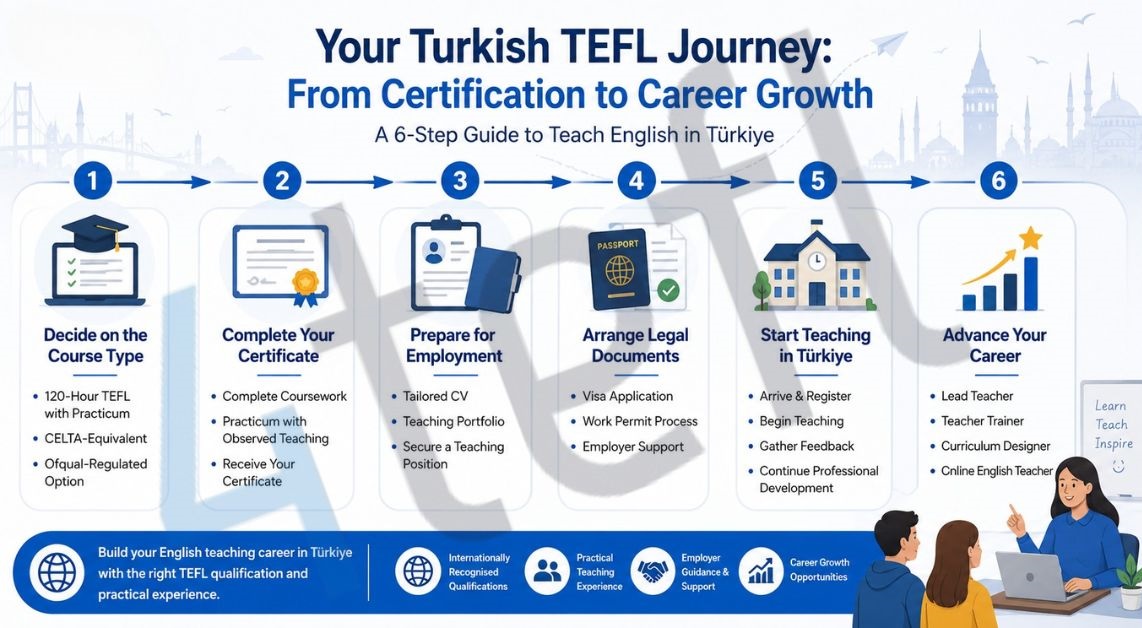
Notes on the above steps: The exact visa path and work-permit requirements can change; always verify with official sources or a competent immigration advisor. Where possible, align your course selection with recognised UK or international standards to maximise compatibility with Turkey’s diverse employer landscape.
Authoritative Sources and Fact Checks (References)
- Office of Qualifications and Examinations Regulation (Ofqual) – UK Government: Official portal to search and verify regulated qualifications and awarding organisations.
- U.S. Department of State – Bureau of Consular Affairs: Official information on Turkish visa reciprocity, entry requirements, and legal stay policies.
- UK Foreign, Commonwealth & Development Office (FCDO) – Foreign Travel Advice: Official guidance for entry requirements, working permits, and safety regulations in Turkey.
- Republic of Türkiye Ministry of Foreign Affairs (MFA): The official consulate portal providing requirements for visa types, work permit procedures, and diplomatic missions.
Do I need a degree to teach English in Turkey?
A bachelor’s degree is commonly requested by many Turkish schools for full-time positions, particularly in international schools and university-affiliated programs. Some private language schools may hire with a strong TEFL/TESOL certificate and teaching experience, but having a degree generally improves job prospects and visa eligibility. Always check the specific job listing and consult official guidance on work permits.
Is a 120-hour TEFL certificate enough for Turkey?
A 120-hour TEFL certificate, especially with a practicum, is a common baseline for many language schools in Turkey. However, more competitive positions or those in international schools may prefer CELTA/TESOL-level qualifications or additional professional development. When possible, choose a certificate with a robust practicum and credible accreditation to improve employability.
Are Ofqual-aligned courses necessary for Turkey?
Ofqual alignment is not legally required for teaching in Turkey, but it provides a recognised standard that many employers value, particularly in international schools and institutions with global pipelines. If you pursue Ofqual-regulated qualifications, verify the awarding body on Ofqual’s register and confirm that the course includes an appropriate practicum.
What visa do I need to teach in Turkey?
Most teachers obtain a work permit through their employer, followed by a long-stay visa or residence permit. The employer often initiates the work-permit process with Turkish authorities, and you apply for the visa as part of the overall process. Requirements can change, so consult the Turkish consulate or embassy and official government guidance (e.g., travel.state.gov) for the latest details.
How long does the work-permit and visa process take?
Processing times vary by applicant country, the specifics of the job, and administrative loads. It is prudent to start the process early and maintain proactive communication with your employer’s visa team. Realistically, plan several weeks to a few months to complete all steps, depending on circumstances and regulatory updates.
Is it safe to teach English in Turkey as a foreigner?
Turkey is a popular destination for expatriates and teachers, with many schools prioritising safety and professional conduct. As with any international assignment, it’s wise to research your city, stay informed about local guidance, and follow practical safety precautions, especially in unfamiliar areas or during travel. Your employer’s support and the local expat community can provide practical safety tips and resources.
How should I approach job applications and interviews from abroad?
Prepare a concise CV and a teaching portfolio that showcases lesson plans, classroom activities, and student outcomes. Tailor your application to each school, emphasising your adaptability to different ages and levels, and be ready to discuss your practicum experiences. Networking with alumni or recruiters who specialise in Turkish placements can improve your chances.
What are typical contract terms I should expect?
Contracts commonly specify a monthly salary, teaching hours, housing arrangements or allowances, holiday periods, and visa support. Some packages include flight allowances or health insurance. Read the contract carefully, confirm all benefits in writing, and clarify any ambiguities before signing.
Are there opportunities to progress beyond classroom teaching in Turkey?
Yes. With experience, you can pursue roles such as lead teacher, teacher trainer, curriculum designer, or program coordinator. There are also opportunities for online TEFL work, which can supplement on-site teaching income and offer flexibility. Career development often depends on your qualifications, demonstrated effectiveness in the classroom, and your ability to network within schools and institutions.