Teach English in Ethiopia: A Comprehensive TEFL Guide


Ethiopia has a rich mix of history, culture and a booming demand that could translate into your being interested in teaching English abroad. But entering this field can be challenging:
- Which TEFL certification matters in Ethiopia?
- How to comply with visa and work permit requirements?
- How to plan your preparation to make the greatest impact possible?
By demystifying the journey, the guide shares practical, fact-checked information that is rooted in reputable sources. It focuses on Ofqual-standard pathways, credible training formats and realistic career options which enable confidence in planning a fruitful teaching experience.
For most new teachers, the road to Ethiopia starts with strong certification. Employers – in private language schools, international schools and development projects – tend to seek credentials that establish both language mastery and pedagogical efficacy.
This article provides detailed steps, from selecting an accredited TEFL certificate that meets Ofqual’s standards to gaining an understanding of visa essentials and practical fieldwork. It combines policy-oriented advice with actionable advice so that you can make your own choices about what you might study, how to train and where to go for opportunities.
Practical Advice Contextualised to Ethiopia: Perhaps the best advice, though, will be practical advice contextualised to Ethiopia: how to prepare culturally, how to design lessons for a range of different class sizes, and how to manage your professional ambitions alongside the realities of living and teaching in East Africa. Whether you’re targeting private language centres in Addis Ababa or participating in NGO-based English initiatives around the nation, this guide is meant to help you progress from initial curiosity to effective classroom practice. 
A Step-by-Step Guide to Teaching English in Ethiopia
Step 1: Assessing your teaching goals and country fit
The first step is clarity. Are you hoping to teach in an international school, a private language centre or an NGO-supported programme? Addis Ababa, regional cities and rural communities all feature unique environments, languages and class dynamics. Knowing where you would like to teach allows you to plan qualifications, residential arrangements and social integration. International schools need better education credentials and more qualifications, whereas private language centres might prefer teaching experience and solid educational qualifications.
UNESCO Education Research Projects Highlight: Improving English language teaching is one of the main goals of many developing countries around the world, and Ethiopia has a dynamic learning environment that can be a strong focus for new teachers.
Step 2: Get a quality TEFL certificate with clear standards
In reality, the majority of Ethiopian employers prefer formal TEFL or TESOL qualifications that demonstrate training in lesson design, classroom management, assessment and practicum experience. Search for programmes that include a structured curriculum, teaching practicum, observed teaching and clear outcome measures.
For UK-aligned requirements, look for certificates from reputable awarding bodies and see whether the programme is Ofqual-regulated or Ofqual-recognised. Ofqual is the UK government regulator for qualifications, and knowing what is meant by ‘Ofqual-standard’ will enable you to compare courses on a level playing field, particularly if you are interested in working with institutions which recognise UK frameworks. Confirm regulatory status with the provider and check Ofqual’s official guidance.
Step 3: Work out your job search, documentation and arrival logistics
With the certificate in your hand, go out and look for employment. Prepare a professional CV specific to TEFL jobs, collect reference letters, and prepare a police background check if necessary for your employer or the Ethiopian authorities.
Your employer will most likely take you through the visa and work-permit process, which usually involves:
- Receiving a job offer
- Providing a passport and photographs
- Evidence of your qualifications
- Health documentation (depending on the job opening)
Check visa and work-permit requirements at the Ethiopian embassy or consulate in your home country and keep an eye on any changes.
Step 4: Prepare for life and teaching in Ethiopia
Adaptive pedagogy and cultural readiness are as important as certification and credentials. Work with large classes and mixed resources in Ethiopian classrooms, alongside a growing focus on English as a means of academic advancement. Build local networks, create local relationships, become involved in teacher communities, and continually revisit and practise your lesson planning.
Regularly consider your own teaching design practices and your ongoing professional development and reflective work. These experiences may include:
- Community teaching
- Micro-teaching
- Hands-on experience
- Professional development in practice
TEFL Certification in Ethiopia: Ofqual-Standard Guide
In recent years, Ofqual-standard TEFL qualifications have become more popular among prospective teachers as a way to improve understanding of regulatory status and international recognition. Here’s what to look for, what Ofqual-aligned credentials mean, and how to determine legitimacy. This guide aims to help you choose a programme that fits well with appropriate regulatory frameworks and Ethiopia’s teaching market.
What Ofqual-regulated or Ofqual-recognised implies for TEFL
Ofqual (the UK regulator for qualifications) does not have the authority to approve all TEFL programmes, although many UK-linked providers offer regulated courses or qualifications that meet qualification standards. When a TEFL certificate is Ofqual-regulated, it reflects that the qualification is part of a formal, government-sponsored qualifications regime and hence provides a clearer path for some employers worldwide to recognise it.
For the reader, the key advice is to check with the provider whether their credential is regulated or recognised by Ofqual and to confirm whether it appears on Ofqual’s official site.
Features to evaluate if you want an Ofqual-aligned TEFL credential
- Hours and structure: Expect a breakdown of theory hours, lesson planning and the teaching practicum. Seek out a defined minimum practicum (typically 6–20 hours of observed teaching practice) and a capstone assignment.
- Accreditation and recognition: Prefer courses that are accredited and awarded by an appropriate awarding body and aligned with Ofqual qualifications. Check the official register to see whether the awarding body, where applicable, is listed.
- Practical outcomes: A strong curriculum should produce documented lesson plans, guidance from trained teaching staff, as well as opportunities to teach in a face-to-face classroom environment, ideally under supervision and reflection.
- Transferability: International schools and language centres which appreciate formal credentialing will often recognise a certificate that is Ofqual-regulated or UK-accredited.
Selecting a provider with clarity and integrity
Given the inconsistency in TEFL credential marketing, it’s wise to choose courses where you know how much progress a student has made, where there is a defined practicum available, and where good support facilities are provided for students after graduation. Find providers that publish their assessment criteria, offer practicum opportunities locally or in partner institutions, and provide further help, post-job-search training and guidance.
Although many valuable training experiences are not covered by the Ofqual framework, it can be reassuring for readers who are aiming to work with institutions which understand regulation as a signal of quality.
A note on verification and due diligence
All programmes claiming Ofqual regulation or recognition should be checked with Ofqual. Ofqual’s own website offers guidelines and registers for reference, and trusted providers should be happy to answer your questions regarding accreditation.
Furthermore, review student reviews, cohort outcomes and a provider’s record of support for students after course completion. If an opportunity sounds too good to be true, or if payment is requested upfront with no clear credentials, proceed cautiously and ask for a third-party or academic reference.
Career Routes and Visa Basics in Ethiopia for TEFL
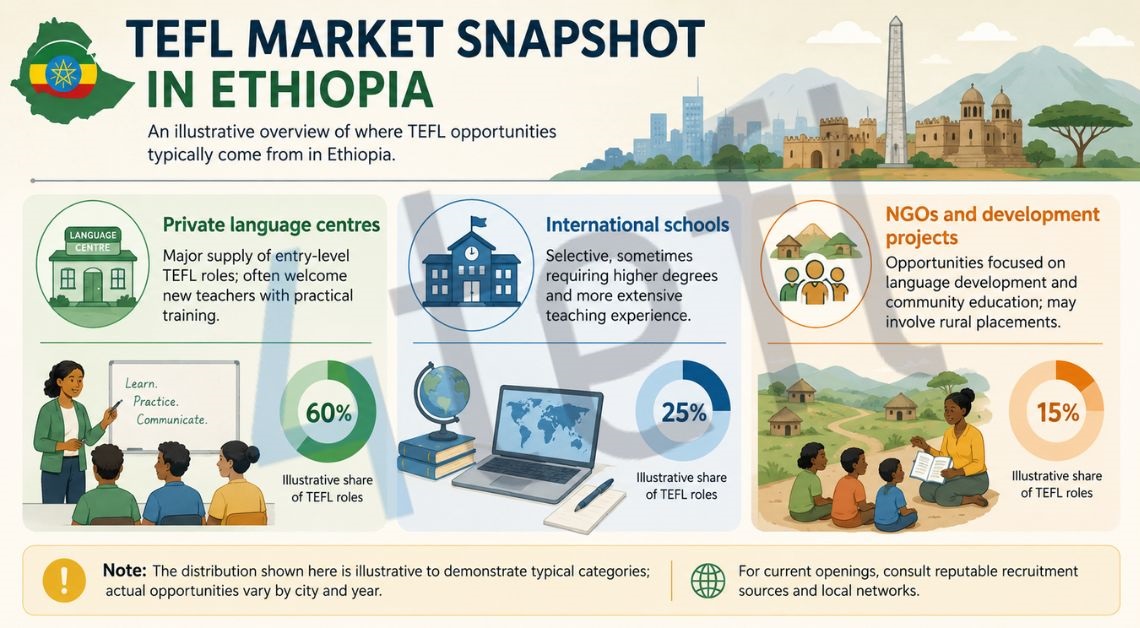
Knowing what routes are open, and what the requirements are if you wish to establish yourself as a TEFL teacher in Ethiopia, enables you to align your qualifications and expectations with realistic timelines. The education sector includes international schools, private language academies and NGO-led English programmes, which offer distinct modes of entry and requirements.
Possible career paths
- International schools and bilingual programmes: These institutions generally require established teaching credentials, a strong command of English and experience working within a professional curriculum. They may provide organised pay bands and more predictable work schedules.
- Private language centres and academies: A diverse group of institutions that often need trained TEFL educators to provide general English training, examination preparation and youth education. This option may provide more convenient start dates, but adapting to diverse student ages and levels may be necessary.
- NGOs, development projects and government-affiliated programmes: English teaching is an important component of some development initiatives; it can range from classroom teaching to training local teachers. In exchange for openness to working in various communities, these positions can provide a positive impact.
Visa essentials and work-permit issues
- Restrictions: In most instances, Ethiopian authorities require work permits for foreigners engaging in teaching. Many institutions manage visa and permit processes through employers, but applicants can expect a somewhat standardised process that may include background checks and educational verification. Visa requirements differ for everyone, and most foreign TEFL teachers complete the visa process with the assistance of their employer.
- Residence and long-term stay: Teachers often obtain residence status through an employer or apply to the Ethiopian authorities after arrival. Practices differ, so it is advisable to apply and make arrangements early.
- Documentation and verification: You will need a valid passport, degree certificates, TEFL/TESOL certificates, professional references and sometimes a clean health check. Documents may need to be translated, apostilled or certified by Ethiopian authorities or the employer.
- Tax and social contributions: Teachers may be responsible for contributions to local taxes or social benefits, as in many countries, depending on the length of residence and the employer’s status. Check your tax obligations and ensure that your employer provides guidance or assistance to help you remain compliant.
Practical tips for a successful application
- Networking and recruitment channels: Make connections with TEFL communities, forums, professional networks and recruitment websites that focus on East Africa or English-language education. Local English-language schools, universities, and international schools may advertise vacancies either on their websites or through local educational networking platforms. Connect with them directly, as the vast majority of positions come through referrals or personal connections and aren’t obtained through mass recruitment.
- Language and cultural readiness: English is the primary language of instruction, but awareness of Amharic or local languages can be helpful both in everyday life and in the classroom when communicating with students. Culturally responsive teaching practices will enable you to respond to a wide range of students’ needs.
- Professional development: Showing that you are engaged in continuous professional growth (e.g., planning coursework, developing classroom management strategies, designing assessments, etc.) demonstrates commitment and willingness to adapt to Ethiopian employers and students. Proactive professional development (e.g., good practicum experience, lesson-planning skills, classroom assessment and testing experience) can help you set yourself apart in a competitive field. According to UNESCO, enhancing the quality of language teaching is an important pillar of educational development. Training that meets Ofqual standards may also be of some assistance to prospective Ethiopian employers seeking qualifications that align with recognised regulations.
Salary and Cost of Living in Ethiopia
One of the most common questions prospective TEFL teachers ask is whether they can live comfortably on a teacher’s salary in Ethiopia. The answer depends largely on the type of institution, your qualifications, and the location of your position. Salaries vary significantly depending on the employer, location and qualifications.
Entry-level TEFL teachers working in language centres or local private schools may earn approximately $250–700 per month, while experienced teachers in international schools can receive substantially higher salaries and additional benefits such as accommodation, annual flights, and medical insurance. Some international school positions advertise salaries exceeding $3,000 per month for qualified teachers with recognised teaching credentials and classroom experience.
Addis Ababa generally offers the highest salaries and the largest number of teaching opportunities. Smaller cities and rural areas may offer lower salaries but often come with a significantly lower cost of living.
Typical monthly expenses in Addis Ababa may include:
- Rent (if not provided): $250–800+
- Utilities and internet: $30–80
- Local transportation: $20–60
- Groceries and food: $100–250
- Leisure and personal expenses: variable
Many schools provide housing assistance or accommodation packages, which can substantially reduce living costs. Teachers working for international schools frequently report being able to save part of their income, while those working in local institutions often prioritise cultural experience and professional development over financial savings.
Before accepting a position, ask employers about accommodation support, medical coverage, visa sponsorship, and relocation assistance, as these benefits can significantly affect your overall financial situation.
Practical Training Formats, Field Experience, and Course Formats
This section provides advice on training effectively for TEFL in Ethiopia, focusing on the formats of the courses to be undertaken, practical hands-on experience in the field, and how a course will suit your own lifestyle and aims. Certificates can range from fully online programmes to blended formats in which online courses are combined with practical experience.
Digital training: online, face-to-face and hybrid
- Online certificates: Online TEFL certificates are flexible and low-cost, covering core theory, grammar, lesson planning and teaching methodologies. Most of them include a practicum component, either locally or via partner schools, to provide hands-on teaching experience.
- In-person courses: Classroom-based programmes that offer direct teacher supervision, peer feedback and immediate practice with live students provide real-time feedback. In particular, they are invaluable for those who are not already part of a regular teaching environment and rely heavily on feedback.
A blend of online learning and a supervised practicum is currently prevalent. In Ethiopia, however, many teachers rely more on classroom observation for feedback. This system can achieve a balance between flexibility and direct coaching.
Observation in the classroom, teaching practicum and the learning environment in the school
It does not matter where teaching occurs. What matters is that every discipline – whether formal practice, informal practice or a student-centred pedagogy – provides input and feedback designed to help you enhance your teaching skills. A solid practicum builds confidence and helps you face new circumstances with confidence.
Field experience tips
- Learn how to work with low-stakes learning objectives: Practise brief, focused classes in community settings or with local partners. Taking part in community lessons or local programmes involving micro-lessons can help develop pacing, voice projection and classroom management skills.
- Align your planning with local contexts: Think about class size, the number of students, available resources and age-related factors; design lessons that meet different learning levels and contexts.
- Embed reflective practice into your routine: Try to incorporate reflection into your routine. After each teaching session, reflect on one success and one area for improvement. After each class, write a brief reflection, note one positive outcome for your students and identify one important improvement you would like to make in your next lesson. This iterative mode of growth is a method that encourages development.
- Find local mentors: Reach out to experienced teachers or coordinators who can assist you. Connect with teachers or coordinators in the area, build strong relationships, share advice on school culture and expectations specific to local settings, and learn from their guidance.
Practical Training Tools and a Snapshot of Certificate Options
Below is a simple snapshot table to illustrate common TEFL certificate options, highlighting the kind of training, typical practicum, and regulatory status. Note that actual programmes vary, and you should verify details with the provider and Ofqual where relevant.
| Certification option | Typical duration | Practicum/teaching hours | Regulated status (Ofqual) | Typical international recognition | Example notes |
| Online 120-hour TEFL | 4–6 weeks | Practicum via partner school, 6–20 hours | Often not Ofqual-regulated unless linked to a UK-awarding body | Widely accepted for private language centres; varies for international schools | Choose providers with robust practicum support |
| Online plus 20-hour observed teaching | 6–12 weeks | 20 hours observed teaching | Potentially Ofqual-recognised if delivered by an Ofqual-regulated body | Strong for private centres; international schools may require additional qualifications | Look for clear observation protocols and feedback |
| Blended 150–200-hour programme | 8–12 weeks | 20–40 hours observed teaching | Ofqual-regulated pathways exist via certain UK-awarding bodies | Strong credibility in many markets; better for job portability | Ensure practicum aligns with Ethiopian classroom contexts |
| In-person 120–180-hour Certificate | 2–6 weeks | 20 hours observed teaching | Some courses are Ofqual-recognised, depending on provider | Highly credible for international schools; solid foundation for career | Great for hands-on feedback and immediate practice |
Opting for the Best TEFL Provider in Ethiopia
When you are starting your career in this field or pursuing a future international teaching career, choosing the right TEFL provider is crucial. Not only does a good programme deliver a strong curriculum, but it also guides you through workplace placement and lifelong learning.
Key criteria to compare
- Credibility and regulatory fit: Look for providers with honest accreditation, clear learning outcomes and a credible practicum component. If you want an Ofqual-compliant qualification, verify whether the provider offers Ofqual-aligned pathways by checking the provider’s status with Ofqual and confirming details through official channels.
- Application: Explore programmes that offer hands-on teaching practice, feedback from experienced educators and opportunities for practicum learning in real classrooms, either in-country or through partner institutions.
- Support and outcomes: Think about the services a careers department provides – CV guidance, interview coaching, job referrals and opportunities for continuing professional development. A strong alumni network can be incredibly helpful.
- Localised context: Teaching resources relevant to Ethiopia, classroom management in changing situations and lesson planning for diverse groups of students may provide particularly useful transferable skills.
Due diligence steps
- Check official regulatory status: If a provider states that it is Ofqual-aligned, check Ofqual’s official website and look for references to a UK awarding body or the RQF framework in the provider’s materials.
- Check independently: Read peer reviews and consider the credibility of reviewers. Student testimonials can be helpful, but also ask for documentation of practicum partners and evidence of job-placement support.
- Clarify practicum structure: Confirm the availability of practicum opportunities according to your location and plans; verify the quality of supervision and methods of assessment.
Context and preparation for practical living
Ethiopia’s major cities, such as Addis Ababa, may provide more developed English-teaching environments than rural areas, which may offer high-impact field experiences with varying levels of resources. Budgeting for accommodation, transport, food and daily living expenses is important, regardless of salary arrangements with your employer. Gathering accurate and up-to-date information in advance can help you prepare financially and personally for an effective teaching experience.
Authoritative Sources and Fact Checks (References)
- UK Government Office of Qualifications and Examinations Regulation (Ofqual): Verify whether your TEFL provider or awarding body is officially recognized and registered on the UK qualifications database.
- UNESCO Portal on Education: Review research reports, literacy frameworks, and language education development initiatives across East Africa.
- Embassy of the Federal Democratic Republic of Ethiopia (Washington D.C. Consular Services): Consult official, up-to-date requirements regarding teaching work permits, qualifications authentication, and long-term residency visas.
Do I need an Ofqual-regulated TEFL certificate to teach in Ethiopia?
Not universally required, but Ofqual-aligned qualifications are highly regarded and can improve job prospects with certain employers. Always confirm the requirements with your target schools or programmes and verify Ofqual status through their official website.
What is the typical timeline to secure a TEFL job in Ethiopia?
Timelines vary, but most teachers secure positions 1–3 months before departure. Having a regulated certificate, a strong practicum, and a professional network accelerates the process. Start networking early and keep documents ready for quick submission.
Which areas in Ethiopia are best for TEFL work?
Addis Ababa offers a broad range of opportunities, including private language schools and international programmes, while regional centres and rural areas provide meaningful field experience with NGOs and community education projects. Availability fluctuates with demand and funding cycles.
How important is the practicum component?
The practicum is essential for translating theory into practice. It provides direct teaching experience, feedback from mentors, and a portfolio of observed lessons that many employers value.
How can I verify a TEFL provider’s credibility?
Check accreditation details, Ofqual status if claimed, the practicum partners, and evidence of past graduate outcomes. Ask for contactable references and sample lesson plans to gauge the quality of training and support.
What about salary and cost of living in Ethiopia?
Salaries and cost of living can vary widely by city and employer. Private language centres may offer different packages than international schools or NGO projects. Research current living costs, housing options, and food costs for your target city, and factor in health insurance, transport, and visa-related expenses.