Teaching English in Denmark: TEFL Certification and Careers


Denmark is a country with very good living standards, good education systems and a culture that appreciates teaching English. And for beginning English teachers, the path into Denmark’s promising TEFL market can be complex: you need a credible certification, a clear understanding of visa and work-permit requirements (especially if you are not an EU citizen), and a sense of where the best opportunities are. This article contains an implementable, data-driven guide for TEFL certification and careers in Denmark through the government’s advice and TEFL rules guidelines for students to work on with confidence.
Finding the right path begins with clarity: You want to know what kind of teaching, does it take you (private language schools, universities, or online platforms)? What credentials will you get from the Danish employers to respect your certification? If you do not have EU citizenship, what type of visa path does that pass? The responses are contingent on your background, what kind of teaching environment you want to have and how you want to upgrade your classroom abilities. In this article you will learn about practical certification paths, training options in and for Denmark, how to consider visa and work-permit issues, and the latest trends about employer demand and salaries. And the idea is to form an evidence-based basis in which you can judge upon taking TEFL/TESOL courses and leading a fulfilling teacher career in the land of Denmark.
By the end, you’ll have a realistic sense of which TEFL qualifications Danish employers recognize, the type of training format works for you, and how to deal with visa rules and job searching in a country in which English teaching is still in demand but competition can be fierce in big cities like Copenhagen and Aarhus. This guidance is congruent with international standards for TEFL/TESOL certification and the good practice that training providers use to prepare teachers for roles in Europe as well as in other countries.
Overview of TEFL in Denmark and Certification Routes
Denmark has a variety of models for TEFL, whether in private language schools, public and private college courses, specialised educational and language programmes in schools, and increasing online teaching. English is often relied upon as a second language for education, business and everyday life, thus ensuring the need for good teachers with reputable TEFL/TESOL qualifications and classroom experience. For an aspiring teacher, a key decision is whether to follow a route that fits the trajectory of a career which Danish school systems generally acknowledge, or to teach English to Danish students either in Denmark or abroad, depending on whether you want to teach at a Danish language school, teach Danish learners in an English-focused curriculum or provide online lessons to Danish learners outside Denmark.
Denmark has certification paths that are usually aligned with world TEFL/TESOL standards. Internationally recognised qualifications such as CELTA (Certificate in English Language Teaching to Adults) and Trinity CertTESOL are strong indicators of quality for many language schools and tertiary institutions. Furthermore, evidence-based programmes which feature sound practicum elements and training in pedagogy for the use of English are frequently favoured by employers who seek evidence of teaching experience with certifications confirmed by British regulatory bodies in the UK or similarly qualified organisations.
NB: While Denmark does not require a single national TEFL credential for all EFL teaching positions, employer expectations differ; most reputable schools, particularly within the HE sector, prefer candidates with successful practicum hours, reflective teaching practice, and a formal credential from an established provider.
For EU/EEA citizens, the road is not nearly as challenging, because freedom of movement allows residence and work without a Danish work permit, with the exception of registration in Denmark. Routes to gain a work permit (Pay Limit Scheme and positions on the Positive List) will also determine your capacity to teach legally in Denmark for non-EU citizens.
Course recognition is certainly important, but it is also vital to check your programme’s level of practical training, mentoring support and pathways to further professional development. Courses which have been accredited and relate to Ofqual-regulated or Danish qualifications can help ensure your certificate meets the demands of Danish employers. Last but not least, when deciding on a path, your personal circumstances matter – whether you need to study online or face to face, your intended timeline for starting teaching, your budget, and which city or region you will work in. These factors may influence whether you obtain an internationally recognised certificate with a conventional practicum or choose a more flexible online format with a substantial teaching practicum component.
- EU/EEA citizens have a right to reside and work in Denmark without a separate work permit, subject to registration requirements (CPR registration) after arrival. This simplifies entry for many teachers from EU countries, though you should still verify any local requirements and licensing for public sector teaching or specific programmes.
- For non-EU citizens, two common entry routes are the Pay Limit Scheme (salary-based work permit) and positions on the Positive List (occupations with labour shortages). Each route has distinct criteria, including job offer conditions, minimum salary thresholds, and employer sponsorship obligations. Always verify the current requirements at nyidanmark.dk, as these schemes can change with policy updates and labour market needs[^2].
Qualified Pathways: TEFL Courses for Denmark
Whether the TEFL course you choose for Denmark is suitable depends on your time frame, budget, and the kind of teaching you wish to enter. The Danish market accommodates a wide selection of TEFL/TESOL qualifications but may prefer courses with a strong emphasis on practicum and evidence of classroom application. In this section we present typical routes (with standard components) and determine their suitability for Danish employment.
A. Internationally recognised certifications with practicum
Teachers often choose CELTA or Trinity CertTESOL because these qualifications are recognised among European and international language schools. A typical CELTA course includes a 4-week intensive in-person component (or a longer online/blended format) in addition to a supervised teaching practicum. Such courses focus on actual classroom teaching, lesson planning and assessment; in Denmark, these are a high priority for employers when evaluating a candidate’s classroom capability. If you plan to target the busy urban markets of Denmark, a CELTA or CertTESOL can be a strong credential that signals solid classroom-ready training. It is also compatible with Ofqual-regulated standards when provided by an approved provider; therefore, it can enhance credibility with European and international employers.
B. Professional development and areas of specialisation post-certification
In addition to obtaining initial certification, many teachers develop specialised areas on their CV, for instance English for Specific Purposes (ESP), pronunciation, or teaching young learners. Some providers may offer short, targeted modules that complement a general certificate, helping you stand out in a crowded and competitive Danish job market. While those add-ons are not always necessary, they do indicate commitment to continued professional development – something many Danish schools value when hiring part-time or full-time staff. Seek out courses with classroom-ready practice, reflective teaching, and mentoring support, including ongoing mentoring or observation after certification.
C. Online and offline formats: Danish context considerations
TEFL courses, whether online or face to face, both have a place within Denmark’s market. However, for Danish employers a solid practicum is almost always necessary, even though online courses are now one of the most affordable ways to obtain foundational knowledge and theory. Conversely, in-person formats may offer stronger classroom observation, formal practicum hours, and feedback from experienced mentors. Consider whether your teaching practicum includes real learners and whether there is an opportunity for classroom experience in a setting similar to your target environment (such as a Danish language school or university partner). If you intend to relocate to Denmark, you might choose a programme which provides a practicum placement in Denmark or allows conversion of practicum hours to Denmark’s professional practice norms. The only thing is to make sure that your chosen certificate aligns with your intended visa route for non-EU applicants.
Certification Route Options
| Certification route | Typical duration | Format | Practical component | Recognition notes |
| CELTA (Cambridge) | 4 weeks, full-time | In-person or blended | 6–8 teaching practice lessons | Widely recognised across Europe; Ofqual-aligned providers available |
| Trinity CertTESOL | 4 weeks, full-time | In-person or blended | 6–8 teaching practice lessons | Widely recognised; strong practicum component |
| Online TEFL with practicum | 8–12 weeks | Online with in-person practicum option | 6–10 teaching hours | Flexible; verify practicum credibility with employers |
| Ofqual-regulated TEFL/TESOL | 6–12 weeks | Online or blended | Practicum hours as required | Aligns with UK-regulated standards; recognised by many European employers |
Notes:
- The table is illustrative; exact durations, costs, and practicum formats vary by provider. When selecting a course, confirm practicum requirements and ensure the certificate is from a reputable, accredited body.
- In Denmark, many employers value demonstrable teaching ability, practicum experience, and clear evidence of classroom-ready skills as much as the certificate’s formal label.
Working in Denmark: Visa, Work Permits, and Jobs
For new teachers, understanding visa and work permit requirements is crucial. Denmark allows EU/EEA citizens to live and work with lower bureaucratic friction (although registration rules remain in effect); for non-EU citizens, a work permit is required for residence and teaching in Denmark. The official rules state that the vast majority of non-EU teachers will need a job offer and sponsorship through an approved work permit scheme. The two routes most applicable for TEFL jobs are the Pay Limit Scheme and Positive List positions. Do not ignore recent guidance on nyidanmark.dk to remain eligible, as rules and pay levels may change with labour market demand.
Main points for taking part in TEFL employment in Denmark:
- For EU/EEA nationals: validate your passport, register with the Danish Civil Registration System (CPR) after arrival and obtain your Danish health insurance card. There’s no need for a Danish work permit, but you do need to secure a contract with a Danish employer and ensure that your status is properly registered for tax and social security purposes. The fact that you can speak English and hold a good TEFL qualification will support (or at least strengthen) applications to language schools, where English is the prevailing medium for learning or communication.
- Start with a tangible job offer if you are a non-EU citizen. Your employer may need to assist with applying for work permits under either the Positive List or Pay Limit schemes. The Positive List (occupations with labour shortages) includes positions where teachers provide English-language instruction in educational contexts; the Pay Limit Scheme applies to roles meeting minimum salary requirements with a sponsoring employer. In either case, you generally submit documents through the nyidanmark website, which is online. Processing times can differ, and starting this process well before you intend to relocate is key. Your application may require documentation such as your certificate(s), proof of teaching experience, contract and proof of accommodation in Denmark.
- Job search priorities in Denmark: Copenhagen and Aarhus have more roles in language schools, international programmes and online teaching than smaller towns, which may offer fewer opportunities but potentially higher compensation. For private language schools and online teaching, fluency in Danish isn’t necessarily a prerequisite, but having some command of Danish makes a significant difference for classroom rapport, interaction with local networks and integration into the Danish education system overall. Some opportunities may become available through networking, local TEFL events, and professional organisations, and you may find openings that are not listed on major job boards.
- Contracts and working arrangements: In Denmark, TEFL jobs vary widely. Some institutions hire on an hourly basis for after-school or evening classes, while others provide fixed-term contracts which specify a set weekly teaching load. Before accepting an offer, ensure that visa requirements, contract length, paid holidays, pension contributions, and termination conditions are clearly explained. If you are teaching English in a public or semi-public environment, you may also encounter additional requirements regarding safeguarding, background checks, or Danish language support resources. Your TEFL certificate, teaching practicum, and references will form the foundation of your eligibility and application.
Employer Demand and Salary Trends for TEFL in Denmark
Denmark requires English language teachers due to its strong education sector and favourable business climate, as well as the continued reliance on English as a lingua franca for higher education and professional communication. In cities such as Copenhagen, Aarhus and Odense, private language schools, international schools and online platforms seek teachers who have strong TEFL qualifications, classroom teaching ability and effective communication skills. Danish job markets are interested in teachers with good subject knowledge, strong classroom management, and a teaching philosophy based on reflection. Demand is strong, but competition is healthy, as jobs with predictable hours, good working conditions and opportunities for advancement are highly sought after.
Salary trends for TEFL teachers in Denmark differ by city, sector, and whether the role is part-time or full-time. Hours for TEFL work in private language schools and online teaching environments depend on tenure, qualifications, language skills and the size and prestige of the institution. Public or university-affiliated programmes may be more lucrative or offer more stable contracts, but may also require additional credentials and more experience. Training and employment conditions vary. In general, entry-level TEFL posts at private language schools usually pay by the hour; however, longer contracts, private lessons or senior teacher roles involving curriculum planning, teacher training, or administrative duties may offer higher earnings.
To assist you in planning, here’s a brief snapshot of available opportunities in Denmark, but actual figures will vary by location, employer, and individual positions.
In Copenhagen and Aarhus, demand for TEFL/TESOL positions is highest as a result of both large international populations and a high concentration of language schools, universities and multinational companies seeking English teaching opportunities. In recent years, online teaching opportunities have grown as teachers have been able to support Danish students either from abroad or within Denmark, supplementing classroom-based teaching. Employers often require or strongly prefer a formal TEFL/TESOL certificate with a solid practicum and visible classroom experience.
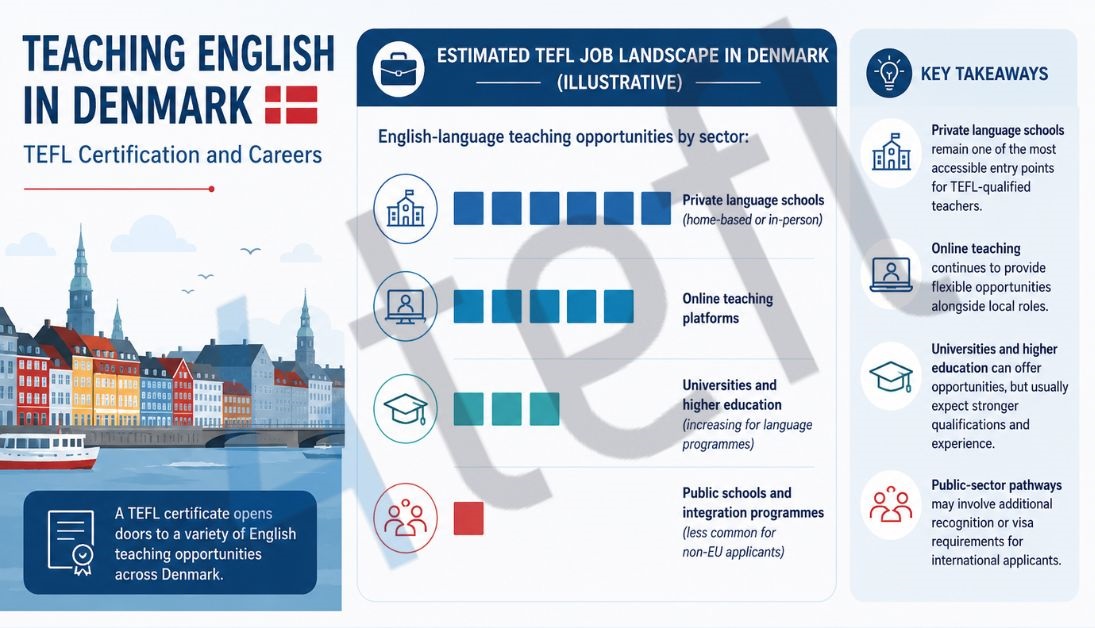
Note: This ASCII chart is intended as a general guide to typical market segments. Actual demand varies by city, school size, and seasonal teaching needs. See nyidanmark.dk for visa implications and local job postings for current openings.
Authoritative Sources and Fact Checks (References)
- Danish Ministry of Higher Education and Science (Uddannelses- og Forskningsministeriet): For guidelines on the official recognition of foreign qualifications and teaching certificates.
- New to Denmark (Ny i Danmark): The official portal for foreign recruitment and integration, detailing the Pay Limit Scheme, Positive List, and registration procedures.
- Ofqual Register of Regulated Qualifications: To verify course alignment with UK regulated framework standards (useful for CELTA/Trinity level checks).
- Life in Denmark: The official Danish public guide for citizens and international residents relocating for work, covering CPR registry, health card registration, and taxation.
Do I need a Danish degree to teach English in Denmark?
Not necessarily. The TEFL/TESOL certificate and relevant teaching practice are typically more important to Danish language schools than a Danish degree, though some positions (especially in universities or public programmes) may require higher qualifications. Check specific job postings to understand requirements.
Is Danish language ability required to teach English in Denmark?
English-language teaching jobs often operate in English, especially in private language schools or online contexts. Some schools value basic Danish to facilitate student communication or staff coordination, but it is not always a prerequisite for private TEFL roles.
Can I teach English in Denmark on a student visa or short-term visa?
Short-term work permissions depend on your visa status and Danish immigration rules. Generally, non-EU citizens need a work-permit under one of the schemes described (Pay Limit or Positive List). Check nyidanmark.dk for precise guidance and ensure your activities align with visa conditions.
How do I begin the visa process if I’m non-EU?
Secure a job offer with a Danish employer who will sponsor your work-permit under the Pay Limit or Positive List. Then apply through the official online process at nyidanmark.dk, providing documentation such as your teaching certificate, contract, passport, and housing details, as required.
Are online TEFL certificates accepted by Danish employers?
Many Danish employers value the practicum and teaching practice that accompany a course, so choose a provider with a credible practicum component and recognized accreditation. Online certificates can be accepted, especially when paired with a substantial, verifiable practicum and robust teaching experience.
What kind of career progression is possible for TEFL teachers in Denmark?
With time and experience, you can move into senior teaching roles, curriculum design, teacher training, or coordinator positions within language schools or universities. Some teachers expand into private tutoring, consulting for schools implementing English-language programmes, or online-teaching leadership roles.
Where can I find reliable TEFL training and job information for Denmark?
Start with Denmark’s official immigration site nyidanmark.dk for visa and work-permit details. For certification guidance, seek programmes with recognised accreditation and practicum components. UNESCO and Wikipedia can provide background material on TEFL standards and English-language teaching context as supplementary references.