Your Path to Teaching English in Bhutan with TEFL Certification


Bhutan offers English teachers a distinct opportunity – a small, culturally enriched country where education remains at the core of national progress and where English is a major vehicle to take success in study and practice at almost all levels. For new entrant teachers looking to become teachers, the maze of TEFL credentials, accreditation and the in-class environment is daunting.
This article examines strategies for teaching English in Bhutan, from the path to certification and Ofqual-approved qualifications through to classroom development and career progression. It’s intended to help you make informed decisions, tailor your training according to Bhutan’s educational landscape, and strategically position yourself for success in the job market.
We have the certification pathways which most often take you to teaching in Bhutan, exploring how each of the qualifications are acknowledged by employers, in the process. We then analyse Ofqual-approved credentials for TEFL and what they are meant to mean to people looking to start up schools in Bhutan, or work at international programmes that run in Bhutan. Then we turn to some practical strategies for the classroom set-up in the country, specifically in a bilingual and multicultural setting, including teaching about engagement, inclusivity and local syllabus alignment, in Bhutan. Lastly, we delve into career progression for teachers in Bhutan in terms of the usual job conditions, qualifications and options for professional development. All the way through, not only actionable takeaways will be shared – but regulatory context and some quality resources which will give you the confidence you need to organise your TEFL journey.
Understanding TEFL Certification Routes to Teach in Bhutan
Selecting a TEFL certificate is a fundamental step in your teaching experience in Bhutan. There are a variety of ways that vary in quality, practicum qualifications and portability.
Core Certification Pathways
- In-Person Programmes: Standardised in-person programmes such as CELTA (Certificate in English Language Teaching to Adults, Cambridge) or Trinity CertTESOL with their emphasis on hands-on teaching which are not only highly regarded but also practised, and delivered in-person and in practice and are conducted over four weeks of experience in a training centre.
- University Courses: TEFL courses delivered through universities take longer and are more theoretical with extensive practical work in various settings that can run up to weeks to months for the structures.
- Online Certificates: Online TEFL certificates are time- and cost-effective and may be better than traditional methods, but some graduates are unable to complete suitable practicums because of the nature of their work, while some Bhutanese employers prefer to work with the teacher only, with formal education/accreditation programmes in place.
Portability and Bhutanese Employer Preferences
Looking to teach in the country, think about the perfect mix of time spent teaching real-life work, teacher feedback and being able to show students in classrooms and the world that they can practise while working in what might be a different country altogether. The portability of your TEFL qualification is important if you are applying to schools in Bhutan. Bhutan has a patchwork of government schools, private schools and foreign or NGO-funded training initiatives. Lots of employers like a solid practicum and show readiness for a classroom, or even want candidates to have completed a course with a well-planned practicum in a real classroom setting.
The demands within countries vary by area: urban schools may have easier access to training opportunities, with much tighter requirements for qualifications, while rural schools tend to require more agility, grit, learning that involves other kinds of skills. Given the great national value of bilingual teaching within Bhutan’s education system and the relevance of local content, being able to relate to local teachers, staff, and students can be as valuable as your eventual certificate.
For your entry to a well-funded international school or a government-driven programme, a CELTA or CertTESOL with an extended practicum, and a good early teaching portfolio provides a welcome supplement to your preparation. If you need more flexibility or seek to combine teaching and to get your teaching experience done (either through online work or travelling) a reputable online certificate, albeit with a practicum attached, can still be useful, especially if it is issued by an awarding body that has recognised standards of quality. Regardless of your options, have a minimum number of practicum hours mapped out, at least 120 hours, depending on the programme, in mind and a teaching portfolio completed and the contents of the portfolio (lessons, reflection notes of the teacher, reflective teaching logs as well as examples of student progress). Use Ofqual (the UK regulator) and education resources from UNESCO as reference points for authoritative guidance on certification standards and certification recognition: How credential value maps onto classroom practice in Bhutan.
TEFL Certification Routes at a Glance
| Route | Typical Duration | Regulator / Recognition | Pros | Cons | Bhutan Employer Relevance |
| CELTA (Cambridge) | 4 weeks (intense) | Cambridge Assessment; widely recognised | Strong practicum; high reputation; transferable globally | High cost; intensive schedule | Highly regarded; commonly preferred by schools that value practical training |
| CertTESOL (Trinity) | 4 weeks (intense) | Trinity; widely recognised | Clear pedagogy focus; good practicum; portable | Similar cost to CELTA; intense pace | Very well viewed by many schools; strong in bilingual contexts |
| University-delivered TEFL | 8–12 weeks (or more) | University accreditation; sometimes Ofqual-linked credits | In-depth theory; academic credibility | Longer time; higher cost; portability varies | Solid basis for long-term academic roles; good for schools seeking teachers with broad knowledge |
| Online TEFL with practicum | 6–12 weeks (flexible) | Various awarding bodies; quality varies; look for accredited providers | Flexible; often affordable; can include practicum | Variable quality; some employers sceptical without practicum | Increasingly accepted when practicum is included and verified; verify with target schools |
Ofqual-Approved Credentials for Bhutan Teaching Jobs
In the UK, Ofqual oversees qualifications and their quality for those studied in England and, to varying extents, for certain recognised qualifications abroad. TEFL classes, even some taught by awarding bodies that are Ofqual-regulated or have Ofqual-recognised status if the qualification is part of a Regulated Qualifications Framework (RQF). For teachers considering positions in Bhutan, Ofqual-approved qualifications can indicate quality and assessment standards that some international schools and NGOs value.
However, Bhutan’s job market for English teachers is diverse; not all schools require Ofqual-regulated certificates, and many only accept very structured TEFL certificates from reputable institutions that include solid practicum components. Verify the credential expectations of your target employer before committing to a specific pathway.
To properly use Ofqual-regulated credentials, focus on courses that show the awarding body and its regulatory status, level (Level 5, or Level 7 if necessary), and the number of practicum hours in a real classroom. For Bhutanese institutions to consider your application, provide verification documents from the awarding body, a detailed syllabus or course outline, and evidence of supervised teaching practice. Highlight how your training is suitable for Bhutan’s bilingual classrooms, where students use English as a medium of instruction but also interact with Dzongkha and local content. Clearly demonstrating your experience and assessments can give employers confidence in your ability to manage classroom operations in various contexts.
Recommended Action Plan
Some practical steps to support building on Ofqual credentials are:
- (1) ask yourself (through a simple but effective research process) if your chosen course has an Ofqual-regulated awarding partner, receiving
- (2) a formal verification letter or certificate detailing level and practicum time;
- (3) compile a portfolio with specific unit plans, lesson notes, and feedback from your supervisor;
- (4) craft a CV that includes bilingual results, classroom observations, and culturally sensitive teaching strategies;
- (5) reach out to Bhutan recruitment channels or international schools in Bhutan to confirm their expectations of your certification.
Beyond credentials, Bhutanese educators typically seek a thoughtful fit with the local context – skills that enable lessons to incorporate Gross National Happiness themes of a local nature and focus on the environment can make or break a project’s quality. Taken together, Ofqual-qualified credentials help lend credibility, but they succeed when complemented with demonstrable classroom readiness and culturally conscious pedagogy.
Practical Classroom Strategies for Bhutan TEFL Teaching
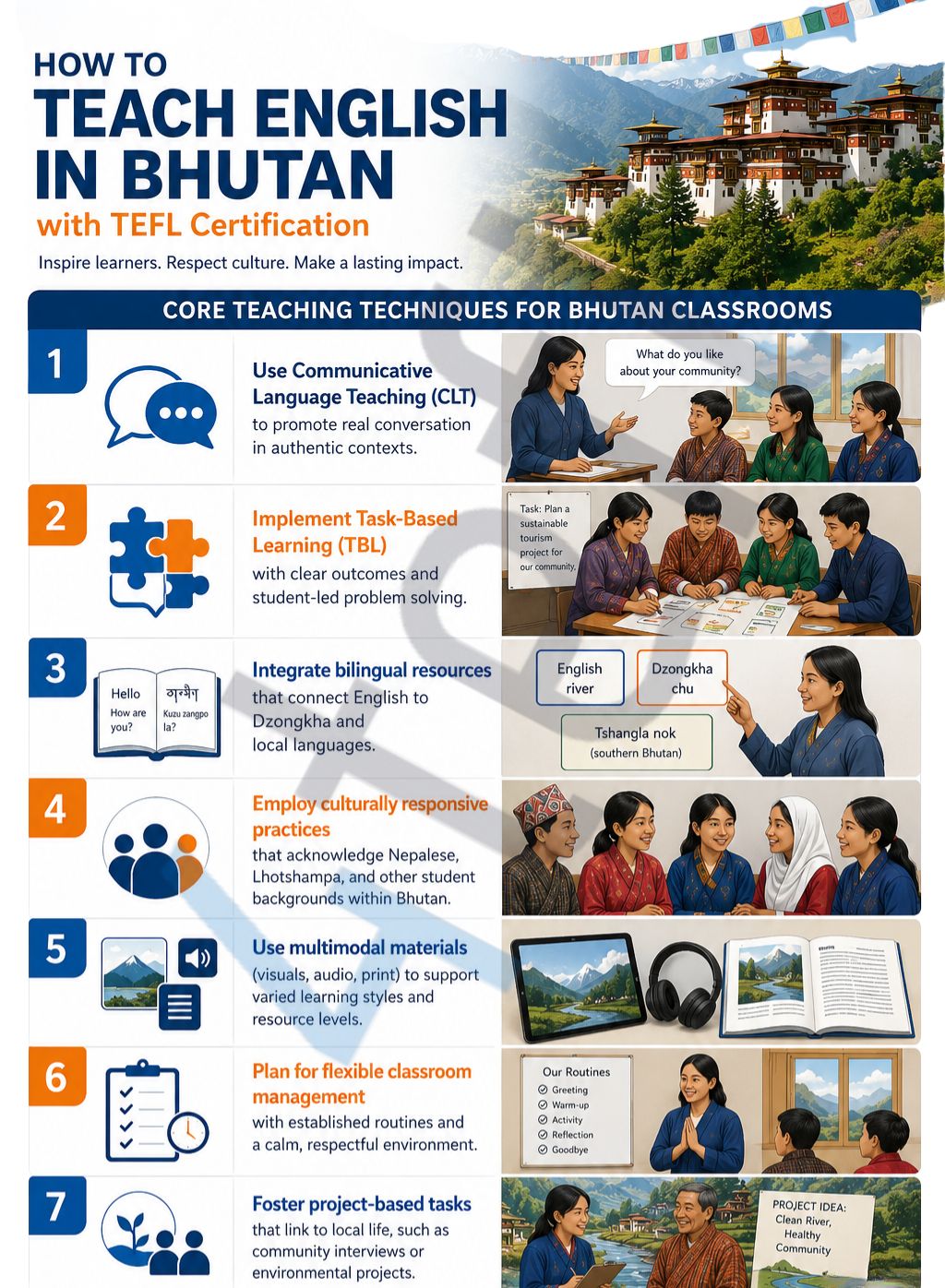
Bhutanese classrooms can be bilingual, where English is often used as the medium of instruction in addition to Dzongkha and, at times, local languages. Teach English in Bhutan with communicative strategies focusing on authentic interaction, cooperation, and real-life language use.
Curricular and Content Alignment
Begin with needs-based assessment to identify learners’ existing knowledge, language skills, and cultural setting. Focus on topic themes that are consistent with Bhutan; like environmental protection, tourism, traditional arts, and community service. Use a mix of pairs and small groups, role-plays, and projects in order to establish the environment for active language production. Design the material to be visually stimulating, use local examples, and take a cultural approach so that students will feel like they belong and be inspired by the work.
Classroom Management Techniques
In Bhutan, classroom management seems to benefit from firm but flexible techniques. Different classes with different resources require teachers to use such techniques as routines, clear expectations, and structured transitions to ensure the flow of information throughout the day. Get used to warm-ups, core activities, and plenary reflection in a predictable manner, while also being responsive to the student.
Consider a blended approach to teaching that balances low-tech with high-impact: picture cues, short videos, songs, and printed handouts together with simple interactive whiteboard projects if possible. Facilitate student autonomy in instruction by providing choice in tasks (e.g., selecting a reading passage or speaking activity), which may enhance engagement and decrease off-task behaviour.
Visual Scaffolding & Differentiation
Cultural and curricular sync is of great importance for lesson design in Bhutan. Use themes drawn from Bhutan’s ecology, society, and values to bridge the gap as to how language learning connects to students’ life histories. For instance, incorporate environmental topics through vocabulary lists (recycling, conservation) or make language exercises grounded in native celebrations and traditions.
Utilise a variety of formative assessment methods – observation notes, exit tickets, brief quizzes, and student reflections – in relation to measure progress. Scaffolding is critical: pre-teach the vocabulary you want, present sentence frames for talking, and slowly add on more difficult tasks. Include local teachers in co-planning – when feasible – to make sure it aligns with the overall national curriculum and promotes collaborative professional growth. Then differentiate the instruction according to learner needs (e.g., the exposure to English for learners with relatively little experience of English) and encourage them with rewards to progress on an incremental basis.
Career Opportunities: Teaching English in Bhutan with TEFL
In Bhutan, there are a variety of English-language teaching opportunities ranging from government schools, private schools, international programmes, and NGOs.
Sectors and Recruitment Channels
- Government and Semi-Government Programmes: These recruit teachers through national vacancy processes and district education offices (where postings are located in urban centres such as Thimphu and more rural districts).
- Private International Schools & Language Centres: These tend to have more standardised class sizes and longer working agreements, and can include housing and allowances.
- Volunteering & Short-Term Placements: Placements through NGOs might be a pathway leading into longer-term roles or local networks, leading to paid work. This opportunity lies in networking with TEFL providers and TEFL graduates working in Bhutan and having opportunities through networks and monitoring a recruitment portal focused on teaching abroad.
Requirements, Visa Regulations, and Benefits
The typical English teaching requirements in Bhutan for TEFL professionals to teach and practise are:
- Having an appropriate TEFL certificate (with a substantial practicum).
- A bachelor’s degree.
- A clean criminal background check.
Some jobs may require a teaching licence or a letter from a previous employer. Permits and residence issues are dealt with by Bhutan’s Labour and Human Resources Department and education authorities, so potential applicants need to consider terms or duration of visa and documents such as official transcripts, degree certificates and medical clearances.
The pay/benefits differ widely: international schools and NGOs are generally paid a little more (sometimes with accommodation or travel allowance), while schools run by the public sector are paid less but have stability and career path. It may include promotion into senior teaching positions or curriculum, teacher mentor, or teacher training and coaching in regional or national settings that will benefit a worker in Bhutan as a long-term career path.
Professional Growth and Long-Term Success
Some students study to qualify with additional certifications or go on to TESOL, English language pedagogy or education leadership as graduate degrees to broaden their curriculum scope. Online teaching opportunities can work in concert with the face-to-face role, allowing you to gain exposure, earn additional money when you are out of practice, or contact international students.
In order to ensure you succeed professionally, make it a career with a strong professional portfolio, collect evidence of student performance, work to support your evidence of your students’ achievements and make a strong connection with the educational environment, local professional networks, professional and continuing education of TEFL/TESOL providers and professionals. Integrating good teaching experience, working in schools coupled with local involvement and professional development, will give you a sustainable and satisfying teaching profession in Bhutan for all time.
Authoritative Sources and Fact Checks (References)
- Ministry of Education and Skills Development (MoESD), Royal Government of Bhutan: The primary authority overseeing school education, teacher recruitment, and national language policies.
- Ofqual (Office of Qualifications and Examinations Regulation): The UK government department that regulates qualifications, examinations, and assessments in England, acting as a baseline for Level 5 and Level 7 TEFL credentialing.
- UNESCO – Education in Bhutan: Provides global education monitoring reports, data on bilingual education, and regional guidance on pedagogical standards.
- Cambridge English Assessment (CELTA Provider): Official regulatory details, qualification verification, and global recognition frameworks for the CELTA certificate.
Do I need Ofqual-approved TEFL to teach in Bhutan?
Not universally. Some Bhutanese employers prefer or recognise Ofqual-regulated credentials, but many schools value well-structured TEFL certificates with solid practicum and clear evidence of teaching practice. Always verify with your target employer and present a documented portfolio. Ofqual approval can enhance credibility but is not a universal requirement.
What qualifications do I need to teach in Bhutan?
Generally, a TEFL certificate and a bachelor’s degree are expected, along with a clean background check and a work visa arranged through Bhutan’s authorities. Some roles may require additional qualifications, such as a teaching licence or prior teaching experience, particularly in international schools or NGO programmes.
Is English the main medium of instruction in Bhutan?
English is widely used as a language of instruction in many schools, especially at secondary and higher levels, while Dzongkha remains Bhutan’s national language. Some rural areas may have more bilingual or multilingual contexts. This bilingual setting means teachers should be prepared to support learners who are proficient in multiple languages.
How long does TEFL training take?
Training durations vary. In-person programs like CELTA or CertTESOL typically run for about four weeks, including the practicum. University-based programs can span longer periods, while online certificates range from six to twelve weeks (depending on the provider) and may include a practicum component.
Where can I find TEFL courses suitable for Bhutan?
Reputable TEFL providers offer courses worldwide, including in-person programs and online options with strong practicum components. Look for courses with clear learning outcomes, practicum hours, and recognised accreditation. Verify curriculum details and read reviews from alumni who have taught abroad, including in South Asia or Southeast Asia, to gauge applicability to Bhutan’s context.
How should I present my credentials to Bhutanese employers?
Build a concise CV in British English, emphasise classroom-based practicum, language skills, and cross-cultural experience. Include a teaching portfolio with lesson plans, sample student work, and supervisor feedback. Obtain official verifications from the awarding body and, if possible, a letter of reference from a previous employer or supervisor. Tailor your application to the specific school’s context, highlighting how your approach aligns with bilingual education and Bhutan’s cultural priorities.
Are there pathways beyond traditional classrooms in Bhutan?
Yes. Many teachers supplement on-site roles with online tutoring or curriculum development projects. NGOs and international organisations may also offer opportunities in teacher training, English language development, or program evaluation. Networking, ongoing professional development, and engaging with local communities can broaden your career options beyond the classroom and create lasting impact.