Dublin TEFL: A Practical Guide for Aspiring Teachers


Most emergent English language teaching and learning professionals find themselves in an uncomfortable dilemma: What course of study in TEFL will allow them to teach abroad or online? The rich language-education landscape in Dublin includes a range of approaches that are suitable for beginners, ranging from hands-on, in-person training to flexible online services. Choosing the right course has the capability to establish early career options, early career confidence in the classroom and long-term occupational adaptability.
Meanwhile, Dublin’s TEFL landscape reflects global demand for English language instruction in the broader context. According to credible sources from international organisations, English continues to be the language of study and commerce worldwide (UNESCO Institute for Statistics), which has a tremendous impact on demand for qualified teachers around the world.
For aspiring teachers studying for teaching in Ireland or elsewhere, accreditation and recognised certificates mean the world when schools finally welcome new staff (Cambridge English and Trinity College London also recognise some core TEFL qualifications).
This article walks you through four key aspects – course quality at beginner level, accreditation and cost consideration, student support and career opportunities, and the importance of hands-on teaching practice – so you can start well-informed.
Exploring Top TEFL Courses in Dublin for Beginners
Dublin’s TEFL scene welcomes novices with a wide range of entry-level training, starting from entry-level certificates that teach principles that underpin good teaching – lesson planning, classroom management skills, assessment systems, micro-teaching and more. Classic formats typically include four to six weeks of full-time in-person study, or longer, slower part-time ones; online formats can extend for several weeks, with a flexible cadence. The focus for beginning teachers is to turn theory into practice in as little time as possible, while practicum elements and time for observation have been developed from the very beginning. When you’re comparing your options, look for programmes that incorporate both theoretical and practical aspects.
A good beginner course should offer structured teaching practice and feedback from experienced tutors, along with a portfolio of lessons you’ve observed that give you valuable insight and can be passed on to future employers.
Dublin’s language school sector and the educational ecosystem in the wider city provide serious opportunities to help translate your training into classroom environments – whether you are in your country of origin teaching locally or teaching learners overseas. UNESCO points out that English-language study is globally prominent; this further emphasises the wide-reaching relevance of TEFL training (UNESCO Institute for Statistics). Cambridge English and Trinity College London frameworks also aid credibility for entry-level qualifications recognised by schools around the world (Cambridge English; Trinity College London). To understand what the teacher’s approach would be, a breakdown of these common delivery methods for some of the entry-level TEFL courses in Dublin will illustrate this better.
Visual Insight (Illustrative Trend): An illustrative pie chart usually displays courses conducted in person as the most popular option, with remote and blended options making up the rest; availability can differ by term and provider. That corresponds to broader trends across many other English-teaching markets in which employers are more likely to favour hands-on practicum experience in hiring practices.
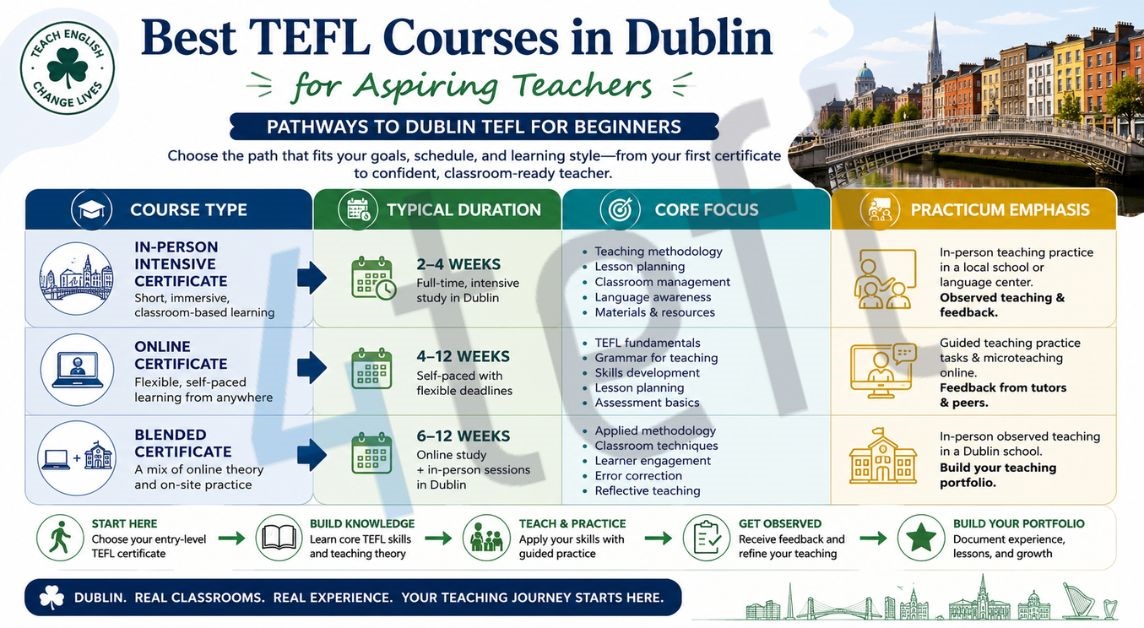
Dublin beginner TEFL course formats
| Course Type | Typical Duration | Certification | Accreditation Notes |
| In-person intensive | 4 weeks (full-time) | Certificate (60–120 hours) | Cambridge CELTA-equivalent, verified by provider |
| Online flexible | 8–12 weeks | 120-hour TEFL certificate | Self-paced; practicum option often required |
| Combined/blended | 6–10 weeks | Certificate plus practicum | Mix of online theory and on-site practice |
| Diploma pathway (introductory) | 3–6 months | QQI-aligned certificate (where offered) | Irish accreditation may apply for specific streams |
In the real world, your decision is likely to be in keeping with your sense of time, budget and style of learning. If you need quick access to the classroom, an immersive in-person programme with a good practicum might be appropriate. If you require flexibility as a result of work or study, an online or blended programme with a thorough practicum will be an ideal option. Be it in a medium or a format, prioritise programmes that highlight teaching practicum opportunities, mentor assistance and an employer-recognised certificate in your target markets.
If you want to know what Dublin schools generally want from their new TEFL graduates, a small portfolio should include: micro-lesson videos, lesson plans, classroom management notes and reflective journal entries from practicum. These reveal your teaching style, how well you can transition into a live classroom, and your appetite for reflective professional learning. While you have information for all options, cross-reference your syllabus with the international recognition of the certificate and check if the provider offers some form of observed teaching (or micro-teaching opportunities).
Accreditation, Costs and Certification Paths in Dublin TEFL
Investing in your first TEFL certificate: credibility matters. You want programmes to be recognised with certification and there should clearly be pathways to more advanced qualifications. Where known standards exist, international qualifications such as Cambridge CELTA or Trinity CertTESOL, in addition to Irish frameworks such as QQI where available, often feature on reputable routes in Dublin.
Credentials like Cambridge English and Trinity College London are recognised in schools around the globe and are commonly accepted by schools and Irish employers, and QQI certification can help if you are interested in studying further within the Irish education sector or continuing studies under the national qualifications criteria. They help to ensure your certificate is recognised by schools both at home and abroad (Cambridge English; Trinity College London; QQI).
TEFL costs for Dublin-based courses will vary by structure and provider. This model assumes that there are online teacher-led certificates available that are more affordable compared to face-to-face, teacher-led courses. A broad range frequently referred to by providers is around €1,200–€3,000 for full-time in-person certificates, though online formats generally begin at much lower costs and increase depending on the demands of the practicum and tutor support. This means always clarify what’s included in the price – teaching practice, observation, feedback sessions and portfolio development are critical to truly market-ready qualifications.
Important Budgeting Tip: When organising and budgeting for practicum placements, take into account extra expenses like textbooks, teaching materials and local travel, as well as incidental costs.
Although the national body for Irish accreditation is QQI, the national organisation that provides a standard reference point for quality assurance and official recognition, check whether a course actually has QQI validation or if it is merely aligned with QQI frameworks (QQI). Set your certification path well in advance and plan your progression beyond the certificate itself. A typical progression consists of moving from a general TEFL certificate to a more specific qualification such as CELTA or Trinity CertTESOL, with specific CPD modules (e.g., lesson planning, assessment methods, inclusive classrooms). Employers are keen to see real advancement and documented teaching practice in this ladder-like system. Certificates in Ireland and across Europe tend to favour those with strong practicum components alongside substantial coursework, as well as evidence of continuing professional development.
For a down-to-earth view, the following one-paragraph map might help you think through your route: you might begin with a 120-hour TEFL certificate (to ensure sufficient foundational preparation and observation), followed by a CELTA or similar qualification for extensive classroom experience and then QQI-level options if you want to align with Irish national benchmarks.
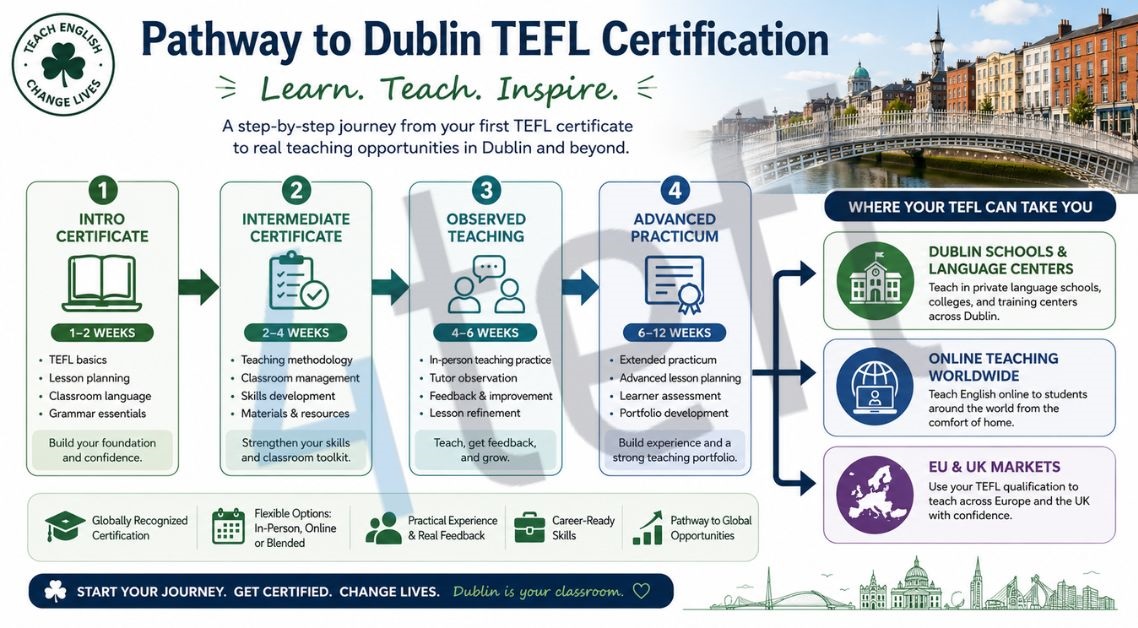
Accreditation and cost considerations
| Factor | What to look for | Why it matters | Typical range (illustrative) |
| Accreditation body | Cambridge CELTA, Trinity Cert TESOL, QQI | Global recognition and local credibility | Cambridge/Trinity; QQI as relevant local option |
| Delivery mode | In-person, online, blended | Aligns with work, study, and travel needs | In-person: higher; online: lower; blended: mid-range |
| Certification scope | 120 hours, observed teaching, portfolio | Demonstrates practical readiness | 120–180 hours with practicum |
| Price range | Course fee, materials, practicum costs | Budget planning and value | €1,200–€3,000 (in-person); €200–€1,200 online |
Accreditation is not merely ceremonial. It affects how easily your certificate is recognised by schools in Dublin, across Ireland, and in international markets you may teach in later. QQI accreditation offers reassurance about alignment with Irish qualifications frameworks, which can be particularly helpful if you intend to pursue further study or a local teaching role. Cambridge English and Trinity Tesol credentials are widely understood by schools worldwide, which can shorten your job-search timeline when you begin teaching abroad or online. For accuracy and up-to-date details, consult the official QQI site and Cambridge English or Trinity’s programme pages.
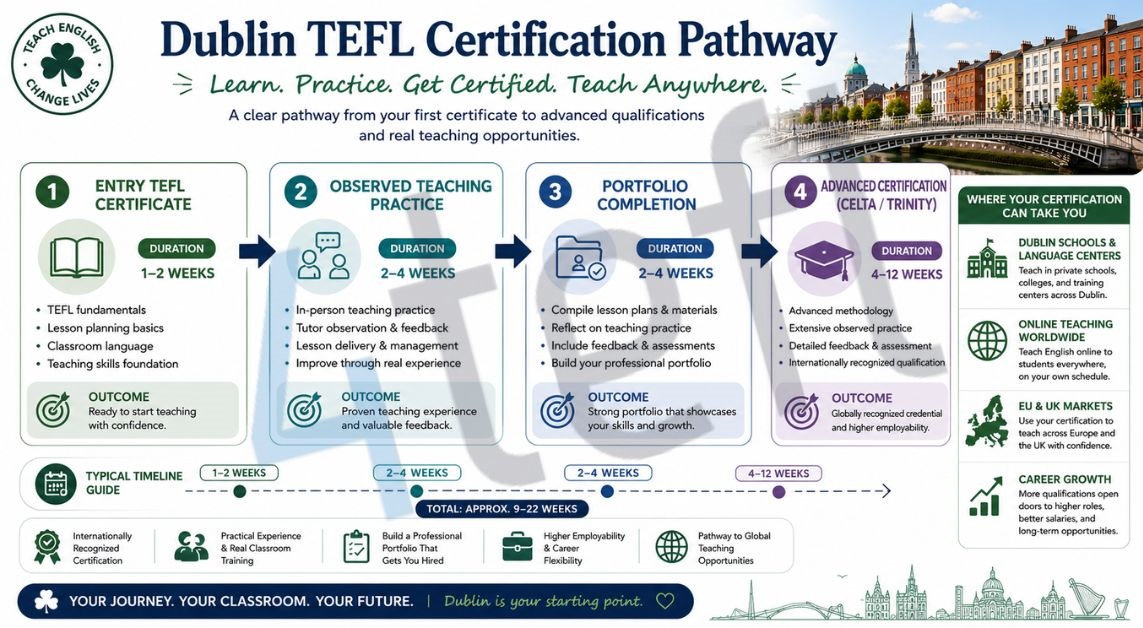
Student Support and Career Prospects after Dublin TEFL
Effective Dublin TEFL programmes focus on student support, from admissions advice to job-search support. Strong programmes provide a good balance between theoretical learning and a strong mentoring structure, opportunities for feedback during teaching practice, and access to teaching tools and communities. That support system is especially helpful for novices translating classroom theory into live sessions. Universities and established language schools will generally provide a more formal mentoring programme, but independent institutions may offer tutor support opportunities and alumni networks. International evaluations and employer needs demonstrate that continued support after certification enhances early career success and classroom readiness (UNESCO; OECD insights into education support systems).
TEFL teachers in Dublin find a variety of positions. Language schools, universities and online teaching platforms have created opportunities across Ireland and beyond. For example, many graduates secure positions in Dublin’s language schools and tertiary-level language programmes; some use online platforms to teach learners across Europe, North America and beyond. Experienced teachers who use classroom observations and a portfolio to demonstrate teaching performance often achieve faster placement. Networking with local schools and joining professional TEFL communities can also open up freelance and part-time employment, particularly during peak teaching seasons when student demand surges. The city’s status as a bilingual centre of English and Irish language education that attracts international students provides another route of entry – and access to potential employers (UNESCO; British Council reflections on global English teaching demand).
For those looking to extend their career after certification, create a teaching portfolio that consists of short teaching videos, reflective journal entries and a summary of the classroom management practices you have observed during practicum. Employers often want to see proof of flexibility, differentiated lesson planning and a capacity to teach diverse groups of students. Participating in local TEFL meetups, online teacher communities and continuing professional development (CPD) workshops can sustain momentum after certification and help you stay current with classroom trends and assessment practices. Indeed, the strongest pathways tend to combine meaningful certification with proactivity in job-hunting, a professional portfolio and ongoing skills development.
Key Takeaways
- Dublin offers a spectrum of beginner-friendly TEFL routes, from in-person certificates with practicum to flexible online programmes. Prioritise practicums and a clear portfolio-building pathway.
- Accreditation matters. Look for recognised certificates (CELTA or Trinity) and consider QQI alignment if you plan to work in Ireland. Always verify the certificate’s recognition with prospective employers.
- Support and practical experience are essential. A programme with mentoring, feedback on teaching practice, and a strong job-search component will accelerate early-career success.
Thank you for exploring Dublin’s TEFL offerings with a focus on beginners. If you’re planning to teach English abroad or online, a well-chosen certificate combined with practical teaching experience can open doors quickly. Use the decision framework from this article to compare formats, accreditation, and practicum opportunities, and remember to build a portfolio that showcases your progress and reflective practice.
Next steps: identify two to three Dublin-area programmes that align with your schedule, budget, and career goals. Check their practicum arrangements, ask about post-certification career support, and request sample syllabi to verify coverage of essential topics like lesson planning, classroom management, and assessment. When you’re ready, set a realistic timeline for starting your course, complete the application steps, and begin building your TEFL portfolio even before the course begins.
Authoritative Sources and Fact Checks (References)
- UNESCO Institute for Statistics (UIS): Global monitoring body for language education and literacy trends.
- Westbridge CPD Institute: CPD Accreditation: CPD accreditation for organisations and professionals. Recognising quality learning, training and development across all industries.
- Quality and Qualifications Ireland (QQI): National agency responsible for quality assurance in further and higher education in Ireland.
- Organisation for Economic Co-operation and Development (OECD): Insights on global education and development of teacher support systems.
What is the difference between CELTA and a standard TEFL certificate?
A CELTA is an internationally recognised, practical qualification focused on classroom teaching with supervised practice. A standard TEFL certificate often provides foundational theory and practical planning but may vary in the depth of supervised teaching practice. Employers in many markets view CELTA as a high-value credential, though the best option depends on your career goals and location (Cambridge English; employer expectations).
Do I need to travel to Dublin to take a course?
Many courses are offered online or as blended formats, allowing you to study remotely while completing practicum locally. If your goal is to teach in Ireland, an in-person Dublin course with a supervised practicum can be advantageous for local networking and job placement.
What career options exist after completing a Dublin TEFL course?
Graduates can pursue roles in Dublin’s language schools, higher education language centres, and online teaching platforms. With additional CPD and certificates such as CELTA or Trinity, you can expand to roles in schools across Europe, online teaching for international learners, or private tutoring.