How a 20-Hour Weekend TEFL Certificate Accelerates Teaching Abroad


Teaching English abroad is an incredibly appealing dream, but many aspiring teachers dread difficult study requirements, expensive programmes, or a world of high entry requirements. A short 20-hour weekend Teaching English as a Foreign Language course holds out the hope of such pragmatism: learn about essential teaching skills in a bite-sized format, earn a certificate quickly, and start applying for roles in classrooms in faraway countries or online. If you want something tangible and you need the momentum, it deserves serious consideration.
Another reason is real-world applicability. Weekend courses give you real lesson planning, classroom management, and core language-awareness strategies you can embrace right away. For people with work, study, or family commitments, a more manageable schedule can be more sustainable than extended programmes.
“But, of course, understand the short-course limits and ensure that you’re combining it with the right accreditation and a professional development structure.”
Lastly, the demand for English instruction worldwide is high. English teaching is an essential part of many educational systems and opens up possibilities in several nations. A 20-hour weekend TEFL certificate can also serve as a stepping stone to the next stage – helping you land entry-level jobs, supplement your online teaching, and, if you decide later on, work towards higher qualifications.
Why a 20-Hour Weekend TEFL Course Works Quickly
Efficiency is the characteristic of the 20-hour weekend TEFL course. You work in a small block throughout one weekend with the key content of lesson design, classroom management, and practical ways of teaching without putting students through long programmes. Young people who juggle study, family, and travel will find this format appealing. The tight focus makes it possible to get instant feedback loops – about what’s going well, about micro-teaching techniques, and through immediate feedback – so you come away not only with theory but with real teaching tools.
The course is organised so that skills that work can be developed. Instead of modelling all the theoretical approaches, weekend TEFL modules target concrete activities like:
- Planning lesson durations of 20–30 minutes,
- Selecting activities suitable for different age groups,
- Adapting materials for other learners,
- Managing classroom climate.
Such a hands-on approach conforms to that of many entry-level employers who seek a candidate who can plan, deliver, and reflect within short teaching windows.
Professional bodies that manage TEFL standards highlight the significance of domain-specific practice and standardised assessment in creating an entry point for teachers who are applying overseas. Expectations must be realistic. To this end, a 20-hour certificate should not be viewed as a replacement for longer, more technical qualifications. It opens the door to certain schools, volunteer programmes, and online platforms that accept concise credentials, while also showing a commitment to advancing your professional development. If possible, confirm accreditation, the depth of placement experience, and the provision of continued training or routes for career progression, as these factors can influence the success of the course’s transition into practical employment.
Typical 20-Hour Weekend TEFL Course Outline
| Module | Approx. Hours | Focus | Assessment |
| Orientation & Needs Analysis | 2 | Course goals, learner profiles, needs assessment | Short reflective summary |
| Lesson Planning Fundamentals | 4 | Objectives, materials, timing | Sample 20-minute plan |
| Classroom Management & Engagement | 4 | Seating, routines, proactive strategies | Micro-teaching observation note |
| Teaching Techniques (PPP, TTT, etc.) | 4 | Teaching models, activities, differentiation | 5-minute demonstration |
| Language Awareness & Simple Grammar Explainers | 3 | Clear explanations, visuals, learner support | Mini-lesson video clip |
| Assessment & Feedback | 3 | Formative assessment, feedback methods | Feedback plan for a mock class |
| Micro-Teaching & Reflective Practice | 4 | Practice teaching in short slots | Video of micro-lesson with critique |
| Safety, Safeguarding & Professionalism | 2 | Classroom safety, welfare, ethics | Policy checklist |
*Note: Hours and modules vary by provider, but core aims stay consistent: practical skills, live practice, and rapid credentialing.
Practical Skills Gained in a Weekend TEFL Certification
In the fast-paced world of our industry, lesson planning and micro-teaching are key competencies learned in compact packages. You learn to develop succinct lesson objectives, pick activities that support those objectives, and arrange lessons for narrow timeframes. Micro-teaching exercises provide a place for practising storytelling, guiding drills, conducting pair-work activities, and then receiving feedback in a controlled environment. Employers who want fast learners are looking for clear planning and flexible skills.
Another pillar is language awareness and classroom dynamics. You’ll learn through practical experience how to explain grammar in meaningful ways that make sense, using visuals, realia, or gestures. You’ll also delve into classroom management techniques to minimise disruptions and encourage participation, such as establishing expectations with learners who speak different levels of English. The focus is on transferable skills that you can put into practice across a variety of age groups and environments, from primary education to adult conversation clubs.
Technology, safety, and reflective practice are integrated into the practical package. Participants will sample a range of simple teaching aids, such as audio-visual resources and basic internet tools used in remote and hybrid online classes. One of the first topics covered is safeguarding and ethical teaching: teaching with care, responsibility, and professionalism. Lastly, you will begin learning to assess your own teaching through short reflections or video reviews, forming a self-improvement loop that supports your future development.
Where to Use a 20-Hour Weekend TEFL Certificate Abroad
Many local language schools in Asia, Europe, and Latin America offer opportunities for weekend TEFL graduates. A lot of centres welcome entrants who can demonstrate practical teaching skills and quickly find their feet. Such centres place an emphasis on enthusiasm over extensive certification; however, if a candidate can demonstrate expertise in lesson planning, student participation, and basic classroom management, they value those qualifications. The weekend certificate serves as a tangible signal of readiness to step into a classroom.
Online teaching is an expanding field that is open to a variety of credentials. An increasingly popular area – and one that continues to grow with global demand for English instruction – often leaves platforms seeking different types of teachers who can provide explanations, engage with students online, and manage their time effectively. The 20-hour weekend TEFL certificate is a useful additional credential when applying for online and hybrid teaching roles, especially when combined with a strong set of lesson plans or a short teaching demonstration video.
Visa status and local requirements differ from country to country. In some destinations, teachers may be eligible for entry-level or work-based visa routes with basic TEFL certification, while in others, additional qualifications and/or university degrees are required. Nations within the European Union, as well as parts of Asia and Latin America, each have different requirements. It’s crucial to consult official government websites or recognised international organisations before applying for work permits or checking age and educational requirements.
Maximising Employability After Completing the Weekend TEFL
- Create a portfolio that exemplifies relevant know-how: Include sample lesson plans, a brief teaching video, evidence of classroom management strategies, and comments from practice sessions. A well-organised portfolio helps you stand out to recruiters and schools that want to see concrete demonstrations of your teaching approach, even if the qualification is compact. Consider collecting short references or letters from peers or mentors who observed your micro-teaching.
- Networking and professional visibility matter: Engage with local teaching communities, attend online TEFL forums, and participate in local language club activities to expand your circle. When recruiters know you’re actively developing your craft, they’re more likely to think of you for short-term contracts or immediate teaching opportunities. A proactive approach to networking complements the certificate and signals long-term commitment to the profession.
- Continuing professional development enhances long-term prospects: After a 20-hour weekend course, many teachers choose to pursue additional certifications such as CELTA or YL-TEFL modules, depending on their career directions. Even without pursuing another full qualification, enrolling in specialised short courses – such as speaking, pronunciation, or classroom technology – can broaden your appeal to employers who value continued growth and versatility in their teaching staff.
What to Expect in a 20-Hour Weekend TEFL Course
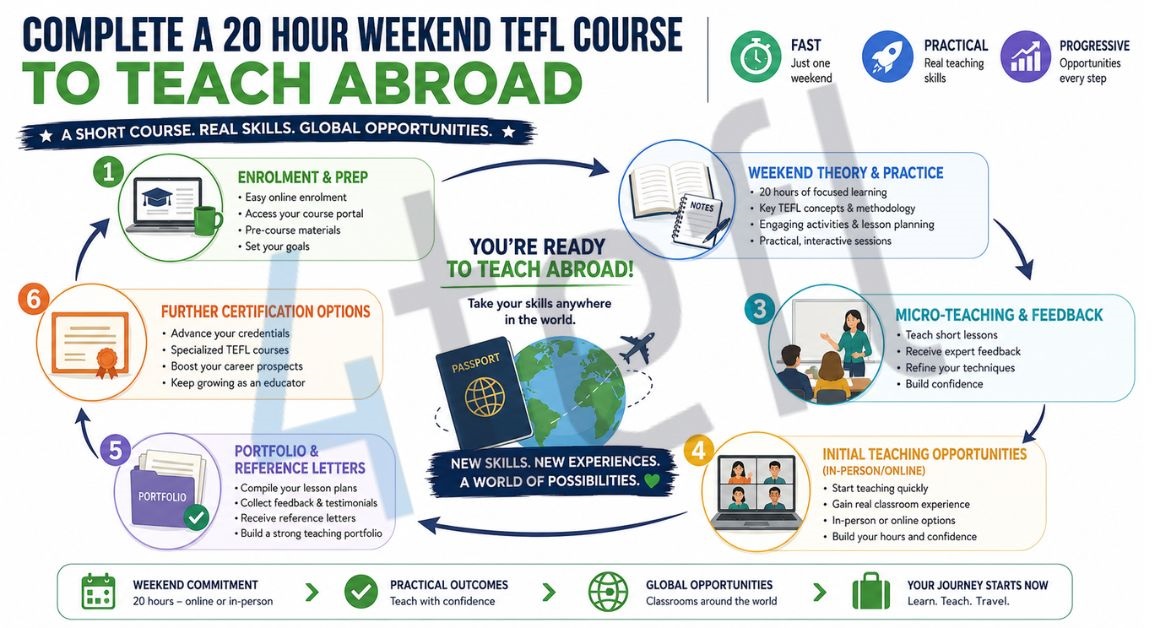
A typical TEFL programme takes place at weekends over one or two days with a tight timetable. Expect some short theory sessions and hands-on practice, including observed micro-teaching and constructive feedback. The schedule focuses on “learn-by-doing opportunities” – students practise an entire lesson from beginning to end, then critique one another and ask more experienced teachers for feedback. The aim is to produce confident beginners who can enter a classroom with a good plan and the right approach.
Assessment is mostly practical in nature rather than exam-based. You will probably compile a small portfolio, give a couple of micro-lessons, and do reflective work. The emphasis on practical results means that you demonstrate your ability to manage a classroom environment, attract the attention of learners, or change strategy when necessary. In doing so, graduates receive a certificate. With it, they are officially recognised by employers as having mastered essential teaching competencies through a short period of training.
The target participant profile includes quite a few people:
- People with little teaching experience who wish to teach overseas or online tend to benefit the most.
- The programme can also be valuable for non-native speakers of English, especially when the course focuses on clear communication, supportive teaching strategies, and culturally responsive approaches.
- Even if you’re already working or studying, there may well be doors you can open to the world of English teaching through the weekend model, provided that you combine credibility with accredited training and clear learning outcomes.
Key Takeaways
With a 20-hour TEFL course over the weekend, you can take the first step into teaching English abroad and working online through a short course. It is built on the principles of planning, delivery, and reflective practice, and you can start teaching sooner rather than later. Conveniently squeezed down to size, the small format appeals to all those who manage to juggle many responsibilities while still seeking credible credentials.
The certificate’s value comes from its credibility, practicum quality, and its translation into real-world classroom readiness. It’s not a panacea for more long-term qualifications, but it is a valid starting point, particularly alongside continued professional development and a good teaching demo. Make sure your choice of course is in line with recognised standards and that it has clear outcomes.
To ensure better chances of employment, concentrate on portfolio-building, strategic networking, and future development. Take the certificate as a springboard to gain real-world experience, earn a few extra certificates, and customise your experiences to fit your teaching needs, whether in in-country classes or web-based learning platforms. The weekend certificate, if well orchestrated, can start a fulfilling, global, and mobile teaching career in a very positive way.
Authoritative Sources and Fact Checks
- UK National Careers Service: Official job profiles, legal guidelines, and entry requirements for teaching English as a foreign language abroad and online.
Do I need a degree to do a 20-hour TEFL course?
In many cases, a degree is not strictly required for enrolment in a 20-hour weekend TEFL programme. However, some employers or host organisations may prefer or require a degree for work visas or certain contracts. It’s important to check the entry requirements of the specific programme and the destinations where you plan to teach. A degree can enhance opportunities, but a well-executed weekend certificate combined with a strong teaching demo can still open doors in many entry-level roles.
Is a 20-hour certificate enough to teach abroad?
A 20-hour certificate generally supports entry-level teaching or online roles and demonstrates practical capability. It is less likely to satisfy employers seeking more comprehensive training like CELTA, especially for in-person classroom roles in competitive markets. For many destinations, the certificate serves as a stepping-stone–allowing you to gain early experience while you pursue additional qualifications or specialise in a particular learner group (young learners, business English, etc.).
How should I verify a 20-hour course’s credibility?
Look for clear accreditation from recognised TEFL bodies, a documented practicum component, and a transparent outcomes statement. Check what the certificate represents (hours, assessment methods, and demonstrable teaching evidence). Reputable providers will outline the exact learning outcomes, the qualifications of the tutors, and opportunities for ongoing development or progression to longer courses. Where possible, seek independent reviews or endorsements from educators or institutions.
Can I combine a 20-hour weekend TEFL with online teaching work?
Absolutely. The brevity and flexibility often pair well with online teaching roles, where asynchronous planning and live sessions demand solid lesson design and classroom management. A well-packaged weekend certificate, together with a robust teaching demo and an online teaching portfolio, can create a competitive profile for platforms that specialise in remote English instruction.
How much does it typically cost, and what is the value?
Prices vary by provider, location, and the depth of practicum offered. When evaluating value, consider the quality of practicum, the accessibility of feedback, and the provider’s track record for student placement or progression. A lower price does not always mean lower value, but ensure you receive credible accreditation, clear learning outcomes, and post-course support.
What’s the best next step after a weekend TEFL certificate?
Build a portfolio, seek opportunities to observe or co-teach, and apply for entry-level roles with a focus on schools that value practical teaching demonstrations. Consider scheduling a few mock lessons with peers and recording feedback to refine your approach. If your goals include long-term teaching in a competitive market, plan a route toward more comprehensive qualifications while maintaining hands-on teaching opportunities.