Teach English in Egypt: TEFL Certification, Visas and Career Opportunities


Egypt is an interesting combination of the old and the new world, where English takes on new life as a door to your future study and later work.
Meanwhile, for learners in the ranks of TEFL teachers, the country offers a spectrum of settings – from bustling urban schools to peaceful language centres in provincial towns – as well as online options that extend the working day across continents.
There is a strong need for communicative English, as well as a burgeoning private education sector and efforts from international bodies to advocate the importance of English as a key skill for young people.
In Egypt’s TEFL market, success relies on a solid starting point – an internationally recognised certification, clear visa requirements, and adaptability to local classroom realities.
Employers also look for practical experience, strong cultural sensitivity, and a well-honed teaching approach where students are not only engaged but show measurable gains towards a destination.
This article surveys TEFL jobs in the cities of Cairo, explains the visa pathways for UK and EU teachers, states how the jobs are generally found, and discusses how to adapt successfully to foreign cultures by practising effectively.
If your goal is to secure a full-time job, get a contract, or go online and teach from a coastal town, the inclusion of professional development with a realistic perspective on the job market will allow you to apply confidently for TEFL opportunities in Egypt.
Exploring TEFL Opportunities Across Egypt’s Cities
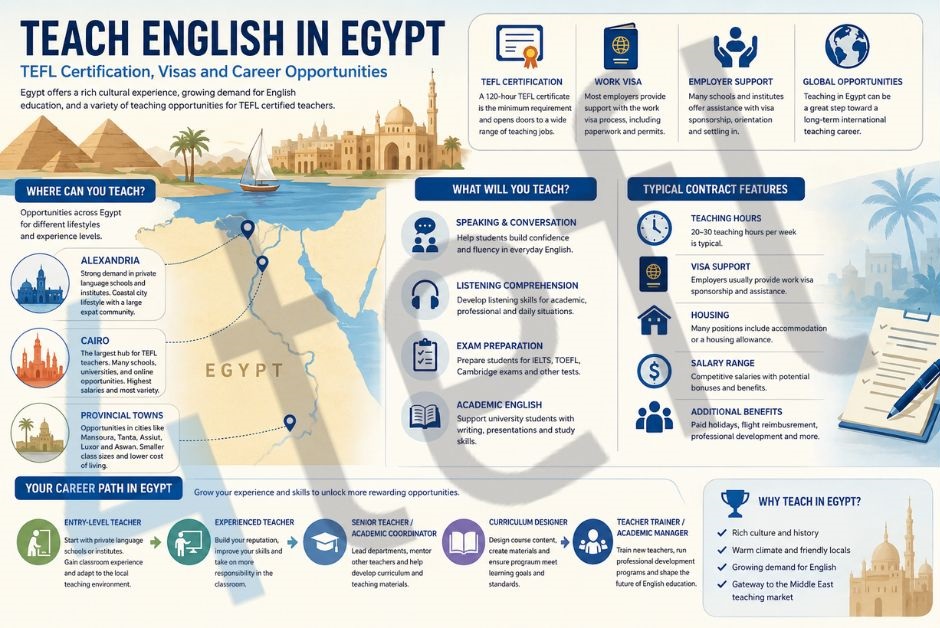
Despite each of Egypt’s cities providing unique opportunities for TEFL, the need for practical English for real-world needs is common across them. As the capital and the largest city, Cairo is home to a complex web of private language schools, international schools, and university extension programmes.
In those environments, teachers find themselves regularly interacting with mixed-age classes that mix exam preparation and general English, also requiring creativity and stretching their classroom management skills. The city’s larger scale also means more options when it comes to start dates, the length of contracts, and negotiation space for terms like class size, hours, and accommodation assistance.
The rhythm of Alexandria, on the Mediterranean coast, is different. It also has some great language institutions, language centres, and universities, all looking for English teachers to support academic English, listening skills, speaking, and professional communication skills. Work here can be closer to the predictable programme structure found in Egypt, and the overall market is smaller than in Cairo.
In some regions of less urban Egypt, like the Suez Canal region or university towns, there are more possibilities, with public and private schools, language centres located on campuses, and some NGOs involved in English literacy initiatives. They can also provide an opportunity to connect with community education projects and engage in local language exchanges that enhance teaching practice.
Outside the three main cities, online TEFL platforms mean that remote teaching is now available, which complements on-site work. A great many Egyptian teachers link classroom hours with online tutoring, evening Business English, or weekend courses for students who are based abroad. This combination of methods provides added flexibility and helps to stabilise income, especially for those beginning in a small local market.
Across various locations, developing a portfolio that represents lesson planning, assessment, and differentiated instruction, as well as evidence of cultural competence and adaptability to diverse classroom settings, is a practical way of advancing your career. Opportunities for the emerging teacher to join local professional networks, attend teacher professional development events, and align with reputable accredited programmes can improve access to quality postings.
TEFL Opportunities by City
| City | Typical institutions | Notes |
| Cairo | Private/International schools | Largest market |
| Alexandria | Language institutes, universities | Regional focus |
| Other cities | NGOs, campus programmes | Smaller teams |
| Online/Hybrid | Online platforms | Flexible hours |
Navigating UK/EU Visa Rules for Teaching in Egypt
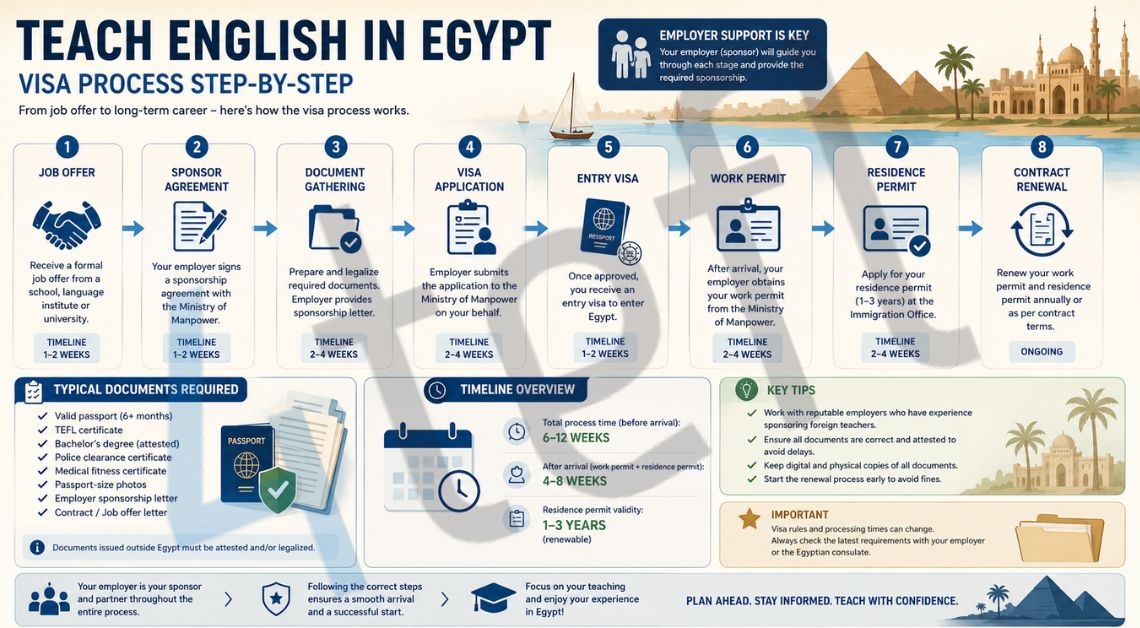
The requirement for a valid work visa and permit is generally required for TEFL teachers to be employed in Egypt. In reality, most employers will arrange or sponsor the necessary documentation so that any visas will, at most, be handled by word of mouth or agency direction.
For teachers from the UK and EU countries, what can be taken into account is seeking out a good employer that can help you understand the regulations in that region, as well as the work permit and residency application processes. Although temporary teaching trips may be allowed under a visitor visa for a short period, any long-term employment must have a work visa in place, and attempting to teach without authorisation can cost you your status and future opportunities.
The usual route starts with an obligatory job offer or contract, and the provision of proof required for a residence permit by the Egyptian authorities. Such documentation can include evidence of qualifications, a criminal record check, medical clearance, a passport, and photos for the entry visa. Often employers help with translations, apostilles, or testimonies essential to legitimise credentials.
Once a job starts, teachers can apply for a residence permit that is tied to their work, with renewals corresponding to the terms of the contract. This set of prerequisites provides educators with a framework for planning their move, negotiating visa policies with a prospective employer, and avoiding unnecessary delays.
Practical tips for navigating visa rules involve some elementary steps. One, verify with your prospective school if they offer visa support and what documents they need. Second, prepare your teaching credentials and background checks in advance so that you can keep them current and apostilled whenever possible. Third, write down everything you communicate with your employer and the government, including the contract description and expected timetable. Finally, remember that visa policies can change; therefore, keeping an eye on the government’s official channels, as well as reputable international teaching bodies, will help ensure that you remain compliant with current regulations and avoid falling foul of non-compliance.
Securing TEFL Jobs in Cairo, Alexandria and Beyond
Cairo is the dominant TEFL arena in Egypt, providing equal opportunities for local private language chains, international schools, and university extension programmes to operate their own teaching programmes.
For the job seeker, a purposeful CV that emphasises classroom practice, assessment strategies, and experiential learning may work particularly well with recruiters who want real results. Networking is important: when you go to local teacher exchanges, find professional groups, and interact with local training providers, you will be able to find positions that aren’t advertised publicly.
Furthermore, this is useful to establish credibility and provide an indication of fit for structured programmes and exam-preparation courses, as it comes with the TEFL certificate having been recognised by a reputable training organisation.
Alexandria has more institutions established in language institutes or academic campuses, and many are looking for instructors who can pitch in on conversation-style courses, IELTS/TOEFL support, and general English. The market is smaller than Cairo’s, but the quality of opportunities is generally high, and the cost of living is generally lower.
In more regional environments, universities and vocational colleges are often willing to pay instructors to teach English in academic or professional roles in support of language development needs (Business English for local businesses and industry, etc.).
Beyond the four walls of the classroom, online language teaching has an alternate route through which teachers can earn more locally within the community, expand the number of learners, and develop a varied teaching portfolio that is flexible enough to meet diverse curricular requirements and student needs.
For the people who appreciate a combination, combining an in-person or interactive language learning programme with online language teaching could offer a promising alternative. It is this that will help to address the increasing global need for remote language learning, particularly in Business English and exam readiness.
While studying to practise, you will want to think about a clear and solid lesson plan that demonstrates differentiation and inclusive teaching, and a portfolio of student feedback and assessment records.
For locations beyond the capital city, consider collaborating with government-supported adult education projects or NGOs working with literacy learners or community participants in literacy and citizenship learning that offer the chance to meet other educators and make a real impact.
Next toolkit: Customise your CV for the Egyptian market: make a list (certificates, methodologies, deliverables, outcomes). Write a short CV detailing how you enable students to thrive, balance the classroom, and work with multiple groups. Make a mark on local professional networks and find temporary or volunteer positions that allow for longer contracts. Having a clear teaching philosophy backed with evidence of reflective practice as well as continual professional development will set you apart from the rest of the market.
Cultural Adaptation and Classroom Skills in Egypt
Cultural sensitivity and flexible teaching strategies play a critical role and are among the main factors for effective TEFL in the Egyptian classroom.
As in other countries around the world, the Egyptian teacher will likely have a mixed, flexible task structure as well as blended formal and informal classes, so much of teaching in Egyptian classrooms is more structured than in many other countries, while teachers often blend this with flexible, student-initiated activities.
Building rapport with parents and students is key – teachers who respect local norms – punctuality, clarity when it comes to expectations, and patience with students throughout the teaching process (timely responses, expectations, and feedback) – are more likely to build good relationships sooner and create a better learning environment.
Adapting to new educational beliefs and practices in a school does not mean abandoning what works best in your home culture. By doing so, it is possible to create materials and activities that are more suitable for Egyptian students.
From an educational strategy standpoint, communicative language education in Egypt remains highly effective, especially when combined with visual resources, authentic materials, and cooperative settings. Role-play projects and classroom tasks help learners develop practical language that can be carried over beyond the classroom.
In addition, teachers ought to be ready to lay out what is expected of students, provide frequent formative feedback on how they are progressing, and adapt tasks so that mixed-ability groups can participate.
When assessing students’ success in learning at local schools and integrating exam preparation with communicative goals, students will develop confidence and measurable progress while also meeting their school or programme requirements.
Cultural adjustment also includes an evaluation of social practices such as family involvement, gender expectations in specific contexts, and the role that hierarchy plays in classroom settings.
Observing school culture in a quiet way (how teachers engage with administrators, how students ask questions, how feedback is framed, etc.) can inform more successful teaching approaches.
Continued professional development through reflection and peer observations also supports efforts to translate effective pedagogy into successful classroom learning.
In conclusion, effective TEFL in Egypt therefore requires sound pedagogy combined with cultural humility, customised to meet the diverse needs of numerous student groups and the expectations of Egyptian institutions.
Key Takeaways
Egypt, especially Cairo, Alexandria, and regional cities, has diverse TEFL opportunities and a high demand for practical English and exam preparation. Where work visas are concerned, the majority of positions require employer sponsorship; a contract in which the employer agrees to support your visa application is vital. Online teaching can help supplement your workload and income alongside on-site roles, and a well-structured CV and portfolio will improve your job prospects. Success in Egyptian classrooms requires cultural adaptation, classroom management, and differentiated instruction. Professional development and participation in local teaching networks extend career longevity and access to better postings. Teaching English in Egypt is a good option for educators who appreciate interactive teaching, cross-cultural approaches, and impactful teaching and learning. In the right circumstances – certification, visa readiness, and a targeted job search – you are able to create a rewarding TEFL career in Egypt that allows you to develop professionally and have vibrant encounters with the local culture. Be flexible in your approach, embrace local realities, and partner with trusted local providers to be in the best position to capitalise on an emerging market segment. Your best tools at the beginning of this journey are voice, pace, and purpose. Treat each city as an educational environment for yourself as much as for your learners, and let curiosity influence your lesson planning, your professional relationships, and your expectations for the future.
Authoritative Sources and Fact Checks (References)
- British Council Egypt – Teaching English: Offers extensive information on the role of English in the Egyptian education sector and professional development opportunities.
- Go Overseas – Teach English in Egypt: A comprehensive resource covering job market expectations, cultural etiquette, and teacher requirements.
- Ministry of Foreign Affairs, Egypt – Visa and Entry Regulations: The official portal for verifying current visa and work permit policies.
Do I need a TEFL certificate to teach English in Egypt?
A recognised TEFL certificate is highly valued by employers in Egypt and often required for formal teaching roles, particularly in private language schools and universities. Some short-term or volunteer opportunities may be accessible with less formal credentials, but a reputable certificate enhances eligibility and job security.
What visa do I need to teach in Egypt?
Most teaching roles require a work visa or a work permit arranged by the employer. Short visits may be possible on a tourist or business visa, but sustained teaching typically requires proper sponsorship and residence documentation. Always confirm visa support with your prospective employer.
How much can I expect to earn teaching English in Egypt?
Salaries vary by city, type of institution, and hours. Private language schools in major cities often provide a higher rate than rural centres, and roles that include exam preparation or international programmes may offer additional benefits. Understand your total compensation package, including housing support, health insurance, and visa assistance.
Is it possible to teach online from Egypt?
Yes. Online teaching can complement on-site work, offering flexible hours and broader learner pools. Time-zone alignment and stable internet are important considerations, but many teachers in Egypt successfully combine on-site classrooms with remote instruction.
What age groups can I teach in Egypt?
Opportunities exist across age ranges – from young learners in private centres to teenagers preparing for exams and adults seeking professional English. Some roles focus on university-level English for academic purposes, while others emphasise conversation and daily communication.
What is the best time of year to find TEFL work in Egypt?
Hiring cycles tend to align with academic calendars and school year structures. Late spring and early autumn are common periods for new hires, though private language schools may hire year-round for ongoing programmes.