Teaching English in Colombia TEFL Certification and Careers

Aspiring teachers of English abroad (and many others) find it relatable: the prospect of visiting a vibrant country, helping students have a positive influence on the world, and creating a stable career in TEFL.
But prospective teachers frequently find themselves grappling with questions such as:
- What certification to pursue?
- How do education and accreditation systems in Colombia think about those credentials?
- What career paths are actually feasible in Colombia today?
The answers aren’t one-size-fits-all. The market in Colombia combines private language schools, bilingual programmes, universities, and emerging online opportunities, each bringing requirements. Most importantly, however:
- Align your certification with credible standards.
- Look at how the local context makes your country’s certification approach relevant.
- Pick pathways which fit in with your aspirations, visa plans, and desired setting of your teaching practice.
This article is an example of a practical and evidence-based guide to TEFL certification and professional teaching in Colombia. Inspired by authoritative sources, it lays out how certification is viewed in Colombia, what accreditation and national standards exist, and what is needed before turning what should be merely a training stage into one where you have a sustainable career in teaching.
The article is a look at:
- Specific steps to selecting a top-notch TEFL/TESOL in-country curriculum course.
- Practical career pathways (in-country and online).
- Scenarios of job market situations.
- A framework for your future plan (private schools, bilingual schools, or online).
The aim is to supply you with reliable information so that you can enrol confidently in TEFL/TESOL courses, making a real impact in Colombia.
Overview of TEFL Certification for Teaching in Colombia
TEFL certification is the equivalent of Teaching English as a Foreign Language and the standard measure for most teaching positions overseas.
Certification Standards
| Component | Standard Requirement | Extended/Advanced |
| Duration | 120 hours | 150-250 hours |
| Content | Lesson planning, involvement techniques | Advanced pedagogy, reflective practice |
| Practicum | Supervised teaching | Portfolio of demonstrations |
Central to every one of these programmes is the knowledge they offer, the use of these in-home teaching approaches as practical, lesson planning, or techniques for involving an active student population. Aspiring teachers will benefit by starting with online or in-class-based courses and preparing for practical teaching in a place such as a local school or language centre at the same time.
Key Combination for Success: Although a certificate on its own is frequently enough to open doors, employers often prefer to match a TEFL degree with a relevant degree and at least some teaching experience. That combination is the best way to land a job in a crowded economy, and it’s the only option.
Training Variations
Variations in the type and type of training programme are found throughout the sector. Some of these providers offer intensive in-country short courses, with the certificate obtained after a few weeks, and online options can offer the option to study from abroad. TEFL training (including structured modules for lesson delivery, assessment, classroom management, and reflective practice), a much larger number of programmes post this alignment with international standards.
In the contemporary teaching landscape, Colombia is all about practical competence, the capacity to design lessons, to stage and adapt lessons in actual classrooms, and to enact reflective teaching through feedback and revision.
For readers intending to teach in Colombia or online to learners elsewhere, you need a course with a solid practicum and a clear assessment framework, showing quality, as well as your hands-on practicum being an effective tool. Seek out courses that have real-life observed teaching practice (real students, not just theoretical models) and a portfolio of teaching demonstrations which you can share with employers, where possible.
Selecting the Right Pathway
Standard 120-hour certificates are standard, as indicated by many Colombian authorities, the standard being certificates from established providers, but not universal. For certain positions, particularly at bilingual schools or higher education, a higher qualification as well as a 120-200 hour course with the requirement for practicum, or, in cases where you are a graduate of an awarding organisation that provides a TESOL/TEFL diploma, for example, more of a higher credential is appropriate or necessary.
Recommendation: I would recommend a 120-hour TEFL with a supervised teaching practicum, as well as a bachelor’s degree (in whatever field/in education) in order to prepare yourself for entry-level teaching roles in English.
Accreditation and Standards for TEFL in Colombia
A key focus of Colombia’s education policy and policy framework is to enhance English proficiency and access, as manifested by the government initiatives that promote English literacy in all areas of the country. In the last several years, the country’s bilingual national strategy and the Ministry of Education (Ministerio de Educación Nacional, MEN) have introduced reforms aimed at improving the quality and reach of English language teaching.
Why National Policy Matters
To budding teachers, this national backdrop is important, because employers everywhere, from private language schools to bilingual schools, care about teachers who grasp the aims and expectations of the public policy setting. It’s not just about the certificate, it’s about what best practices you apply in the classroom so that students can become communicative practitioners in practice.
Quality Benchmarks
Quality standards for TEFL certification in Colombia generally reflect global norms:
- Fixed Contact Hours: Ensuring sufficient instructional time.
- Substantial Practicum: Hands-on experience is non-negotiable.
- Assessment: Capability in lesson planning and classroom monitoring.
Apart from what you learn from the course, Colombia’s employers are always looking for a variety of TEFL qualifications, accompanied by documentation of language skills and successful past teaching practicum experience. To protect your future, make sure that you have selected a course with:
- Support of a supervisor for teaching.
- Clear criteria for assessment.
- A clear certificate of completion.
Professional Development
MEN policy supports the professional development of English teachers and the recruitment of qualified staff to schools and language centres. For candidates, the key takeaway is that TEFL programmes need to be prioritised against international quality standards.
When assessing courses, be sure to look out for:
- Structured teacher development.
- Practicum sessions in real classrooms.
- Clear credentialing and certificates that employers can recognise.
These dimensions complement your professional profile, making you more suited to teaching in a variety of environments, private language schools and university-level settings, and giving you confidence in attending interviews that relate to planning, teaching, evaluation, reflection, and applying your skills in practice.
Pathways to Careers: Teaching English in Colombia
There are several paths for teachers with TEFL certification in the Colombian market, which is also in line with the preference of the country for English fluency in education and business.
Traditional Local Opportunities
- Private Language Schools: The most common entry point in major cities.
- Bilingual Programmes: Located in private primary and secondary schools.
- International/Private Universities: English as a core or elective subject.
Key Hubs: Bogotá, Medellín, Cali, and Cartagena. These environments offer hands-on experience and the potential for stepping into more advanced roles, such as teacher trainer or curriculum developer.
Online and Hybrid Models
Online and hybrid teaching have evolved rapidly. Colombian teachers are increasingly combining local classroom experience with remote work.
- Pros: Flexibility, global portfolio, higher hourly pay.
- Required Skills: Confidence with digital platforms, asynchronous/synchronous formats, and screen-based task structuring.
This two-tier model can be valuable as you continue to gain local classroom exposure while also teaching online, helping to diversify your income and develop a financially sustainable TEFL career in Colombia.
Pragmatic Blueprint for Career Launch
- Certification: Obtain a strong certificate and a solid teaching practicum.
- Networking: Join local TEFL meet-ups, virtual teaching communities, or school networks.
- Legal Requirements: Look into work permit requirements as early as possible. Your employer may assist with visa or work permit applications depending on your nationality.
- Strategic Growth: Start in a private language school, move to a bilingual school, and then possibly to online teaching.
Job Market, Salaries and TEFL Careers in Colombia
Considering Colombia’s job market, TEFL positions reflect a combination of public and private demand.
Sector Analysis
- Private Language Schools: Entry point with structured environments and steady demand.
- Bilingual & International Schools: Path to better positions; requires stronger credentials and classroom management skills.
- Universities & Research: Long-term career paths in ESL instruction and teacher training.
Salary and Income Trends
Salaries and income in TEFL jobs vary depending on location, city, and qualifications.
- Language Schools: Align with the local cost of living.
- Bilingual/International Schools: Higher pay but additional responsibilities.
- Online Teaching: Used as a supplement or primary source to maximize earnings.
Geographic Distribution of Opportunities
- Major Cities (Bogotá, Medellín, Cartagena): Highest concentration of language schools and professional networks.
- Smaller/Rural Areas: Fewer opportunities, mostly linked to tourism or regional development.
TEFL in Colombia is therefore a viable career path when supported by strong certification, a proactive job search strategy, adaptability to different working environments, and a willingness to engage with local communities and learners.
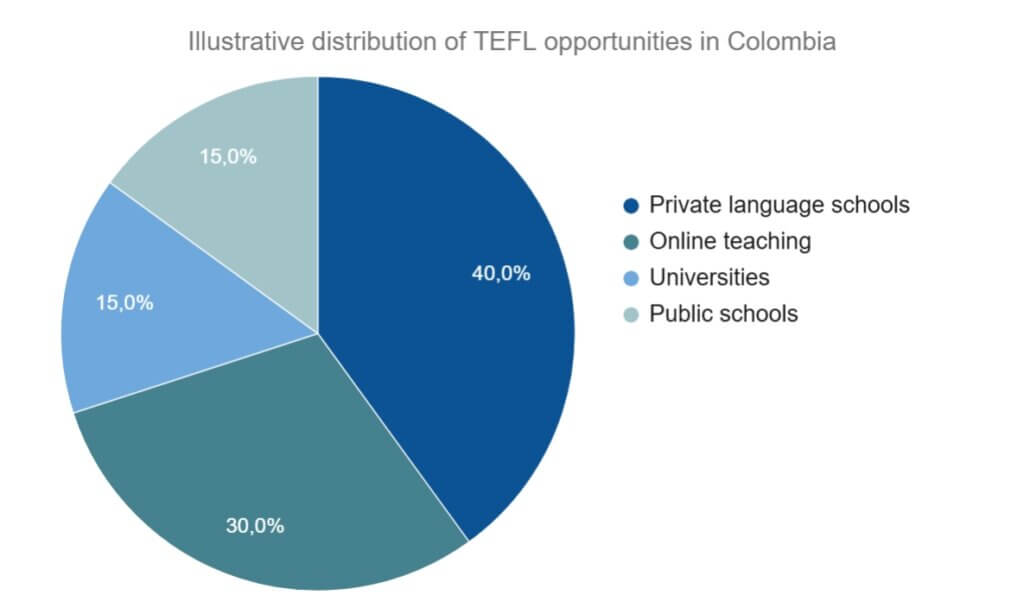
Typical TEFL Career Sectors in Colombia
| Sector | Typical Setting | Example Roles | Notes |
| Private language schools | Urban language academies and community education centres | English teacher, conversation partner, exam-preparation tutor | Most common entry point; opportunities to advance with experience |
| International/bilingual schools | Private K-12 schools, international campuses | EFL teacher, language coordinator, curriculum support | Higher salary potential; stricter requirements |
| Universities and colleges | Higher-education institutions | ESL instructor, language lab supervisor, adjunct lecturer | Postgraduate credentials often preferred |
| Online teaching (global learners) | Remote teaching platforms and independent clients | English tutor, conversation coach | Flexible hours; scalable income with client base |
| Public schools and regional programmes | Government-funded or NGO-supported initiatives | English teacher (short-term or long-term contracts) | Variable funding; visa considerations apply |
Authoritative Sources and Fact Checks (References)
- Ministerio de Educación Nacional (MEN) – Colombia: Official source for national bilingualism strategies and education standards in Colombia.
- UNESCO Institute for Statistics: Data regarding education frameworks and literacy initiatives.
Do I need a teaching certificate to teach English in Colombia?
In many private language schools and online roles, a TEFL/TESOL certificate is the standard entry credential and a bachelor’s degree strengthens your profile. Some positions may require additional qualifications or experience. Always verify employer expectations for your target role and city.
Is a certificate from an online course acceptable in Colombia?
Yes, a 120-hour TEFL certificate with a practical component can be acceptable, particularly for private language schools and online roles. Preference often goes to certificates with real-teaching practicum and quality assurance, so choose a reputable provider that includes observed teaching practice.
What government policies affect TEFL in Colombia?
Colombia’s government has prioritised English within the education system through plans for bilingual education and teacher development. These policies influence employer expectations and the demand for qualified English teachers in schools and language centres.
Are there visa considerations I should be aware of?
Working legally in Colombia typically requires a work visa or an appropriate permit. Some employers assist with visa processes; in other cases, teachers arrive on a tourist visa and transfer after securing a contract. Always consult Migración Colombia and your potential employer for current regulations before moving.
How can I maximize my job prospects in Colombia?
Focus on high-quality TEFL certification with an extensive practicum, demonstrate classroom management and lesson-planning skills in your CV, build a diverse portfolio of lesson plans and micro-teaching videos, network locally, and consider combining in-country teaching with online work to broaden your opportunities and earnings.
What are realistic salary expectations for TEFL teachers in Colombia?
Salaries vary by city and institution. Private language schools tend to offer modest monthly pay aligned with local cost of living, while bilingual and international schools can provide higher compensation. Online teaching can supplement income and increase total earnings, especially when you build a steady client base. Always research current market data for your target city and role and plan your budget accordingly.
How can I ensure my TEFL certification will be recognised in Colombia?
Choose a well-regarded course with a clear practicum, supportive learning resources, and a certificate of completion you can present to employers. If possible, select courses with international recognition or alignment to widely used standards, and verify how employers in your target sector view different qualifications.