
Understanding DELTA Coursework Mistakes and How to Avoid Them


The DELTA coursework is an ambitious mix of actual classroom work, self-aware reflection, and intense writing assignments. Aspiring teachers who wish to practise and work abroad or online can find the DELTA requirements daunting when faced with difficulties. This article outlines a list of the most frequent miscalculations and provides concrete, evidence-based strategies to sustain momentum, from a basic understanding of the criteria to a focus on producing coherent, well-supported arguments. By attending to these insights, candidates will be better prepared to plan, reflect more actively on practice, and compile reports that are professionally produced.
The foundation of education comes from having a good grasp of the DELTA assessment criteria and their application in reality. Common errors are miscomprehending what the criteria actually ask for, writing with insufficient attention (over-reporting classroom encounters, for instance, but ignoring how they play out), and failing to clearly map classroom measures to theoretical models.
To avoid such mistakes, begin by:
- Reading each module’s marking criteria
- Outlining what the requirements specifically are
- Designing a specific plan that outlines where you will target each of the criteria in your writing
DELTA has the intent to develop both practical teaching competence and analytical capacity, so evidence from practice must be regarded in light of appropriate theory and contemporary pedagogical concerns (British Council). It is this conflation between practice, theory, and assessment criteria that is central to coherent, defensible arguments. If you approach the guidelines as a design brief, not like a checklist (as well as a checklist), you can guarantee that every part of your work will have a good evaluative intent in how it is judged. A first-pass mapping exercise – criterion by criterion – can uncover gaps earlier, saving you from having to completely rework your work through substantial reorganisation at a later date. The outcome is a wider objective for both your planning and writing, as well as a more compelling argument in favour of your own advancement as a writer.
Understanding Assignment Criteria to Dodge Common Mistakes
Inadequate assignment criteria can come from a mismatch between what you write and what the assessor wants. By starting with a close reading of the task, you can translate the language of the prompt into specific parts of your write-up. If you receive a prompt that calls for you to connect classroom observation to learner development, your first draft should provide:
- An overview
- An account of what happened in that space
- A critical reading that connects those observations to theory
- A conclusion that draws practical connections
This level of clarity limits the danger of getting lost in unnecessary minutiae and can help to keep your writing focused and purpose-driven from the outset. Another common error is taking the assignment to be a performance of your teaching rather than a critical, research-grounded argument about teaching and learning. To do this, create a simple rubric for yourself, which mimics the criteria in the official marking rubric:
- The quality of the analysis
- The strength of evidence drawn from data
- The coherence of the argument
- Reflection and forward planning
Then systematically review that each element is in its own well-defined section, with tangible connections from theory to classroom practice. Referencing reliable sources (e.g. established and relevant pedagogical frameworks and enquiry methods) bolsters the piece and showcases scholarly rigour. Evidence-informed practice is important to the British Council.
Finally, you want your writing to speak to your scholarly voice across the board. In DELTA, precision of language, accurate terminology, and register make a difference. Unclear statements of fact, unsupported generalisations, or shifts in tense betray trust and hinder the reader’s ability to understand the reasoning behind your argument. But after the first draft, I suggest the following practice: a process of a criteria-based rewrite – checking each criterion against a piece of your text, comparing how each claim is supported, and checking how the conclusion ultimately helps you fulfil the task at hand. One of the best ways to avoid the misalignment and surface description that plagued all my drafts was to go through a disciplined revision process based on the assessment criteria.
Understanding DELTA Criteria and How to Address Them
| Criterion Focus | What to Include | How to Demonstrate it |
| Alignment with task | Clear mapping of each task to criterion | A short grid showing where each criterion is addressed |
| Evidence and data | Classroom observations, data, or artefacts | Integrate examples with explicit references to data |
| Theoretical linkage | Theory or framework supporting claims | Quote or paraphrase relevant sources with analysis |
| Reflection and action | Critical evaluation and future steps | A reflective cycle showing change over time |
Avoiding Time-Management Pitfalls in DELTA Coursework
Time management is a common stress for DELTA candidates. Students, in addition to teaching and writing, have to juggle extra study for study-related assignments, and they are faced with time management issues as well. There are many mistakes, but the single biggest one is that, in underestimating the time needed for deep analysis and revision, they come to drafts far too hurriedly and bring the connections between theory and practice into the paper.
One proactive thing to do is to devise an effective action plan that consists of a series of phases, such as:
- Reading and data gathering
- Drafting
- The first revision of the draft
- The second redraft (it means the end result will be clear)
Add buffers for potential gaps, unexpected delays, and the fact that you will inevitably need to rewrite or reorganise sections in response to the inevitable need to reword or reorganise as reflections and comments are reflected in feedback. The best routines provide regular blocks of writing time when the brain is free of fatigue and distractions, as well as time specifically for critical thinking on evidence or theory. Organised approaches to the management of time can help.
Think about a weekly calendar that has a set of blocks scheduled for planning, drafting, and peer feedback, in addition to shorter times for light revision and checking references. Time-boxing (with time-stamps at the beginning and end of each task) decreases procrastination and maintains cognitive reserve for thorough analysis. For DELTA work in particular, the trade-off between the synthesis of evidence and interpretation of theory is also beneficial, as lengthy drafting for early work is offset by multiple drafts as deeper understanding emerges and understanding crystallises.
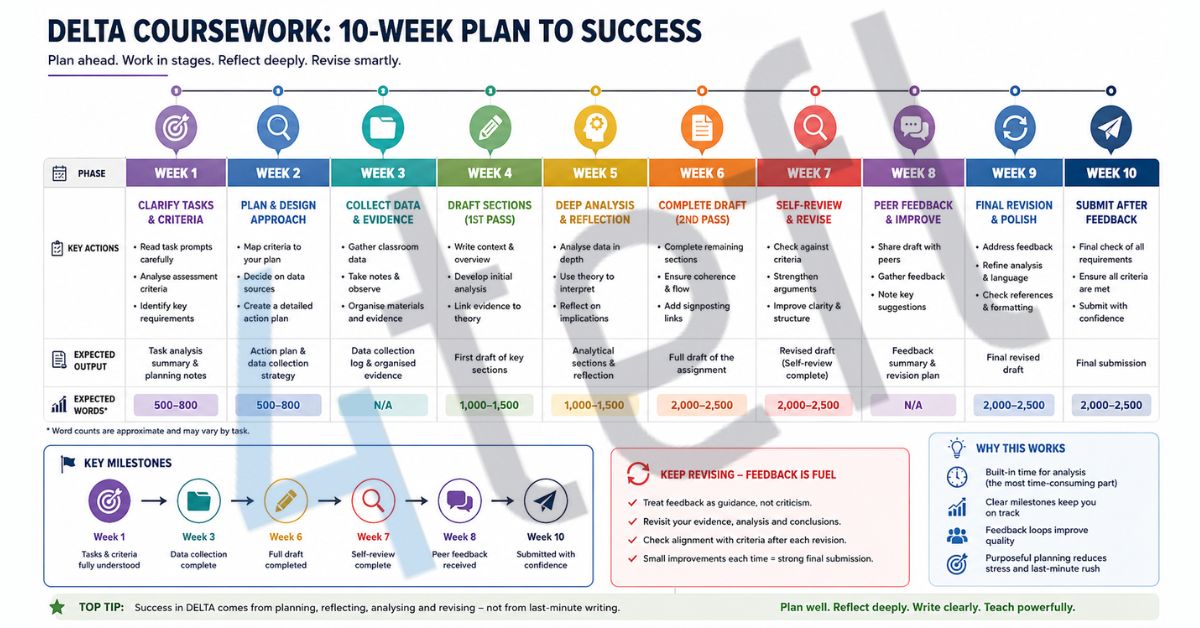
Typical DELTA Timeline and Milestones
| Phase | Focus | Timeframe (approx.) |
| Planning and briefing | Clarify tasks, collect materials | Week 1–2 |
| Drafting | Produce initial sections | Week 3–5 |
| First revision | Address major gaps | Week 6–7 |
| Second revision | Fine-tuning, language, and referencing | Week 8–9 |
| Final polish | Proofreading and formatting | Week 10 |
Mastering Reflection and Analysis to Meet DELTA Standards
Reflection in DELTA work is more than describing what a lesson is about. This involves:
- Explaining the reasons why an action created certain outcomes
- Integrating the observed elements into already established theories or pedagogical models
- Using that reasoning to direct future practice
Making claims without sufficient evidence to support them and theoretical underpinning is a common mistake and is easily misinterpreted. To prevent this, make descriptive texts distinct from analytical paragraphs, as well as anchor each analytical argument in data and give a brief theoretical explanation for it. The best pieces of reflection demonstrate a clear shift from what happened to what was learned and how the learning will influence future teaching.
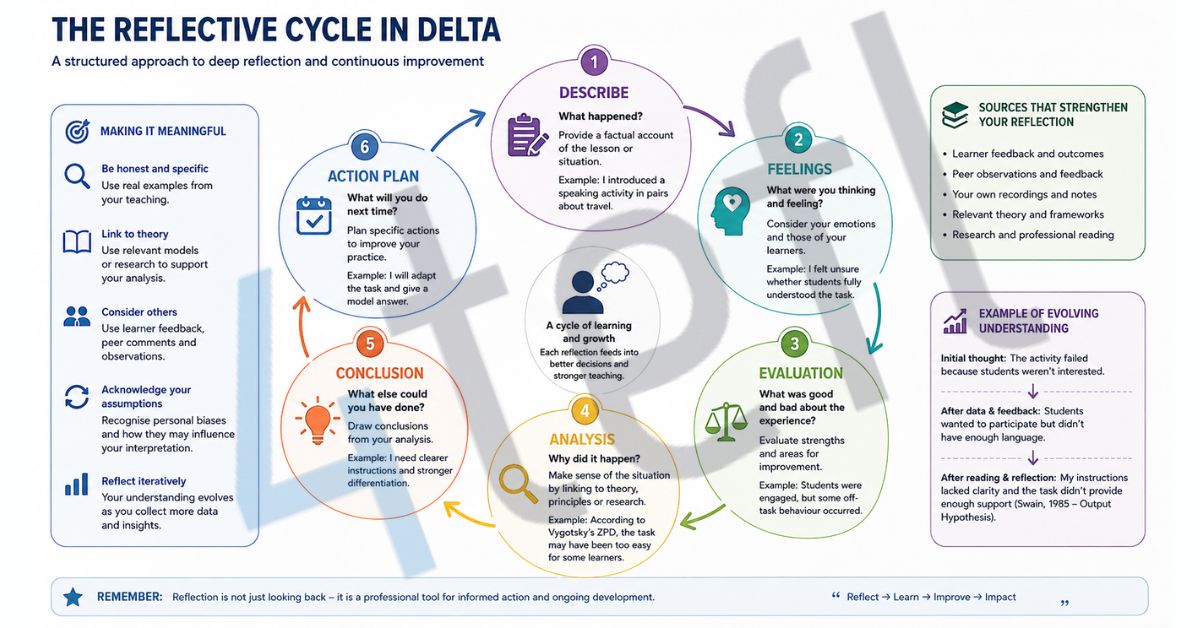
Frameworks such as Gibbs’ Reflective Cycle or Kolb’s Experiential Learning can assist in structuring your inquiry, but you need to take them within context rather than apply them as a rigid template. In practice, you may do so, for example, by:
- Starting with a quick overview of the lesson
- Developing a critique of what went well and what did not go well
- Offering the reader another analysis linking classroom action to the big idea in question (such as learner autonomy, feedback strategies, or language awareness)
- Lastly, giving a concrete action model for future lessons
This crosscutting method demonstrates that you’re able to translate knowledge gained in the classroom into practice, and that is core to DELTA’s vision as a professional development qualification.
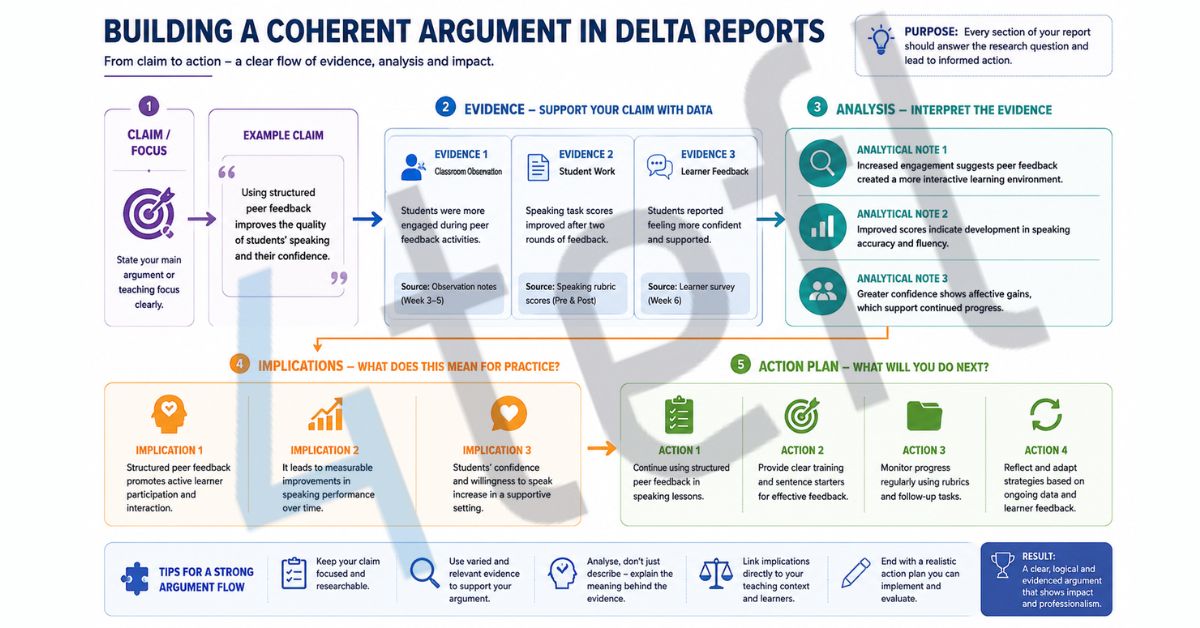
Structuring Evidenced Arguments for Coherent Reports
A coherent DELTA report weaves together description, analysis, and evidence to support clear, defensible conclusions. Start with a concise context and a precise research question or teaching focus, then present data from observations, materials, or learner outcomes as evidence. Each claim should be immediately followed by evidence and an interpretation that explains its significance in relation to the research question. A well-structured narrative keeps the reader oriented by maintaining a logical progression from context to conclusion, with explicit links between sections that show how the data leads to the recommendation or intervention proposed.
Signposting and cohesive devices are essential to maintain clarity and flow. Use topic sentences that preview the purpose of each paragraph, connect paragraphs with linking phrases (for example, “furthermore”, “however”, “as a result”), and ensure that the sequence of arguments mirrors the progression of the data. Avoid overusing formulaic phrases and instead aim for precise language that communicates complex ideas succinctly. A strong report will also demonstrate how your interpretations align with theoretical concepts and how your proposed actions could be tested or evaluated in future practice.
To illustrate the practical side, consider a compact example structure for a DELTA section:
A table of signposting phrases can help you maintain consistency and avoid repetition.
Signposting Phrases
| Function | Phrases |
| Introduction of evidence | “The data indicate that…”, “According to the observations…”, “This suggests that…” |
| Contrasting ideas | “In contrast with…”, “Despite this…, however…” |
| Drawing conclusions | “Therefore,” “As a result,” “This implies that…” |
Avoiding Language and Citation Gaps in DELTA Reports
Language accuracy and correct citation are more than mere embellishments of style; they contribute to your overall submission’s credibility. There is a risk of shifting between tenses and using ambiguous language when dealing with teaching procedures and theoretical topics.
To manage that:
- Develop a tense framework in which the past is used for description and the present for analysis of implications.
- Use the same language for teaching ideas, learner types, and methodological approaches.
- Try to focus solely on exact, discipline-appropriate language to share your thoughts with clarity and credibility.
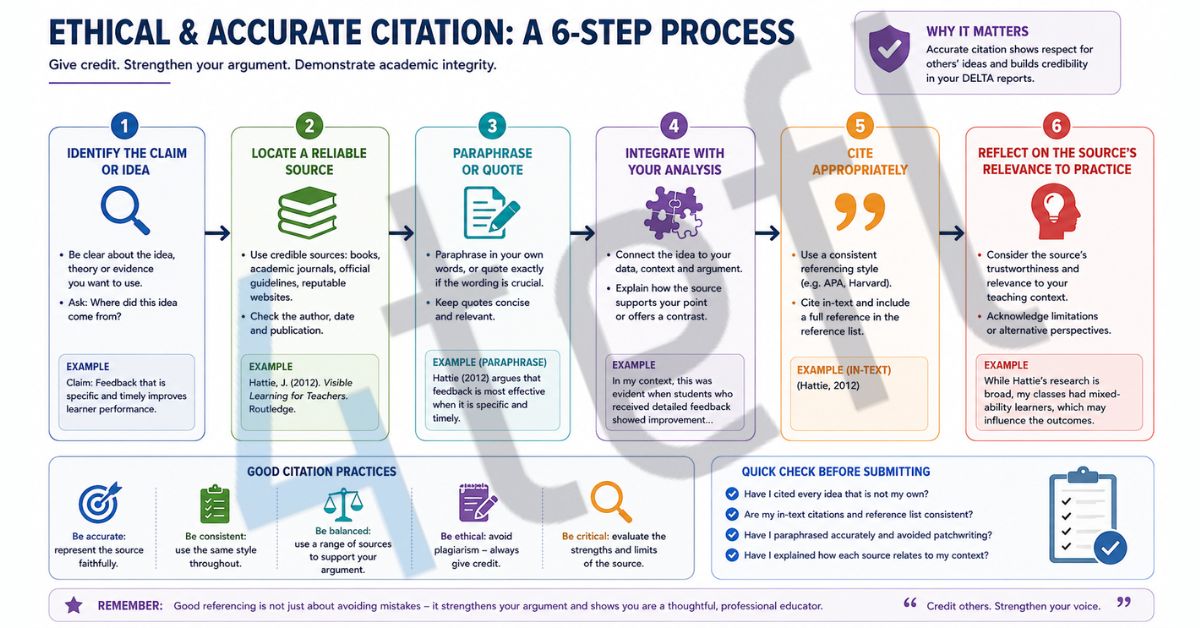
It is important to include references and evidence in your teaching context in DELTA work. This should not be done on the basis of a slavish style but from evidence, reference literature, and academic research studies through established pedagogy, peer-reviewed literature, and official guidance from recognised organisations. Use only exactly what you have stated or what has really stood out, but paraphrase if you can. Make sure to attribute all claims that derive from external ideas to a source, as well as provide a brief criticism of the source’s pertinence to your context.
Peer Feedback and Revision Strategies
Peer feedback is a useful tool for improving DELTA coursework; however, the process should be structured. Start with a specific feedback brief that includes what peers should be looking for:
- Alignment with the criteria
- Strength of the argument
- Evidence quality
- Clarity of writing
Feedback can be kept simple (using a feedback form with targeted prompts) and actionable. This sort of setup makes specific, constructive feedback more likely and reduces the likelihood of vague or unhelpful critiques.
After receiving feedback, establish and implement a disciplined cycle of revisions. Track edits that you’ve made and why in a revision log, so you know what you need to do next; it helps in setting a deadline for the next round of refinement. Focus first on the central issues in order to improve how evidence is integrated with the argument, for example, before polishing language or formatting.
A two-pass format (content-first/language-second) is often particularly successful for DELTA writers in that you do not lose your voice, but instead you can preserve it and ensure precision and clarity. Trying different angles can strengthen your final product – but you have to stay professional as well. If feedback is being applied from your colleagues, it’s good to balance their suggestions with your reflection and the assignment’s aims. If there’s a peer question that challenges your interpretation, see the data again, and consider relevant theory to support or revise your stance. This cycle also shows flexibility and a growth-oriented mindset, which DELTA and professional teaching practice highly reward.
Key Takeaways
The success of deliverables assessment for the DELTA coursework lies in careful tuning of the course to the assessment criteria, effective time management, self-reflection, and a strong, structured, evidence-based argument. Building a coherent work plan to map your tasks to the criteria from the beginning helps your writing not to get out of line with the criteria and develop a continuous story. Writing blocks, regular revision cycles, and disciplined utilisation of feedback are necessary for making a DELTA portfolio.
Utilise checklists, rubrics, and signposting to ensure a logical continuum with respect to coherence and demonstrate the coherent development of the description and analysis and subsequent action from description to analysis to action. Consider DELTA an evolving process of learning, not an examination. Combine data from the classroom with theorisation and theory, plan how you will use insights to incorporate into your future practice, and communicate the meaning of your learning clearly and honestly.
As long as you plan out what you plan, you practise how you will do it in your practice, and you write well, it will become practice in which you become very expert in teaching even beyond the end of the school year. The process of DELTA is based on tightly structured criteria, deep reflection, and clear, evidence-based writing. By embedding assessment into all tasks, planning time intentionally, and taking feedback, you construct a professional practice that comes with you into classrooms across the world. Do not forget that the surest way to both success in DELTA outcomes and powerful teaching is through constant, disciplined practice.
Authoritative Sources and Fact Checks (References)
- Cambridge English Qualifications – DELTA (Diploma in Teaching English to Speakers of Other Languages): Access the official syllabus specifications, modular handbook, and assessment frameworks directly from Cambridge.
- British Council – TeachingEnglish Professional Development: Explore official frameworks, articles, classroom resources, and teacher development pathways curated by the British Council.
How long does DELTA coursework typically take to complete?
DELTA is commonly studied part-time over 9-12 months, though intensive formats exist in some programmes. The pacing should allow ample time for reading, data collection, drafting, and revision, with spaced opportunities for feedback and reflection so you can develop a well-supported, coherent portfolio and reports.
Do I need to include external sources in my DELTA assignments?
Yes. Credible sources should be used to ground your analysis and connect your classroom practice to established theory. Paraphrase effectively, quote sparingly for precise definitions, and always cite sources to demonstrate the integration of research with practice. Your own classroom data should be synthesised with these sources to show evidence-informed reflection.
How can I ensure my writing meets the DELTA criteria while remaining readable and engaging?
Start with a clear map of criteria and plan sections that correspond to each. Use precise language, maintain a formal register, and ensure every claim is supported by data or theory. Apply a two-pass revision process: first, check structure and argument flow; second, refine language, accuracy, and referencing. Don’t underestimate the value of peer feedback in improving coherence and clarity.